Italian GP FP1 Results: Leclerc Leads a Ferrari 1-2 at Monza
Charles Leclerc topped first practice at Monza with a 1:23.008, and he did it on the medium tyre while the cars behind him were on softs. Full results and telemetry.
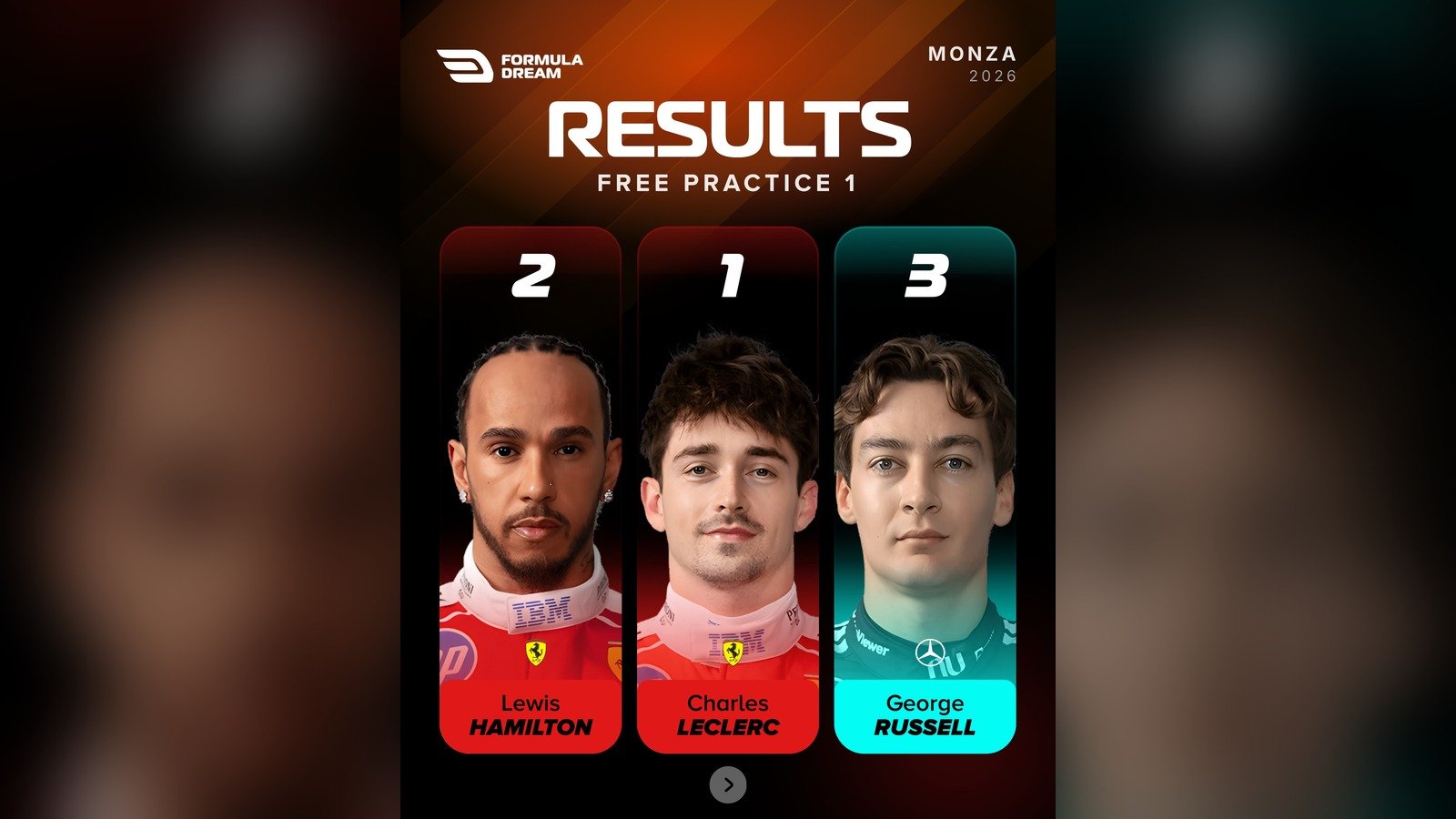
Charles Leclerc topped first practice for the Italian Grand Prix with a 1:23.008, leading Lewis Hamilton by 0.173s for a Ferrari 1-2 at Monza. George Russell was third for Mercedes, 0.304s back.
The headline number is not the interesting part. Leclerc set that time on the medium tyre, and so did Hamilton. The three cars directly behind them were all on softs and none of them got close. On a circuit where Ferrari has not had much to celebrate lately, that is the detail worth holding on to.
Here is what the timing data actually shows, including the laps that were taken away.
Deleted laps are excluded, so this is every driver's best legal time.
Italian Grand Prix FP1 classification, top ten. Deleted laps excluded.
Pos
Driver
Team
Lap time
Gap
Tyre
1
CharlesLeclerc
FerrariFER
1:23.008
-
Medium
2
LewisHamilton
FerrariFER
1:23.181
+0.173
Medium
3
GeorgeRussell
MercedesMER
1:23.312
+0.304
Soft
4
LiamLawson
Red BullRBR
1:23.433
+0.425
Soft
5
KimiAntonelli
MercedesMER
1:23.644
+0.636
Soft
6
LandoNorris
McLarenMCL
1:23.719
Oscar Piastri was 11th at +1.176, Yuki Tsunoda 12th at +1.563, Nico Hulkenberg 13th at +1.618 and Oliver Bearman 14th at +1.638. Luke Browning took 15th at +1.732 on his Williams outing, ahead of Carlos Sainz at +1.819 and Ayumu Iwasa at +1.865.
Esteban Ocon was 18th at +2.844 on the hard tyre, then Valtteri Bottas at +2.976, Lance Stroll at +3.058 and Fernando Alonso at +3.064. Colton Herta was last with five laps, nearly seven seconds off.
Alonso is the one to look at twice. He crossed the line with a 1:25.780, which would have put him 18th, and the stewards deleted it for track limits at Turn 7. His real best was 1:26.072, and it dropped him to the back of the runners.
Why the medium tyre result matters
The soft is the quickest tyre over one lap. That is the whole point of it. So when the two fastest cars in a session are on mediums and the next three are on softs, the raw gap understates the difference.
At Monza the compounds are usually separated by something in the region of three to four tenths over a lap, though it moves with track temperature and fuel load. Leclerc beat the fastest soft-tyre runner by 0.304s on the harder tyre. Hamilton did it on a nine-lap-old medium, which is a used tyre by any reasonable definition, while Leclerc's was two laps old.
Neither Ferrari had shown its qualifying hand. If you want a sense of how the compounds actually differ, that mechanism is in F1 tyre compounds explained.
Image gallery, 3 slides
1 / 3
Every stint in FP1 by compound and length, positions 1 to 8.
The stint chart is the part the timesheet hides. It shows who ran what, for how long, and on new or used rubber, which is the only way to judge whether a lap time meant anything.
One caution before anyone gets carried away. Fuel loads in practice are unknown and teams do not publish them, so a single lap time is never a clean measure of car performance. What we can say is narrower and still useful: Ferrari went quickest on a slower tyre, and nobody on the quicker tyre answered them.
The red flag, and the car that would not move
Practice was stopped roughly twenty minutes in.
Colton Herta, on his first Formula 1 weekend outing with Cadillac, stopped on track with a suspected hydraulic problem. Race control deployed the virtual safety car at 10:47:51 UTC, called marshals to Turn 6, and then went to a red flag at 10:49:36. The Cadillac proved awkward to shift because the car was stuck in gear, which is what turned a routine recovery into a stopped session.
The pit exit reopened at 10:56, so the interruption cost about six minutes of a sixty minute session. Herta returned to the track afterwards but completed only five laps all session, against 29 for Leclerc. He finished nearly seven seconds off the pace, which is a reflection of a broken afternoon rather than anything else.
The stoppage also cost other people time. Leclerc, Tsunoda, Norris, Bottas, Colapinto and Lindblad all had laps deleted for double yellow infringements at Turns 5, 6 and 7 in the moments before the red flag, which is a normal consequence of a flag appearing mid-lap. The flag rules that trigger those deletions are covered in F1 flags explained. Every radio message from the weekend, and the rest of the season, is in the 2026 team radio archive.
Sixteen deleted laps, and where they were lost
Track limits were the story of the session away from the timing screen. Sixteen laps were deleted in one hour.
The pattern is specific:
Turn 1, the Variante del Rettifilo, accounted for the largest share
Turn 5, at the Variante della Roggia, was the second offender
Turns 2, 4 and 7 picked up the remainder
Hamilton lost four laps, more than anyone. Luke Browning lost four as well on his Williams outing. That two of the most experienced and least experienced drivers on the circuit had identical deletion counts tells you this is about the corner rather than the driver.
Monza's first two chicanes are the classic place to gain time illegally, because the kerbs are aggressive, the run-off is flat and inviting, and the reward for straightening the corner is immediate. Both are heavy braking zones at the end of very long full-throttle sections, which is exactly where a driver is most tempted. The rule and how it is policed is in F1 track limits explained.
Expect this to matter on Sunday. A circuit that produces sixteen deletions in a single practice hour will produce them in the race.
This was a rookie session, so read it carefully
Four teams ran a rookie in FP1, which is a requirement teams have to satisfy across the season rather than a coincidence.
Ayumu Iwasa took Max Verstappen's Red Bull
Paul Aron drove the Alpine
Luke Browning drove the Williams
Colton Herta was in the Cadillac
Liam Lawson was in the other Red Bull, standing in for the injured Isack Hadjar.
That means the FP1 order is missing Verstappen, Pierre Gasly, Alexander Albon and Sergio Perez entirely. Any read of the competitive picture from this session alone is reading a session where four cars had a driver who has not raced them. It is the single biggest reason FP1 and FP2 told different stories a few hours apart.
For a rookie, though, the times are worth noting. Lindblad was seventh, and Aron and Iwasa both put in respectable laps. Browning's four deletions suggest he was finding the limit the expensive way.
Where the lap time actually was
The sector data says nobody had a complete car.
Sector 1: Leclerc, 27.224s
Sector 2: Russell, 28.011s
Sector 3: Hamilton, 27.591s
Three different drivers, three different sectors, and two different teams. Stitch the best of each together and you get a composite lap of 1:22.826, which is 0.182s faster than Leclerc's actual best.
Leclerc, Hamilton, Lawson and Antonelli all set their personal best sector times on the same lap, so there was nothing left in their runs. Russell was the exception, leaving 0.053s on the table across his session.
Image gallery, 3 slides
1 / 3
Sector 1 rankings.
Sector 2 at Monza is the Lesmos and Ascari, the only part of the lap that asks a real question of the car in corners. Russell owning it while Ferrari owned Sector 1 is a genuine difference in car character, not a rounding error.
Conditions, and what they hide
Air temperature sat between 30.2C and 31.9C. Track temperature ran from 47.1C up to 53.8C across the hour, with 38% humidity and almost no wind. Dry throughout.
That is hot for tyre management and it matters for the long runs, which were messy in FP1 because the red flag broke up the programmes. The useful long-run data came later in the day.
Teams spent the session mostly on the harder end of the range: 235 medium laps and 184 hard laps against only 126 on the soft. That is a Friday morning distribution, not a qualifying simulation, and another reason to treat the order with care.
What FP1 actually told us
Three things stand up.
Ferrari were genuinely quick, on the harder tyre, at their home race. That is not nothing, whatever the fuel loads were.
Mercedes had the best Sector 2 in the field. In the only part of the lap that is about cornering rather than power, they were ahead.
Monza's chicanes are going to keep taking lap times away from people all weekend.
What FP1 could not tell us was race pace, because the red flag and the rookie programmes fragmented everyone's running. That question got answered in FP2, where the order changed, Mercedes went to the top and the long runs pointed somewhere different again.
For the engineering underneath both sessions, including corner-by-corner apex speeds and the 251 km/h braking event at Turn 1, we went through the car telemetry in the Monza practice data analysis.
Follow the session as it happens
Practice is where the weekend is decided and it is the part television covers least. Long runs, tyre ages and the gap between a soft-tyre lap and a medium-tyre lap are invisible unless you are watching the timing.
The Formula Dream app runs a live Dashboard through every session including FP1: every car on the circuit map, and a timing tower with lap times, gaps and intervals, tyre compound and age, plus flag and safety car alerts as race control calls them. You also get live driver radio as it is broadcast, and every FIA document of the weekend as it is published, which is where deleted laps and steward decisions actually appear before anyone reports them.
Free, no subscription, no ads, independent. Not affiliated with Formula 1.
Charles Leclerc, with a 1:23.008 on the medium tyre. Lewis Hamilton was second for a Ferrari 1-2, 0.173s behind, also on mediums. George Russell was third for Mercedes on softs.
Why was FP1 red flagged at Monza?
Colton Herta stopped on track in the Cadillac with a suspected hydraulic problem. The car was stuck in gear and difficult for marshals to move, so a virtual safety car became a red flag at 10:49:36 UTC. The session resumed after about six minutes.
How many laps were deleted in Italian GP FP1?
Sixteen. Most were for track limits at Turn 1 and Turn 5, the two chicanes. Lewis Hamilton and Luke Browning lost four laps each, more than anyone else.
Which rookies drove in Italian GP FP1?
Four. Ayumu Iwasa took Max Verstappen's Red Bull, Paul Aron drove the Alpine, Luke Browning the Williams and Colton Herta the Cadillac. Liam Lawson was in the second Red Bull deputising for the injured Isack Hadjar.
Does FP1 predict qualifying at Monza?
Not reliably, and less than usual here. Fuel loads are unknown, four cars had rookie drivers, and a red flag broke up the running. FP2 produced a different order, with Mercedes on top.
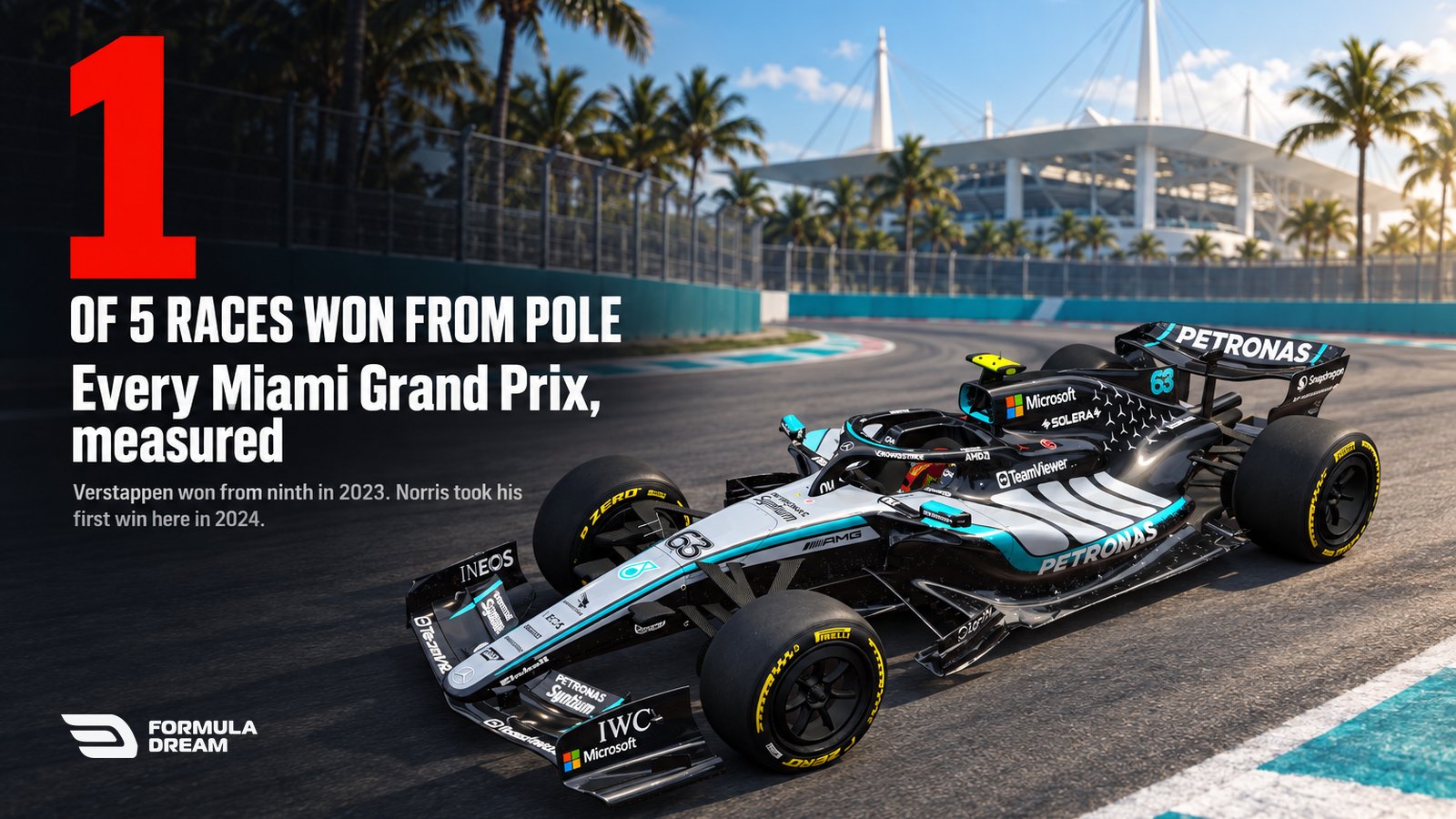
Every Miami Grand Prix winner, measured: five races, and pole has won only one of them
Five Miami Grands Prix have been held since 2022, and only one was won from pole: Kimi Antonelli's in 2026. Max Verstappen won from ninth in 2023, and Lando Norris took his first win there in 2024. Every winner, grid slot and safety car, measured.