F1 Team Orders Explained: What the Radio Actually Shows
F1 team orders: what 37,359 radio messages actually show
Team orders are the most argued-about thing in Formula 1 and among the rarest things you will ever hear on the radio. We counted every instance across eight seasons of our archive.
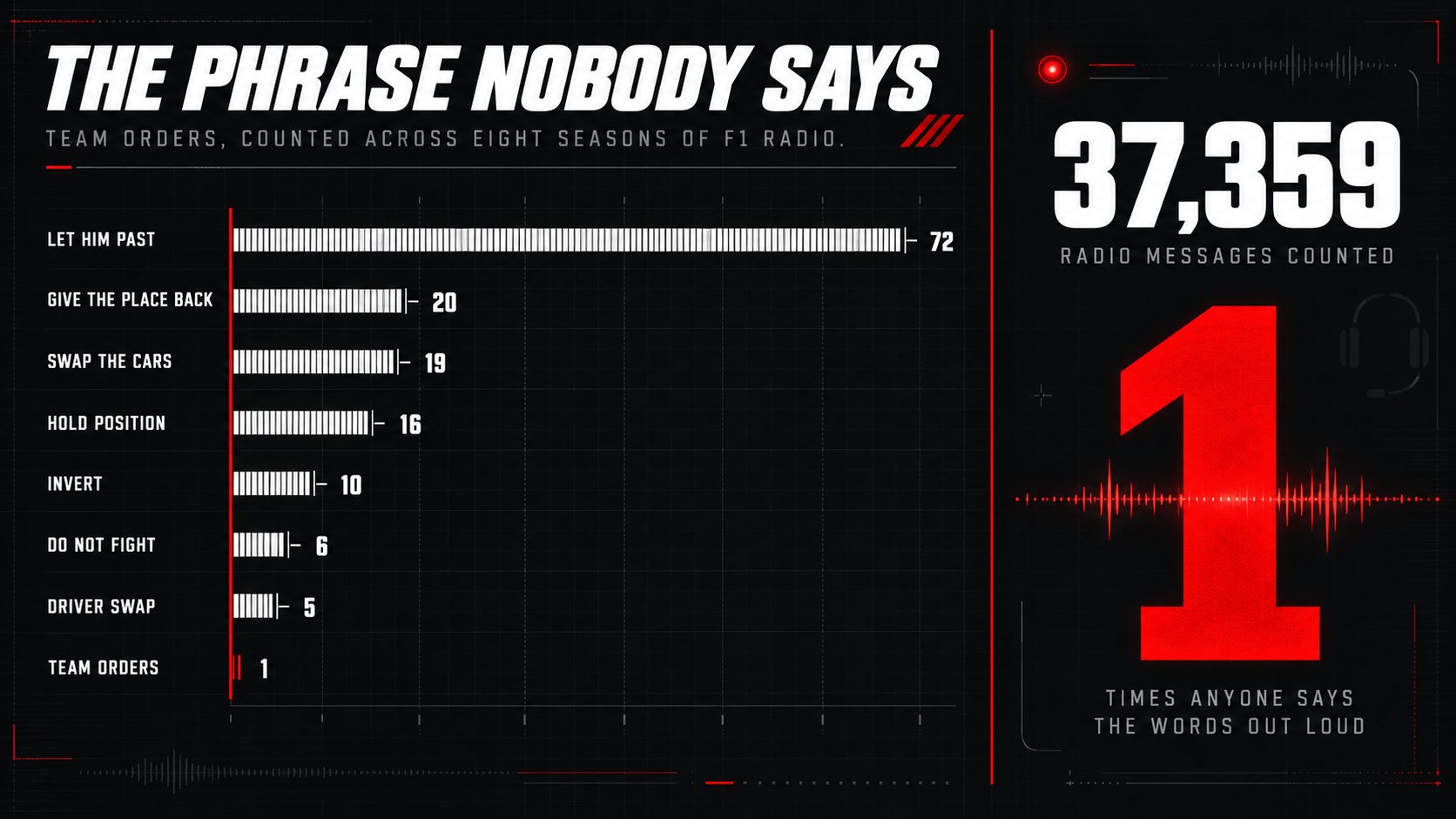
The phrase "team order" is said out loud exactly once in 37,359 Formula 1 radio messages. It is Valtteri Bottas's engineer at the 2021 British Grand Prix:
"And team order, do not fight with Lewis."
Everything else is code, euphemism, or a driver asking a question he already knows the answer to. We counted all of it.
What we counted, and what the number means
Our team radio archive holds every message Formula 1 has broadcast since 2018, transcribed, with the driver and engineer separated. At the time of this count it held 37,359 of them.
We searched every line for the language teams actually use when they move one car past another: telling a driver to let a team mate past, to swap, to hold position, to invert the cars, not to fight, or to give a place back.
149 messages contain it. That is 0.40%, or one message in every 251.
One number needs a caveat before any of the rest is useful. This counts what Formula 1 chose to broadcast, not what was said. Teams speak in code precisely because every rival pit wall hears the same world feed we do, so "Plan B" and a driver number said in a particular tone do not show up in a text search. Treat one in 251 as a floor, not the true rate. The interesting part is not the total. It is the shape.
The words they actually use
Phrase
Messages
Let a team mate past
72
Give the place back
20
Swap the cars
19
Hold position
16
Invert the cars
10
Do not fight, do not race
6
"Driver swap" as a named procedure
5
The words "team orders"
1
Caption: Team order language across 37,359 broadcast radio messages, 2018 to 2026.
"Let him past" is half of everything. It is the plainest possible instruction and teams reach for it far more often than any of the coded alternatives, which undercuts the idea that this is all done in secret. When a team wants a driver moved, they usually just say so.
One in five times, it is the driver who raises it
Of the 149 messages, 120 came from the pit wall and 29 came from the driver. That is a fifth of all team order talk being started by the person in the car, and it is almost always one of two things: asking to be let past, or complaining that somebody else has not been.
Daniel Ricciardo at the 2018 Hungarian Grand Prix, after being hit:
"There's no way he keeps that spot. He has to give it back, it's compromising me."
Brendon Hartley at Brazil in 2018, stuck behind his own team mate:
"Mate, is he going to let me by or what is going on? He's holding me up so much."
The popular picture of team orders is a driver being told something he does not want to hear. A fifth of the time it is the opposite: a driver asking for something and waiting.
Thirty eight percent of it happens when there is nothing to win
93 of the 149 messages came during a race. The other 56 did not. More than a third of all team order language happens in practice or qualifying, where there are no championship points on the table at all.
That is because the instruction is doing a different job. In qualifying it is about the tow at Monza, or who leads whom out of the pit lane, or getting a car out of the way of a team mate on a flying lap. Alexander Albon's engineer at Monza in 2020, mid-session:
"OK, just hold station for now, do what you need to do."
Nobody argues about those on television, and they are a third of the total.
Which teams say it out loud
Rate per 1,000 messages on that team's own radio channel, for teams with at least 1,000 messages in the archive:
Team
Messages
Rate per 1,000
Red Bull
34
5.87
Alpine
11
5.00
Haas
13
4.82
Aston Martin
8
4.58
McLaren
21
4.24
Mercedes
23
4.04
Ferrari
12
2.80
AlphaTauri
3
1.78
Williams
3
1.18
Caption: Red Bull uses team order language more than twice as often as Ferrari, per message broadcast.
Read that carefully, because it is easy to read it wrong. It does not say Red Bull gives more than twice as many team orders as Ferrari. It says Red Bull's broadcast radio contains the language more than twice as often. A team that says "Plan B" where another says "let him past" will sit at the bottom of this table while doing exactly the same thing.
What it does show is a difference in how openly teams do it, and Ferrari, the team whose name is most attached to the subject, is the second most guarded of the lot.
"Give the place back" is usually not a team order at all
This one surprised us. Twenty messages tell a driver to hand a position back, and most of them have nothing to do with team strategy. They are the stewards.
Carlos Sainz's engineer at the 2020 Austrian Grand Prix:
"Copy, we're checking with the FIA. The worst case should be we have to give back the position."
Valtteri Bottas at the 2021 United States Grand Prix:
"We need to give the position back to Gasly, we need to do it now, otherwise we're going to get a penalty."
And Max Verstappen at Jeddah in 2021, in the most argued-about example of the lot:
"Max, so let's give the position back to Hamilton, obviously do that strategically, give the position back."
That is a car returning a place it gained by leaving the track, not a team choosing a winner. If you are counting team orders by ear, this category is the one that will inflate your total.
Monza 2026: a team order you could hear happening
The 2026 Italian Grand Prix produced the clearest example on the archive, and it used the rarest word in the table.
Kimi Antonelli led his home race from lap 18. On lap 23 he was behind George Russell again, and his engineer explained why while it was happening:
"George has been given the message to build the gap... we will invert."
Antonelli was P1 on lap 22 and P2 on lap 23. He was not happy about it, and said so:
"Do you want me to have to sit behind or what?"
He won the race anyway, from nineteenth on the grid. Twenty seven laps later, once he had passed Russell on merit, both Mercedes were given the same instruction within fifty seven seconds of each other: keep it clean, no risks. The whole sequence is in the Monza 2026 race radio, and we went through it message by message in our Italian GP radio piece.
Are team orders against the rules?
Not any more, and the history is worth knowing because it explains why the language sounds the way it does.
Team orders were banned outright after the 2002 Austrian Grand Prix, where Rubens Barrichello was told to move aside for Michael Schumacher metres from the line. The FIA wrote Article 39.1 into the Sporting Regulations: "Team orders which interfere with a race result are prohibited."
It lasted eight years and was effectively unenforceable, because a team that wants a driver to move has a hundred ways to say so. The 2010 German Grand Prix settled it. Ferrari's "Fernando is faster than you" was so obviously an instruction that the team was fined and referred to the World Motor Sport Council, which then took no further action. The FIA deleted Article 39.1 for 2011.
Team orders have been legal ever since. What remains is Article 151c of the International Sporting Code, which covers anything that brings the sport into disrepute, so a team can still be punished for how it does this, just not for doing it.
That is why the radio sounds the way it does. The instruction is legal. The embarrassment is not.
Hear it as it happens
Team orders are decided in seconds and are almost always audible before they are visible. By the time the television cut shows two cars swapping, the instruction has already been given.
The Formula Dream app carries live driver radio as it is broadcast, with the transcript running alongside it and the driver and engineer colour coded, so you can read the instruction at the moment it is given rather than working it out from the timing screen. It runs a live Dashboard through every session, currently in beta, with every car on the circuit map and a timing tower showing lap times, gaps, intervals, tyre compound and age, plus every FIA document of the weekend as the stewards publish it, which is where the give-the-place-back decisions actually come from.
Free, no subscription, no ads, independent. Not affiliated with Formula 1.
Yes. They were banned from 2003 under Article 39.1 of the Sporting Regulations after the 2002 Austrian Grand Prix, and the FIA deleted that article for the 2011 season because it could not be enforced. Teams can still be punished under Article 151c of the International Sporting Code if the way they do it brings the sport into disrepute.
How common are team orders in F1?
Rarer than the arguments suggest. Across 37,359 broadcast radio messages we found team order language in 149 of them, one in every 251. That is a floor rather than a true rate, because teams use code precisely so that rivals listening to the world feed cannot hear the instruction.
What do teams say instead of "team orders"?
Almost anything else. "Let him past" is the most common by a distance, followed by swap, hold position, invert, and do not fight. The words "team orders" themselves appear once in the entire archive, at the 2021 British Grand Prix.
Why do drivers have to give a position back?
Usually because the stewards told them to, not the team. If a driver gains a place by leaving the track, handing it back immediately avoids a penalty. Those messages sound identical to a team order on the radio and are a completely different thing.
What was the most famous F1 team order?
Two compete. Austria 2002, where Barrichello moved aside for Schumacher on the line and the ban followed, and Germany 2010, where "Fernando is faster than you" proved the ban unworkable and led to it being scrapped.
All counts in this article were measured from our own team radio archive of 37,359 transcribed messages covering the 2018 to 2026 seasons. Coverage is not even across those years and 2022 is absent.
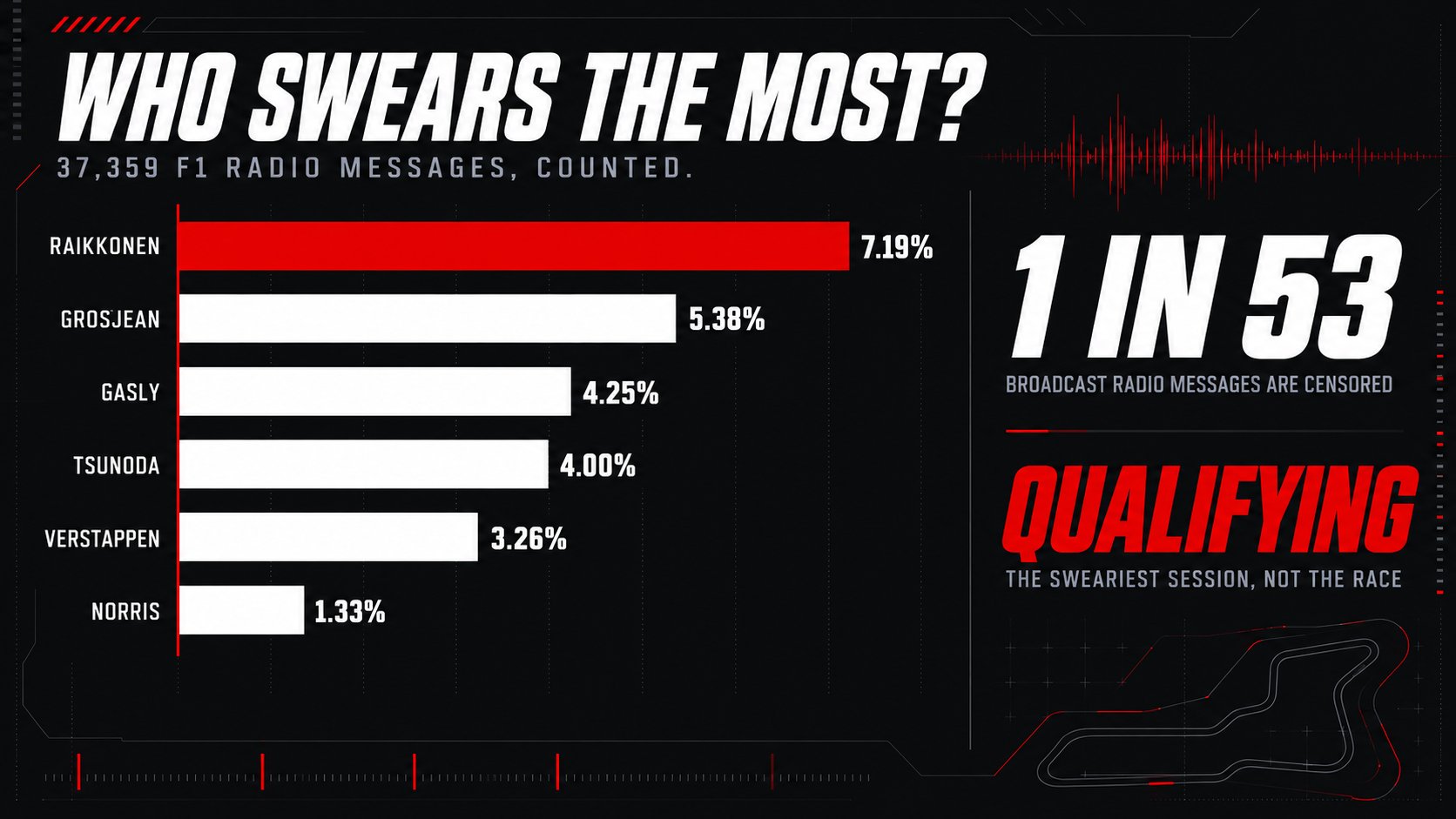
One broadcast radio message in 53 contains something the transcript has to censor. Three in four of them come from the driver, and the sweariest session is not the race.