F1 Undercut vs Overcut Explained: Winning Races in the Pit Lane
The F1 undercut and overcut explained, the two pit-stop strategies that let a driver pass a rival without ever overtaking on track. How each works, and when teams use them.
The undercut and the overcut are the two ways an F1 team can pass a rival without ever overtaking them on track. Both use pit-stop timing to swap positions, and between them they decide a huge number of races. The difference is simple: the undercut pits earlier than your rival, the overcut pits later. Everything else is about tyres and timing.
What is the undercut?
The undercut is the aggressive one, and by far the more common. You pit before the car you are chasing, bolt on fresh tyres, and use their extra grip to bang in one or two very fast laps in clean air while your rival is still out on worn rubber. Fresh tyres can be worth
, so in a couple of laps you can make up the entire pit-stop time and more. When your rival finally stops, they rejoin behind you. You have passed them without ever pulling alongside.
That pace gap from fresh rubber is the whole engine of the undercut, and it is why teams watch the timing screens lap by lap, waiting for the moment a rival is vulnerable.
The undercut in one picture: B pits first, loses time in the pit lane, then fresh-tyre pace erases the deficit, and when A finally stops, B is ahead.
The 2019 Singapore Grand Prix is the textbook case, and a slightly awkward one for Ferrari. Charles Leclerc was leading, but his own team mate Sebastian Vettel, running third, was brought in first. On fresh tyres Vettel produced a blistering out-lap, and by the time Leclerc pitted a lap later he came out behind the team mate he had been leading. Vettel took the win, the 53rd and last of his career, without ever passing Leclerc on track.
What is the overcut?
The overcut is the patient one. Instead of stopping early, you stay out longer than your rival on your current tyres. It works for the opposite reason to the undercut: when your rival pits for fresh tyres, those tyres need a lap or two to warm up and switch on, and the rival often rejoins in traffic. If you can keep lapping quickly in clean air while they are stuck warming up their new tyres behind slower cars, you can pit a few laps later and come out ahead.
The overcut is rarer and more of a gamble, because it depends on your old tyres still having decent pace. It shows up most on low-degradation tracks, where tyres last well, or when the fresh-tyre advantage is small.
Why they work at all
Both tricks exploit the same three truths of modern F1:
Fresh tyres are much faster than worn ones, but they take time to reach their working temperature.
Clean air is a big advantage. A car in traffic loses lap time; a car with clear track ahead can attack.
Overtaking on track is hard. Two cars of similar pace can circulate nose-to-tail for a whole stint, so passing in the pit lane is often the only realistic way through.
Put those together and pit timing becomes a weapon. The tyre choice underneath it all matters too, which is why it helps to understand F1 tyre compounds before the strategy.
When teams choose each
Undercut: the default on most circuits, especially where tyres wear quickly and the fresh-tyre gain is large. If a chasing car is within a second or so and the pit window opens, the undercut is the first move a strategist reaches for.
Overcut: used when tyres last a long time, when a rival will rejoin into traffic, or when a driver's current tyres are still strong and stopping early would just drop them into a pack.
The risks
Neither is a guarantee. An undercut fails if the out-lap runs into slower traffic, or if the fresh tyres do not warm up fast enough on a cold track. An overcut fails if the old tyres fall off a performance "cliff" before the stop, handing the position straight back. This is why you hear so much radio traffic about gaps and lap times near a pit window, the strategists are running the numbers in real time on whether the move will land.
See the gap the undercut has to beat
An undercut lives or dies on the gap between the two cars when they pit. Our Gap Visualizer draws that gap to scale as real metres of track, so you can see exactly how much time a driver has to make up, and how close these pit-lane battles really are.
Spot the undercut coming
An undercut is obvious in hindsight and hard to see live, unless you are watching tyre age.
The Formula Dream app runs a live Dashboard through every session: every car moving on the circuit map, and a timing tower with lap times, gaps and intervals, tyre compound and age, pit counts and positions, plus flag and safety car alerts the moment race control calls them. You also get live driver radio as it is broadcast, and every FIA document of the weekend collected as it is published, which is where the stewards' decisions that change results actually appear.
Free, no subscription, no ads, independent. Not affiliated with Formula 1.
Pitting for fresh tyres before the car ahead of you, then using the fresh-tyre pace advantage to set faster laps and rejoin ahead of that rival once they pit.
What is an overcut in F1?
Staying out on track longer than a rival, using clean-air pace while they warm up their new tyres in traffic, then pitting later and rejoining ahead.
Is the undercut or overcut more common?
The undercut is far more common, because fresh tyres usually give an immediate, reliable pace boost. The overcut is a rarer gamble used mainly on low-tyre-wear tracks.
Why don't drivers just overtake on track instead?
Because two cars of similar pace are very hard to separate on track, especially in dirty air. Pit-stop strategy is often the only realistic way to change position.
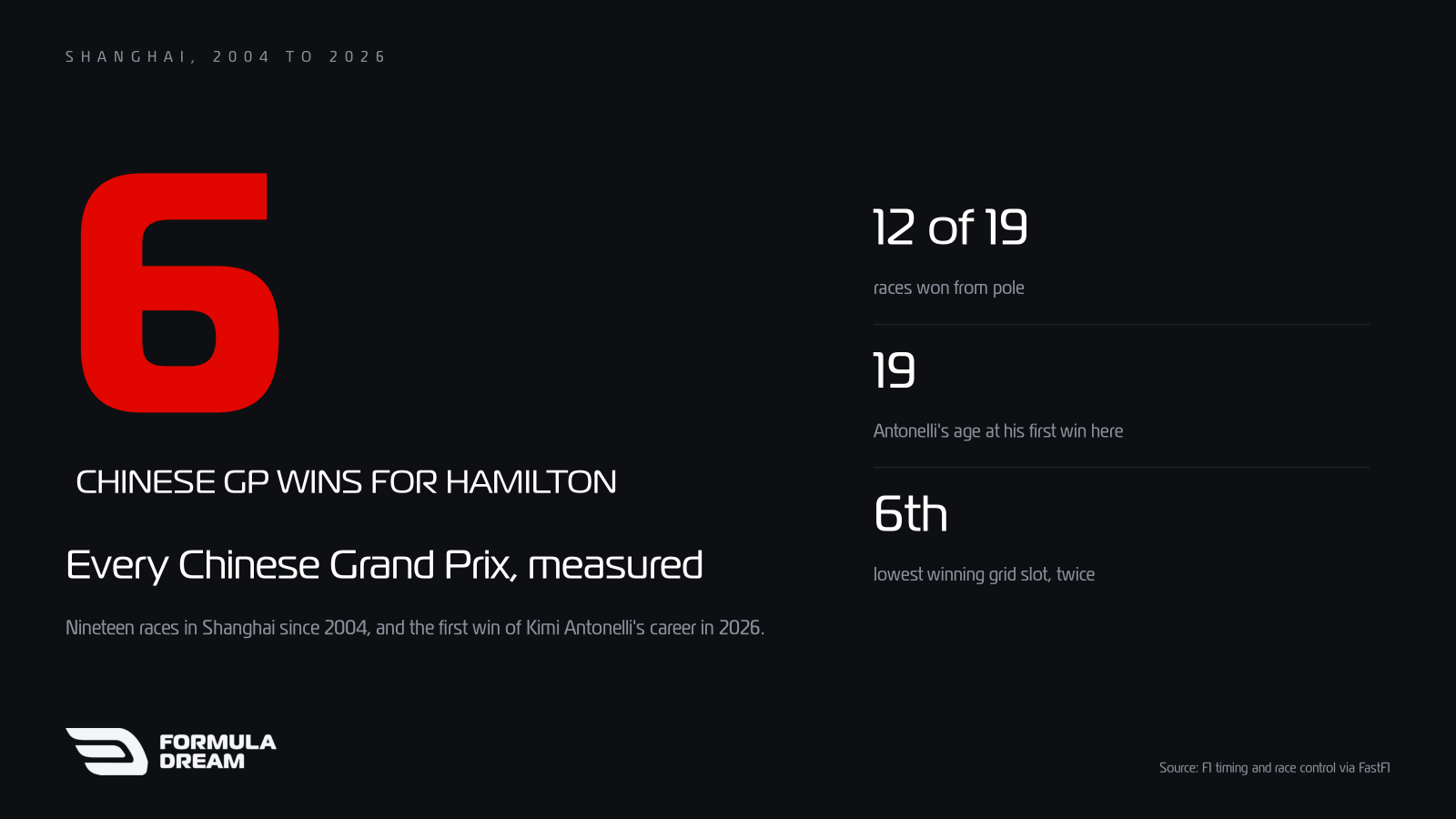
Nineteen Chinese Grands Prix have been held in Shanghai since 2004. Lewis Hamilton won six, pole won twelve, and in 2026 Kimi Antonelli took the first win of his career there, at 19, with Hamilton on the podium for Ferrari for the first time. Every winner, grid slot and safety car, measured.