F1 Tyre Degradation Explained: Graining, Blistering and the Cliff
Tyre degradation explained through the 2013 race Mercedes lost from pole, the narrow temperature window tyres must live in, what graining and blistering are, the cliff, and why tyre management wins races.
At the 2013 Spanish Grand Prix, Nico Rosberg started from pole position in a fast Mercedes. He finished sixth. His team mate Lewis Hamilton started third and finished twelfth, out of the points entirely. Meanwhile Fernando Alonso, starting fifth, pitted four times on his way to winning. The Mercedes was arguably the quickest car in Barcelona that weekend. It lost because, in 36 degree heat, it chewed through its tyres faster than anyone.
That race is the perfect illustration of the force that decides more Grands Prix than raw pace: tyre degradation. Here is what "deg" actually is, why it happens, and why the drivers who master it win races that faster drivers lose.
Tyre degradation, shortened to deg in the paddock, is the rate at which a tyre loses lap time as it is used up over a stint. It comes from two things:
Wear: the physical loss of rubber from the surface, exactly like the tread wearing off a road tyre, only far faster.
Thermal degradation: heat damage to the rubber. Every corner heats the tyre, and once it is pushed beyond its ideal temperature, the compound breaks down at a molecular level and loses grip for good.
Of the two, thermal degradation is usually the bigger enemy, and it all comes back to one thing: temperature.
The narrow window everything depends on
An F1 tyre only works properly inside a narrow band of temperature, roughly 80 to 110 degrees Celsius. Inside that window, the rubber is in its sweet spot and delivers peak grip. Stray outside it, in either direction, and the tyre turns against you.
Run the tyre too cold and it cannot generate grip, so the car slides. Run it too hot and the grip falls away and, again, the car slides. And here is the vicious part: sliding itself generates heat and scrubs rubber off the surface, so a tyre that is outside its window slides, which overheats it further, which makes it slide more. It is a spiral, and once a driver falls into it, the tyre is cooked. Keeping four tyres inside that little window, lap after lap, is the hidden game beneath every race.
An F1 tyre only grips properly in a narrow band, around 80 to 110 degrees. Too cold or too hot and it slides, which overheats it further and wears it out fast.
Graining
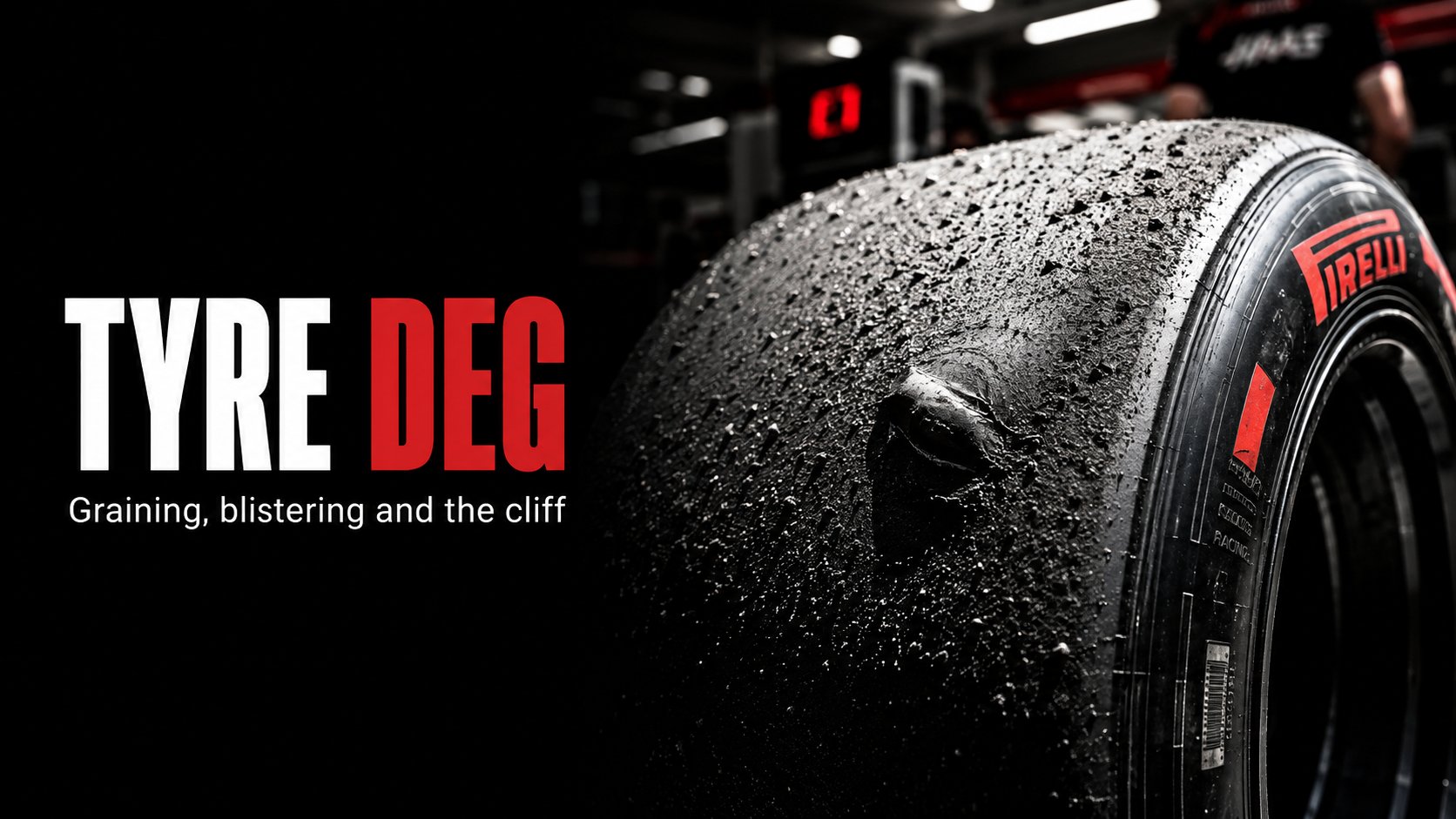
Graining happens when the tyre surface slides while it is still too cool to work properly. The rubber tears rather than grips, flicking off little strips that stick back onto the surface and leave it rough and grainy. That loose layer sits between the tyre and the track and steals grip. The upside is that graining can clear once the driver gets heat into the tyre and stops it sliding, which is why you will hear an engineer tell a driver to "work through the graining."
Blistering
Blistering is the opposite problem: too much heat. When a patch of the tyre overheats, the rubber underneath bubbles up into blisters. As they open, grip drops sharply, and unlike graining, the damage is permanent. Blistering is common on abrasive, high-energy circuits, or when a car is simply too hard on its tyres.
The cliff
The most dramatic moment in any stint is the cliff. For most of a tyre's life, deg is gradual, a few tenths lost per lap. But once the compound is worn or overheated past its working range, grip does not fade gently, it collapses, and lap times can fall away by three to four seconds in the space of a lap or two. That collapse is exactly what teams are trying to stay ahead of. Every pit call is a bet on where the cliff is, because being caught out by it can cost several positions in a single lap.
Why tyre management is a superpower
Because tyres are so fragile, the ability to make them last is one of the most valuable skills a driver can have. Some drivers are simply gentler on their rubber than others: Sergio Perez built an entire F1 career on it, earning the nickname "the tyre whisperer" for his ability to make a set of tyres last far longer than anyone expected, opening up strategies, like stopping one fewer time, that rivals could not match.
Drivers manage tyres with a whole set of tricks: braking a fraction earlier, easing the throttle on exit, "lift and coast" to cool the tyres on the straights, and simply not sliding the car. It looks like going slower, and in a sense it is, but a driver who nurses a tyre to the end of a long stint while a rival hits the cliff will beat them every time, even in a slower car. It is the deeper game inside every race, and it is why understanding tyre compounds and the undercut and overcut matters so much.
A word on marbles
All that scrubbed-off rubber has to go somewhere. It gathers off the racing line in little balls called marbles. They look harmless, but running over them coats the tyres in cold, dead rubber and destroys grip, which is why drivers stay religiously on the line and why going off it to overtake, or in the wet, is such a gamble.
Watch degradation as it happens
Degradation is the most visible thing on a timing screen and the least visible on television.
The Formula Dream app runs a live Dashboard through every session: every car moving on the circuit map, and a timing tower with lap times, gaps and intervals, tyre compound and age, pit counts and positions gained or lost. It is the same information these measurements come from, arriving live. You also get live driver radio as it is broadcast, and every FIA document of the weekend as it is published.
Free, no subscription, no ads, independent. Not affiliated with Formula 1.
The rate at which a tyre loses lap time over a stint. It comes from wear (rubber physically coming off) and thermal degradation (heat pushing the tyre out of its working temperature window).
What is the ideal F1 tyre temperature?
Roughly 80 to 110 degrees Celsius. Below it the tyre is too cold to grip; above it the grip falls away. Both cause sliding, which heats and wears the tyre even more.
What is the difference between graining and blistering?
Graining happens when a cool tyre slides and tears, leaving a grainy surface that saps grip but can clear. Blistering happens when a tyre overheats and bubbles form, causing permanent damage and a sharp loss of grip.
What is the cliff in F1?
The point where a tyre's grip suddenly collapses after it is worn or overheated beyond its working range, costing three to four seconds a lap almost immediately and forcing a pit stop.
Why is tyre management so important?
Because a driver who keeps their tyres alive can run longer, stop less and stay off the cliff, beating a faster rival who wears their tyres out. It is why gentle drivers like Sergio Perez, "the tyre whisperer", were so valuable.
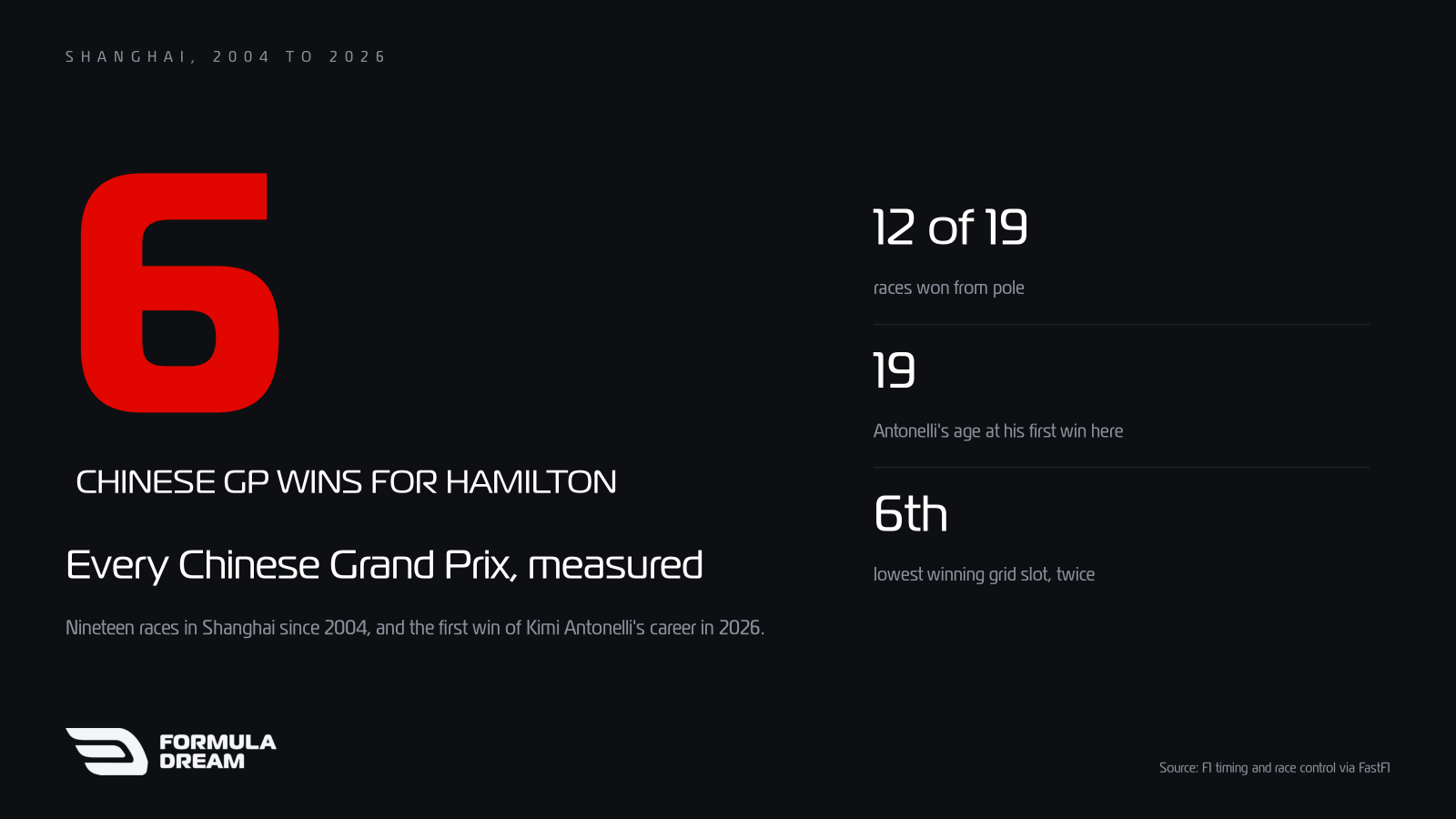
Nineteen Chinese Grands Prix have been held in Shanghai since 2004. Lewis Hamilton won six, pole won twelve, and in 2026 Kimi Antonelli took the first win of his career there, at 19, with Hamilton on the podium for Ferrari for the first time. Every winner, grid slot and safety car, measured.