Famous F1 Team Radio Messages and Quotes | Formula Dream
Guides
Famous F1 Team Radio Messages: The Most Iconic Moments
From "just leave me alone, I know what I'm doing" to "GP2 engine" and "Multi 21", the famous F1 team radio messages that became part of the sport's language, and the races behind them.
Some of the most famous F1 team radio messages have escaped the cockpit entirely and become part of the sport's everyday language. A few words fired off in a moment of triumph or fury end up on T-shirts, in commentary, and in every fan's memory. Here are the ones that stuck, and the races behind them.
Five lines that outlived the races they came from, in the colours of the drivers who said them.
"Just leave me alone, I know what I'm doing!" (Kimi Räikkönen, Abu Dhabi 2012)
The line Kimi Räikkönen is immortalised by came at the 2012 Abu Dhabi Grand Prix. On his way to a first win since returning to Formula 1 with Lotus, Räikkönen grew tired of his engineer feeding him updates on the gap and the tyres, and cut him off. He told his race engineer, Simon Rennie, "Just leave me alone, I know what I'm doing!" He won the race, and the phrase became the definitive distillation of the Iceman.
It still echoes. At Monza in 2024, on his way to winning the Italian Grand Prix, Charles Leclerc told his own engineer: "Leave me alone with this. If I don't do things you ask, don't ask ten times."
"GP2 engine! GP2!"
"GP2 engine! GP2! Aargh!" (Fernando Alonso, Japan 2015)
Fernando Alonso's frustration with the underpowered McLaren-Honda boiled over at the 2015 Japanese Grand Prix at Suzuka. Passed on the straight by Max Verstappen's Toro Rosso, Alonso vented over the radio that his power unit was a "GP2 engine", comparing an F1 engine to the junior category's, followed by a despairing "ARGH". It captured an entire painful era for McLaren in four words.
"Multi 21"
"Multi 21, Seb. Multi 21." (Mark Webber, after the 2013 Malaysian Grand Prix)
Not every famous message is a driver's. At the 2013 Malaysian Grand Prix, Red Bull gave the coded instruction "Multi 21", meaning car 2 (Mark Webber) should stay ahead of car 1 (Sebastian Vettel). In the closing stages Vettel ignored it, passed Webber, and won. On the radio, team principal Christian Horner told him "This is silly, Seb, come on." The line everyone remembers came afterwards, not over the radio: in the cool-down room a furious Webber said "Multi 21, Seb. Multi 21", and that, with the frosty podium that followed, turned a piece of internal team code into one of the most quoted phrases in the sport, shorthand for a teammate crossing the line.
"Get in there, Lewis!"
"Get in there, Lewis!" (Peter Bonnington, Mercedes race engineer)
Proof that a catchphrase can belong to the engineer, not the driver. Peter "Bono" Bonnington's calm, rising "Get in there, Lewis!" became the soundtrack to Lewis Hamilton's win after win across his record-breaking career. It is the rare radio line fans actively wait to hear, a signal that another race has been won.
The 2008 Brazil title decider
Some radio moments are famous for the emotion, not the words. At the 2008 Brazilian Grand Prix, Hamilton needed to finish fifth on the last lap to win his first World Championship. He passed Timo Glock, who was struggling on dry tyres in the wet, at the very last corner to snatch the title by a single point. The McLaren pit wall's radio, veering from dread to disbelief to pure release in a few seconds, is one of the most replayed clips in the sport.
"Simply lovely"
"Simply lovely." (Max Verstappen)
A reminder that new catchphrases are still being made. Max Verstappen's understated "simply lovely" after a strong lap or a win has become his modern signature. He first used it on the opening lap of the 2017 Mexican Grand Prix, after passing Sebastian Vettel for the lead, and in May 2024 an application to trademark "Simply Lovely Inspired by Max Verstappen" for a clothing range was lodged with the EU's intellectual property office. It is the calm-confidence opposite of a meltdown, and fans have adopted it wholesale.
Our archive holds it again and again, in his own voice. After winning the 2023 Miami Grand Prix from ninth on the grid: "I call that simply lovely. That was a good race all round."
The blunt ones
"To whom it may concern..." (Valtteri Bottas)
Team radio is also where the pressure escapes. Valtteri Bottas's gloriously blunt "to whom it may concern..." message aimed at his doubters, first delivered after winning the 2019 Australian Grand Prix and repeated after he won in Russia in 2020, and Sebastian Vettel's various on-track rants, are famous precisely because they are unfiltered, a driver at 300 km/h saying exactly what they think. We will leave most of the exact wording to your imagination, although Bottas's 2020 version is in the archive, starred out: "again it's a nice moment to thank my critics, to whom it may concern."
Hear them for yourself
Descriptions only go so far. The real thing, the tone, the timing, the crackle, is what makes team radio worth revisiting. Our Team Radio Archive holds over 39,000 messages from 2018 onward, searchable by driver and team, with the original audio and a transcript that colours itself as it plays. It is the closest you can get to standing on the pit wall after the fact.
If you want the mechanics behind all of this, we also explain how F1 team radio actually works, the button, the engineer, and the rules on what can be said.
The archive is also browsable a season at a time, each one listing every Grand Prix it covers: 2018, 2019, 2020, 2021, 2023, 2024, 2025, 2026. 2022 is absent from the source data, which is why it is missing from the list and from every count in this article.
Hear the next one live
Every message on this page was once just a driver talking during a session, unremarkable until it was not.
The Formula Dream app runs a live Dashboard through every session: every car moving on the circuit map, and a timing tower with lap times, gaps and intervals, tyre compound and age, pit counts and positions, plus flag and safety car alerts the moment race control calls them. You also get live driver radio as it is broadcast, and every FIA document of the weekend collected as it is published, which is where the stewards' decisions that change results actually appear.
Free, no subscription, no ads, independent. Not affiliated with Formula 1.
Kimi Räikkönen's "just leave me alone, I know what I'm doing", from his winning drive at the 2012 Abu Dhabi Grand Prix, is probably the most quoted of all.
What does "GP2 engine" mean?
It was Fernando Alonso's 2015 radio jab at his underpowered McLaren-Honda, comparing his Formula 1 engine to one from the junior GP2 category, a stinging way to say the car was down on power.
What was "Multi 21"?
A Red Bull team order at the 2013 Malaysian Grand Prix telling the cars to hold position (Webber ahead of Vettel). Vettel ignored it and passed Webber to win, and the phrase became shorthand for defying team orders.
When did Max Verstappen first say "simply lovely"?
On the first lap of the 2017 Mexican Grand Prix, after passing Sebastian Vettel for the lead. It has since become his signature, and in 2024 a trademark application for "Simply Lovely Inspired by Max Verstappen" was lodged in the EU.
What was Bottas's "to whom it may concern" message?
After winning the 2019 Australian Grand Prix, Valtteri Bottas said "To whom it may concern", followed by an expletive, aimed at critics of his 2018 season. He repeated the message after winning the 2020 Russian Grand Prix.
Where can I listen to famous F1 team radio?
You can search and play the real audio, with synced transcripts, by driver and team in the Team Radio Archive.
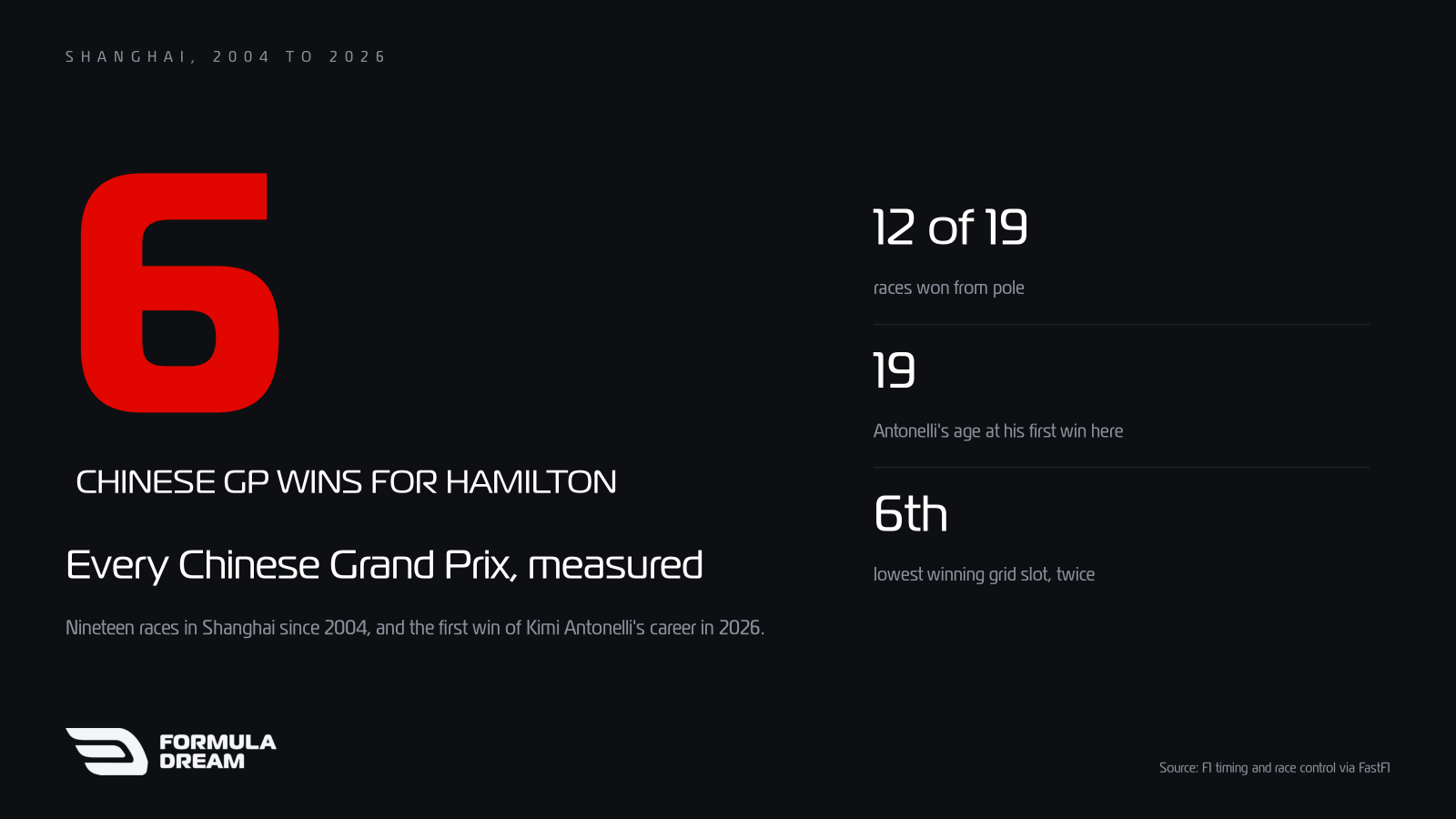
Nineteen Chinese Grands Prix have been held in Shanghai since 2004. Lewis Hamilton won six, pole won twelve, and in 2026 Kimi Antonelli took the first win of his career there, at 19, with Hamilton on the podium for Ferrari for the first time. Every winner, grid slot and safety car, measured.
Max VerstappenRed Bull · Miami Grand Prix 2023 · Race · 21:03:38 local
EngineerYeah, good drive today, Max. We made it harder for ourselves, but we'll have a look at what we could have done better yesterday. Today was a very good drive, well done.
DriverI call that simply lovely. That was a good race all round. So thank you very much.
EngineerThat
Driverwas really, really good. Also good for the team again.
EngineerWell done, Max. That was a mighty middle stint. That was really impressive on the hard tyre. And thanks for racing and cleaning with your teammate today. It was a great team performance, 1-2 in America. Brilliant.
DriverYeah, that tyre lasted really nicely. And yeah, that was a good final check-up. Yeah, that was very good. Good day.