How F1 Team Radio Works: Who Drivers Talk To | Formula Dream
Guides
How F1 Team Radio Works: The System Behind the Messages
How F1 team radio works, the steering-wheel button, the race engineer on the pit wall, the rules on what can be said, and why you only hear a fraction of it on the broadcast. Explained, with real messages.
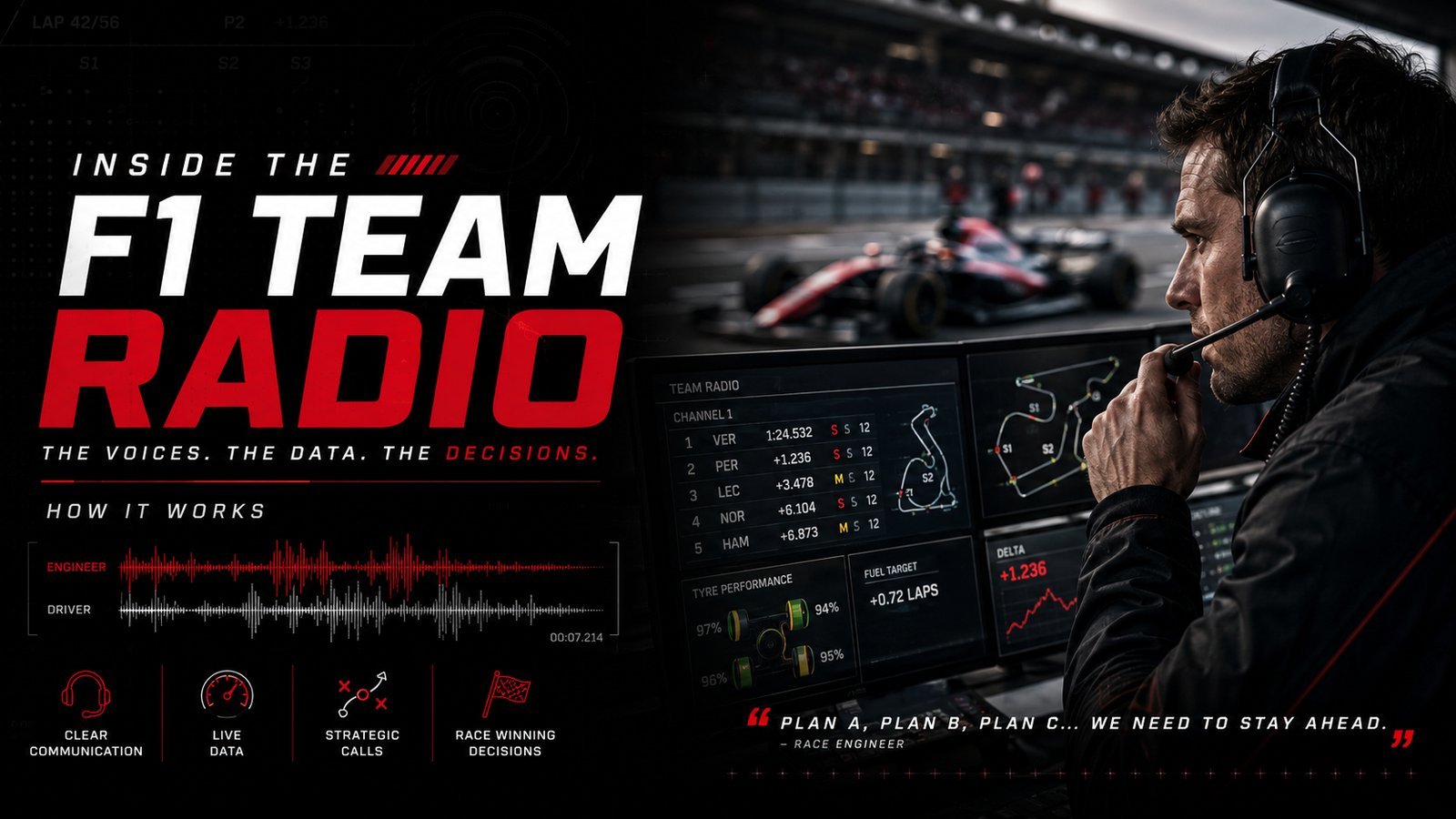
How F1 team radio works is simple at its core: each driver has a button on the steering wheel that opens a radio link to their race engineer on the pit wall, and they talk through a microphone and earpiece built into the helmet. Everything you hear on the broadcast, the strategy calls, the warnings, the odd meltdown, comes through that one channel.
If you want to hear the real thing rather than read about it, every message broadcast during the last Grand Prix is in our Spanish Grand Prix 2026 race radio archive, audio and transcript side by side.
But there is a lot more going on behind those few clips TV plays. If you came here to actually listen, our F1 team radio archive holds over 39,000 real messages from 2018 to 2026, searchable by driver and race, with the audio and a synced transcript. This page explains the system behind them.
The basic setup
A Formula 1 driver is sealed into a cockpit at 300 km/h with a helmet on, so the radio is their only link to the outside world. Press the radio button on the wheel, speak into the helmet microphone, and the message goes to the race engineer, the single person on the team assigned to talk to that driver all weekend. The engineer replies through the driver's earpiece. That one-to-one relationship is the heart of it: one driver, one engineer, one voice they trust for two hours.
Who is actually on the other end
The voice you hear is the race engineer, but they are not working alone. They sit on the pit wall surrounded by strategists, data analysts, and the team principal, plus back-channel radio links to the garage, the tyre and fuel crews, and the drivers' performance engineers. Dozens of people are watching timing screens and telemetry; the race engineer is the funnel who turns all of it into a few calm sentences the driver can act on mid-corner. That is why a good engineer is judged as much on when they stay quiet as on what they say.
What they actually say
Strip away the famous outbursts and most team radio falls into a few types:
Timing and gaps: "Gap to the car behind is 1.2 and stable" tells a driver whether to push or manage.
Tyres and strategy: the calls to box, to switch compound, to hit a target lap time, or to save the tyres for a later attack.
Warnings: yellow flags, a safety car, weather moving in, a rival pitting.
Car and problem management: turning up or down engine modes, saving fuel, nursing an issue to the flag.
The human stuff: the encouragement, the frustration, the immortal "leave me alone, I know what I'm doing" that Kimi Räikkönen is remembered for as he won the 2012 Abu Dhabi Grand Prix.
Every one of those categories is sitting in the public archive if you want to hear the real thing rather than a description of it (more on that below).
The rules: what can and can't be said
Team radio is more open than many fans assume. Back in 2016 the sport banned "driver coaching", messages about racing lines, braking points or gear selection, to stop engineers effectively driving the car by remote. It proved so unpopular that the F1 Strategy Group lifted it on 28 July 2016, in time for the German Grand Prix, the twelfth round of the season, and today teams can pass their drivers almost any information they like during the race.
The restriction that survived was around the start. When the 2016 rules were relaxed, the FIA kept limits in place between the start of the formation lap and the start of the race, and drivers still could not be told about clutch bite points or engine mapping for the launch. The principle behind it is still written into the Sporting Regulations: under Article B1.8.1, a driver must drive the car "alone and unaided".
One more thing shapes what you hear: the teams do not choose what goes out. Formula 1's own broadcast picks which messages the world hears, which is the only reason any of it can be heard or archived at all.
Can F1 drivers talk to each other on the radio?
No. Each driver's radio is a private link between that driver and their own pit wall. There is no channel connecting one driver to another, and no way for a driver to call a rival, or even their own team-mate, directly.
Anything that looks like drivers communicating is going through the teams. A message passes from one driver to their engineer, engineer to pit wall, pit wall to the other team's pit wall, and back down. That is why an apology or a request to swap positions takes so long to arrive, and why it usually sounds oddly formal by the time it does.
Team-mates are the same. Two drivers in the same team each talk to their own race engineer, not to each other.
Can teams hear each other's radio?
Yes, but only the part everyone hears.
Formula 1 broadcasts a curated selection of messages to the world feed, and every rival pit wall is listening to that feed exactly like the television audience. Nothing stops a strategist hearing a rival's engineer call a pit stop, because it was just played on television.
That single fact shapes how teams speak. If a message is going out live to nine competitors, you do not say "box this lap for hards". You say "Plan B", and the meaning stays inside the garage. The whole vocabulary of coded radio exists because teams assume they are overheard, and it is covered in F1 radio codes explained.
What is not public is the full channel. Only a fraction of the traffic is ever broadcast, and the rest stays between a team and its drivers. The detail of how those channels are secured is not something teams publish, so treat confident claims about interception with caution.
The clearest case of a team knowing it is overheard is a team order, where the instruction is legal but the wording is not something anyone wants replayed. We counted every instance in the archive: the phrase "team orders" is said out loud exactly once in 37,359 messages. See F1 team orders, measured.
Why you only hear a fraction on TV
During a race, the broadcast dips into a handful of radio messages, usually the dramatic ones, because there is simply no time to air them all. For scale, our archive holds 71 broadcast messages from the whole 2026 Italian Grand Prix weekend, across five sessions, and that is only what was chosen for broadcast out of everything said between drivers and pit walls. The clips on TV are a highlight reel, not the full conversation.
The driver and engineer talk on a private channel. The Formula 1 broadcast airs only a handful of those messages, often after a delay.
The full record is what makes team radio worth exploring after the race, when you can go back and hear how a result was actually built, corner by corner and call by call.
Hear it for yourself
We keep a searchable Team Radio Archive of over 39,000 messages spanning 2018 to 2026. You can pick a driver or a team, play the original audio, and read a transcript that colours itself as it goes, the driver in their team colour, the engineer in white, so a fast exchange is easy to follow. It is the difference between reading that team radio exists and actually hearing the moment a race turned.
If you are after the messages everyone quotes rather than the mechanism, we have collected the most famous team radio messages and the races behind them.
How to hear team radio live, during a session
The archive is for going back. Listening as it happens is a different problem, and it is the thing fans ask about most.
The broadcast gives you a curated handful of clips per race, chosen by the world feed director and usually played back well after the moment. If you want the radio as it is transmitted rather than as it is edited, you need a source carrying the live feed. We go through every option, and the geo-blocking that catches people out, in how to listen to F1 driver radio.
The Formula Dream app carries live driver radio during the session, alongside a live Dashboard with every car on the circuit map, a timing tower with lap times, gaps, intervals, tyre compound and age, and flag or safety car alerts the moment race control calls them. It also collects every FIA document of the weekend as it is published, which is where the stewards' decisions behind a penalty actually appear, often while the drivers are still arguing about it on the radio.
Free, no subscription, no ads, independent. Not affiliated with Formula 1.
No. Each driver's radio connects only to their own team's pit wall. There is no driver-to-driver channel, not even between team-mates, so any message between drivers has to be relayed team to team.
Can F1 teams hear each other's radio?
They hear whatever is played on the world feed, which is the same curated selection the television audience gets. That is why teams speak in code such as "Plan B" rather than naming a strategy out loud.
How does F1 team radio work?
Each driver has a radio button on the steering wheel that opens a link to their race engineer on the pit wall. They speak through a microphone and earpiece in the helmet, and the Formula 1 broadcast chooses which of those messages the public hears.
Who does a driver talk to on the radio?
Their race engineer, one dedicated person per driver, who relays information from the strategists, analysts, and crew on the pit wall and in the garage.
Can teams say anything they want to the driver?
During the race, almost anything. A 2016 ban on "driver coaching" was lifted before that year's German Grand Prix, and when it was, the FIA kept limits in place from the formation lap to the race start, including no information on clutch bite points or launch mapping.
Why do we only hear some team radio on TV?
The broadcast airs a small selection of the messages exchanged each weekend, usually the most dramatic. Our archive keeps every message that was broadcast, so they can be revisited afterwards.
Can you listen to F1 team radio live?
Yes, though not through the standard broadcast, which only plays a curated selection. A source carrying the live radio feed is needed to hear it as it is transmitted. The Formula Dream app carries live driver radio during the session.
Where can I find F1 radio transcripts?
Our Team Radio Archive holds more than 39,000 messages from 2018 to 2026, searchable by driver, team, season and session, with the original audio alongside a colour-coded transcript.
Where can I listen to F1 team radio?
You can search and play the full archive by driver and team, with synced transcripts, in the Team Radio Archive.
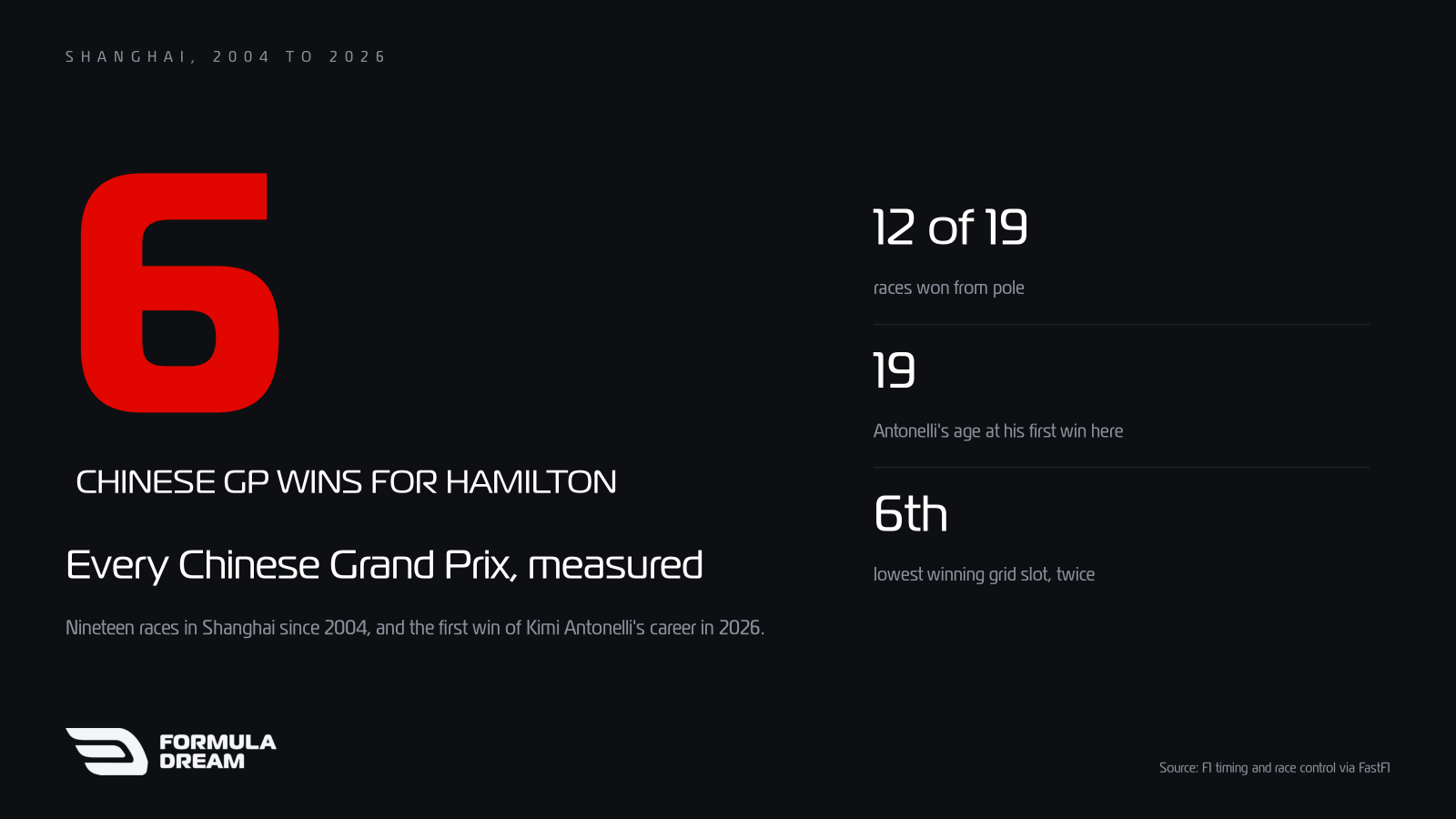
Nineteen Chinese Grands Prix have been held in Shanghai since 2004. Lewis Hamilton won six, pole won twelve, and in 2026 Kimi Antonelli took the first win of his career there, at 19, with Hamilton on the podium for Ferrari for the first time. Every winner, grid slot and safety car, measured.