A Formula 1 weekend is not one race with some warm-up attached. It is a sequence of sessions, each answering a different question, and the answers to the early ones determine what is possible on Sunday.
Watch it that way and Friday stops being filler.
The standard weekend
Three days, and on a normal weekend it runs like this.
Friday: FP1 and FP2, one hour each and two to three hours apart, under Article B2.1.1 of the 2026 Sporting Regulations. FP stands for free practice. FP1 is the first look at the circuit: track conditions, initial balance, and whatever upgrades have arrived. FP2 is usually the session that matters most for prediction, because teams use it for long runs on race fuel. When Pirelli brings extra tyres for testing, FP2 is extended to 90 minutes.
, one final hour to fine-tune, starting at least 18 hours after FP2 ends, then
qualifying
two to three hours later.
Sunday: the Grand Prix.
Qualifying, and why the sessions get shorter
Qualifying is three stages, and the durations are deliberately uneven:
Q1: 18 minutes. All 22 cars. Slowest six eliminated, setting P17 to P22.
Q2: 15 minutes. 16 cars. Slowest six eliminated, setting P11 to P16.
Q3: 13 minutes. Ten cars fight for pole. There is a seven-minute break before Q2 and another before Q3 (Article B2.4.2).
Those numbers changed for 2026. The grid expanded to 22 cars across 11 teams when Cadillac joined, so the FIA moved from eliminating five per session to six, keeping ten cars in Q3 as before.
The shrinking clock is the point. Q1 is long enough for everybody to get a lap in without chaos. By Q3 there is time for perhaps two runs, which concentrates everything into a handful of laps and makes a single mistake unrecoverable.
Q1 is also where the tension is highest for the teams nobody is filming. For a midfield car, escaping Q1 is the whole weekend.
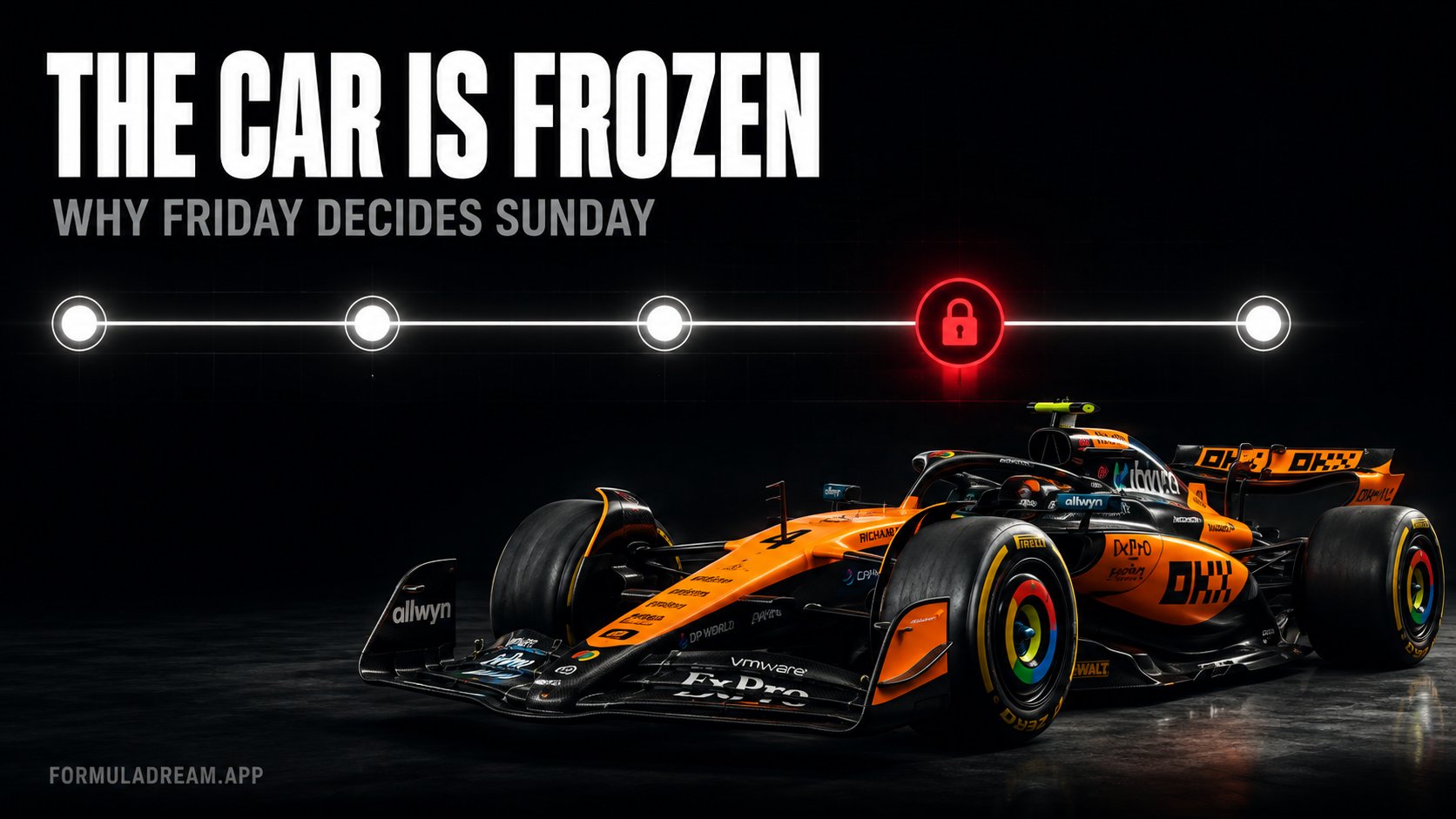
Parc fermé: the moment the car is frozen
This is the rule that makes the weekend a sequence rather than three independent days, and casual coverage barely mentions it.
When qualifying begins, parc fermé conditions apply, and most work on the car is banned. Teams cannot change setup between qualifying and the race. The car that qualifies is, with narrow exceptions, the car that races.
Every consequence flows from this:
Friday matters because Saturday is the deadline. Practice is not rehearsal, it is the only window to decide what the car will be for the entire weekend.
Teams must choose between qualifying pace and race pace. A setup that produces one blistering lap may destroy its tyres over a stint. That trade is committed to before qualifying starts and cannot be undone.
Breaking parc fermé has a cost. A team that must change something significant typically starts from the pit lane.
So when a driver says on Sunday that the car is difficult, the decision that made it difficult was taken on Friday afternoon.
The sprint weekend, which changes everything
On a sprint weekend, two practice sessions are deleted.
Friday: FP1, then Sprint Qualifying. SQ1 is 12 minutes, SQ2 is 10, SQ3 is 8. Six drivers are eliminated after SQ1, setting P17 to P22, and six more after SQ2, setting P11 to P16. There are mandatory tyres: mediums in SQ1 and SQ2, softs in SQ3.
Saturday: the Sprint, the fewest laps that add up to more than 100km, about a third of a Grand Prix, with points for the top eight. Then qualifying for the Grand Prix later the same day.
Sunday: the Grand Prix, points for the top ten as normal.
The thing to understand is what this does to preparation. A sprint weekend gives teams one hour of practice. One. Everything after that is competitive. The rules do allow that session to be stretched to 90 minutes, but only if the FIA, Formula 1 and a majority of teams agree at least a week before the event.
That is why sprint weekends produce unusual results, and it is why our own telemetry work showed the 2024 Miami pole was slower than the 2023 one despite a year of development: less practice means less setup work, and it lands on the timesheets. We covered that measurement in how much of an F1 lap is full throttle.
What to actually watch in each session
FP1: who has brought upgrades, and whether anything is broken. Long-run pace is meaningless here; the track is filthy and everybody is on different programmes.
FP2: the important one. Watch the long runs, on race fuel, at race time of day. Compare tyre degradation across teams rather than single-lap pace. This is where Sunday is forecast.
FP3: final setup tweaks, and the last chance to fix a problem before the car is frozen. Watch for teams still experimenting, which means they have not found the answer.
Qualifying: grid position, obviously. It no longer tells you the starting tyres, though. Until 2021 the top ten had to start the race on the tyres they set their best Q2 time on; since 2022 every driver has a free choice.
The race: intervals rather than gaps, and tyre age against lap time. Both are covered in our guide to reading a timing tower.
The part that happens off-screen
Across all of this, the FIA is publishing documents: the race director's notes setting track limits for specific corners, the technical delegate's scrutineering reports, the component allocations that predict grid penalties, and the stewards' decisions that change results after the flag.
None of it is announced. All of it is public. It is genuinely the biggest gap between what a broadcast shows you and what is actually happening, and we wrote a full guide to what the FIA publishes and how to read it.
Following it without staying up all night
The practical problem with all this is time zones. A weekend spread across three days at a circuit eight hours away is largely unwatchable live.
Our app has a weekend timeline that replays everything in order: news, FIA documents, session results and the statistics, so you can pick up a weekend from the beginning after it has happened without being spoiled by a results table.
During a session it puts every car on the circuit map with the full timing tower carrying gaps, intervals, tyre compound and tyre age, pit stop counts and positions gained or lost, plus alerts for safety cars and yellow and red flags. Driver radio streams live with the transcript running beside the audio.
Free, no subscription, no ads. Independent, and not affiliated with Formula 1.
FP stands for free practice. FP1 and FP2 are the two practice sessions on the Friday of a normal race weekend, where teams test setup, tyres and upgrades before the car is frozen for qualifying. FP3 follows on Saturday. A sprint weekend has only FP1.
How long is FP1 in F1?
One hour. FP2 and FP3 are also one hour each, although FP2 is extended to 90 minutes when Pirelli brings extra tyres for testing, and on a sprint weekend FP1 can be extended to 90 minutes if the FIA, Formula 1 and most teams agree in advance.
How long is F1 qualifying?
About an hour in total: Q1 lasts 18 minutes, Q2 15 minutes and Q3 13 minutes, with a seven-minute break between each. Sprint qualifying is shorter, at 12, 10 and 8 minutes.
How long is an F1 sprint?
The fewest laps that add up to more than 100km, about a third of a Grand Prix, with a one-hour time limit. Points go to the top eight.
Singapore Sprint 2026 Results: Russell Crashes From the Lead
Russell took the lead at turn one and crashed at the final corner of the same lap. Verstappen won, Hamilton charged to second, and the McLarens hit each other.