The Formula 1 calendar spans time zones from Melbourne to Las Vegas. Wherever you live, a large part of the season happens while you are asleep or at work. And the moment you wake up, every phone notification you own is trying to tell you who won.
The advice you normally get for this is to mute some accounts and avoid social media. That advice fails, and it fails for a structural reason worth understanding.
Why spoilers are almost impossible to avoid
The result of a Grand Prix is not confined to Formula 1 coverage.
It reaches general sports apps, news homepages, push notifications from services you never associated with motorsport, group chats, autoplaying video thumbnails, and the "trending" module on any platform you open. A friend who has no idea you follow F1 will mention it.
Muting keywords helps with text. It does not help with a thumbnail of a driver celebrating, a headline that says a team is "under investigation", or a notification that merely says "Grand Prix". You now know something happened.
The half-spoiler is the worst outcome. Learning "there was a dramatic finish" or "a penalty changed the result" removes the tension while giving you nothing. You still have to watch, but you watch waiting for a thing you know is coming.
The two genuinely different situations
Most advice treats this as one problem. It is two.
Watching delayed but complete, where you have two hours and want the race as if live.
Catching up quickly, where you have twenty minutes and want to understand what happened.
They need opposite approaches, and conflating them is why generic advice is useless.
If you want to watch it properly, delayed
Decide before you sleep. The spoiler risk is highest in the first ten minutes after waking, before you are alert enough to be careful. Put the phone somewhere else, or set it to deliver nothing until you have started watching.
Turn off notifications by category, not by keyword. Sports notifications, news notifications, and anything with a "trending" feature. Keyword muting is too narrow because the spoiler rarely contains the keyword.
Avoid the video platform homepage. Thumbnails spoil results without text, and recommendation algorithms actively surface the biggest moment of the weekend.
Start from qualifying if you can. A race watched without knowing the grid is a substantially better race, and qualifying is only an hour.
If you want to catch up quickly
Here the goal is different: you want the weekend's story in order, at speed, without a results table ruining the first thirty seconds.
The problem is that almost every catch-up source leads with the outcome. A highlights package is edited around the result. A report's headline is the result. A standings table is the result.
What you actually want is chronology: what happened, in the order it happened, so the weekend unfolds rather than being summarised backwards.
That includes the parts that never make highlights. The FIA documents that changed the grid before the start. The stewards' decision published an hour after the flag that altered the classification. A weekend where a result changed post-race is a weekend where the highlights package is telling you a story that was not true at the time.
Why a race weekend is worse than other sports for this
Three reasons.
It is spread over three days. A football match is ninety minutes; you either saw it or you did not. A Grand Prix weekend has practice, qualifying and a race, sometimes with a sprint, and spoilers can arrive for any of them for days.
The result is provisional after the flag. Classifications stay provisional until post-race checks are complete, and decisions can land hours later. We wrote about that in what the FIA publishes across a race weekend.
The interesting part is often not the winner. A midfield battle, a strategy call, a tyre gamble. Knowing the winner does not spoil those, but standard highlights are edited around the winner, so the parts you actually wanted get cut.
The honest limits
No approach makes you spoiler-proof. If you exist online, some weekends you will find out.
What you can realistically do is reduce the odds substantially, and make the catch-up better when it fails. A race you already know the result of is still worth watching if you can follow the strategy properly, which is largely a question of having the timing information rather than just the pictures. Our guide to reading a timing tower covers that.
How we handle it
This is the exact problem the weekend timeline in our app was built for.
It replays a whole race weekend in chronological order: news as it broke, FIA documents as they were published, session results and statistics, in sequence rather than summarised from the outcome backwards. You can start at Friday and move forward without a results table appearing first.
Alongside it, during a session the app puts every car on the circuit map with a full timing tower carrying gaps, intervals, tyre compound and tyre age, pit stop counts and positions gained or lost. Driver radio plays live as it is broadcast, which is often where the real story of a weekend is, and it almost never survives into a highlights edit.
If you are catching up afterwards rather than live, our separate Team Radio Archive on the website holds more than 39,000 messages going back to 2018, searchable by driver, team and session, with the original audio and a colour-coded transcript. That is a website tool rather than part of the app, and it is the best way to go back through a session you missed.
Free, no subscription, no ads. Independent, and not affiliated with Formula 1.
How do I watch an F1 race later without seeing spoilers?
Mute the obvious sources before the session starts rather than after: notifications from news and sports apps, the sport's own accounts, and any group chat that follows racing. Start from the beginning of the session, not a highlights package, because highlights are edited backwards from the result and give it away in the first thirty seconds.
What time do F1 races start?
It varies enormously by round, because the calendar spans Melbourne to Las Vegas. Races are usually scheduled for a local afternoon, which means the same event can land anywhere from early morning to the middle of the night depending on where you live. Check the specific round rather than assuming a pattern.
Is it better to watch a race delayed or read the result first?
If you have around two hours, watching delayed from the start is far better, because a Grand Prix is a strategy story that only makes sense in sequence. If you have twenty minutes, a chronological catch-up beats a highlights edit, since highlights are cut to the outcome and remove the tension entirely.
Why are F1 spoilers harder to avoid than other sports?
Because a race weekend runs across three days with results at every stage. Practice times, qualifying and the sprint all generate headlines before Sunday, so there are several days of opportunities for the outcome to reach you rather than one.
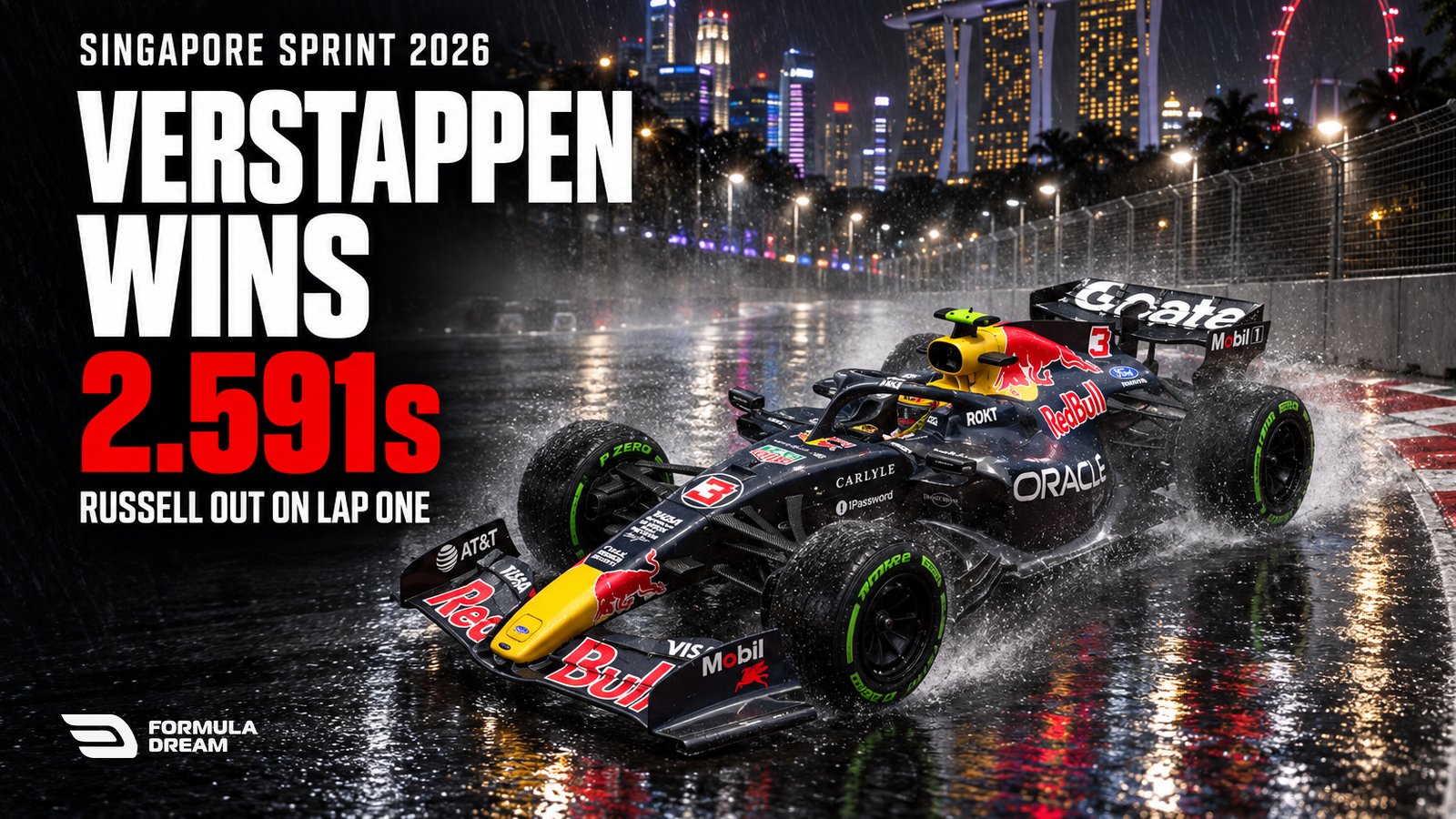
Singapore Sprint 2026 Results: Russell Crashes From the Lead
Russell took the lead at turn one and crashed at the final corner of the same lap. Verstappen won, Hamilton charged to second, and the McLarens hit each other.