In 1971, Peter Gethin won the Italian Grand Prix by 0.01 seconds. It is still the closest finish in the history of Formula 1, it was the only Grand Prix he ever won, and he started eleventh.
Put that margin into distance and it stops being a number. At the speed cars cross the line at Monza, a hundredth of a second is somewhere between 0.7 and 1.0 metres. Five cars finished within six tenths of each other. The winning margin was less than a car length.
Fifty-five years later the circuit still does this, because Monza is built to. Everything here happens close together and at enormous speed, and the whole weekend gets decided in about four places.
Autodromo Nazionale Monza: 5.793 km, 53 laps, with the two heaviest braking zones marked
Built in 1922 in a royal park north of Milan, Monza is one of the oldest purpose-built racing circuits in the world, and it has hosted the Italian Grand Prix every year since the championship began in 1950, with a single exception in 1980. They call it the Temple of Speed and they are not being romantic about it.
Length 5.793 km
Turns 11
Race 53 laps, 306.72 km
Lap record 1:20.901, Lando Norris, 2025
That lap record is worth a moment. It is the exact time our own gaps data holds for the fastest lap of the 2025 race, which is a useful check that the numbers on this site agree with the record books.
Turn 1 and 2, the Variante del Rettifilo. The first heavy braking zone after the start, and the hardest stop on the lap. Brembo's 2026 figures have cars braking from about 318 km/h to 87 km/h in 153 metres, in 3.22 seconds, at up to 3.8 g and with 111 kg on the pedal, for a tight left-right. Get the entry wrong and you go straight on over the kerbs, which is exactly what happened at the front of the field in 2025.
Turn 3, the Curva Grande. A long right, flat or close to it, and the reason cars are trimmed out so far. It rewards commitment and punishes anything nervous.
Turn 4 and 5, the Variante della Roggia. The second chicane and the classic overtaking spot, because you arrive with a slipstream and can take the inside. The 2026 cars have less downforce to stop with here: Brembo puts the braking zone at an estimated 121 metres, up from 107 in 2025, at 3.7 g rather than 4.5. Its kerbs will unsettle a low-downforce car instantly.
Turn 6 and 7, the Lesmos. Two quick rights, and the point on the lap where a car set up for the straights feels worst. There is no downforce to lean on and the driver has to be patient with something that does not want to be.
Turn 8 to 10, the Variante Ascari. The best corner complex on the circuit, a left-right-left taken at genuinely high speed. It separates a good Monza car from a merely fast one, and it decides the run down the back straight.
Turn 11, the Parabolica. Long, opening, and the last corner before the pit straight. Exit speed here carries past the line and all the way into the next lap's braking zone. Lose two tenths in the Parabolica and you lose the position a lap later at the chicane.
The Temple of Speed is really a braking circuit
Monza's reputation is built on straights and the reputation is earned. Teams arrive with the lowest downforce package they run all year.
But a car with no wing is a nervous car under braking. Take the downforce away and you take away the thing that plants the front axle when a driver stands on the pedal at 340 km/h. Monza gives you four of those runs and then asks you to stop for a chicane.
You can hear it happening. From 2024 qualifying, inside five minutes of each other:
Pierre Gasly, at 16:03: "Smoke's coming out of the front brakes."
Gasly again at 16:05: "I just have no front, which is very annoying, I've absolutely no front." His engineer: "OK, we'll have a think what we can do for the next one." Gasly: "Front brakes, smoking, turn 1, no deceleration."
Alexander Albon, at 16:08, in a different car from a different team: "A lot of smoke on the front brakes into Turn 1."
Two drivers, two teams, the same complaint, the same corner, five minutes apart. That is not a car problem. That is the circuit.
The most revealing message of that session came from McLaren to Oscar Piastri: "So Oscar, turn one, there was a bit more tailwind than P3. You braked 10 metres later and with less peak pressure."
Ten metres. That is the margin an engineer thinks is worth mentioning at a place where the lap is decided by how late you dare to leave it.
The whole grid, drawn to scale
Every car in 2025 qualifying, placed at the distance its gap actually puts it behind pole
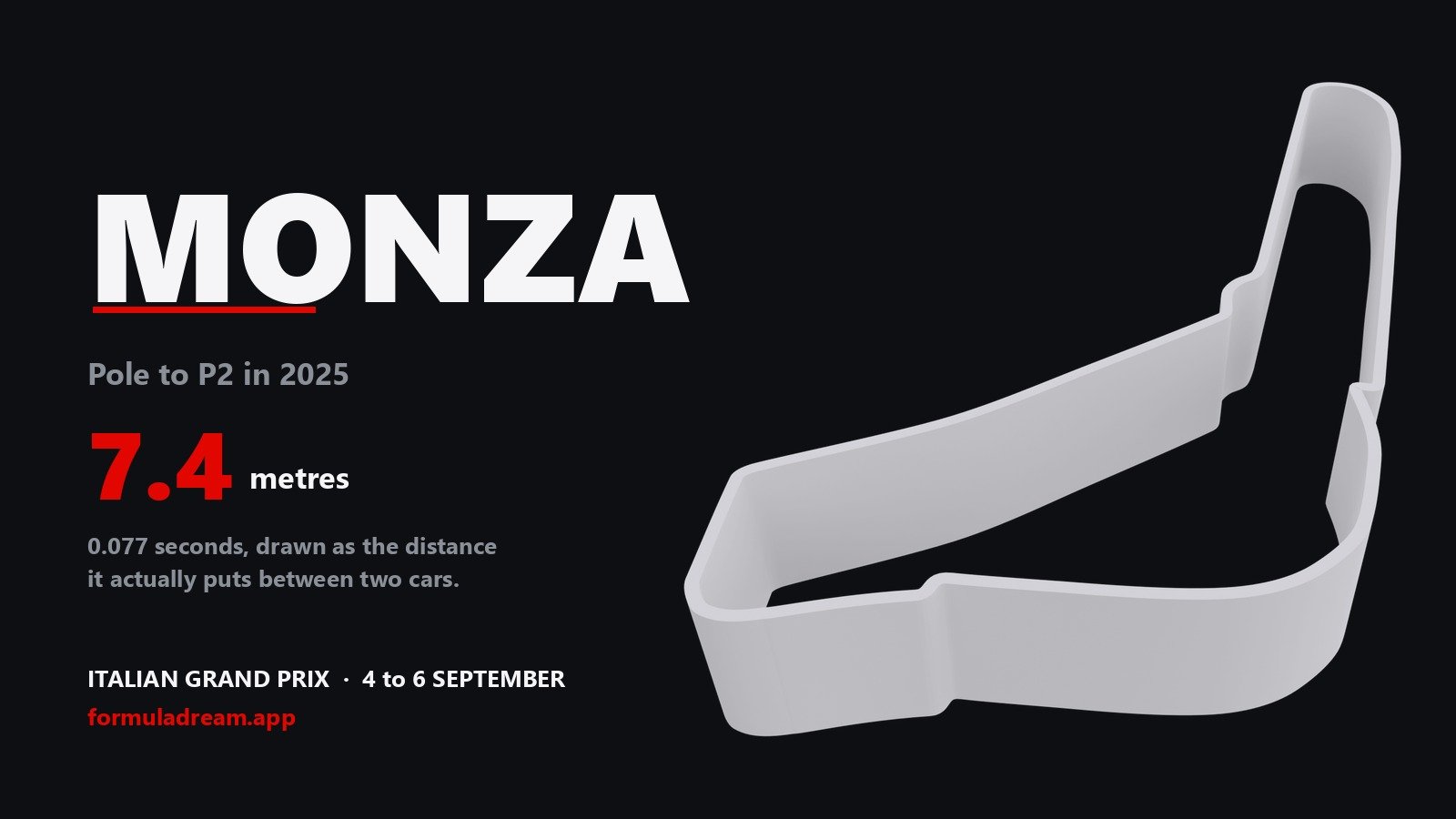
Max Verstappen took pole in 1:18.792. Lando Norris was 0.077 behind, which is 7.4 metres, less than two car lengths after nearly eighty seconds of lap.
Liam Lawson, last of the twenty, was 1.487 seconds back. That is 143.7 metres, and it is still only 2.5% of a lap. The entire Formula 1 grid fits inside the run from the Parabolica exit to the start line.
The top seven:
Max Verstappen, pole, 1:18.792
Lando Norris, plus 0.077, 7.4 metres
Oscar Piastri, plus 0.190, 18.4 metres
Charles Leclerc, plus 0.215, 20.8 metres
Lewis Hamilton, plus 0.332, 32.1 metres
George Russell, plus 0.365, 35.3 metres
Kimi Antonelli, plus 0.408, 39.4 metres
Seven cars inside 40 metres, which is shorter than the braking zone they are all about to arrive in.
2024 was a different circuit with the same corners
Lando Norris took pole in 1:19.327, and the grid behind him was shaped nothing like 2025:
Oscar Piastri, plus 0.109, 10.5 metres
George Russell, plus 0.113, 10.9 metres
Charles Leclerc, plus 0.134, 12.9 metres
Carlos Sainz, plus 0.140, 13.5 metres
Lewis Hamilton, plus 0.186, 17.9 metres
Max Verstappen, plus 0.695, 66.8 metres
The 2024 top six were tighter than the 2025 top six, all inside two tenths. And Verstappen, who would take pole and win the following year, was two thirds of a second and nearly 67 metres off it.
Across the full field the spread moved the other way. Pole to last was 203.6 metres in 2024 and 143.7 in 2025, so the front loosened while the back closed up.
Saturday tells you less here than almost anywhere
Fastest race laps in 2025:
Lando Norris, fastest, 1:20.901
Max Verstappen, plus 0.102, 9.5 metres
Oscar Piastri, plus 0.344, 32.1 metres
Charles Leclerc, plus 0.393, 36.7 metres
Alexander Albon, plus 0.467, 43.6 metres
Look at fourth and fifth. Leclerc and Albon were nowhere near the front on Saturday, and over a race distance they were within half a second of the quickest car on track. Monza rewards a car that can run in traffic and hold its tyres through the Lesmos, and a single qualifying lap measures neither.
Thirty seconds in 2025, from three cockpits
At 15:04 on race day, Lando Norris said this:
"Yeah, what was this idiot doing, come on, just put me in the grass."
Ninety seconds later, from the other McLaren, Oscar Piastri: "He needs to give that back. He went to defend and went long." His engineer replied, "Yeah, we saw, we saw."
Two minutes after that, from the Red Bull, Max Verstappen: "You let the brakes go, mate."
Three cars, three versions of the same half minute. Verstappen had started from pole, defended into the first chicane, run wide over it and kept the lead. Norris, who launched better and took the inside, ended up on the grass. Race control agreed with Piastri, Verstappen was told to hand the place back, and he took it again on lap four at the same corner. He then won by more than 19 seconds.
All of it at Turn 1. At Monza, most things are.
Why the crowd matters here
Monza is the closest thing Formula 1 has to a home fixture, and it does not feel like any other weekend.
The tifosi turn the grandstands into an unbroken block of red, and when the race ends they come over the fences and flood the main straight to stand under the podium. It is one of the sport's genuinely great sights, and it happens whether or not a Ferrari has won.
The circuit has earned it. Gerhard Berger and Michele Alboreto took a Ferrari one-two here in 1988, weeks after Enzo Ferrari died. Michael Schumacher took his first Ferrari win at Monza in 1996. Sebastian Vettel won his first Grand Prix here in 2008, at twenty one, from pole, in the wet. Charles Leclerc won in 2019 and again in 2024. Pierre Gasly took his only victory here in 2020, and McLaren finished one-two with Daniel Ricciardo and Lando Norris in 2021.
That is a lot of firsts for one circuit, and it is not a coincidence. Monza compresses the field, punishes a single mistake at the chicane, and hands a slipstream to anyone brave enough to sit in it.
What happened, 6 September 2026
We wrote the four things to watch before the weekend. Three of them decided the race.
The first chicane on lap one. Not quite. It was Parabolica on lap 2 instead: Charles Leclerc spun and hit the barrier hard enough to red-flag the race after three laps, which handed all twenty one remaining cars a free tyre change and a standing restart. Everything after that followed from it. The mechanics are in red flag rules.
The brakes and Turn 1. Exactly as expected, and worse than expected. Twenty one lap times were deleted for track limits during the race and fourteen of them were at Turn 1. Qualifying had produced sixteen deletions with ten at the same corner. Almost the whole field ran out of road there at some point.
The tow in qualifying. It produced the shock of the season. Pierre Gasly took pole by 0.060 from George Russell, his first and Alpine's first, and he did it without setting a single fastest sector all afternoon. We took that lap apart in what purple, green and yellow actually mean.
Race pace against grid position. The strongest version of this we have ever measured. Kimi Antonelli started nineteenth after a power unit penalty, restarted twelfth after the red flag, and won, averaging 1:24.663 over the final stint against Russell's 1:25.366. Full stint and pace data in the Italian GP race report.
What the drivers said here
The radio is the part of a weekend that does not make the highlights. We hold every message Formula 1 broadcast from Monza in 2026, 71 of them across the whole weekend, transcribed with the original audio and the driver and engineer colour coded, on the Monza 2026 team radio page.
It is worth a scroll before a race here, because the complaints repeat. Drivers tend to raise the same two or three things about a circuit every year, and reading last season back is the quickest way to know what to listen for in this one.
Frequently asked questions
How many laps is the Italian Grand Prix at Monza?
53 laps. Monza is 5.793 km long, so the race distance is 306.72 km. Both the 2025 and 2026 races ran the full 53 laps.
Which corner at Monza is the first heavy braking zone after the start?
Turn 1, the entry to the Variante del Rettifilo, the first chicane at the end of the pit straight. Brembo's figures for 2026 have cars braking from about 318 km/h to 87 km/h in 153 metres and 3.22 seconds, at up to 3.8 g.
How many corners does Monza have?
11 turns. Most of them come in pairs or threes: the two chicanes, the two Lesmos and the three-part Variante Ascari, with the Curva Grande and the Parabolica as single long corners.
What is the lap record at Monza?
1:20.901, set by Lando Norris on the final lap of the 2025 Italian Grand Prix. At an average of 257.781 km/h it is the fastest race lap in Formula 1 history.
Where to follow it
The Monza circuit hub has every qualifying gap converted to real distance, session by session, plus the team radio from previous Italian Grands Prix, deep-linked to the session it came from.
Every radio message quoted here came from our team radio archive, more than 39,000 messages from 2018 onward with the audio alongside the transcript. The 2024 brake-smoke sequence is in there, timestamped, and so is the whole of that first lap in 2025.
For the next race weekend, the FormulaDream app streams driver radio live during the session with the transcript running next to it, collects every FIA document as the stewards publish it, and puts all twenty two cars on the circuit map with a full timing tower. At a circuit where the race is decided by a stewards' decision at Turn 1 as often as not, that last part is what matters.
Free, no subscription, no ads. Independent, and not affiliated with Formula 1 or the FIA.
Singapore Sprint 2026 Results: Russell Crashes From the Lead
Russell took the lead at turn one and crashed at the final corner of the same lap. Verstappen won, Hamilton charged to second, and the McLarens hit each other.