Bahrain GP 2026 at Sepang: Times and Pole Forecast
Guides
Bahrain GP at Sepang preview: session times and a pole forecast from 2017
The 2026 Bahrain Grand Prix runs at Sepang in Malaysia on 4 October, as a day race. Session times in Malaysian time, and our forecast of a 1:31.6 pole from how 2026 cars compare with 2017 at unchanged circuits.
The last time anyone took pole at Sepang, it was Lewis Hamilton with a 1:30.076 in 2017. The next time will be on Saturday 3 October, in a car built to rules that did not exist then, by a grid where most drivers have never raced here.
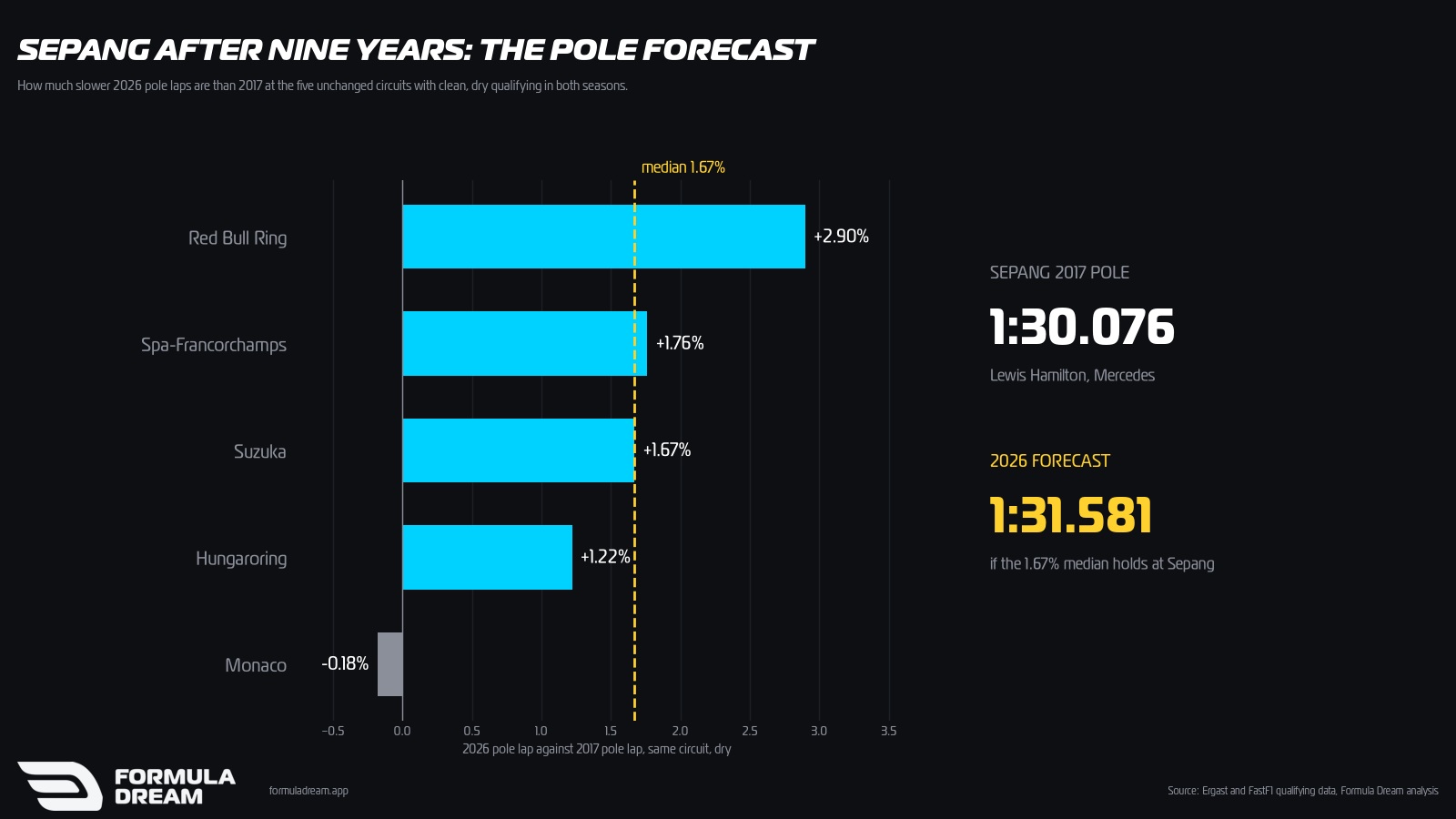
Nobody can look up how fast a 2026 car will be at Sepang. But we can measure how 2026 pole laps compare with 2017 pole laps at circuits that have not changed since, and that gives a forecast: pole at about 1:31.6, roughly a second and a half slower than Hamilton.
The race runs as the Bahrain Grand Prix, moved to Malaysia after the original April race in Bahrain was cancelled. Why that happened, and which drivers have raced here before, is in our
. This page is the race weekend: when it happens, the forecast and what to watch.
There is no team radio from Sepang in our archive yet, because Formula 1 left before our archive begins in 2018. The first messages will land there as they are broadcast. Until then, the most recent race radio is from Madrid, in our Spanish Grand Prix 2026 race radio archive.
Bahrain GP 2026 at Sepang: session times
It is a day race. Early reports suggested the Bahrain night-race timings would carry over, but Sepang does not have the lighting for Formula 1 at night, as GPblog reported.
Session
Day
Malaysia time
UTC
Practice 1
Friday 2 October
12:30
04:30
Practice 2
Friday 2 October
16:00
08:00
Practice 3
Saturday 3 October
12:30
04:30
Qualifying
Saturday 3 October
16:00
08:00
Race
Sunday 4 October
15:00
07:00
Caption: Times from Formula 1's 2026 event schedule. Malaysia is eight hours ahead of UTC.
The race is 56 laps of the 5.543 km Sepang International Circuit, 310.408 km in total. It is round 16 of 23, a week after Azerbaijan and a week before Singapore. The event was confirmed on 26 July, with Bahrain covering most of the cost and keeping the ticket rights, according to the event's Wikipedia entry.
The pole forecast: about 1:31.6
Comparing a 2017 lap time directly with a 2026 one tells you nothing on its own: different cars, different tyres, different rules. In our Sepang guide we said we would not do it. What we can compare is the ratio between the two seasons at the same circuits, because that measures how the cars changed rather than how the tracks did.
So we took every circuit that hosted qualifying in both 2017 and 2026, and kept only those where the layout is unchanged and both pole laps were set on a dry track:
Circuit
2017 pole
2026 pole
Change
Monaco
1:12.178, Raikkonen
1:12.051, Antonelli
-0.18%
Hungaroring
1:16.276, Vettel
1:17.207, Norris
+1.22%
Suzuka
1:27.319, Hamilton
1:28.778, Antonelli
+1.67%
Spa-Francorchamps
1:42.553, Hamilton
1:44.361, Antonelli
+1.76%
Red Bull Ring
1:04.251, Bottas
1:06.113, Russell
+2.90%
Caption: Pole laps from official qualifying results. The median change is +1.67%.
Left out, and why: Albert Park and Barcelona have both been reconfigured since 2017. Monza's 2017 qualifying was wet. Canada's 2026 qualifying had rain. Shanghai's 2017 pole was set on a track still drying, and Silverstone's 2017 qualifying started in the rain. Including those two would not move the median: it stays at 1.67%.
Apply 1.67% to Hamilton's 1:30.076 and the 2026 pole comes out at 1:31.581. The middle three circuits give a range of roughly 1:31.2 to 1:31.7.
Three things could break it. The 2026 cars have been closest to the 2017 cars at slow, twisty circuits (Monaco) and furthest at fast ones (the Red Bull Ring), and Sepang has both long straights and slow hairpins. The tyres are completely different. And qualifying starts at 16:00 in a month when afternoon thunderstorms are common around Kuala Lumpur, according to Rough Guides. A wet session makes any dry forecast irrelevant.
Sepang is 5.543 km with 15 corners, two long straights either side of the final hairpin, and one of the widest tracks Formula 1 visits. The race lap record is Sebastian Vettel's 1:34.080 from 2017, set in a Ferrari SF70H.
Ten of the 22 drivers on the 2026 grid raced here in 2017. Max Verstappen won that race from third on the grid, with Hamilton second. The other twelve, including championship leader Kimi Antonelli, both McLaren drivers and Charles Leclerc, have never raced a Formula 1 car at Sepang. The full list is in our Sepang guide.
That makes Friday worth more than usual. Three hours of practice is all twelve drivers get to learn a lap the other ten last drove nine years ago, in very different cars.
What to watch
The weather at 15:00 and 16:00. Qualifying and the race both start in the afternoon, the part of the day when storms usually arrive.
The heat. Sepang has historically been one of the most physically demanding races of the season, which is why Formula 1 now has a heat hazard procedure and driver cooling systems. The rules are in F1 heat hazards and cooling vests.
Who learns fastest. Twelve drivers are learning the lap from scratch across three practice hours. Watch whether Verstappen, the last winner here, has an edge on Friday that disappears by Saturday.
Whether the forecast holds. Pole under 1:31.2 would put Sepang closer to its 2017 time than every unchanged circuit except Monaco.
Frequently asked questions
When is the 2026 Bahrain Grand Prix at Sepang?
Sunday 4 October 2026 at 15:00 Malaysia time (07:00 UTC). Practice starts on Friday 2 October and qualifying is on Saturday 3 October at 16:00.
Is the Bahrain Grand Prix at Sepang a night race?
No. It is a day race, because Sepang does not have lighting for Formula 1 at night.
Why is the Bahrain Grand Prix in Malaysia?
The original race at the Bahrain International Circuit in April was cancelled, along with the Saudi Arabian Grand Prix, after the outbreak of the 2026 Iran war. The race was moved to Sepang and kept the Bahrain name.
What is the lap record at Sepang?
1:34.080, set by Sebastian Vettel for Ferrari during the 2017 Malaysian Grand Prix. The fastest qualifying lap there is Lewis Hamilton's 1:30.076 pole from the same weekend.
What will pole be at Sepang in 2026?
Our forecast is about 1:31.6, based on 2026 pole laps being a median 1.67% slower than 2017 at five unchanged circuits with dry qualifying in both years. We will update it after first practice.
Pole laps: 2017 and 2026 qualifying results via Ergast and FastF1, with weather and tyre data from official timing for 2026
Follow the return live
The first Formula 1 race at Sepang in nine years will be decided by who learns the circuit fastest and whether the rain arrives. The Formula Dream app plays live driver radio as it is broadcast, with the transcript beside the audio, a live timing Dashboard (currently in beta) with flag and weather-driven safety car alerts, and every FIA document of the weekend the moment it is published.
Free, no subscription, independent. Not affiliated with Formula 1.
Singapore GP 2026 preview: the first Marina Bay sprint and a pole forecast
Singapore hosts its first sprint on 9 to 11 October, the last sprint of 2026. Session times in Singapore time, our 1:31.8 to 1:32.1 pole forecast, the last three races and what the 2025 radio tells you to listen for.