F1's Heat Hazard Rule and the Cooling Vests Drivers Don't Want
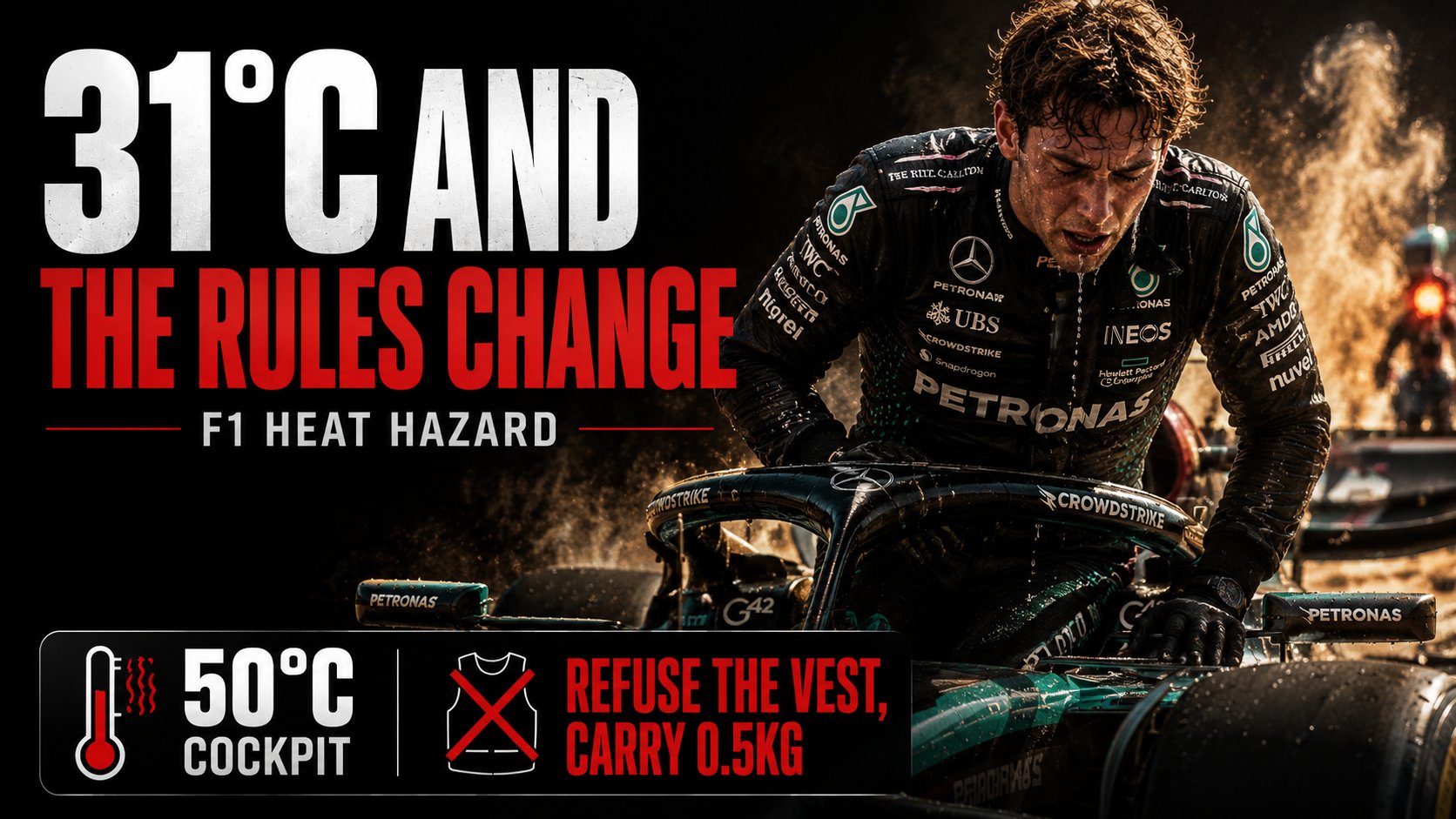
Above 31°C the FIA declares a Heat Hazard and every car must carry a cooling system. Drivers can refuse to wear the vest, and the rule makes sure it costs them nothing.
When forecasts predict 31°C or above during a Sprint or Grand Prix, the FIA can declare a Heat Hazard. Every team then has to fit a Driver Cooling System to both cars.
The drivers do not have to wear it. Several of the biggest names have said publicly that they would rather not.
And the rule anticipates exactly that, in a way that tells you how the FIA thinks. A driver who declines the vest gets 0.5kg of ballast
The threshold is a forecast, not a measurement on the day. In the FIA's wording, a declaration follows "if pre-weekend weather forecasts predict temperatures of 31 Celsius or above at some point" during the Sprint or the race.
It is issued before the weekend runs. At the Austrian Grand Prix the race director declared it on the Thursday morning, giving teams time to fit the equipment.
For 2026 the rule was extended: a Heat Hazard can now be declared between a Sprint and the main race, rather than only once for the whole event. On a sprint weekend the two sessions are a day apart and the weather can change in between.
What the cooling system actually is
It is not a gimmick garment. It is a plumbed system built into the car.
The Driver Cooling System consists of a pump, plumbing and thermal storage, circulating chilled fluid through tubes sewn into a fireproof vest worn under the race suit. The car carries the hardware; the vest is the part touching the driver.
The regulations separate those two things deliberately. All components must be fitted for the entire competition, with the exception of the cooling medium itself and the personal equipment the driver wears. So the car is always equipped, whatever the driver decides.
Why the rule exists
It came out of the 2023 Qatar Grand Prix, where conditions left several drivers close to collapse and some needing medical attention after the race.
That was not a freak inconvenience. A driver is working in a cockpit that reaches around 50°C, in multiple layers of fireproof clothing, under sustained physical load for up to two hours, losing several kilograms in sweat. Heat is a performance problem and, past a point, a safety one. The physical demands are covered in how F1 drivers train.
Why drivers resist it
The objections are practical rather than macho, and they are worth taking seriously.
The vest adds bulk in a cockpit fitted to the millimetre around a seat moulded to the driver's body. It adds another system that can fail, and a failed cooling system is worse than no cooling system if it leaves warm fluid sitting against the torso. Drivers have also complained about comfort and about the sensation being distracting, and some have simply said they would rather manage the heat as they always have.
Lewis Hamilton and Max Verstappen have both publicly urged the FIA not to enforce them. The counterargument is Qatar 2023, and the FIA's position is that a driver's tolerance is not the only thing at stake when someone becomes impaired at 300 km/h.
The ballast rule, and why it is clever
Here is the part that shows the regulation was written by someone who has seen this before.
Making the vest optional creates an obvious loophole. Every gram matters on a car built to a 768kg minimum weight that includes the driver and their kit. A driver refusing the vest would be lighter, and lighter is faster at roughly a tenth of a second per 10kg.
So the rule closes it. In the FIA's wording, "the difference in mass between the driver's personal equipment normally used and any items of a driver's personal equipment that form part of the system must be compensated by the fitting of 0.5kg of ballast."
Decline the vest and the weight goes back into the cockpit area anyway. The choice becomes purely about comfort and safety, with no performance incentive attached in either direction. The weight rules are in how much an F1 car weighs.
It is the same regulatory instinct as the 2026 amendment that banned tyre cooling as well as heating: identify the space where the words did not reach, and close it before anyone engineers into it.
What to watch for
Check for the declaration before a hot race. It arrives as an FIA document before the weekend, which is where most of the interesting decisions live.
Watch the closing laps. Heat effects are cumulative. A driver managing dehydration and core temperature makes mistakes late, and the last twenty laps of a hot race are where the field spreads.
Watch for retirements that are not mechanical. In extreme conditions, the limiting component is sometimes the person.
Follow the calls as they come
Heat Hazard declarations, and everything else race control decides, are published as documents before most people notice them.
The Formula Dream app collects every FIA document of the weekend as it is released, which is where a Heat Hazard declaration actually appears. It also runs a live Dashboard through every session with all the cars on the circuit map, a timing tower carrying lap times, gaps, intervals, tyre compound and age, flag and safety car alerts, and live driver radio as it is broadcast, which in a hot race is where you hear a driver start to struggle.
Free, no subscription, no ads, independent. Not affiliated with Formula 1.
A declaration the FIA can make when pre-weekend forecasts predict 31°C or above during a Sprint or Grand Prix. It requires every team to fit a Driver Cooling System to both cars.
Are F1 cooling vests mandatory?
The car-side system must be fitted, but a driver may elect not to wear the personal equipment. Refusing it means 0.5kg of ballast is added in the cockpit area instead, so there is no weight advantage in going without.
How does an F1 cooling vest work?
A pump, plumbing and thermal storage in the car circulate chilled fluid through tubes built into a fireproof vest worn under the race suit.
Why was the Heat Hazard rule introduced?
After the 2023 Qatar Grand Prix, where extreme conditions left several drivers close to collapse and some requiring medical attention.
Why do some drivers refuse cooling vests?
Because of bulk in a cockpit fitted to the millimetre, comfort and distraction, and the risk of a failed system leaving warm fluid against the body. Hamilton and Verstappen have both publicly argued against enforcing them.
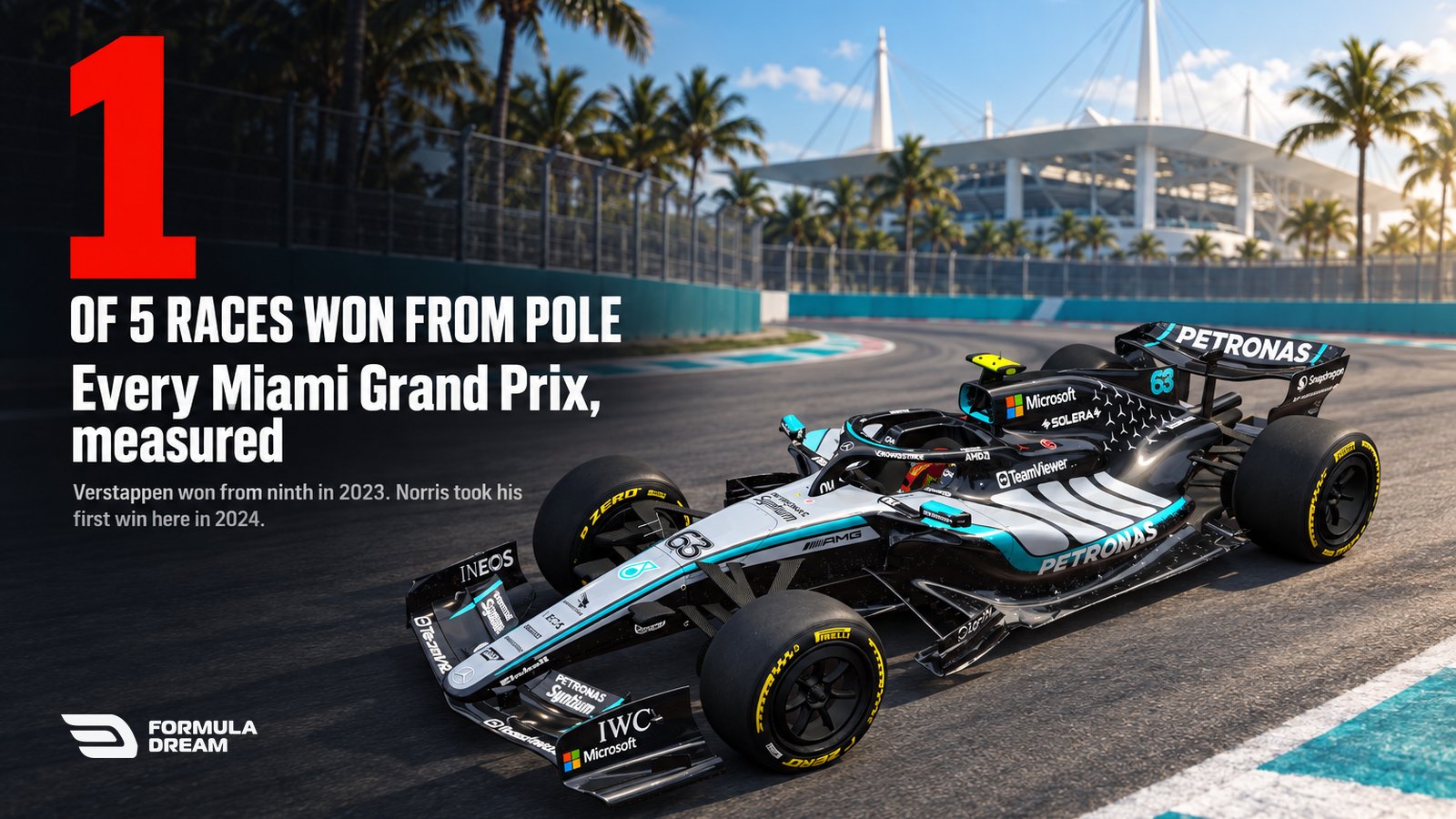
Every Miami Grand Prix winner, measured: five races, and pole has won only one of them
Five Miami Grands Prix have been held since 2022, and only one was won from pole: Kimi Antonelli's in 2026. Max Verstappen won from ninth in 2023, and Lando Norris took his first win there in 2024. Every winner, grid slot and safety car, measured.