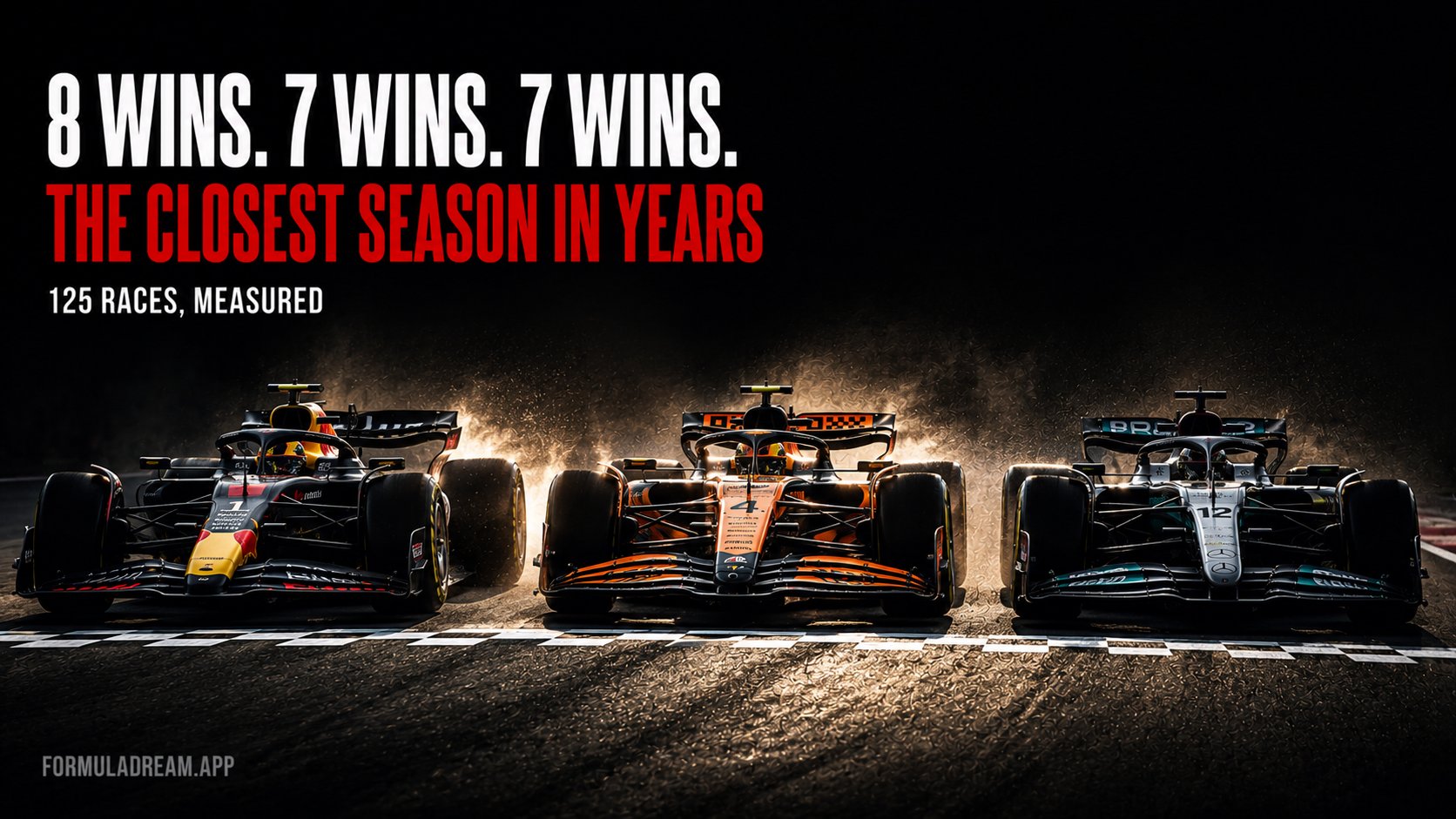
In 2024, seven different drivers won a Grand Prix. In 2025, only four did.
2025 was the more competitive season, and it is not close. Three drivers won 8, 7 and 7 races. The top driver took 33% of the wins, the lowest share in six years.
In 2023, by contrast, Max Verstappen won 19 of 22 races. Only three drivers won anything all year.
Race wins by driver for each season from 2021 to 2026
2024: Verstappen 9, Norris 4, Leclerc 3, Sainz 2, Russell 2, Hamilton 2, Piastri 2
2025: Verstappen 8, Norris 7, Piastri 7, Russell 2
2026 so far: Antonelli 6, Russell 2, Hamilton 1, Leclerc 1, Norris 1
2023 is the outlier of the modern era. Nineteen wins from twenty-two starts is 86% of the season, and the only other drivers to win were his team-mate and one Ferrari.
Why counting winners is a bad measure
The number everyone quotes is how many different drivers won. It is easy to say and it is close to useless.
Number of different race winners compared with the top driver's share of wins
2024 had seven different winners. 2025 had four. Yet 2025 was clearly the closer season.
The reason is that counting winners treats a one-off victory the same as a title challenge. In 2024, four of those seven drivers won twice or fewer. The season still had Verstappen on nine, comfortably clear.
In 2025 the top three won 8, 7 and 7. Three drivers, separated by a single race across a whole season. That is as close as a modern Formula 1 championship has been, and the winner-count metric marks it down for it.
The better measure is how concentrated the wins are. The top driver's share, by season:
2021: 45%
2022: 68%
2023: 86%
2024: 38%
2025: 33%
2026 so far: 55%
2025 is the most competitive season in this window at 33%. 2023 is the least at 86%.
The two measures disagree because they answer different questions. "How many drivers were capable of winning on their day" is what winner-counting measures. "How evenly was the season actually shared" is what concentration measures, and it is the one that matches how a title fight feels.
2021 is the case study
2021 had six different winners, which sounds open. Verstappen and Hamilton took 18 of the 22 between them, which does not.
That season is remembered as one of the great title fights, and correctly so, but the competition was between exactly two people. Four other drivers won one race each, and none of them was ever in the championship.
A season can be a brilliant contest and a narrow one at the same time. The winner count cannot tell those apart.
2026 has a new name at the top
The winningest driver's share of races in each season from 2021 to 2026
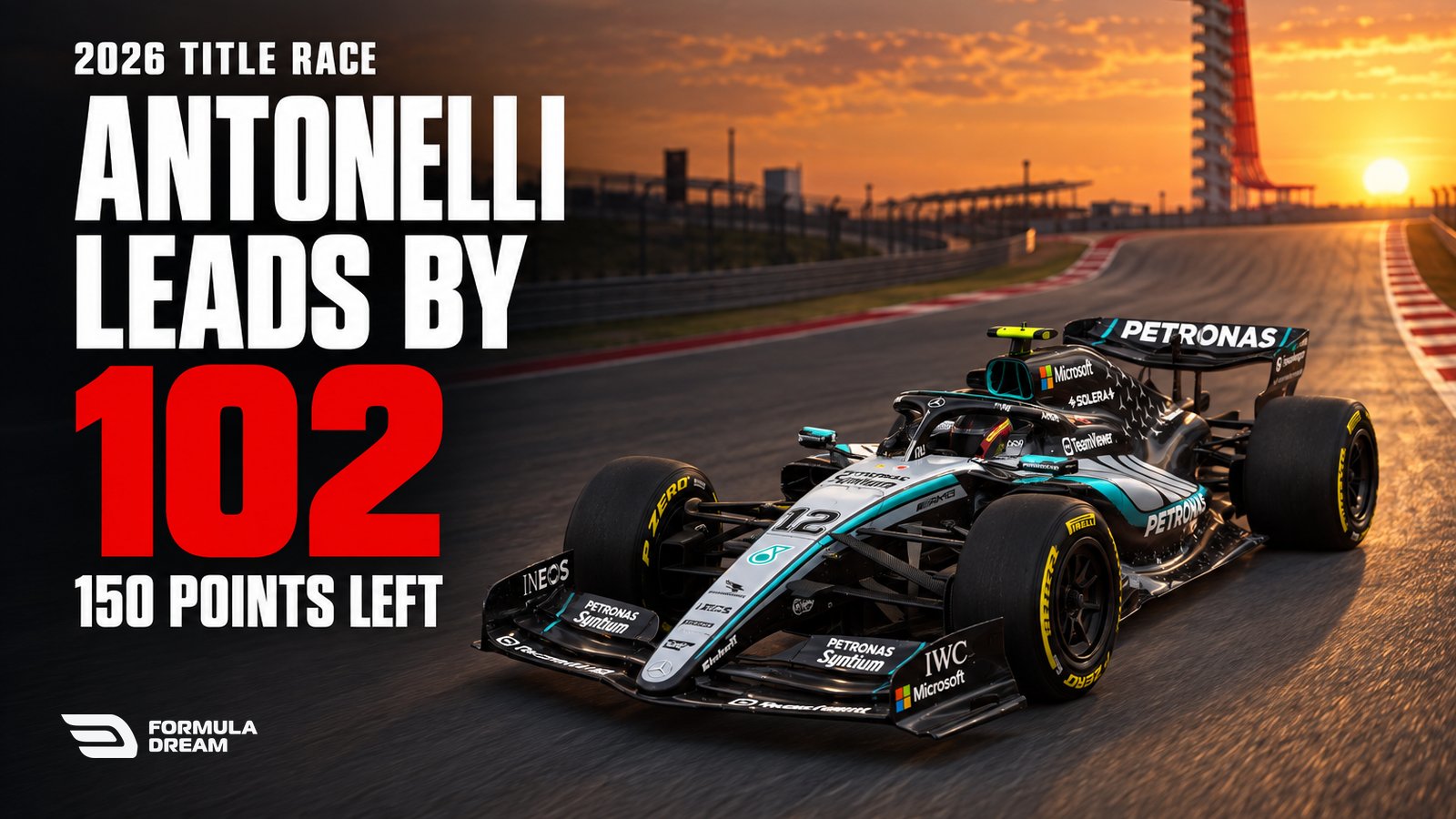
Eleven races into 2026 the leading winner is not Verstappen, Norris or Hamilton. It is Kimi Antonelli, with 6 wins from 11, a 55% share.
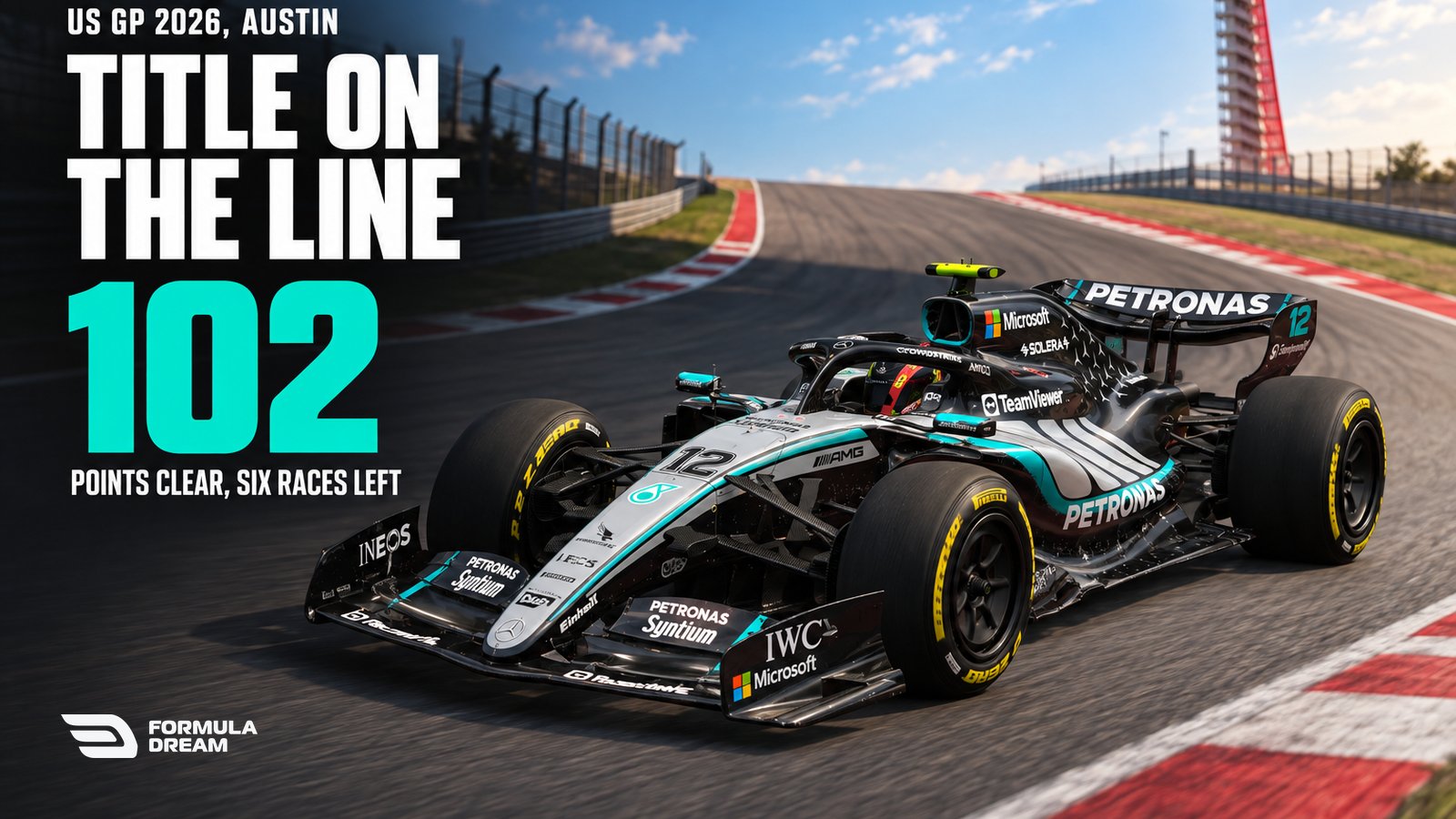
Antonelli leads the drivers' championship on 219 points, from Hamilton on 169 and Russell on 160, and became the youngest championship leader in the sport's history at 19 years and 216 days. Mercedes lead the constructors' championship.
That fits something else we measured. In 2025 Antonelli was out-qualified by his team-mate Russell 21-2. In 2026 he leads that head-to-head 7-4, the largest year-on-year swing of any driver pairing on the grid. The wins and the qualifying data tell the same story about the same driver.
A 55% share would make 2026 less competitive than the last two seasons, though with 12 rounds still to run that number has plenty of time to move.
What this changes about arguing over F1
Ignore "how many different winners" as a competitiveness stat. It rewards a fluke victory and punishes a genuine three-way fight.
Look at how the wins are split among the drivers who got them. 8-7-7 is a season. 19-2-1 is a procession.
A great title fight can be a two-car title fight. 2021 proves it, and so does the arithmetic.
Watch the top driver's share as the season runs. It is a single number that tracks how open a championship is, and it updates every race.
Method
Data: FastF1 race classifications, every Grand Prix from 2021 to 2026 that loaded, being 125 races.
Accounting check: exactly 125 winners across 125 races.
"Different winners" counts distinct drivers who won at least one race. "Top share" is the winningest driver's races won divided by the season's races.
2026 covers 11 of 23 rounds and every 2026 figure will move. It is included because the season is the live story, not because it is settled.
Sprint race wins are not counted. Only Grands Prix.
Championship points and the youngest-leader record are external, cited, and not from our measurement.
This measures wins only. A driver can have a dominant season on points without the win share reflecting it, and constructor-level dominance is a separate question we have looked at through race pace.
Competitiveness is a season-long argument built from single results.
The Formula Dream app carries the standings, results and full weekend timeline in Race Center, so the championship picture stays current without hunting for it. During a session it runs a live Dashboard with every car on the circuit map, a timing tower carrying lap times, gaps, intervals, tyre compound and age, live driver radio as it is broadcast, and every FIA document of the weekend as it is published.
Free, no subscription, no ads, independent. Not affiliated with Formula 1.
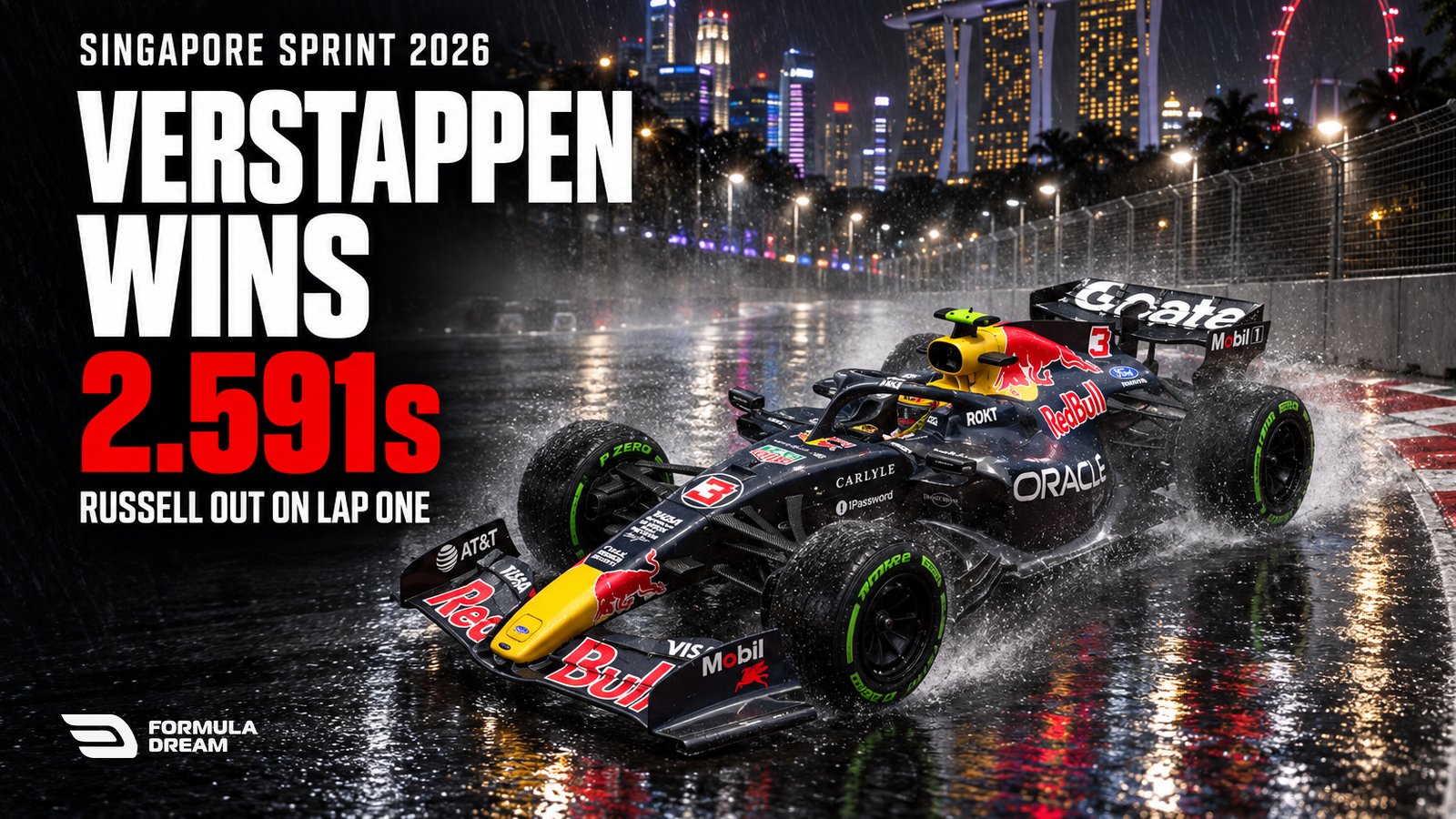
Singapore Sprint 2026 Results: Russell Crashes From the Lead
Russell took the lead at turn one and crashed at the final corner of the same lap. Verstappen won, Hamilton charged to second, and the McLarens hit each other.