Valtteri Bottas appears on Formula 1 team radio 1,481 times in our archive. In 1,030 of those, he does not say a single word.
Someone talks to him. He does not answer, or if he does, it never reaches the broadcast. Seventy percent of the time his radio channel is a one-way street.
We counted every word of it. 37,359 team radio messages, 788,190 words, 66 drivers, 20 teams, 159 race weekends, 2018 to 2026, counted on 31 August 2026. Every message is attributed to one driver's channel, and every line inside it is marked as either the driver speaking or their race engineer. Nobody has published what that split actually looks like, so we did.
The one-way streets
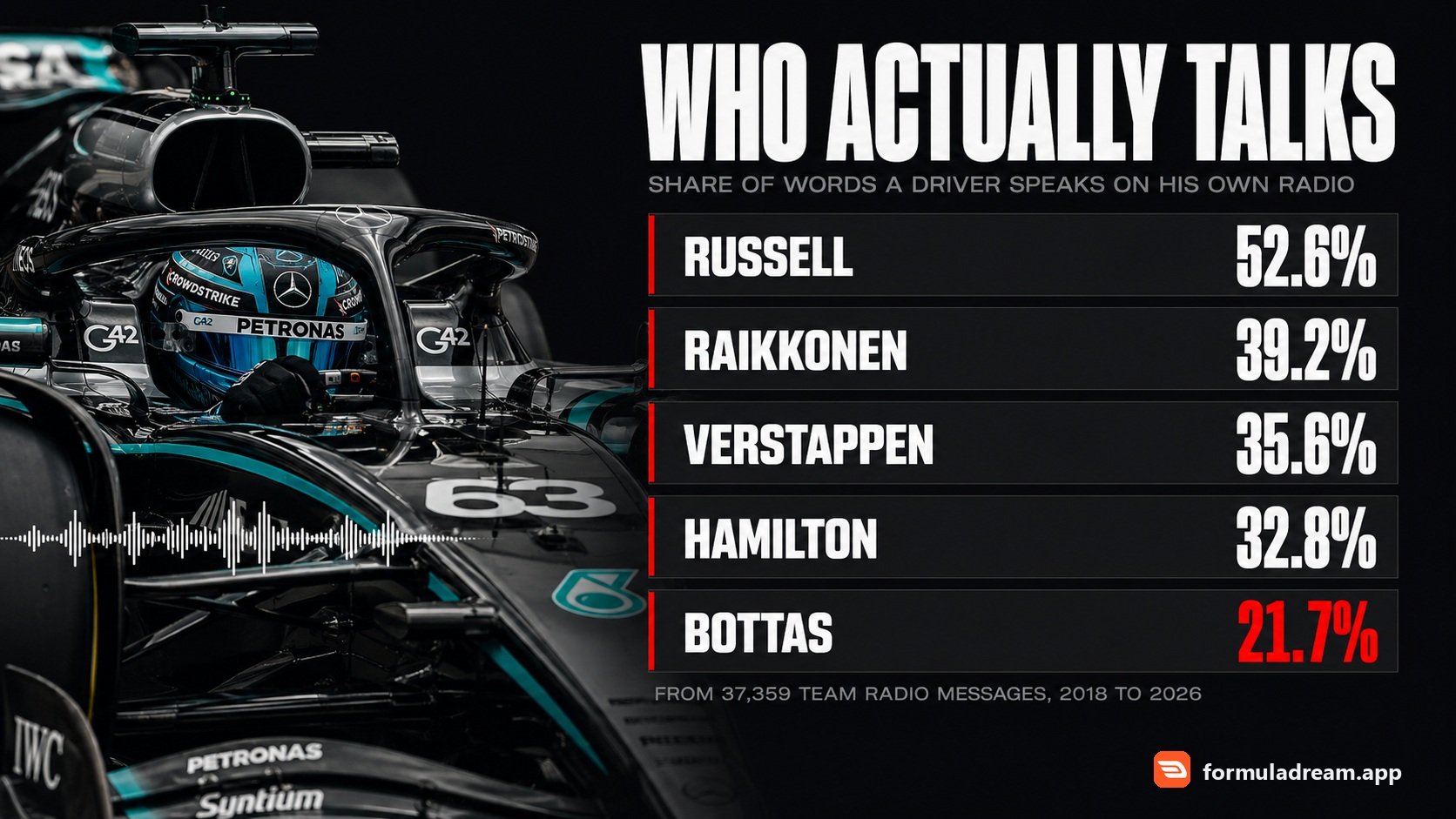
Here is the share of words on a driver's own radio channel that the driver actually speaks. Anyone with at least 150 messages in the archive.
A driver's share of the words on his own radio channel, from 37,359 messages
The quietest end:
Stoffel Vandoorne, 18.6%
Kevin Magnussen, 20.8%
Valtteri Bottas, 21.7%
Lance Stroll, 25.1%
Esteban Ocon, 25.2%
Mick Schumacher, 27.8%
The talkative end:
Zhou Guanyu, 62.4%
Daniil Kvyat, 58.9%
George Russell, 52.6%
Yuki Tsunoda, 52.2%
Charles Leclerc, 46.8%
Nicholas Latifi, 42.3%
Bottas is the extreme case and it is not close. When he does speak, the median message is nine words long.
There is a pattern in the quiet list worth noticing. Magnussen, Stroll, Ocon, Schumacher, Vandoorne. These are not drivers known for being uncommunicative. They are drivers who spent large parts of their careers in cars that were not fighting for anything, where the radio is largely the pit wall managing a long afternoon.
Kimi Raikkonen talks more than Max Verstappen
This is the number that surprised us most.
Raikkonen's entire public reputation rests on being monosyllabic. "Leave me alone, I know what I'm doing" is probably the most quoted team radio message in the sport's history, and it made him the patron saint of drivers who cannot be bothered to talk.
In the archive, Raikkonen speaks 39.2% of the words on his own channel. That puts him ahead of:
Each of those names goes to that driver's own channel in the archive, every message they have on record with the audio, so you can check any of these numbers yourself rather than taking ours.
When Raikkonen does speak, he averages 16.4 words. His longest message in the corpus runs to 105 words, a 2020 exchange where he is trying to explain a front-end failure to a pit wall that keeps asking him whether the car is safe: "No, I said something broke in the front left. There was some smoke from the left front."
That is not a man who will not talk. That is a man who talks when there is something to say, which turns out to be reasonably often.
He also swears more than anyone else on the grid. In a separate count of the same archive, 7.19% of Raikkonen's broadcast messages contain censored language, one in every 14, against a grid-wide 1.87%. The full leaderboard, and the finding that qualifying is sweariest rather than the race, is in which F1 driver swears the most.
What the radio is actually about
Across all 37,359 messages, the subjects that come up most:
Tyres, in 9.7% of messages
Pit stops and box calls, 9.0%
Brakes, 5.6%
Engine and power unit, 4.3%
Weather, 4.2%
Car balance, 4.0%
Traffic, 3.6%
Flags and safety cars, 1.9%
Penalties and track limits, 1.5%
Fuel, 1.2%
Tyres and pit stops together account for close to a fifth of everything said on the radio. If you have ever felt like F1 broadcasts are mostly people talking about tyres, the data agrees with you.
The one thing drivers bring up themselves
Now split those topics by who raises them, the driver or the engineer.
Almost every subject is the pit wall pushing information outward:
Pit and box calls: 2,760 engineer mentions against 834 from drivers
Penalties and track limits: 484 against 97
Fuel: 380 against 95
Flags and safety cars: 576 against 161
Traffic: 993 against 376
The engineer tells the driver about the race. That is the job.
Then there is car balance:
Balance, understeer and oversteer: 801 engineer mentions against 798 from drivers.
Dead level. It is the only subject in the whole corpus where drivers speak up as often as they are spoken to.
The reason is straightforward once you see it, and it is the most interesting thing in the dataset. The pit wall can see everything except one thing. It has lap times, sector splits, tyre temperatures, fuel loads, GPS positions and the timing screen. It cannot feel the car. On that single subject the driver is not a recipient of information, he is the only sensor there is, and the radio changes direction to reflect it.
Every other topic is data flowing to the cockpit. Balance is the one thing that only flows out of it.
The most common thing a driver says
Counting every three-word phrase spoken by drivers, the winner is not a complaint or an instruction.
"I don't know" appears 680 times. It is the single most common thing an F1 driver says on the radio, ahead of "a little bit" at 514 and "a lot of" at 488.
Some drivers say it far more than others. Per 100 messages:
Romain Grosjean, 3.8
Alexander Albon, 3.8
Nicholas Latifi, 3.6
Pierre Gasly, 3.6
Kimi Raikkonen, 3.6
There is something quietly honest about that. These are the best drivers in the world, travelling at 300 km/h, being asked what the car is doing, and the most frequent answer is that they are not sure yet.
For balance, "good job guys" appears 129 times.
Some pit walls talk twice as much as others
Engineer words per message, by team:
Haas, 17.1
Racing Point, 16.5
McLaren, 16.4
Aston Martin, 15.9
Renault, 15.5
Alpine, 15.1
AlphaTauri, 14.4
Red Bull, 13.6
Williams, 12.8
Alfa Romeo, 12.1
Toro Rosso, 11.6
Mercedes, 11.5
Ferrari, 9.6
Kick Sauber, 8.0
Haas engineers push more than twice as many words per message as Kick Sauber's. Mercedes and Ferrari, two of the most successful operations in the sport across this period, sit near the bottom.
We would not read too much into that as a measure of quality. A team running at the front with a settled driver pairing has less to explain, and how much of a team's radio reaches the broadcast is a decision made by Formula One Management, not by the team.
What this measures, and what it does not
Being straight about this matters more than the findings.
This is the broadcast feed, not the team channel. Formula One Management decides which radio clips air. Drivers and engineers talk far more than this. So when we say Bottas says nothing in 70% of his messages, the honest statement is that he says nothing in 70% of the messages that reached the public feed.
The transcripts come from speech recognition and they are imperfect. Radio audio is clipped, compressed and noisy. Word counts across tens of thousands of messages are robust because errors do not favour one driver. Individual quotes should be checked against the audio, which is why we publish the audio alongside every transcript.
Season coverage is uneven. 2018 through 2024 are well covered, 2025 and 2026 are thinner in this archive, and 2022 is missing entirely from our source data. Every figure above is a share or a rate rather than a raw total, so uneven coverage does not distort the comparisons.
Driver totals reflect careers, not seasons. Verstappen has 3,308 messages and Mick Schumacher has 190, because one has been racing throughout the period and the other had two seasons.
The archive is also browsable a season at a time, each one listing every Grand Prix it covers: 2018, 2019, 2020, 2021, 2023, 2024, 2025, 2026. 2022 is absent from the source data, which is why it is missing from the list and from every count in this article.
Every message counted here is public. The Team Radio Archive holds all of it, searchable by season, race, session and driver, with the original audio next to each colour-coded transcript. If you want to check a number in this article, the underlying message is in there.
If you want the live version, the FormulaDream app streams driver radio during the session with the transcript running next to it, alongside the timing tower and every FIA document as the stewards publish it. Free, no subscription, no ads. Independent, and not affiliated with Formula 1 or the FIA.
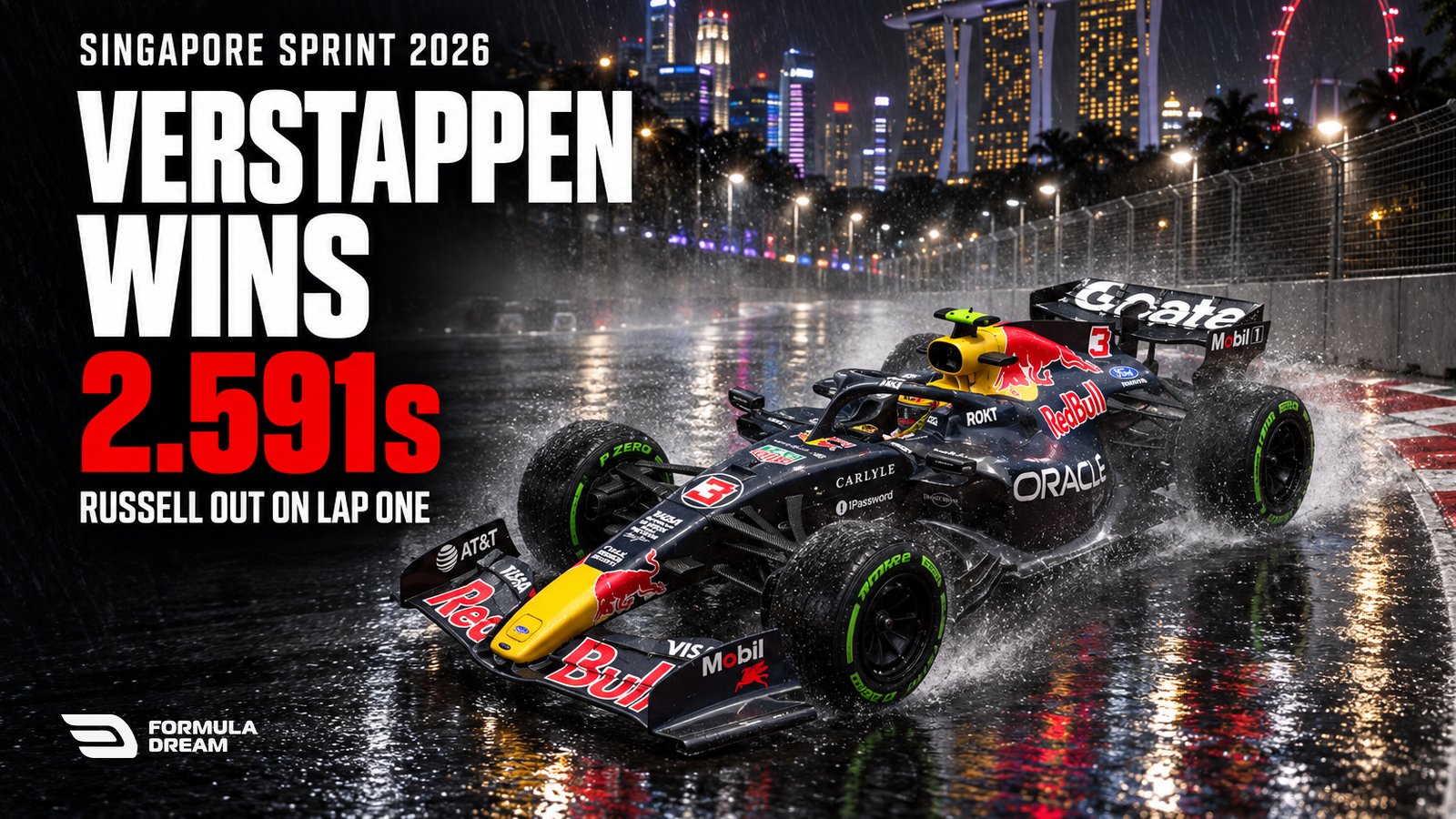
Singapore Sprint 2026 Results: Russell Crashes From the Lead
Russell took the lead at turn one and crashed at the final corner of the same lap. Verstappen won, Hamilton charged to second, and the McLarens hit each other.