F1 Halo: What It Is, and the Lives It Saved | Formula Dream
Guides
What Is the Halo in F1? The Hated Device That Keeps Saving Lives
The F1 halo explained, the decade of deaths that forced it in, the alternatives that were rejected, how a 7kg titanium hoop withstands 12 tonnes, and every time it has saved a driver.
When the halo appeared on every Formula 1 car in 2018, it was one of the most unpopular changes in the sport's history. Fans said the titanium hoop over the cockpit was ugly. Drivers and team bosses argued it betrayed the open-cockpit spirit of the sport. Some of the very people it was designed to protect were against it. Within two years, almost none of them were still arguing, because by then it had started saving lives. Here is the full story of the halo: the deaths that forced it in, the ideas that lost out to it, and every driver it has since pulled from the edge.
structure that arcs over the top of the cockpit, bolted to the car's survival cell at three points. It sits in a wishbone shape above and around the driver's head, with a single strut rising up in front of them. Its one and only job is to stop large objects, a wheel, a piece of debris, a barrier, or another car, from striking the exposed head of the driver. To keep every car equal, it must be built to a single FIA standard,
8869-2018
, and supplied by an FIA-designated manufacturer. The original concept was designed by
Mercedes
.
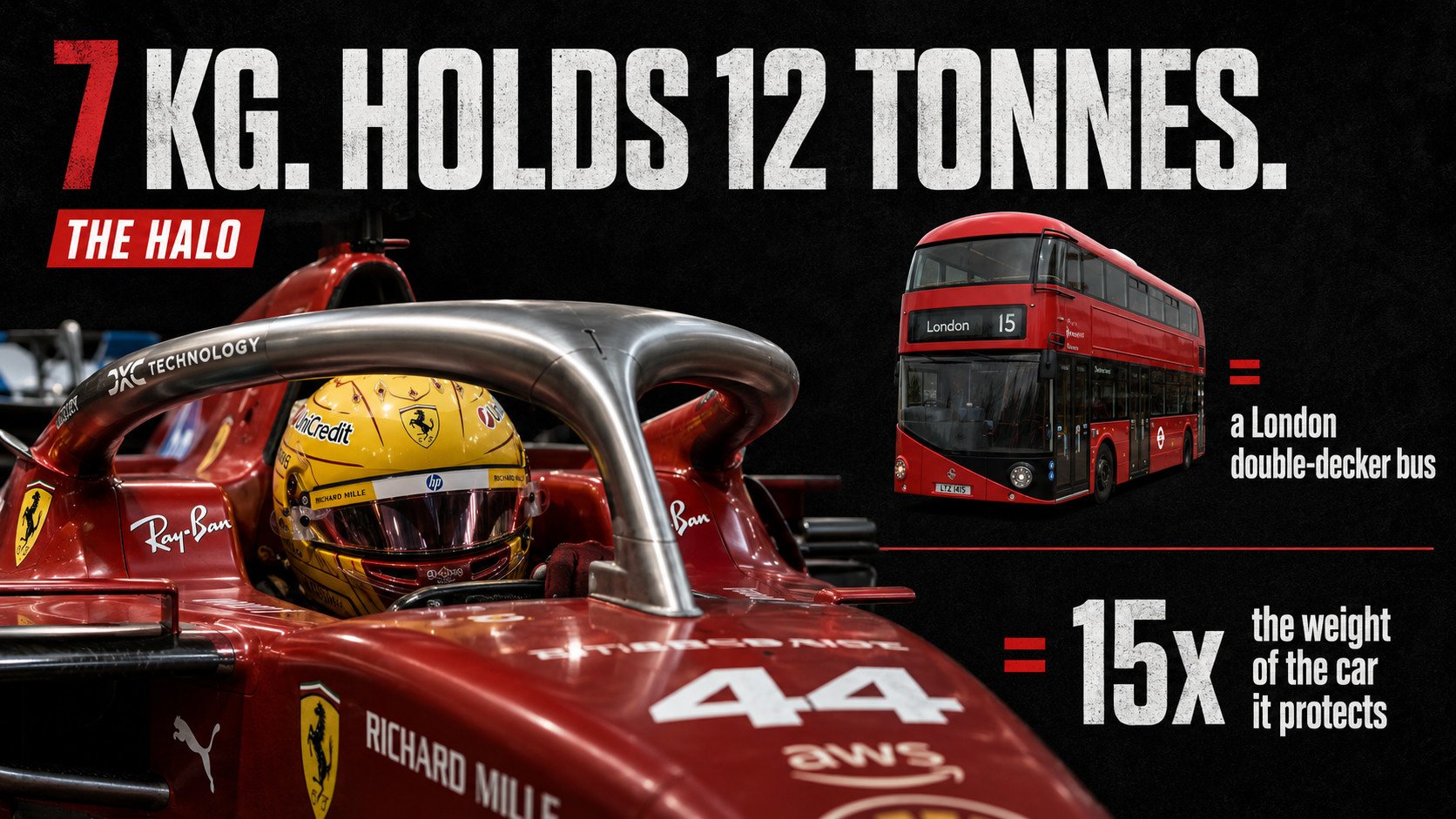
The halo: a titanium hoop bolted over the cockpit, the last line of defence for the one part of the driver still exposed, their head.
The deaths that forced the issue
The halo did not come out of nowhere. It was the answer to a decade of tragedies that made open-cockpit racing's oldest danger impossible to ignore. In 2009, the British driver Henry Surtees, son of the F1 champion John Surtees, was killed in a Formula 2 race when a wheel that had come off another car struck him on the head. Weeks later, at the 2009 Hungarian Grand Prix, Felipe Massa was hit on the helmet by a suspension spring that had fallen from the car ahead, fracturing his skull, he survived, but only just. In 2015, the popular British driver Justin Wilson was killed in an IndyCar race by a piece of debris from another car.
And overshadowing all of it was the death of Jules Bianchi, who suffered severe head injuries in a crash at the 2014 Japanese Grand Prix and died in July 2015, F1's first fatality in over twenty years. The pattern was undeniable: the head was the one part of the driver still dangerously exposed, and the sport had run out of excuses. The FIA accelerated its cockpit-protection research, and the drivers' association pushed hard for it.
The alternatives that lost
The halo was not the only idea. Three concepts were developed. Red Bull built the Aeroscreen, a wraparound windscreen. The FIA developed the Shield, a curved screen in front of the cockpit. And there was the halo. The drivers actually preferred the screens, which looked far less intrusive, but the screens had problems: when Sebastian Vettel tried the Shield in practice, the distortion left him dizzy after a single lap. The halo won out for one reason: it was the strongest and most proven at doing the job. It was not the prettiest solution. It was the one that worked. (IndyCar later combined the ideas into its own aeroscreen.)
How strong is it?
Specification
Figure
Weight
Several kilograms
FIA load requirement
125 kN, about 12.7 tonnes
Material
Aerospace-grade titanium
Introduced
2018
Mounting
Bolted to the survival cell at three points
Standard
FIA 8869-2018, from an FIA-designated manufacturer
The F1 halo, key specifications.
Absurdly strong for its size. The halo is made from several kilograms of titanium, so it barely affects the car's weight, yet the FIA requires it to withstand 125 kilonewtons, a load equivalent to about 12.7 tonnes, or more than 16 times the minimum weight of a 2026 car. Mercedes' James Allison described what that meant for the teams: "We had to strengthen the design of the chassis so it would be able to take roughly the weight of a London double decker bus sitting on top of the halo."
Every time it has saved a driver
The halo stopped being controversial the moment it started working, and the first save came almost immediately, in its very first season:
Charles Leclerc, Belgium 2018. At the start at Spa, Fernando Alonso's McLaren was launched over the cockpit of Leclerc's Sauber. The FIA's investigation found Alonso's front wing endplate was on course for Leclerc's visor, and put the peak force on the halo at 58kN, 46% of what it is built to take. The halo was left structurally intact. It was its first headline save, months after drivers had complained about it.
Romain Grosjean, Bahrain 2020. Grosjean's car speared through a barrier at high speed, split in two and burst into flames. The halo held the barrier apart above his head as the car punched through, and he climbed out of the fire alive.
Lewis Hamilton, Monza 2021. In a collision with Max Verstappen, Verstappen's car was launched up and over Hamilton's, and a rear tyre came down directly onto the cockpit, inches above Hamilton's helmet. The halo took the full impact.
Zhou Guanyu, Silverstone 2022. Zhou's car was flipped upside down at the start, slid across a gravel trap on its roll hoop and wedged between the tyre barrier and the catch fencing. The halo kept the cockpit intact in a place a bare cockpit could not have survived. Carlos Sainz, who won that race, said the halo had "probably saved two lives" that weekend, counting a Formula 2 crash involving Roy Nissany.
Those are only the most famous cases in Formula 1.
Why it took a fight, and what it teaches
It is worth remembering how hard the halo was to introduce, because it is a lesson the sport keeps relearning. Drivers thought it was ugly. It raised the car's centre of gravity, which engineers hated. It broke with decades of tradition. Romain Grosjean was among those who spoke against it, and then it saved his life. That is the pattern of almost every safety advance in motor racing: unpopular, resisted, sometimes ridiculed, and only truly accepted once the evidence becomes impossible to argue with.
The halo is now used far beyond F1, in Formula 2, Formula 3, Formula E and more, and it works alongside the sport's other protections, the HANS device, the survival cell and the systems that let a driver survive huge g-forces, as one layer of a system that has made death in an F1 car mercifully rare.
Follow the sport it protects
The halo does its work in incidents, and the investigation into each one is published.
The Formula Dream app collects every FIA document of the weekend as it is released, which is where the decision behind a penalty actually appears, usually before the commentary catches up. It also runs a live Dashboard through every session with all the cars on the circuit map, a timing tower carrying lap times, gaps, intervals, tyre compound and age, flag and safety car alerts the moment race control calls them, and live driver radio as it is broadcast.
Free, no subscription, no ads, independent. Not affiliated with Formula 1.
A titanium safety structure that arcs over the cockpit of every F1 car, introduced in 2018, designed to stop wheels, debris and other cars from striking the driver's exposed head.
Why was the halo introduced?
After a series of deaths and serious injuries from open-cockpit head strikes, including Henry Surtees (2009), Justin Wilson (2015) and the head injuries that killed Jules Bianchi, the FIA accelerated cockpit protection and made the halo mandatory in 2018.
How strong is the F1 halo?
It is made from several kilograms of titanium, but the FIA requires it to withstand 125kN, a load of about 12.7 tonnes. Mercedes' James Allison likened it to the weight of a London double-decker bus sitting on top of the halo.
Has the halo saved lives?
Yes. The best-known cases include Charles Leclerc at Spa in 2018, where the FIA found Fernando Alonso's car was on course for his visor, Romain Grosjean in his 2020 Bahrain fireball, Lewis Hamilton at Monza in 2021 and Zhou Guanyu at Silverstone in 2022.
Why was the halo controversial?
Drivers and fans thought it was ugly and against the open-cockpit tradition, and it raised the car's centre of gravity. The criticism faded once it began saving drivers' lives, sometimes the very drivers who had opposed it.
Who invented the halo in F1?
The original concept was designed by Mercedes. The FIA chose it over Red Bull's Aeroscreen and its own Shield, and confirmed in July 2017 that it would be mandatory from 2018.
When was the halo introduced in F1?
In 2018, on every car. The FIA confirmed the decision in July 2017.
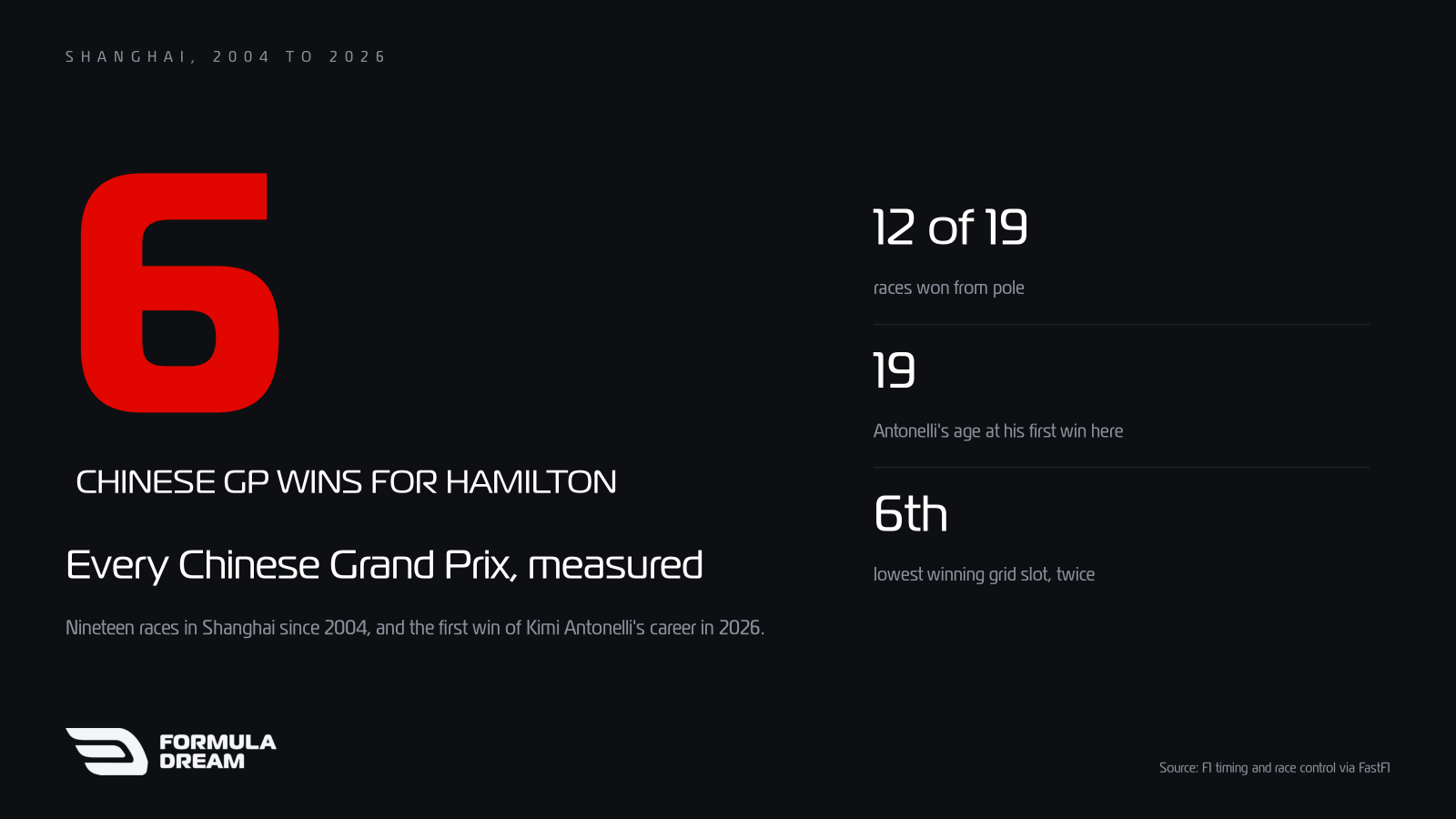
Nineteen Chinese Grands Prix have been held in Shanghai since 2004. Lewis Hamilton won six, pole won twelve, and in 2026 Kimi Antonelli took the first win of his career there, at 19, with Hamilton on the podium for Ferrari for the first time. Every winner, grid slot and safety car, measured.