What Is the HANS Device in F1? How It Works | Formula Dream
Guides
What Is the HANS Device in F1? The Simple Collar That Ended a Killer
The HANS device explained in full, the biomechanics of how a simple carbon collar stops a fatal head injury, the 20-year fight to get drivers to wear it, and how it turned basilar skull fracture from a killer into a rarity.
For decades, one of the deadliest things in motor racing was not fire, and not the barriers. It was a crash you could otherwise walk away from. A driver would hit a wall head-on, the car would absorb the impact, the survival cell would stay intact, and yet the driver would die anyway, killed by the movement of their own head. The injury had a name that appeared again and again in accident reports: basilar skull fracture. The device that finally stopped it is one of the least glamorous and most important inventions in the history of the sport, a simple collar called the HANS device. This is what it is, exactly how it works, and the long, stubborn fight it took to get drivers to wear it.
To understand the HANS device, you have to understand the specific way an unrestrained head kills a driver in a frontal crash.
When a car hits something head-on and stops violently, the driver's body is held firmly in the seat by the harness. The head is not. It weighs around 5 kilograms on its own, closer to 6.5 with a helmet, and in a big impact it keeps travelling forward at the speed the car was doing a fraction of a second earlier. The only things holding it back are the soft tissues and bones of the neck. In a severe enough impact, they cannot cope. The head snaps forward and the tremendous load concentrates at the point where the spine meets the skull, fracturing the base of the skull. This is the basilar skull fracture, and it is very often instantly fatal, even when the rest of the driver is unharmed.
This is what makes it so cruel. It is not a violent, obviously unsurvivable accident. It is the crash that looks survivable and is not.
What the HANS device actually is
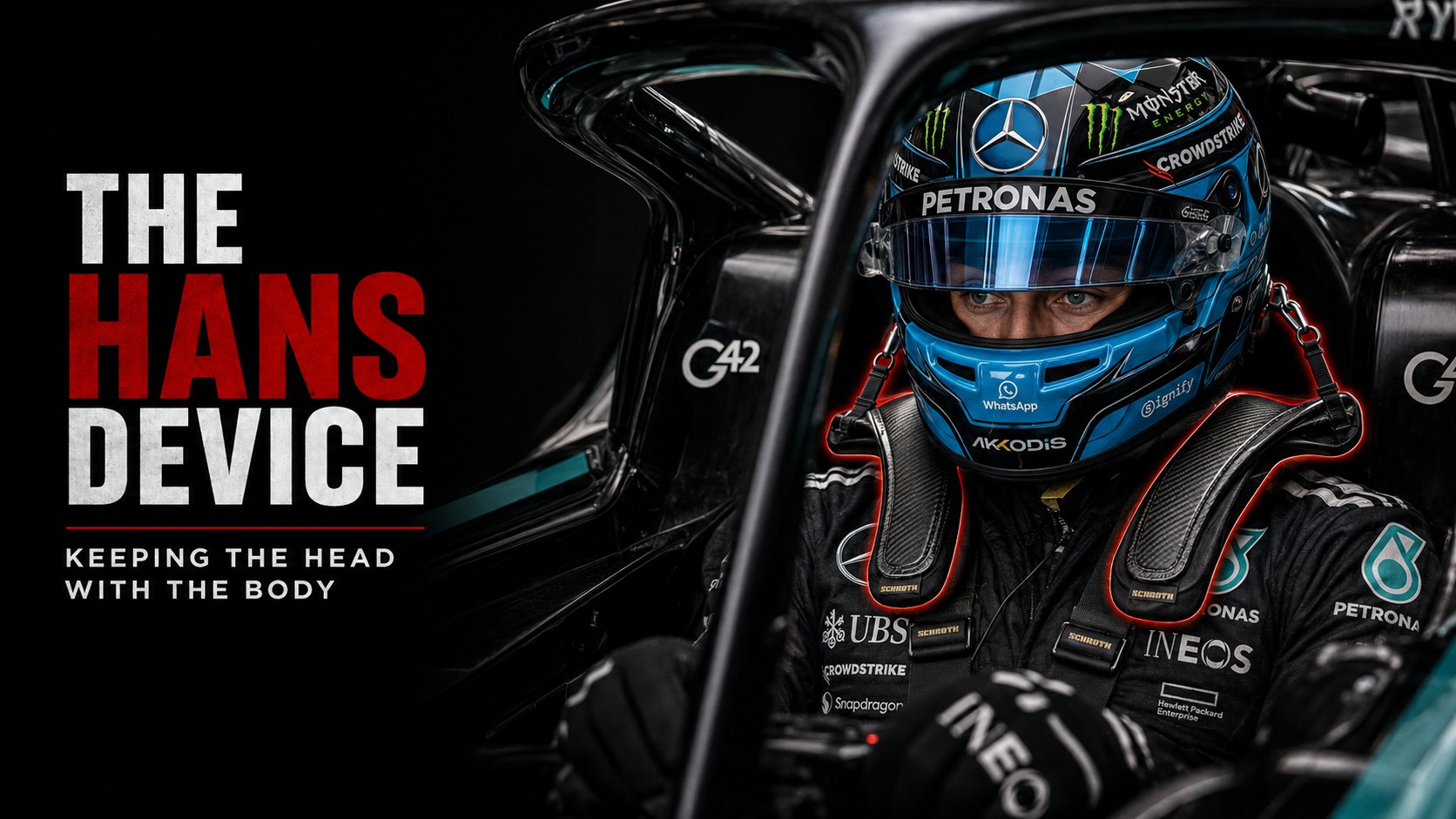
For a problem that killed so many people, the solution is almost absurdly simple to look at. HANS stands for Head And Neck Support. It is a U-shaped collar made of carbon fibre, light enough to hold in one hand, that a driver wears over their shoulders. It has two key connections:
It sits underneath the harness belts, so the car's seat belts trap it firmly against the driver's shoulders and torso.
It is tethered to the helmet by two short, strong straps that clip to anchor points on either side of the helmet.
That is essentially the whole device. There is no electronics, no mechanism, nothing to fail. Its genius is entirely in the biomechanics.
How it works
The whole point of the HANS device is to connect the head to the body, so that when the belted body stops, the head is forced to stop with it instead of continuing forward alone.
Here is the sequence in a frontal impact. The car decelerates and the harness locks the torso in place. Because the collar is pinned under those same belts, it cannot move forward either. And because the helmet is tethered to the collar, the head is now anchored to the strong, restrained upper body. As the head tries to pendulum forward, the tethers go tight and hold it back. The enormous forces that would otherwise have been channelled straight through the neck and into the base of the skull are instead absorbed by the collar and redistributed into the shoulders and chest, which are far better built to take them.
Without HANS, the head pendulums forward and the base of the skull takes the full load. With it, the collar and tethers hold the head with the body and transfer the force into the shoulders and chest.
The clever detail is where the tethers attach. The helmet anchor points sit close to the centre of gravity of the head, so the restraint spreads the load evenly rather than yanking on one point, and it transfers the peak loading away from the top of the spine and toward the forehead, which can withstand far more force. The result, measured in crash testing, is dramatic. Earlier tests had put the threshold for a basilar skull fracture at around 740 pounds of vertical neck tension and 700 pounds of forward neck shear; with the HANS device fitted, testing brought both down to about 210 pounds. It does not restrict the driver during normal running, the tethers are flexible enough for a driver to look through a corner, but the instant a real impact happens, they do their job.
The twenty-year fight to get it worn
You would think a device that prevents a common fatal injury would have been adopted overnight. It took roughly two decades.
The HANS device was invented in the early 1980s by Dr Robert Hubbard, a professor of biomechanical engineering at Michigan State University, together with his brother-in-law Jim Downing, a championship sports car racer. Hubbard understood the physics of the injury; Downing understood racing. In 1990 the two formed a company, Hubbard Downing Inc., to make and sell it. And then, for years, almost nobody wanted it.
The resistance came from drivers and equipment makers alike, and their objection was always the same: it was uncomfortable and restrictive. Drivers complained that the collar got in the way, made it harder to turn their heads to look around the cockpit, and put pressure on the shoulders over a long race. Many genuinely feared it would cause more injuries than it prevented, trapping them in a burning car or breaking a collarbone. The most famous sceptic of all was NASCAR legend Dale Earnhardt, who reportedly dismissed it as "that damn noose".
The deaths that forced the issue
What changed everything was a run of tragedies that the sport could no longer explain away.
For Formula 1, the turning point was the darkest weekend in its modern history: Imola, 1994. On the Saturday, Roland Ratzenberger was killed in qualifying, his death attributed to a basilar skull fracture. The next day, Ayrton Senna died in the race. The twin loss of a rookie and a three-time world champion on the same weekend triggered a complete safety revolution in F1, driven hard by the FIA's medical delegate Professor Sid Watkins, and the FIA turned to Mercedes-Benz to help develop better head protection. Mercedes tested the HANS device for the FIA from 1996 to 1998 and concluded that it out-performed its own airbag project, and a version was developed to fit inside the tight confines of an F1 cockpit.
In stock car racing, the reckoning came in 2001. Dale Earnhardt, the man who had mocked the "noose", was killed at the Daytona 500 by a basilar skull fracture. He was the fourth NASCAR driver killed by that exact injury in nine months, after Adam Petty in May 2000, Kenny Irwin Jr. in July and Tony Roper in October. The evidence was now impossible to ignore.
The result was a wave of mandates across the sport. Formula 1 made the HANS device compulsory in 2003, and other major series followed. Later refinements, including quick-release tethers that let a driver be extracted fast in an emergency, answered the last of the safety fears. Once it was finally universal, the injury it was designed to stop, once a recurring headline, became vanishingly rare.
What the rules require today
The HANS device is no longer optional anywhere near Formula 1. Under Article B1.8.2 of the 2026 Sporting Regulations, every driver in every session must wear a Frontal Head Restraint, the rulebook's generic name for the HANS-type collar, alongside flame-resistant clothing and a helmet.
The details sit in Chapter III of Appendix L to the International Sporting Code. It requires the restraint to be worn only with FIA-approved parts: tethers and helmet anchorages approved to the FIA 8858 standard, and a helmet approved to one of the FIA's top helmet standards, 8859 or 8860. So the collar, the straps and the helmet are tested and approved as a system, not bought separately.
One layer of a bigger system
The HANS device does not work alone. It is one part of the layered safety system that makes modern F1 survivable, and each layer solves a different problem. The carbon-fibre survival cell keeps the structure of the car intact around the driver. The harness and seat hold the body. The halo shields the head from anything coming at it from outside, a wheel, debris, another car. The whole package is engineered to let a human survive the huge g-forces of a crash. And the HANS device handles the one threat the others cannot: the driver's own head, thrown forward by the very deceleration the car survived.
It is the perfect illustration of how motorsport safety actually advances. Not usually through one dramatic breakthrough, but through unglamorous engineering that is often resisted, sometimes ridiculed, and only accepted after it has quietly proven, again and again, that it works.
Follow the sport it made survivable
The HANS device belongs to a category of safety work that only surfaces in FIA reports.
The Formula Dream app collects every FIA document of the weekend as it is released, which is where the decision behind a penalty actually appears, usually before the commentary catches up. It also runs a live Dashboard through every session with all the cars on the circuit map, a timing tower carrying lap times, gaps, intervals, tyre compound and age, flag and safety car alerts the moment race control calls them, and live driver radio as it is broadcast.
Free, no subscription, no ads, independent. Not affiliated with Formula 1.
A U-shaped carbon-fibre collar worn over the shoulders, held down by the harness belts and tethered to the helmet. It stops the driver's head from flying forward in a crash, which prevents a basilar skull fracture.
What is a basilar skull fracture?
A fracture at the base of the skull, caused when the head is thrown violently forward while the belted body stops, concentrating the force where the spine meets the skull. It is often instantly fatal, and it was one of the biggest killers in motorsport before head-and-neck restraints.
How does the HANS device work?
The collar is trapped under the seat belts so it cannot move, and the helmet is tethered to it. In an impact the head is held back with the body instead of pendulling forward, transferring the load from the neck and base of the skull into the much stronger shoulders and torso.
When did the HANS device become mandatory in F1?
In 2003, after Mercedes had tested it for the FIA from 1996 to 1998. Formula 1 had pursued better head protection since the deaths of Roland Ratzenberger and Ayrton Senna at Imola in 1994, and the wider mandate across motorsport was accelerated by the death of Dale Earnhardt in 2001. Today Article B1.8.2 of the Sporting Regulations requires every driver to wear one.
Why did drivers resist the HANS device?
They found it uncomfortable and restrictive, disliked how it limited head movement, and feared it might cause injuries or hamper escape from the car. Dale Earnhardt, who was later killed by the injury it prevents, reportedly called it "that damn noose".
Is the HANS device the same as a frontal head restraint?
Yes, in effect. Frontal Head Restraint is the FIA's name for the category, and the HANS device is the original and best known design. The rules require it to be used with tethers approved to FIA standard 8858 and a helmet approved to FIA 8859 or 8860.
---
Sources
Invention, the 1990 company, Mercedes' 1996 to 1998 testing, the 2003 Formula 1 mandate and the neck load figures: HANS device
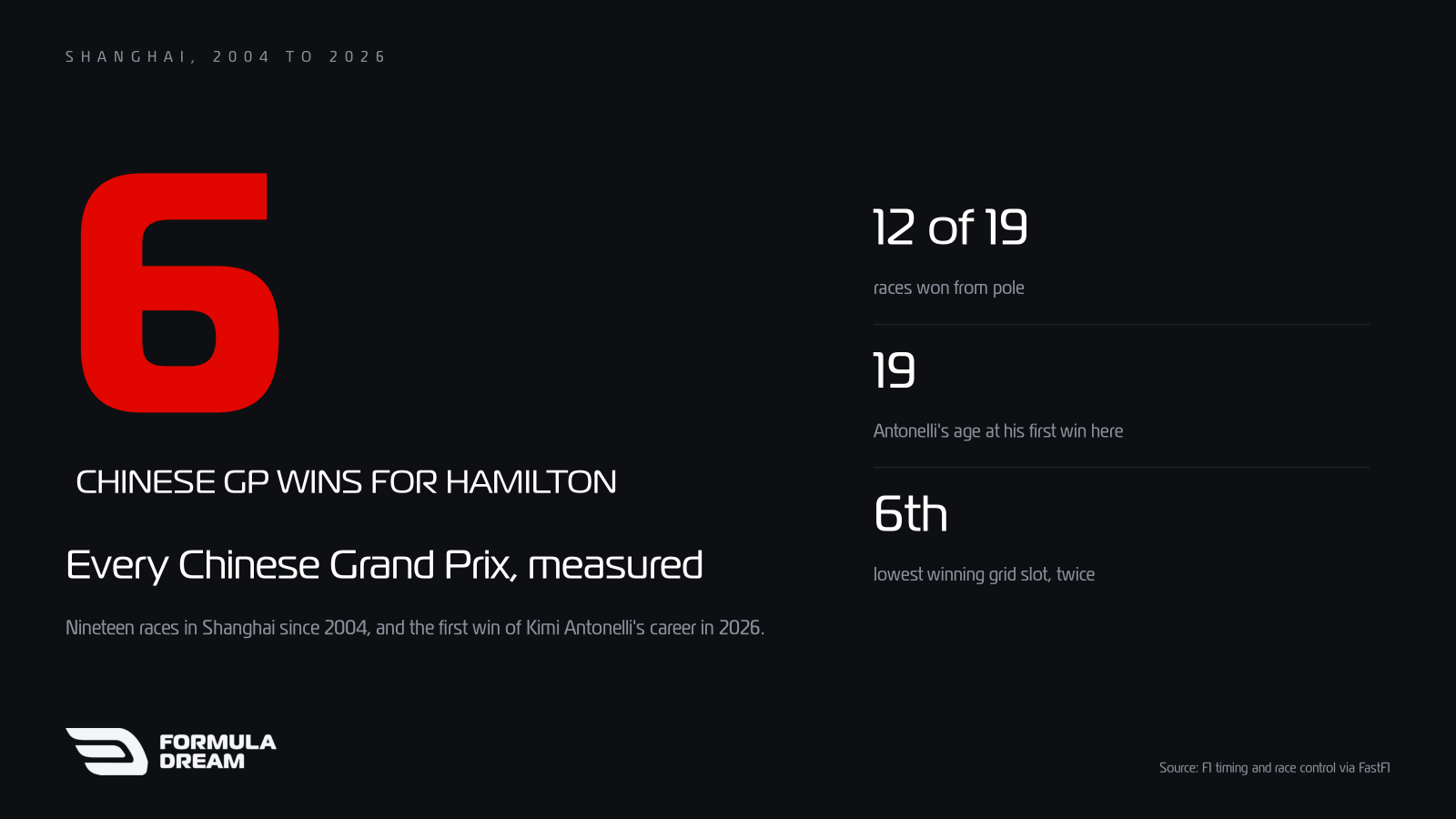
Nineteen Chinese Grands Prix have been held in Shanghai since 2004. Lewis Hamilton won six, pole won twelve, and in 2026 Kimi Antonelli took the first win of his career there, at 19, with Hamilton on the podium for Ferrari for the first time. Every winner, grid slot and safety car, measured.