How Many G's Do F1 Drivers Experience? G-Force Explained
How many g's F1 drivers take under braking and cornering, why 2026 cars brake far less hard, why the neck is the hardest part, and the biggest crash loads ever recorded in the sport.
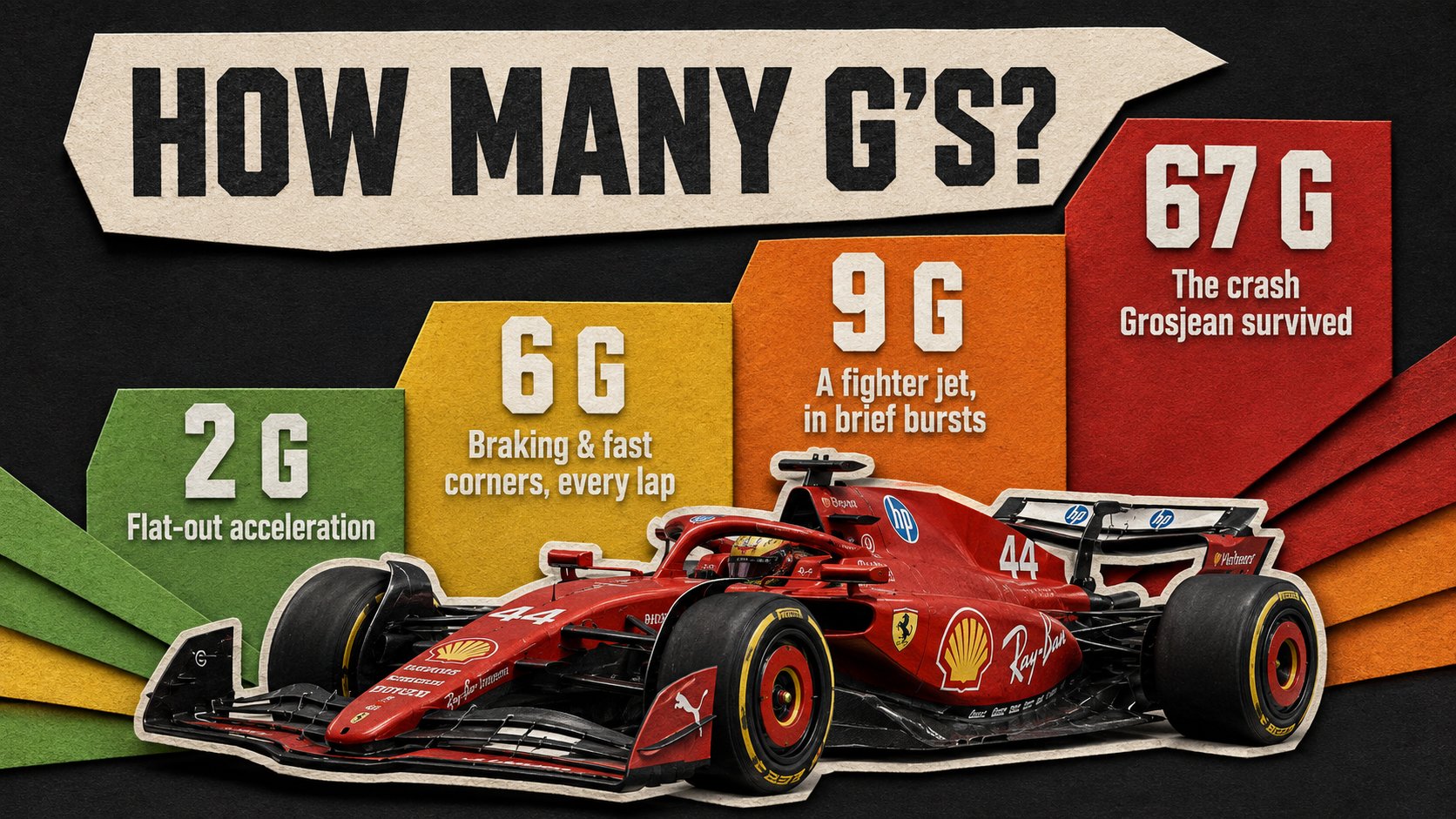
An F1 driver takes up to about 5g under the heaviest braking and 5 to 6g of sideways force through the fastest corners. The biggest impact ever recorded in the sport is the 254g estimated for Jules Bianchi's head at Suzuka in 2014, and the biggest anyone has survived is the 179.8g calculated for David Purley's crash at Silverstone in 1977.
Those numbers alone undersell it. What makes Formula 1 brutal is not the peak, it is the repetition: a driver takes those loads dozens of times a lap, for the best part of two hours, with no g-suit and nothing holding their head up but their own neck.
Here is what the body actually goes through, corner by corner.
What is a g?
One g is the force of normal gravity, the weight you feel just standing still. Pull two g and everything feels twice as heavy; pull six g and it feels six times as heavy. In a car, you feel g whenever you change speed or direction: accelerating presses you back into the seat, braking throws you forward against the belts, and cornering flings you sideways. The harder and faster the change, the more g, and an F1 car changes speed and direction harder than almost anything else on the planet.
How many g's do F1 drivers experience?
A lot, and, crucially, over and over again:
Heavy braking: up to about 5g. Brembo, which supplies the brakes, put turn 1 at Baku at 5g in 2025, with cars slowing from 329 km/h to 119 km/h in 2.12 seconds and the driver pressing the pedal with 176 kg.
The fastest corners:5 to 6g of lateral force, trying to fling the driver's head sideways out of the cockpit.
Acceleration: much less than either. Out of a slow corner the rear tyres run out of grip long before the engine runs out of power, so the push back into the seat is the gentlest load of the three.
The single number is only half the story. What makes F1 so brutal is the relentless repetition. A driver takes those loads at every braking zone and every fast corner, dozens of times a lap, for a full race distance. It is not one big hit. It is thousands of them, back to back, while making split-second decisions at 300 km/h.
2026 cars brake far less hard
The loads are not fixed. They follow the cars, and the 2026 cars carry less downforce and harvest far more energy through the motor under braking.
Brembo's figures for the same corner a year apart show how big the change is. At turn 3 at Silverstone, the hardest stop of the lap in 2025:
Turn 3, Silverstone
2025
2026
Speed lost
165 km/h
131 km/h
Peak deceleration
4.5g
2.9g
Brake pedal load
152 kg
78 kg
Braking power
2,260 kW
869 kW
Brembo's braking figures for turn 3 at Silverstone, 2025 against 2026
The pedal load has almost halved. In 2026 turn 3 is no longer even the hardest stop at Silverstone: Brembo now names turn 16, at 3.1g.
Which corners pull the most g?
Lateral load comes from cornering speed, so the highest figures are not at the tightest corners but at the fastest ones, the places where a car is turning hard while barely slowing down: Copse at Silverstone, 130R at Suzuka, Pouhon at Spa.
Published figures for corners like these run from about 5g to 6g, and they depend heavily on the year's car. On the 2017 car, Mercedes put the peak through turn 11 in Melbourne at 5g, and data from that year's British Grand Prix had drivers at nearly 5g through Copse.
We tried to measure this ourselves from the public timing data and could not get a figure we would stand behind. That data records a car's speed and position roughly four times a second, which is too coarse to catch a peak that lasts a fraction of one. Our braking estimate for 2025 landed within 0.1g of Brembo's at Silverstone but half a g short at Baku, so we are quoting the people with sensors on the car instead.
Slow corners barely register by comparison. Monaco's hairpin, the slowest corner in the sport at around 46 km/h, produces almost nothing laterally. This is why a driver's physical week is built around the high-speed circuits, and why Suzuka, Silverstone and Spa are the ones they talk about in terms of survival rather than lap time.
Why the neck is the hardest part
The part of the body that suffers most is the neck, because the head has to stay free to see. A driver's head plus helmet weighs roughly 6.5 kilograms. In a six-g corner, that suddenly pulls on the neck like around 40 kilograms trying to wrench sideways, and it happens on every fast corner of every lap. No seat belt can help, because the head cannot be strapped down.
That is why F1 drivers train their necks harder than almost any other muscle group, an unglamorous, punishing routine of weighted helmets, resistance rigs and pulley systems. The reigning champion Lando Norris has spoken about working his neck at least five times a week. It is the difference between a clear, precise head at the final corner and a fading, heavy one, and it is one of the least visible but most important parts of an F1 driver's fitness. There is more on the full regime in our guide to how F1 drivers train.
How much g-force can a driver actually take?
It depends almost entirely on direction and duration, which is why single "limit" figures are misleading.
Sustained vertical g, the kind that drains blood from the head, is what causes greyout and blackout, and untrained people start losing vision somewhere around 4 to 5g. Lateral g, which is what an F1 driver mostly deals with, is tolerated far better because the blood is not being pulled away from the brain in the same way. And very brief spikes, measured in fractions of a second, can be survived at levels that would be fatal if held for any length of time. That is the whole reason a 67g impact is survivable and a sustained 10g would not be.
So the honest answer is that an F1 driver is not operating anywhere near a physiological cliff on any single corner. They are operating near an endurance limit, which is a different problem, and it is solved with training rather than tolerance.
Is F1 g-force tougher than a fighter jet?
The comparison people always reach for is a fighter pilot, and it is more even than you would think. A jet pilot can pull more in a single manoeuvre, around nine g in a hard combat turn, more than an F1 driver ever sees in normal running. But a pilot experiences those peaks in brief, occasional bursts, and often wears a g-suit that squeezes the legs to keep blood in the upper body.
An F1 driver has no g-suit, and takes five or six g again and again, corner after corner, for up to two hours, all while steering, braking and racing wheel to wheel. In peak magnitude the jet wins; in sheer, sustained, repeated punishment, an F1 driver's afternoon is arguably the harder shift.
The highest g-force crashes in F1
Everyday racing forces are nothing next to a crash, and the figures below are not all the same kind of number. Some come from the car's accident data recorder, some from accelerometers in the driver's earpieces, one was calculated by engineers decades before either existed, and one has simply been reported without a source.
Driver
Crash
Peak
Where the figure comes from
Jules Bianchi
2014 Japanese GP, Suzuka
254g
FIA estimate for his head. His earpiece sensors read 92g, but the FIA believed they had moved
David Purley
1977 British GP practice, Silverstone
179.8g
Calculated afterwards by engineers: 108 mph to a stop in just over half a metre
Robert Kubica
2007 Canadian GP, Montreal
about 75g
The car's accident data recorder, studied by the FIA, from a 230 km/h impact
Romain Grosjean
2020 Bahrain GP
67g
The FIA's accident investigation
Charles Leclerc
2026 Italian GP, Monza
about 60g
Widely reported, but no official figure has been published
Max Verstappen
2021 British GP, Silverstone
51g
Red Bull team principal Christian Horner
Fernando Alonso
2016 Australian GP, Melbourne
45g, then 46g as the car rolled
The FIA, from in-ear accelerometers
The highest g-forces recorded in Formula 1 crashes, with the source of each figure
Bianchi's 254g is the highest, and he did not survive it: he struck a recovery crane at Suzuka and died of his injuries in July 2015. Purley's 179.8g is the highest anyone has walked away from, and it came from a stuck throttle in practice at Silverstone. Among crashes measured by an on-board data recorder, Kubica's roughly 75g in Montreal is the biggest, ahead of Grosjean.
Leclerc's crash at the 2026 Italian Grand Prix is the newest on the list. He lost the car on the second lap at the Parabolica, went into the tyre barrier and walked away, and the 60g figure that has been widely repeated since has not come from the FIA or Ferrari. Treat it as an estimate until one of them publishes a number.
Grosjean, 2020: the crash the safety systems were built for
At the 2020 Bahrain Grand Prix, Romain Grosjean lost control on the exit of Turn 3 at 241 km/h after contact with Daniil Kvyat. His car speared into a triple guardrail barrier at 192 km/h, at an angle of 29 degrees, split in two and burst into flames. The FIA's investigation, which drew on the accident data recorder and the accelerometers in the driver's earpieces, put the peak force at 67g. That is more than ten times the load of heavy braking.
He walked away, with only burns to his hands. He survived because every layer of the safety system did its job at once: the halo held the barrier away from his head, the HANS device stopped his neck taking the load, and the carbon survival cell kept its shape around him. The everyday five or six g is what a driver trains their body to withstand. The 67g is what the car is built to withstand for them.
The minutes after it are in the 2020 Bahrain race radio. What you hear is not drama but procedure, and every engineer on the grid asking the same question about a driver who is not their own.
See the forces as they happen
G-force is one of those things that only really lands when you watch it arrive in real time.
The Formula Dream app runs a live Dashboard through every session: every car moving on the circuit map, a timing tower with lap times, gaps, intervals, tyre compound and age, and flag or safety car alerts the instant they are called. You also get live driver radio as it is broadcast, which is where you hear what a driver sounds like after thirty laps of this, and every FIA document of the weekend as it is published, including the accident and stewards' reports.
Free, no subscription, no ads, independent. Not affiliated with Formula 1.
Up to about 5g under the heaviest braking, such as turn 1 at Baku in 2025, and roughly 5 to 6g in the fastest corners, repeated dozens of times a lap for a full race distance.
What is the highest g-force in F1 cornering?
Published figures for the fastest corners, such as Copse at Silverstone, 130R at Suzuka and Pouhon at Spa, run from about 5g to 6g, depending on the year's car.
What is the highest g-force crash in F1?
Jules Bianchi's crash at the 2014 Japanese Grand Prix, where the FIA estimated the load on his head at 254g. He died of his injuries in 2015.
What is the highest g-force survived in F1?
179.8g, calculated for David Purley's crash in practice for the 1977 British Grand Prix. Among crashes measured by an on-board data recorder, the highest is Robert Kubica's roughly 75g in Canada in 2007, ahead of Romain Grosjean's 67g in Bahrain in 2020.
Do 2026 F1 cars brake as hard as before?
No. Brembo's figures for turn 3 at Silverstone fell from 4.5g in 2025 to 2.9g in 2026, and the brake pedal load almost halved, from 152 kg to 78 kg.
Is F1 g-force more than a fighter jet?
A fighter pilot can pull more in a single turn, around 9g, but only briefly and often with a g-suit. An F1 driver takes 5 to 6g over and over for up to two hours with no g-suit, so the sustained load is arguably tougher.
Why do F1 drivers have such big necks?
A head and helmet weigh about 6.5kg, which under six g pulls on the neck like roughly 40kg trying to wrench it sideways, on every fast corner of every lap. The head cannot be strapped down, so the neck has to hold it.
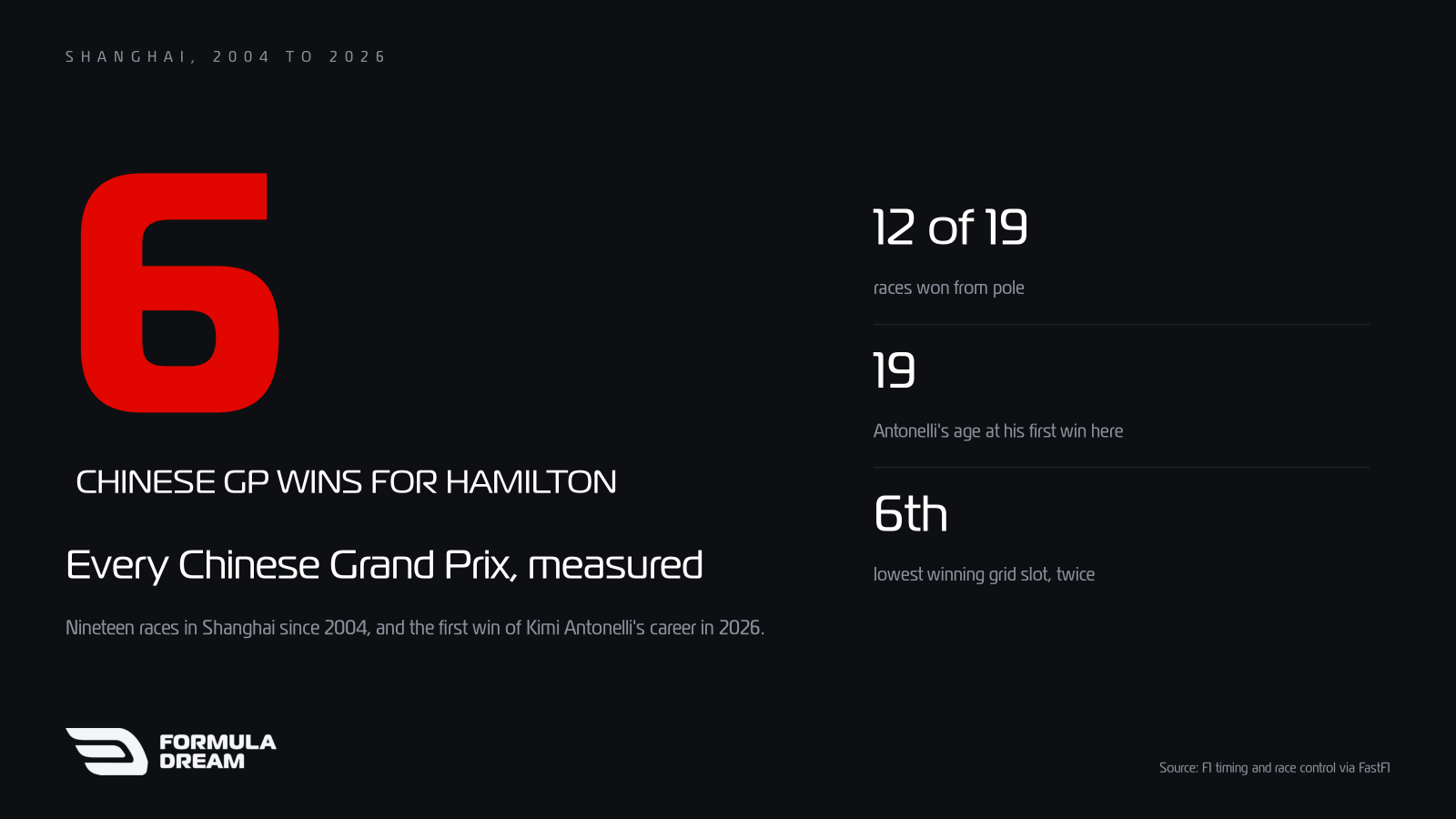
Nineteen Chinese Grands Prix have been held in Shanghai since 2004. Lewis Hamilton won six, pole won twelve, and in 2026 Kimi Antonelli took the first win of his career there, at 19, with Hamilton on the podium for Ferrari for the first time. Every winner, grid slot and safety car, measured.