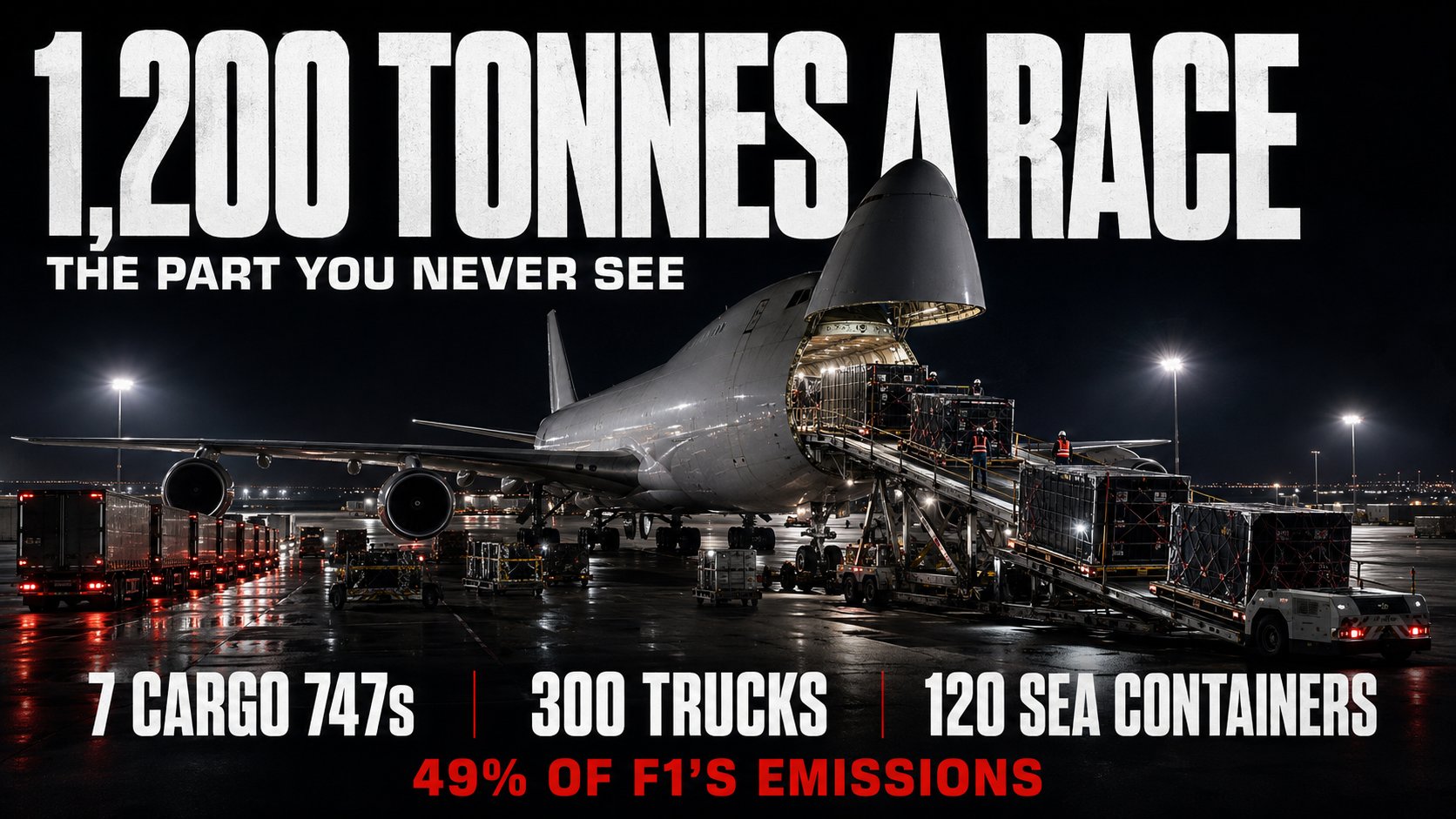
Around 1,200 tonnes of freight, up to seven 747s an event, 300 trucks across Europe and 120 ocean containers in permanent circulation. The hardest job in the sport.
A Formula 1 team packs up on Sunday night and has to be racing on another continent within a fortnight. Sometimes within a week.
Doing that takes roughly 1,200 tonnes of freight per race, up to six or seven Boeing 747 cargo aircraft for a flyaway event, about 300 trucks for a European round, and roughly 120 ocean containers in permanent circulation around the world.
It is the largest operation in the sport, it is almost never televised, and it is also the reason Formula 1's environmental problem is not the cars.
The freight is not just cars. For each event it includes the race cars themselves, spare chassis, power units, tyres, tools, garage structures, timing and broadcast equipment, hospitality units and catering.
Teams pack it into air containers or pallets, and the collective shipment is called a kit. Equipment typically reaches a circuit around 14 days before the event and is removed about a week afterwards, which is why the calendar's spacing matters more than it looks.
In 2021, one season's accounting had DHL moving 1,540 tonnes of equipment and 532 cars more than 74,500 miles. Reported per-race tonnage figures vary between roughly 1,200 and 1,400 tonnes depending on the event and the source, which is unsurprising given how differently a European round and a flyaway are handled.
Three transport modes, chosen by urgency
The operation is genuinely multimodal, and the choice is driven by how quickly something is needed.
Air for anything time-critical. Cars, power units, and the equipment that cannot exist in duplicate travel by Boeing 747 freighter, and for outsized loads the Antonov An-124. A flyaway race can need six or seven 747s. Over a season the air operation covers well over 130,000km.
Sea for anything that can be planned months ahead. Around 120 ocean containers circulate continuously, carrying furniture, catering equipment and garage fittings. These are not shipped back and forth: multiple identical sets leapfrog around the world, so a set is already at the next venue while another is still in use.
Road for Europe, where the calendar is dense enough that flying is pointless. A European round can involve up to 300 trucks, which parked nose to tail would form a convoy more than five kilometres long.
The sea freight sets are the clever part. Duplicating the non-critical equipment several times over is cheaper and far more reliable than flying it, and it is what makes a back-to-back calendar physically possible.
Why this is the sustainability story
Here is where the logistics stop being a curiosity.
In Formula 1's own 2022 carbon accounting, logistics accounted for 49% of the sport's total footprint, with business travel at 29%, event operations 12% and factories 10%. The fuel burned in the cars was under 1%.
So the entire 100% sustainable fuel programme, which gets the coverage, addresses less than a hundredth of the problem. The freight is the problem, and F1 knows it: the stated plan is to move more than half of broadcast and related freight off air transport by 2030, to regionalise the calendar so consecutive races are geographically closer, and to invest in sustainable aviation fuel. DHL has introduced biofuel-powered trucks in Europe and more efficient aircraft for the same reason.
Once you understand the freight, several complaints about the schedule make more sense.
Why races get grouped by region. A calendar that bounces between continents is not just tiring, it is expensive and carbon-heavy. Regional grouping is a logistics decision as much as a commercial one.
Why triple headers exist. Three races in three weekends is brutal on people, but efficient on freight, because the equipment moves once between neighbouring venues rather than returning to base.
Why a new venue is a big deal. Adding a race is not just a commercial negotiation, it is a freight route. Where a Grand Prix happens is decided by Liberty Media as commercial rights holder, and the logistics cost is part of that calculation.
The bit that never gets filmed
The garages you see on television are built and demolished every fortnight. The timing equipment, the pit wall, the hospitality units: all of it arrives in boxes, gets assembled, works flawlessly for three days under global broadcast, and is packed away again.
More than 100 people work on the logistics operation at each race, including around 35 specialists from the freight partner. Their entire job is that nothing about the process is ever visible.
When a session is running normally, that is the outcome of the largest and least glamorous effort in the sport.
Follow the weekend they build
All that freight exists so that twenty cars can run three days of sessions.
The Formula Dream app runs a live Dashboard through every one of them: every car on the circuit map, and a timing tower with lap times, gaps and intervals, tyre compound and age, plus flag and safety car alerts as race control calls them. You also get live driver radio as it is broadcast, and every FIA document of the weekend as it is published.
Free, no subscription, no ads, independent. Not affiliated with Formula 1.
By air for anything time-critical, using Boeing 747 freighters and occasionally the Antonov An-124 for outsized loads. Within Europe everything moves by road instead, with up to 300 trucks per event.
How much freight does F1 move per race?
Roughly 1,200 tonnes, with reported figures ranging to about 1,400 depending on the event. In 2021 the season total was around 1,540 tonnes of equipment plus 532 cars.
How does F1 use sea freight?
For non-urgent items like furniture, catering and garage fittings. About 120 ocean containers circulate permanently, with multiple identical sets leapfrogging around the world so one is always in place at the next venue.
Why does F1 group races by region?
Because freight is the dominant cost and the dominant emission. Logistics account for 49% of F1's carbon footprint, so consecutive races that are geographically close move equipment once rather than repeatedly across continents.
Is F1's environmental problem the cars?
No. In F1's 2022 accounting, the fuel burned in the cars was under 1% of its footprint. Logistics were 49% and business travel 29%.
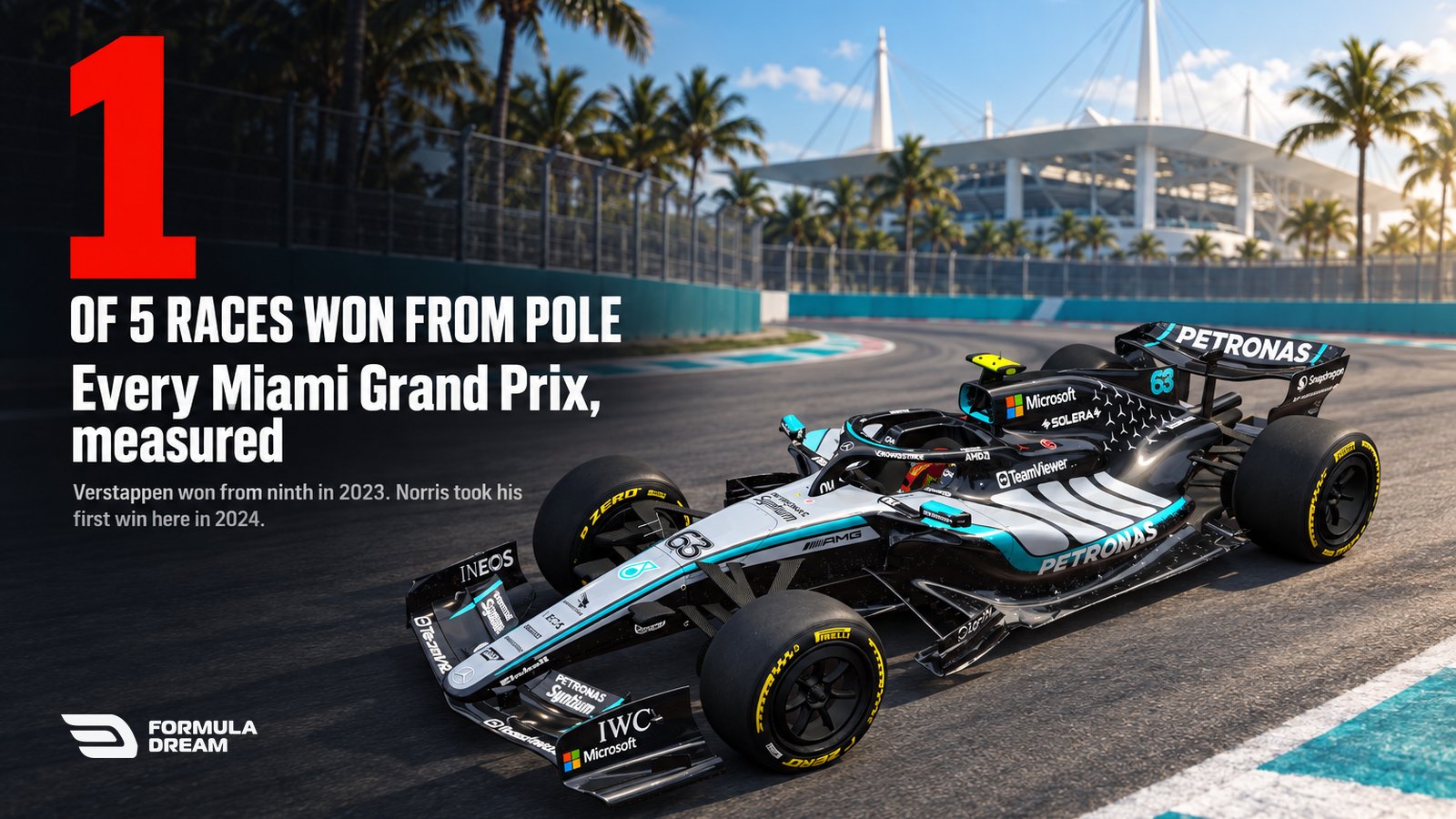
Every Miami Grand Prix winner, measured: five races, and pole has won only one of them
Five Miami Grands Prix have been held since 2022, and only one was won from pole: Kimi Antonelli's in 2026. Max Verstappen won from ninth in 2023, and Lando Norris took his first win there in 2024. Every winner, grid slot and safety car, measured.