F1's 100% Sustainable Fuel Explained | Formula Dream
Guides
F1's 100% Sustainable Fuel, and What It Actually Does
From 2026 every F1 car runs fuel with no crude oil in it. The cars are also under 1% of F1's carbon footprint, which makes the real argument for it a different one.
From 2026, every Formula 1 car runs on 100% advanced sustainable fuel. Nothing in it comes from crude oil.
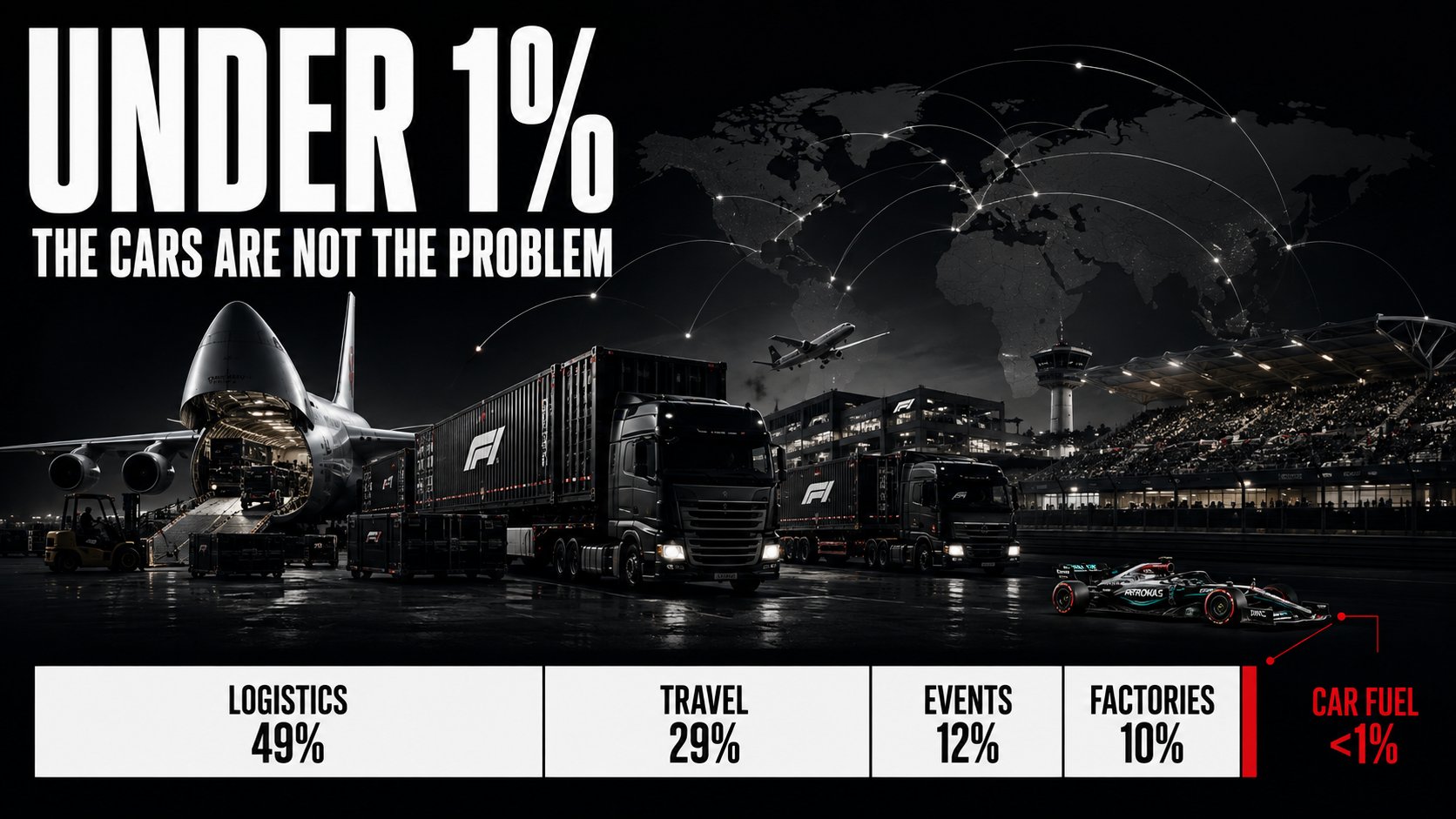
There is a fact that reframes the whole subject, and it comes from F1's own carbon accounting. In its 2022 footprint, the fuel burned in the cars was less than 1% of the sport's total emissions. Logistics were 49%, business travel 29%, event operations 12% and factories 10%.
So the sustainable fuel programme is not really about cleaning up Formula 1. F1 says as much itself, describing sustainable fuels as "a small part of the whole" of its Net Zero commitment. The actual argument for it is more interesting, and better.
The 2026 fuel is an e-fuel, produced from one of three carbon sources or a mix of them:
Carbon capture, taking CO2 directly from the air or from industrial emissions.
Municipal waste, including the organic fraction of household rubbish.
Non-food biomass, meaning agricultural residues, forestry waste and energy crops grown on land unsuitable for food production.
The defining rule is about where the carbon came from. Every carbon molecule in the fuel must originate from a non-fossil source. That is what separates it from a conventional biofuel blend and why F1 calls it advanced rather than simply renewable.
Turning that raw carbon into a usable racing fuel takes one of two routes. The biochemical route uses microorganisms to ferment biological material into intermediates that are then processed into fuel components. The thermochemical route partially combusts biomass in controlled oxygen conditions to produce synthesis gas, which is then converted into liquid hydrocarbons.
Either way, the output is a liquid hydrocarbon fuel that behaves like petrol, because chemically it more or less is petrol. It simply has a different origin story.
What "drop-in" means, and why it is the whole point
The fuel is a drop-in fuel: designed to replace a fossil equivalent without requiring any adjustment to the engine.
That word is doing an enormous amount of work.
A drop-in fuel does not need a new engine, a new fuel system, or a new distribution network. It works in the engine that already exists. F1 has demonstrated the point on historic racing cars, machines built decades before anyone thought about this.
And that is the real case for the programme. There are well over a billion internal combustion vehicles on the world's roads, and they will not be replaced quickly. A fuel that works in the cars people already own is the only intervention that reaches that fleet at all. Electrification handles the cars not yet built. Drop-in fuel is aimed at the ones already out there.
Judged as an F1 emissions measure, the programme is close to pointless, because the cars are under 1% of the footprint. Judged as a development and proving programme for a road-car technology, it makes considerably more sense. F1 has form here: the power unit was pushed to roughly 50% thermal efficiency by regulation, against about 30% for the V8s it replaced.
Will it make the cars slower?
Formula 1's own answer is admirably blunt: "We really don't know!"
The expectation is "something very close to the fossil fuel level of performance, that develops rapidly over the next few years". The one hard data point is that Aramco's sustainable fuel, already used in Formula 2 and Formula 3, had no adverse impact on performance.
What can be said is that fuel is not the reason 2026 cars are slower. We measured pole laps as 3.046% slower than 2025 at the ten circuits raced in both seasons, and that loss is dominated by the aerodynamic reset, not the fuel. The comparison is in are F1 cars getting faster.
The fuel also sits alongside a fuel flow limit, which caps how quickly fuel can enter the engine and therefore caps power without ever writing a horsepower number into the rules.
Where the emissions actually are
If the cars are under 1%, the honest question is what the other 99% is, and the answer is moving things around the world.
Logistics, 49%. Freight: cars, garages, broadcast equipment and hospitality shipped between continents on a calendar that criss-crosses the globe.
Business travel, 29%. Thousands of people flying to twenty-plus events.
Event operations, 12%, and factories and facilities, 10%.
F1's stated plan targets the large numbers rather than the visible one: moving more than half of broadcast and related freight off air transport by 2030, regionalising the calendar so consecutive races are geographically closer, and investing in sustainable aviation fuel.
That is far less photogenic than a green fuel in a racing car, which is precisely why the fuel gets the coverage and the freight does not.
Why it is still worth doing
Three reasons survive the scepticism.
It develops a technology the road fleet needs. The billion-plus existing engines are the problem drop-in fuels are built for.
It is a genuine engineering constraint. Manufacturers are competing on efficiency within a fixed fuel flow limit and a fixed fuel chemistry, which is how F1 produced a 50% efficient engine in the first place.
It removes an argument. A sport that races fossil-fuelled cars while claiming environmental credentials has a credibility problem regardless of the percentages. Removing crude oil from the fuel removes that specific objection, even if it does little to the total.
None of which makes it the emissions story. It makes it the technology story, which is the one F1 should be telling.
Follow the new formula live
The 2026 fuel arrives alongside the biggest technical reset in years, and the effects show up in lap times, energy deployment and strategy.
The Formula Dream app runs a live Dashboard through every session: every car on the circuit map, and a timing tower with lap times, gaps and intervals, tyre compound and age, plus flag and safety car alerts as race control calls them. You also get live driver radio as it is broadcast, which is where fuel saving and lift-and-coast instructions are actually given, and every FIA document of the weekend as it is published, including the fuel sample checks.
Free, no subscription, no ads, independent. Not affiliated with Formula 1.
An e-fuel produced from carbon captured directly from the air or from industrial emissions, from municipal waste, or from non-food biomass. Every carbon molecule must come from a non-fossil source, and nothing in it comes from crude oil.
What does drop-in fuel mean?
That it replaces a fossil fuel without any change to the engine, fuel system or distribution network. It works in engines that already exist, including historic cars, which is the main reason the technology matters beyond F1.
Does sustainable fuel make F1 cars slower?
F1 says it does not know yet, and expects performance close to fossil fuel. Aramco's sustainable fuel in Formula 2 and Formula 3 had no adverse effect. The 2026 cars are slower, but that is the aerodynamic reset rather than the fuel.
How much of F1's carbon footprint is the cars?
Less than 1%. In F1's 2022 footprint, logistics accounted for 49%, business travel 29%, event operations 12% and factories 10%.
Is F1 carbon neutral now?
No. F1 has a Net Zero by 2030 commitment and describes sustainable fuels as a small part of it. The large reductions have to come from freight and travel, not from the fuel in the cars.
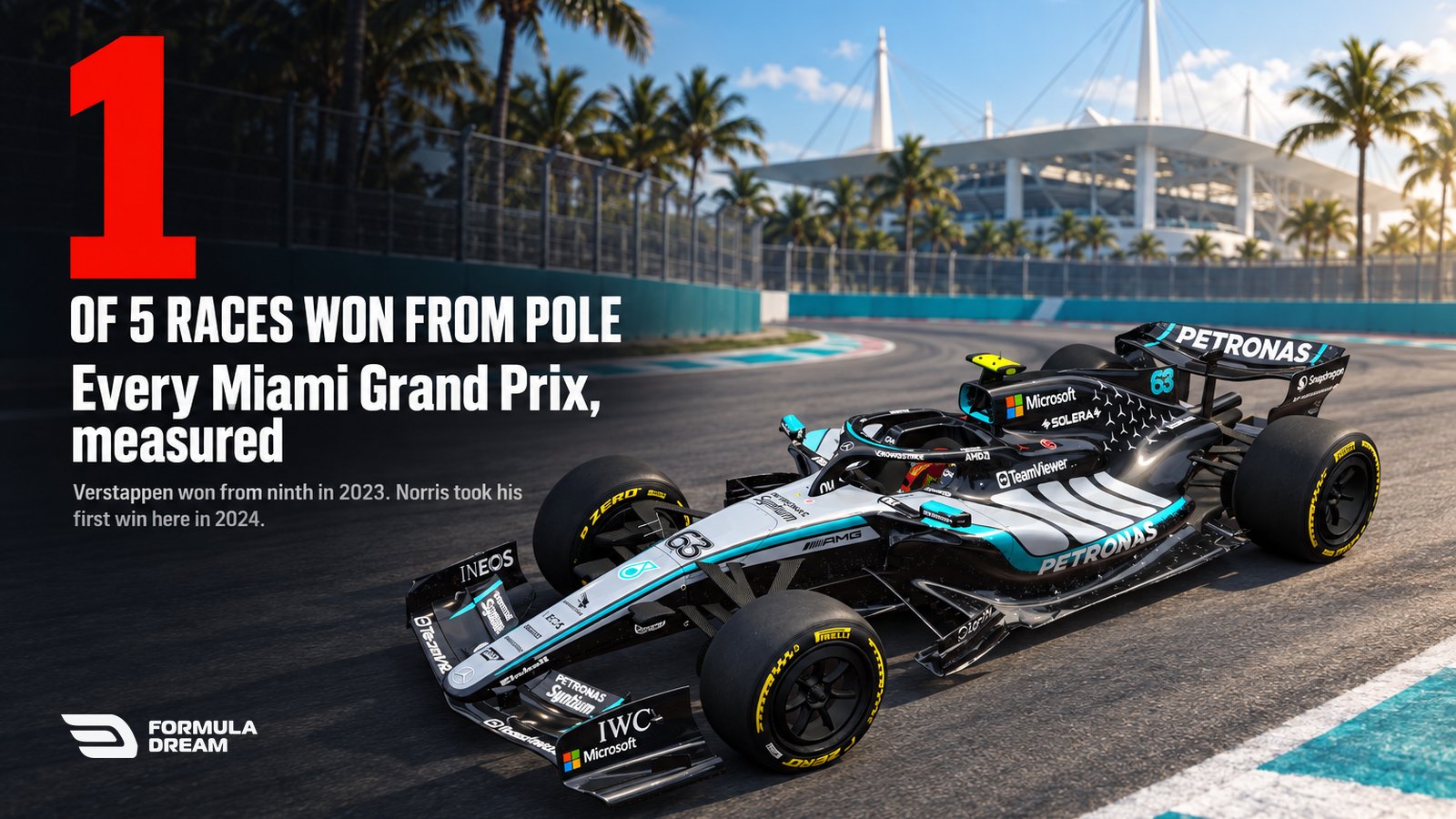
Every Miami Grand Prix winner, measured: five races, and pole has won only one of them
Five Miami Grands Prix have been held since 2022, and only one was won from pole: Kimi Antonelli's in 2026. Max Verstappen won from ninth in 2023, and Lando Norris took his first win there in 2024. Every winner, grid slot and safety car, measured.