What Is Parc Fermé in F1? Rules Explained | Formula Dream
Guides
What Is Parc Fermé in F1? The Rule That Locks the Cars
Parc ferme explained, the closed-park rule that freezes an F1 car's setup from qualifying to the race, why it exists, how the FIA enforces it with 40,000 seals, and the new rain exception.
You will hear commentators say a driver is "stuck with their qualifying setup", or that a team has "broken parc fermé and will start from the pit lane". Both come down to one rule that quietly governs every race weekend: parc fermé. It is the reason the car you see qualify is the same car that lines up on the grid, and it stops F1 from becoming an overnight engineering free-for-all. Here is what it is, why it exists, and how seriously the FIA polices it.
What is parc fermé?
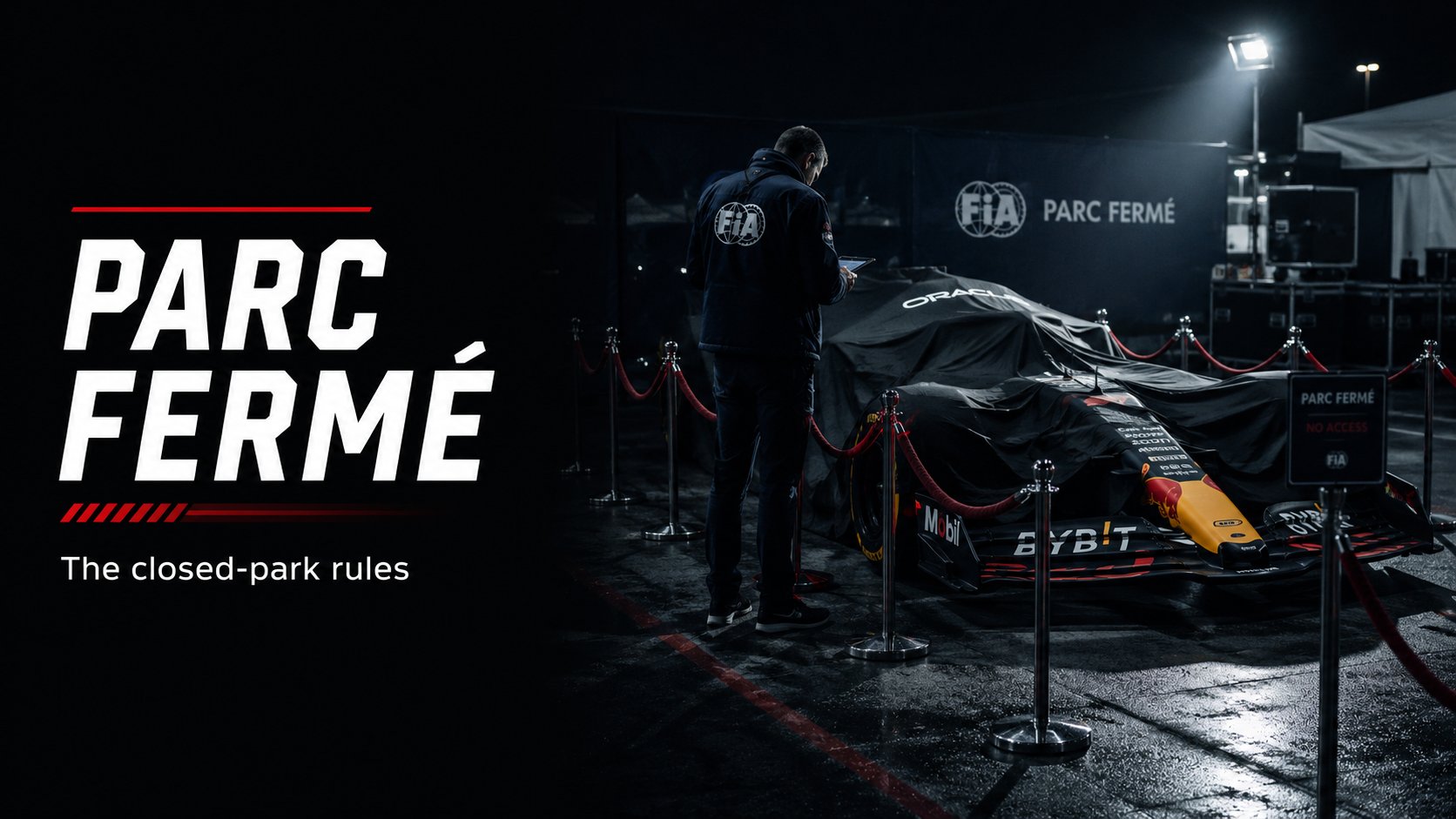
Parc fermé is French for "closed park", and the name is a leftover from the sport's French rulebook because no English phrase quite captures it. It began as a literal place: a secure, roped-off area where cars were locked away after a session, out of reach of the teams' "fiddling fingers", so scrutineers could check them for legality. Over time it became less a place and more a
: a state the car enters, under which teams are forbidden from touching almost anything.
A car goes into parc fermé conditions the moment it leaves the pit lane for the first time in qualifying (Q1), and stays locked that way, through qualifying, overnight, and the morning of the race, right up until the start of the Grand Prix.
The setup is free to change in practice, then locked the moment the car runs in qualifying, and stays locked all the way to the race start. Break it and you start from the pit lane.
Why it exists
Parc fermé between qualifying and the race arrived in 2003, alongside one-lap qualifying, when cars also had to qualify on the fuel they would start the race with. It solved a real problem. Before it, the richest teams built effectively two different cars: a qualifying special with a knife-edge setup for one flying lap, and then, overnight, a car rebuilt for the race. It was fabulously expensive, and it made Saturday's grid a poor guide to Sunday. Parc fermé killed that practice at a stroke. It made qualifying honest, because the car that sets the time has to race, and it cut a huge amount of cost out of the sport.
What teams can and cannot change
Under parc fermé the car's setup is frozen, but a few essential jobs are still allowed.
Allowed under parc fermé
Not allowed
Adjusting the front wing flap angle
Changing suspension settings or ride height
De-glazing brake pads and bleeding the brakes
Adding, removing or replacing front wing parts
Patching or bonding damaged bodywork
Fitting a part of a different design, bar six approved cases a season
Cooling changes, once the FIA declares a change in climatic conditions
Any other change to the setup or configuration
What teams can and cannot do in parc fermé, from Article B3.5 and Appendix B2 of the 2026 Sporting Regulations.
The rule itself is blunt. Under Article B3.5.3, once a car is in parc fermé no part of it may be replaced or modified and no change to its setup or configuration may be made, apart from the permitted jobs listed in Appendix B2 or work the FIA's technical delegate approves. That is the whole point: the car that sets the time is the car that races.
How the FIA enforces it
This is where it gets serious, because parc fermé is only as good as the policing behind it, and the FIA takes it to an almost forensic level. The FIA says it has 20 scrutineers monitoring every operation on the cars and writing it down to be checked later, and the rules allocate one scrutineer to each car. Every team must also mount a Parc Fermé Camera directly above each car, with a view of the whole of it, uncovered and running for the entire event. Within two hours of the end of qualifying, every car has to be covered and ready for FIA seals, and the covers and seals only come off five hours before the formation lap. Over a season the FIA orders up to 40,000 seals. In effect, from the moment it enters parc fermé, the car belongs to the FIA, not the team.
Breaking it: the pit lane start
Sometimes a team decides the setup they qualified with is simply wrong for the race, usually because the weather has turned, and they want to make bigger changes anyway. They are allowed to, but there is a price: under Article B3.5.3 the driver has to start from the pit lane instead of their earned grid slot. Replacing a broken part with an identical one is different. That can be approved by the FIA's technical delegate without any penalty, and six times a season a team can even be allowed a replacement wing or floor part of a different design, provided it has already been run in testing or qualifying. It is a real trade-off, sacrificing track position for a car better suited to the conditions, and teams that have qualified poorly will sometimes take it as a gamble with little to lose.
The new rain exception
For a long time this left teams horribly exposed to the weather: qualify in the dry, then face a wet race with a bone-dry setup and no legal way to fix it. So for 2026 the rules added a Rain Hazard. If the official weather service puts the probability of rain during the race above 40 percent, or the Race Director decides so, a Rain Hazard can be declared, no later than two hours before qualifying. While it is in force, teams may carry out an extra list of jobs on cars in parc fermé, set out in a separate FIA technical document, without the pit lane penalty. Reports before the season said that list covers wing and suspension settings. It is deliberately limited, enough to adapt the car for rain, not enough to allow a full dry-to-wet rebuild that would make parc fermé meaningless.
Sprint weekends
On sprint weekends the timing shifts. Parc fermé applies from the start of sprint qualifying through the sprint, is then lifted so teams can adjust before the main event, and is re-imposed for the Grand Prix qualifying session. A breach before the sprint means a pit lane start in the sprint, and a breach after Grand Prix qualifying means a pit lane start in the race. A Rain Hazard for the sprint has to be declared two hours before sprint qualifying.
Watch the rules being applied
Parc fermé breaches, setup changes and pit lane starts all arrive as published FIA documents, usually before the commentary catches up.
The Formula Dream app collects every FIA document of the weekend as it is released, which is where a parc fermé breach actually appears. It also runs a live Dashboard through every session with all the cars on the circuit map, a timing tower with lap times, gaps, intervals, tyre compound and age, flag and safety car alerts, and live driver radio as it is broadcast.
Free, no subscription, no ads, independent. Not affiliated with Formula 1.
It is French for "closed park". It is the rule that freezes a car's setup from the moment it first leaves the pit lane in qualifying until the start of the race, so the car that qualifies is the one that races.
Why was parc fermé introduced?
To stop teams building qualifying-special cars and rebuilding them overnight for the race. It arrived between qualifying and the race in 2003, which made qualifying a better guide to the race and cut costs.
What can teams change under parc fermé?
They can adjust the front wing flap angle, de-glaze and bleed the brakes, patch damaged bodywork and, with FIA approval, replace a broken part with an identical one. They cannot change suspension settings, ride height or anything else in the setup.
How does the FIA enforce parc fermé?
Each car has its own scrutineer and an overhead camera watching it, cars are covered and sealed overnight, and the FIA says it orders up to 40,000 seals a season.
What happens if a team breaks parc fermé?
The driver must start the race from the pit lane instead of their qualifying position. From 2026 a Rain Hazard, declared when the chance of rain in the race is above 40 percent, lets teams carry out extra permitted work for wet weather without that penalty.
When does parc fermé start and end?
It starts the moment a car first leaves the pit lane in qualifying and ends at the start of the race. On sprint weekends a separate period runs from sprint qualifying to the start of the sprint.
How do you pronounce parc fermé?
Roughly "park fair-MAY". It is often misspelled "park ferme", but the French spelling is parc fermé.
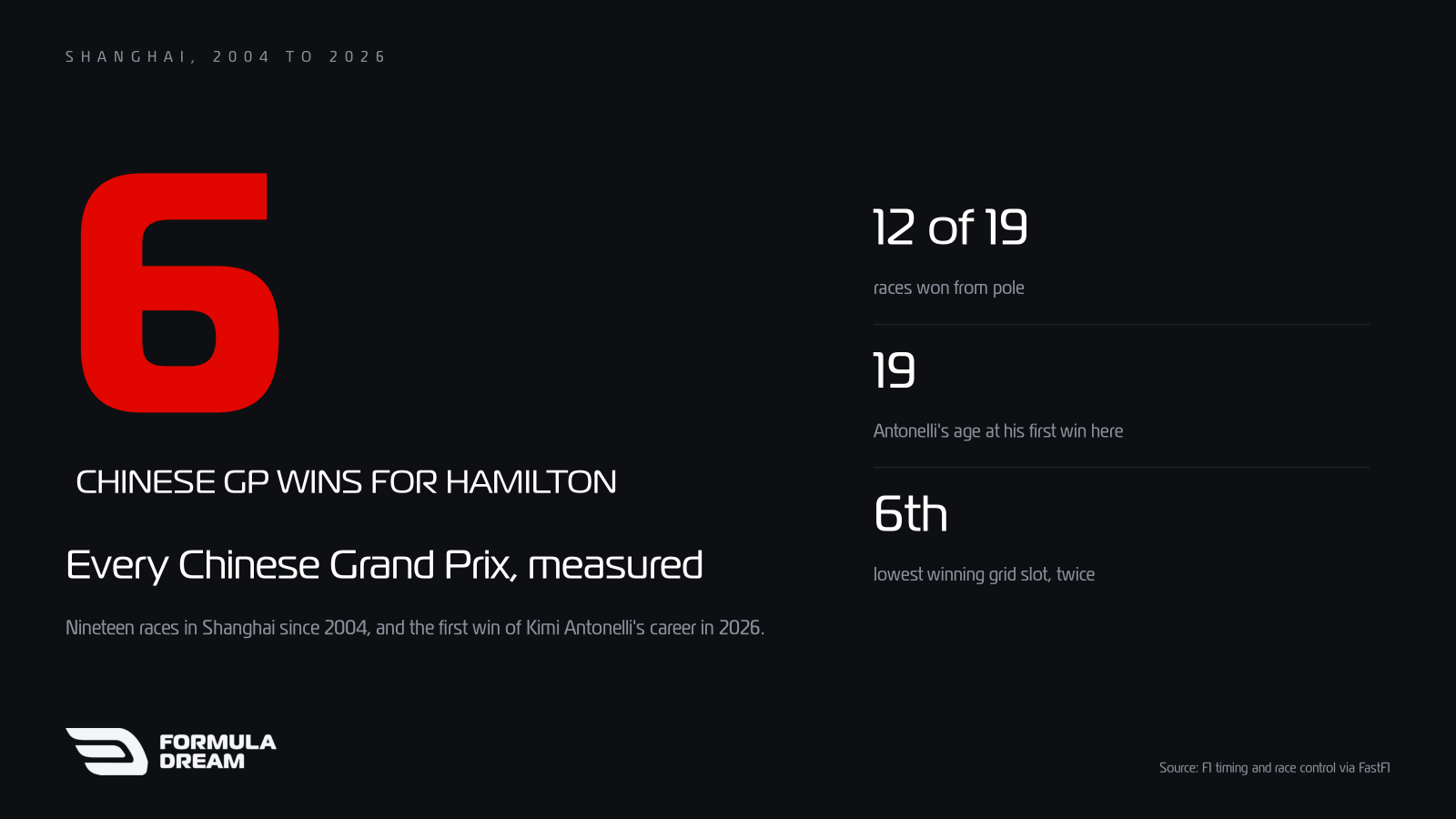
Nineteen Chinese Grands Prix have been held in Shanghai since 2004. Lewis Hamilton won six, pole won twelve, and in 2026 Kimi Antonelli took the first win of his career there, at 19, with Hamilton on the podium for Ferrari for the first time. Every winner, grid slot and safety car, measured.