F1 Qualifying Format Explained: Q1, Q2, Q3 | Formula Dream
Guides
F1 Qualifying Format Explained: How Q1, Q2 and Q3 Work
F1 qualifying format explained, how the Q1, Q2 and Q3 knockout works, how many cars are eliminated in each part, the 2026 changes for a 22-car grid, and how the grid is set.
At most circuits, Saturday sets up Sunday. At Monaco, it very nearly decides it: the streets are so narrow that overtaking is almost impossible, so whoever takes pole on Saturday usually wins on Sunday. That is why teams throw everything at qualifying, and why one lap on Saturday afternoon can matter as much as the whole race.
F1 qualifying decides the starting order for the race, and it runs as a three-part knockout. Over three sessions, called Q1, Q2 and Q3, the field is trimmed down until only the fastest ten fight for pole position. The car quickest across the whole session starts first; everyone else lines up in the order they were knocked out.
Here is exactly how it works, including what changed for 2026 now that the grid has grown to 22 cars.
Qualifying is split into three timed segments with a short break between each. Drivers can run as many laps as their tyres allow, and only their single fastest lap counts.
Session
Length
Cars taking part
Eliminated
Grid slots set
Q1
18 minutes
22
6
P17 to P22
Q2
15 minutes
16
6
P11 to P16
Q3
13 minutes
10
0
Pole to P10
The 2026 F1 qualifying knockout, adjusted for a 22-car grid.
How the eliminations work in 2026
With Cadillac joining, the grid is now 22 cars, so the FIA adjusted how many drop out of each session. Instead of five, six cars are now eliminated after Q1 and after Q2:
After Q1: the six slowest are out, locking in grid places P17 to P22.
After Q2: the six slowest of the remaining sixteen are out, taking places P11 to P16.
Q3: the final ten drivers battle for P1 to P10.
The knockout: Q1 drops six for grid places P17-P22, Q2 drops six more for P11-P16, and the last ten fight for pole in Q3.
There is also the long-standing 107% rule in Q1: a driver whose best lap is slower than 107% of the fastest Q1 time can be refused a place on the grid, though stewards often allow it if the driver has shown reasonable pace in practice.
The pole shootout
Q3 is the part everyone watches. Ten cars, one short window, and usually two flying laps each. Because everyone is on their absolute limit with low fuel and fresh tyres, the gaps are tiny, pole is often decided by hundredths of a second. The driver who nails one perfect lap starts the race at the front, with the cleanest air and the best shot at the first corner.
Sprint qualifying
On sprint weekends there is a second, separate qualifying session that sets the grid for the short Sprint race. It follows the same knockout shape but is quicker: SQ1 lasts 12 minutes, SQ2 10 minutes, and SQ3 eight minutes.
Why those tiny gaps matter
A whole qualifying session, and often a driver's entire weekend, can come down to a few hundredths. That sounds abstract until you convert it into distance. Our Gap Visualizer draws the qualifying gaps to scale as real metres of track, so you can see just how close the grid actually is:
The session lengths changed this season, and the reason is arithmetic.
With Cadillac joining and the grid growing to 22 cars, Q3 was extended from 12 minutes to 13. To keep the whole hour intact, the break between Q2 and Q3 was cut from eight minutes to seven. Q1 and Q2 kept their 18 and 15 minutes.
It sounds trivial. It is not, because Q3 is where the track is fastest and every extra minute is another possible lap on a set of tyres a driver may not have spare.
The lap time appears from nowhere
Here is something measurable that most explanations of qualifying miss entirely: drivers get significantly faster as the session runs, in a car that has not changed.
We measured it across two seasons of dry qualifying. The same driver, in the same car, is 0.825% faster in Q3 than in Q1. On a 90 second lap that is about three quarters of a second, found in roughly forty-five minutes with no upgrade fitted to the car.
Most of it is the track itself. As cars run, they lay rubber, and the surface grips progressively better through the hour. Fuel loads come down, tyres get used at their best moment, and drivers learn the circuit's evolving limit. The full method is in why F1 qualifying times drop.
The practical consequence is that running order matters. A driver who sets their time early in a segment is driving a slower track than one who runs at the end, which is why you see the pit lane queue up in the closing minutes and why a badly timed traffic jam can end a driver's session.
Why qualifying decides so much
Saturday matters more than it used to, and we can put a number on it.
Across 125 races from 2021 onwards, pole position won 56.0% of the time. The front row won 77.6%, and the top three grid slots won 87.2%. The all-time figure for pole converting to a win is about 43.6%, so the modern rate is far higher.
That is a direct consequence of how hard overtaking has become. A car that starts ahead and is not obviously slower tends to stay ahead, because dirty air costs a following car about half a second a lap. The measurements are in how often pole position wins.
The cleanest comparison in the sport
Qualifying is also the fairest way to compare two drivers, because it removes strategy, traffic, safety cars and reliability. One lap, same car, everything on the table.
We measured every team-mate pairing on the grid this way. The results range from total dominance to statistical noise: Verstappen out-qualified Yuki Tsunoda 20-0 across 2025, while at McLaren, Norris beat Piastri 13-10 by an average of just 0.035%, about three hundredths of a second. A head-to-head record without the gap behind it tells you very little. Both sets of numbers are in F1 team-mate qualifying head to head.
Watch qualifying live
Qualifying is decided in the last three minutes of each segment, and the timing screen is the only place you can see it coming.
The Formula Dream app runs a live Dashboard through every session: every car on the circuit map, and a timing tower with lap times, gaps and intervals, tyre compound and age, plus flag and safety car alerts the moment race control calls them. In qualifying that is how you see who is still to set a lap and who is about to be knocked out. You also get live driver radio as it is broadcast, and every FIA document of the weekend as it is published, including the deleted lap times that change a grid.
Free, no subscription, no ads, independent. Not affiliated with Formula 1.
The thing that ruins more qualifying laps than anything else is other cars. We counted how much time traffic actually costs in F1 traffic, measured.
Frequently asked questions
How does F1 qualifying work?
It is a three-part knockout. Q1 (18 minutes) eliminates the slowest cars, Q2 (15 minutes) trims the field again, and Q3 (13 minutes) is a shootout between the last ten for pole. Only each driver's fastest single lap counts.
How many cars are eliminated in each part of qualifying?
For the 22-car 2026 grid, six cars are knocked out after Q1 (P17-P22) and six after Q2 (P11-P16), leaving ten to contest Q3 for P1-P10.
What is the 107% rule?
In Q1, a driver whose fastest lap is slower than 107% of the quickest Q1 time can be denied a grid spot, though stewards may permit it if the car showed enough pace in practice.
How long is each qualifying session?
Q1 is 18 minutes, Q2 is 15 minutes, and Q3 is 13 minutes, with a short break between each. Sprint qualifying is shorter at 12, 10 and 8 minutes.
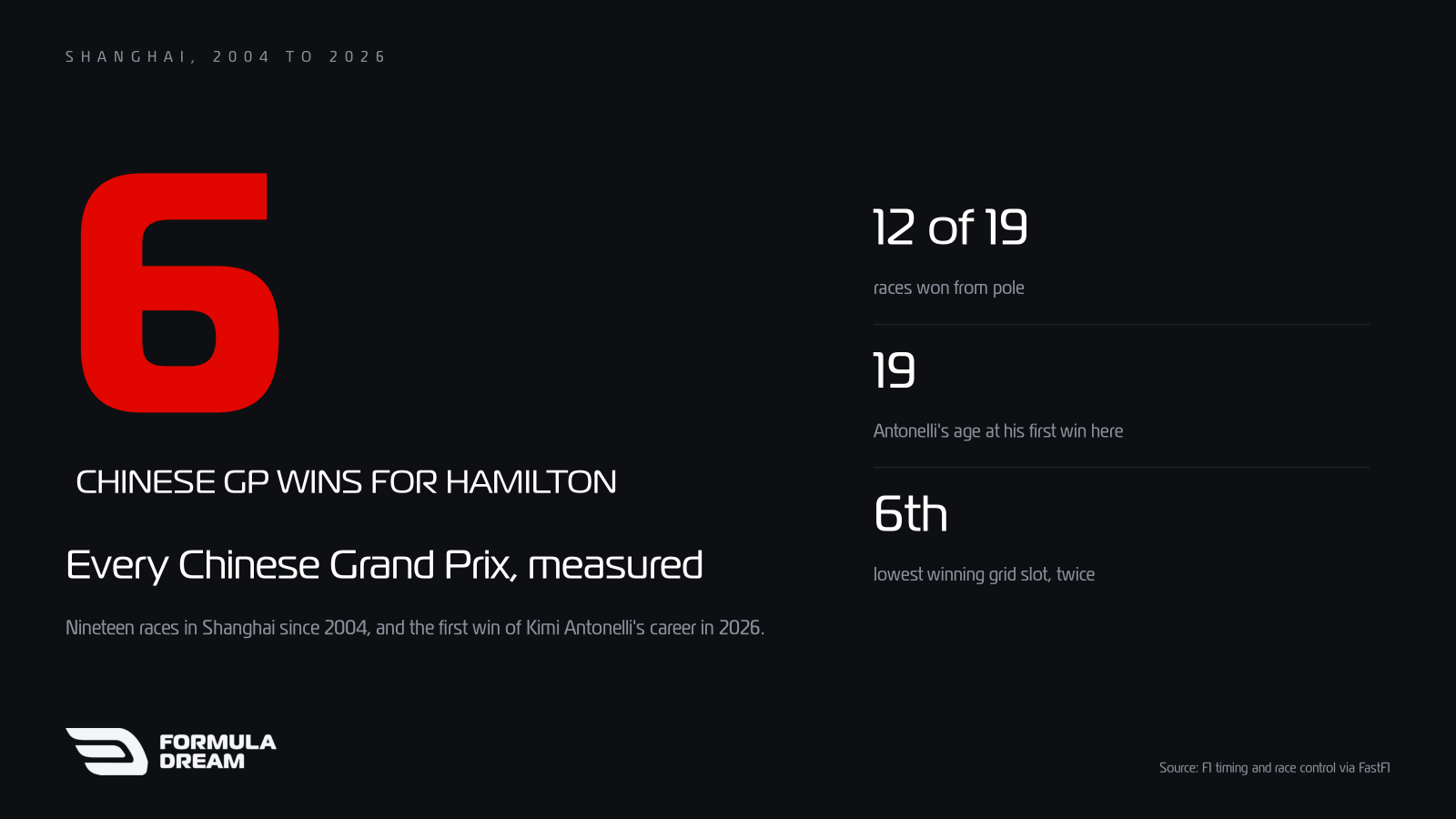
Nineteen Chinese Grands Prix have been held in Shanghai since 2004. Lewis Hamilton won six, pole won twelve, and in 2026 Kimi Antonelli took the first win of his career there, at 19, with Hamilton on the podium for Ferrari for the first time. Every winner, grid slot and safety car, measured.