F1 Sprint Format Explained: How It Works | Formula Dream
Guides
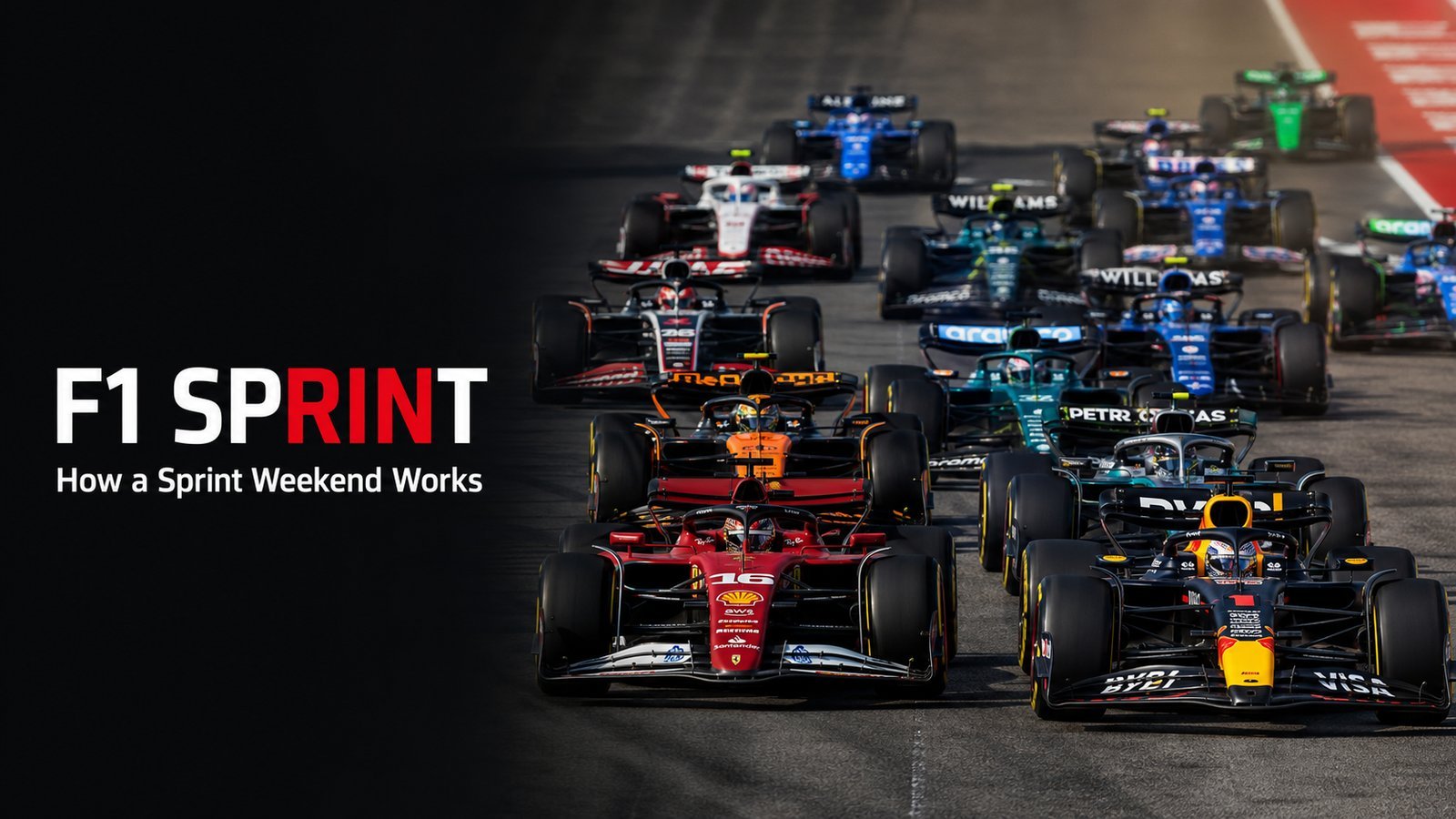
F1 Sprint Format Explained: How a Sprint Weekend Works
The F1 Sprint format explained, how a sprint weekend is structured, what Sprint Qualifying is, the 100km Sprint race, the points on offer, and which six 2026 races have a Sprint.
A Sprint weekend adds a second, shorter race to a Grand Prix weekend, with its own qualifying and its own points. It squeezes more competitive action into the same three days, but it also rearranges the schedule you are used to. Here is exactly how an F1 Sprint weekend works.
2027 update: Formula 1 has doubled the format to ten sprint weekends for 2027, including firsts at Monaco, Bahrain, Australia, Japan and Abu Dhabi. Every date, and our measurement of how much overtaking each of those ten venues produces, is in F1's 2027 calendar has 10 sprints.
A normal weekend has three practice sessions before qualifying and the race. A Sprint weekend cuts practice to the bone and runs two separate qualifying sessions and two races:
Friday: a single one-hour practice session, then Sprint Qualifying to set the grid for the Sprint.
Saturday: the Sprint race in the morning, then normal Qualifying in the afternoon to set the grid for Sunday.
Sunday: the Grand Prix, as usual.
The key thing to understand is that these are two independent events. The Sprint has its own qualifying and its own grid; the Grand Prix has its own qualifying and its own grid. Your result in the Sprint does not set where you start the main race.
A sprint weekend trades two of the three practice sessions for a Sprint Qualifying and a 100km Sprint, so the cars are racing for real almost from the moment they arrive.
Sprint Qualifying
Sprint Qualifying (sometimes called the Sprint Shootout) is a compressed version of normal qualifying. It runs the same three-part knockout, SQ1, SQ2 and SQ3, but shorter, at 12, 10 and 8 minutes, and with mandated tyres: teams must use mediums in SQ1 and SQ2 and softs in SQ3. It sets the grid for the Sprint only.
The Sprint race
The Sprint itself is a flat-out dash of 100 kilometres, roughly a third of a Grand Prix, lasting about 25 to 30 minutes. There is no mandatory pit stop, so drivers simply pick a tyre and go, which makes it a pure, low-strategy race. It is its own standalone contest, and again, it has no bearing on the grid for Sunday.
Sprint points
Points are awarded to the top eight finishers in the Sprint:
1st: 8 points
2nd: 7
3rd: 6
4th: 5
5th: 4
6th: 3
7th: 2
8th: 1
Added to the 25 for a Grand Prix win, that means a driver can score up to 33 points across a single Sprint weekend, which is why these weekends can swing a championship. For the full breakdown, see our guide to the F1 points system.
Which races have a Sprint in 2026?
Six of the 24 rounds run the Sprint format in 2026: the Chinese Grand Prix (Shanghai), Miami Grand Prix, Canadian Grand Prix (Montreal), British Grand Prix (Silverstone), Dutch Grand Prix (Zandvoort), and the Singapore Grand Prix.
How it differs from a normal weekend
The big changes are less practice and more that counts. Teams get just one hour to set up the car before it all matters, so they lean heavily on simulation and get it right first time. And with two qualifying sessions and two races, there are far more chances to gain, or lose, over the three days. It is a format built to keep every session meaningful.
Is the sprint actually better racing?
This is the argument the format lives or dies on, and it is answerable with numbers rather than opinion.
We counted every on-track pass across ten sprint weekends and compared each sprint with the Grand Prix at the same circuit.
Per lap, the sprint is far denser. Sprints produced 0.90 on-track passes per lap. The Grands Prix at those same circuits produced 0.44. So minute for minute, a sprint gives you roughly twice as much overtaking.
Over the full session, the Grand Prix still wins. A sprint produced 15.4 passes on average. A Grand Prix produced 24.6. The sprint is shorter, so the higher rate does not make up the difference.
Both things are true at once, which is why the argument never resolves. If you have thirty minutes, the sprint is the better use of them. If you have two hours, the Grand Prix gives you more.
There is a further wrinkle worth knowing: in our data the density advantage only became clear recently, so the format's case has strengthened rather than being constant since it was introduced. The full method is in what we measured about sprint races.
Why the racing is different, not just shorter
A sprint changes driver behaviour, and the reasons are structural.
No mandatory pit stop. Strategy largely disappears, so there is no waiting for an undercut to develop. A driver who wants a position has to take it on track.
Less tyre management. Over 100km there is far less need to nurse a set of tyres to the end, so drivers can push closer to the limit for longer. Degradation still exists, it just matters less.
Less to lose, and more. The points run only to eighth place, so the downside of an ambitious move is smaller than in a Grand Prix. But a crash still damages a car that has to race on Sunday, under a cost cap where repairs come out of the development budget.
That combination produces a race where drivers attack more but teams worry more, which is roughly what the format was designed to do.
The one practice session problem
The part that genuinely changes a weekend is what gets removed.
A normal weekend has three practice sessions. A sprint weekend has one, and then the cars go into parc fermé conditions far earlier, locking in setup.
That single hour has to serve every purpose the usual three cover: checking the car works, learning the circuit, evaluating tyres, and setting up for both a sprint and a Grand Prix in conditions that may differ. Teams arrive with far less information and are committed much sooner, which is why sprint weekends produce more surprises and occasionally a team that is simply lost all weekend.
It is also why live timing matters more on a sprint weekend than a normal one. There is no second session in which to work out what you missed.
Follow a sprint weekend live
A sprint weekend compresses everything, so there is no second practice session to work out what is going on.
The Formula Dream app runs a live Dashboard through every session of a sprint weekend: every car on the circuit map, and a timing tower with lap times, gaps and intervals, tyre compound and age, plus flag and safety car alerts as race control calls them. With only one practice session, that data is the whole picture. You also get live driver radio as it is broadcast, and every FIA document of the weekend as it is published.
Free, no subscription, no ads, independent. Not affiliated with Formula 1.
Friday has one practice session and Sprint Qualifying; Saturday has the 100km Sprint race and then normal Qualifying; Sunday has the Grand Prix. The Sprint and the Grand Prix each have their own separate qualifying and grid.
How long is an F1 Sprint race?
About 100 kilometres, or roughly a third of a Grand Prix, lasting around 25 to 30 minutes with no mandatory pit stop.
How many points do you get for the Sprint?
The top eight score: 8, 7, 6, 5, 4, 3, 2 and 1. Combined with a Grand Prix win, a driver can take up to 33 points in a Sprint weekend.
Does the Sprint result set the grid for the Grand Prix?
No. The Sprint has its own qualifying and grid, and a separate full qualifying session sets the grid for Sunday's race.
How many Sprint races are there in 2026?
Six: China, Miami, Canada, Britain, the Netherlands and Singapore.
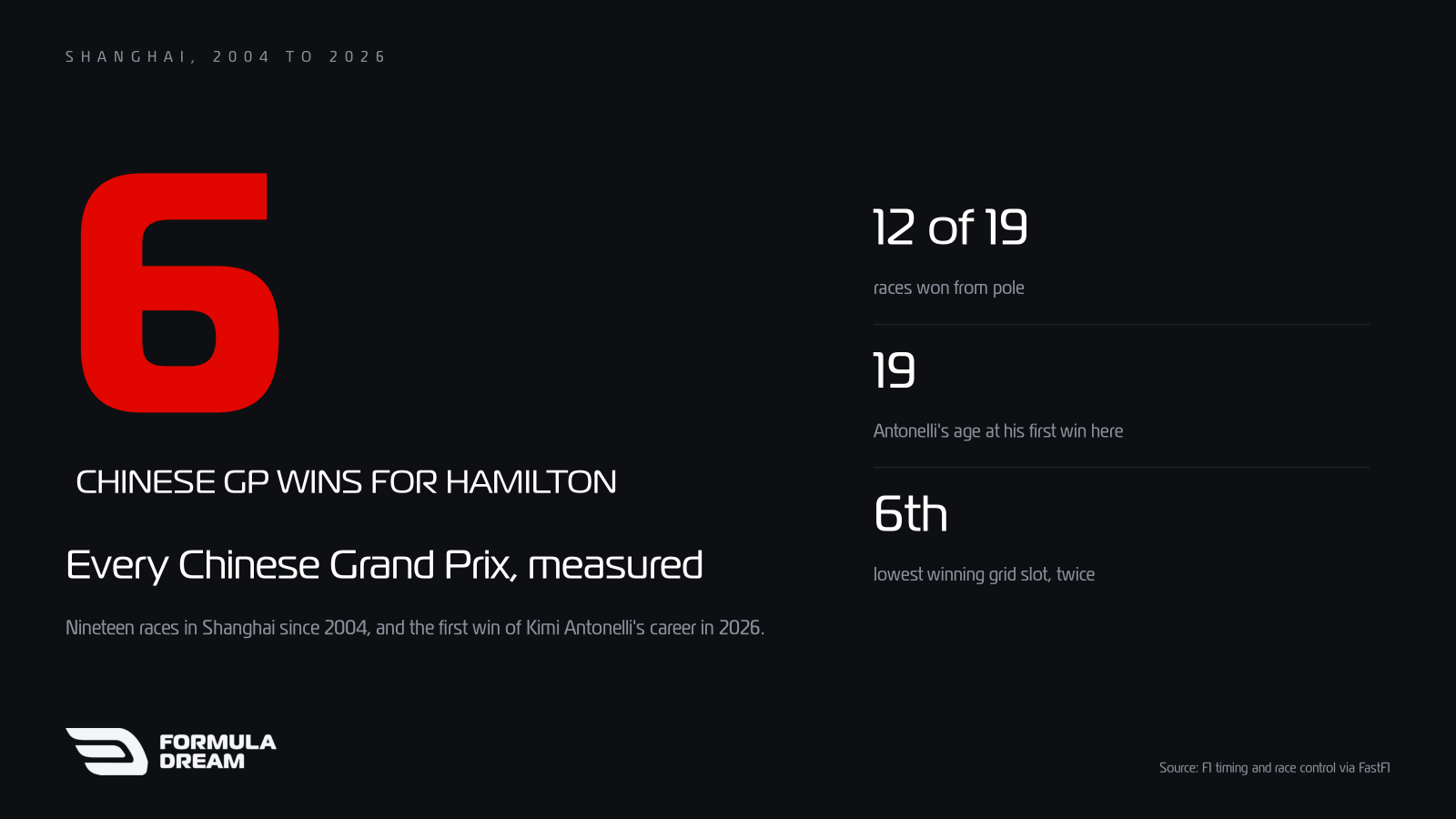
Nineteen Chinese Grands Prix have been held in Shanghai since 2004. Lewis Hamilton won six, pole won twelve, and in 2026 Kimi Antonelli took the first win of his career there, at 19, with Hamilton on the podium for Ferrari for the first time. Every winner, grid slot and safety car, measured.