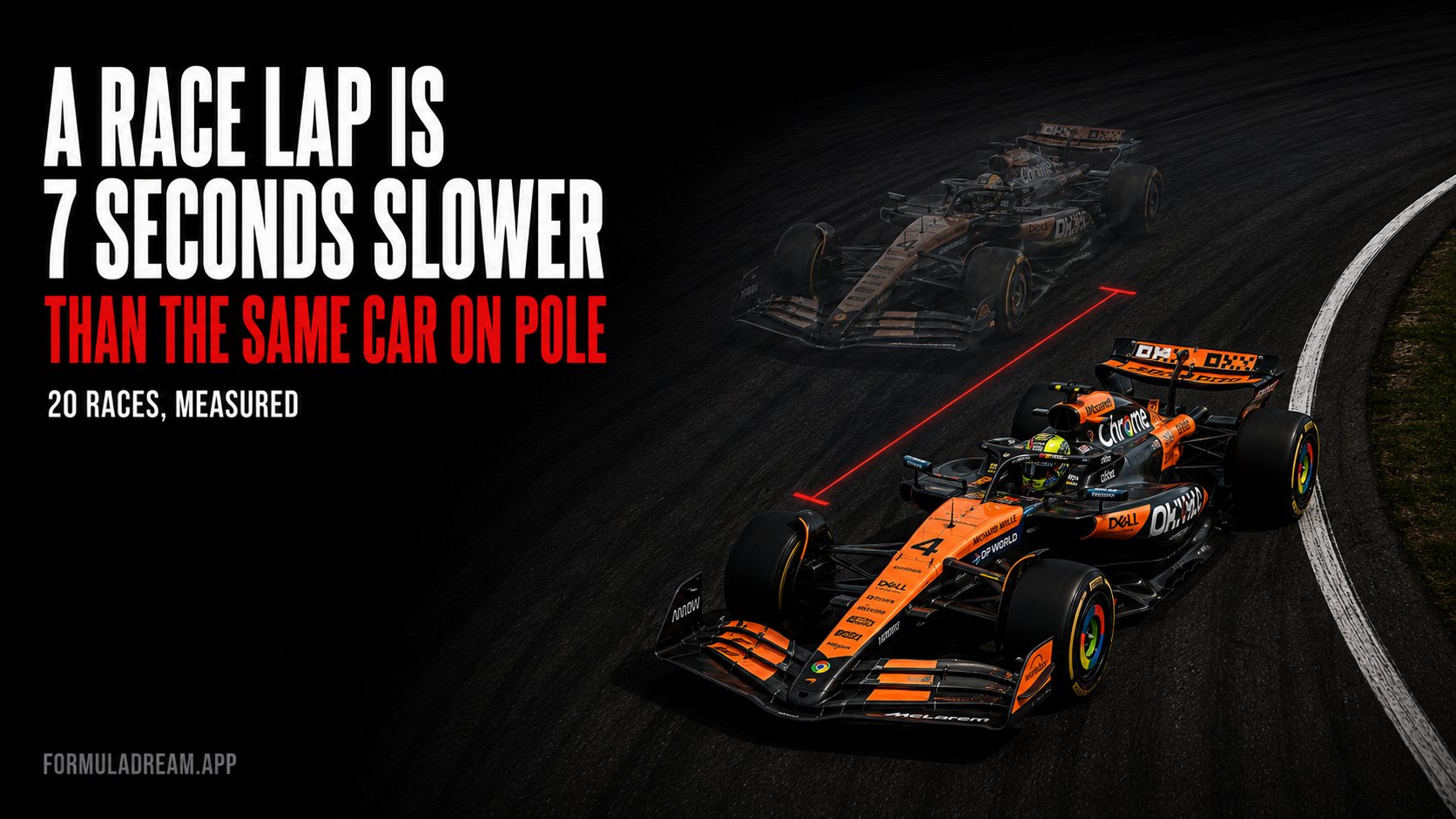
The pole lap is the fastest a Formula 1 car goes all weekend. The typical race lap is 6.99 seconds slower than it. Even the single fastest lap of the race, set on low fuel with everything to gain, is 3.97 seconds off.
In percentage terms that is 8.73% and 5.01% of lap time. Held over a full Grand Prix, the difference is about seven minutes, or five laps of the circuit.
The three tiers of pace: pole, fastest race lap and typical race lap, 2025 season
Everyone knows race pace is slower than qualifying pace. What almost nobody publishes is the number. Search for it and you get the reasons, fuel and tyres and engine modes, without a single measured figure attached. So we measured all three, at every race of the 2025 season.
Three quantities, all of them directly observed. No modelling, no baseline to argue about.
Pole: the fastest lap of the qualifying session.
Fastest race lap: the quickest green-flag lap anybody managed on Sunday.
Typical race lap: the median green-flag lap across the entire field.
Green flag only, no in-laps or out-laps, no deleted laps, and nothing from the opening two laps.
Wet sessions had to go, and the data told us which ones. Rather than judge it by eye, we flagged any session where a car ran intermediate or wet tyres. That caught exactly four events: Australia, Britain and Belgium had wet races, and Las Vegas had a wet qualifying session. Las Vegas is the clearest illustration of why this matters. Its "fastest race lap" came out 14.6 seconds quicker than pole, which is nonsense as a pace comparison and simply reflects a wet Saturday against a dry Sunday. That left 20 dry-on-dry events.
Fuel explains the typical lap. It does not explain the fastest one.
A car starts a Grand Prix with up to 110kg of fuel on board. The accepted rule of thumb, and it is remarkably consistent across the sport, is that every 10kg costs roughly 0.3 to 0.4 seconds a lap. A full tank is therefore worth something like three to four seconds a lap on its own, before tyres or driving style enter the conversation.
That accounts for a large share of the 6.99 second typical gap. A race lap is an average across the whole afternoon, including the early laps when the car is at its heaviest.
But now look at the fastest race lap. It is almost always set late, on a light car, frequently on a fresh set of softs bolted on specifically to chase the bonus point. Fuel is barely a factor. And it is still 3.97 seconds slower than pole.
That gap is where the real answer lives, and it is made of things that have nothing to do with weight:
Energy deployment. A qualifying lap gets a full, unrestrained deployment of electrical energy, mapped to the corner exits where it does the most good. In a race that energy has to be harvested and spent across a whole stint.
The tyre is never as good. A qualifying run has a dedicated preparation lap to bring a brand new set into its exact working window for one lap. Nothing in a race does that.
The track is at its best on Saturday. Qualifying happens at the rubberiest point of the weekend for a session of that type, on a circuit that has been cleaned up by two days of running.
Nobody drives a race lap like a qualifying lap. Kerbs get used more gently, entry speeds are a fraction lower, and the driver is protecting a set of tyres they need for another twenty laps.
And a chunk of it is traffic. We measured separately that running within a second of another car costs about 0.49 seconds a lap, and inside half a second it costs 0.61. On a Sunday most cars spend a large part of the race in someone else's wake. On a Saturday, nobody does.
At Baku the race is almost qualifying. At the Red Bull Ring it is not.
Expressed as a percentage of lap time, so that a 100 second lap and a 65 second lap compare fairly, the spread between circuits is large.
How much slower the fastest race lap is than pole, by circuit, 2025
Red Bull Ring: 6.18%
Hungaroring: 6.03%
Mexico City: 5.91%
Bahrain: 5.90%
Barcelona: 5.87%
Singapore: 5.22%
Monaco: 4.67%
Interlagos: 4.16%
Monza: 2.68%
Baku: 2.25%
Monza and Baku sit alone at the bottom, and they are the two lowest-downforce circuits of the year.
That is not a coincidence. On a circuit dominated by long full-throttle straights, a huge share of the lap is simply the car at maximum speed, and there is very little a driver can do to go faster or slower there. You cannot manage a tyre on a straight. You cannot brake later on a straight. The parts of a lap where race pace differs from qualifying pace, the braking, the entry speed, the kerb use, are exactly the parts that Monza and Baku have least of.
The Red Bull Ring and the Hungaroring are the opposite. Short laps, corner after corner, everything leaning on grip that a driver can either use or protect.
What that gap looks like over a full race
Multiply the typical gap by the number of laps and it stops being an abstraction.
Time lost to race pace over a full Grand Prix, expressed in laps of the circuit
Barcelona: 7.7 laps
Monaco: 7.2 laps
Zandvoort: 7.0 laps
Hungaroring: 6.3 laps
Bahrain: 5.0 laps
Monza: 3.0 laps
Baku: 2.3 laps
The median across the season is about five laps, or roughly seven minutes.
Obviously no car could do this. There is no tyre that survives a race distance at qualifying pace and no way to carry the fuel. That is precisely the point: the gap is not a small compromise at the edges, it is most of the difference between what a Formula 1 car can do and what it is asked to do.
What this changes about watching a race
Do not read race pace off qualifying. A tenth on Saturday and a tenth on Sunday are different currencies. Cars separated by 0.2s in qualifying routinely run a second apart in a stint, because the things that make a race lap slow affect every car differently.
The fastest lap of the race is not the car's fastest lap. It is still four seconds off what the same car did the day before.
A driver "not pushing" is usually accurate, not lazy. They are seven seconds a lap away from the limit, and almost all of that is deliberate.
At Monza and Baku, expect the race to look faster and closer to qualifying form. At the Hungaroring and the Red Bull Ring, expect it to look nothing like Saturday.
Method
Data: FastF1, all 24 events of the 2025 season, of which 20 are used.
Pole is the fastest lap of the qualifying session. Race best is the fastest green-flag race lap. Race typical is the median green-flag race lap across the field.
Race laps excluded: any lap not under green flag, in-laps, out-laps, deleted laps, and laps 1 and 2.
Wet events excluded by tyre compound, not by judgement. Any session in which intermediate or wet tyres appeared was dropped: Australia, Britain and Belgium (wet races) and Las Vegas (wet qualifying). This is stated because dropping four of twenty-four events is a large intervention and readers should be able to check it.
Percentages are the gap divided by that circuit's pole time, so circuits with very different lap lengths can be compared.
Laps-ahead figures multiply the typical gap by that race's actual lap count, then divide by a typical race lap at that circuit.
The 110kg fuel limit and the 0.3 to 0.4 seconds per 10kg rule of thumb are external, widely used figures, not our own measurement, and are cited as such.
The gap between a pole lap and a race lap is easiest to believe when you watch both.
The Formula Dream app runs a live Dashboard through every session: every car moving on the circuit map, and a timing tower with lap times, gaps and intervals, tyre compound and age, pit counts and positions gained or lost. It is the same information these measurements come from, arriving live. You also get live driver radio as it is broadcast, and every FIA document of the weekend as it is published.
Free, no subscription, no ads, independent. Not affiliated with Formula 1.
Singapore Sprint 2026 Results: Russell Crashes From the Lead
Russell took the lead at turn one and crashed at the final corner of the same lap. Verstappen won, Hamilton charged to second, and the McLarens hit each other.