F1 Race Start Explained: The Formation Lap, Five Lights and the Getaway
The F1 race start explained, the formation lap, the five red lights and their random hold, why the getaway is a hand-operated driver skill since launch control was banned, and how jump starts are caught.
An F1 race is often won or lost in its first few seconds. Before the cars even reach racing speed, there is a whole procedure, a formation lap, five red lights, a nerve-shredding random pause, and then a hand-operated launch that is one of the most under-appreciated skills in the sport. Get it right and you gain three places into the first corner. Get it wrong and you lose four. Here is exactly how an F1 race start works.
The formation lap
Before the start proper, the cars complete one formation lap (also called the warm-up or parade lap). They leave the grid in order, and immediately begin weaving hard and braking sharply
, not for show, but to force heat into the tyres and brakes, which only work in a narrow temperature window. A cold tyre or a cold brake on the run to the first corner is a recipe for a spin or a lock-up, so the formation lap is really a frantic warm-up.
The lap is deliberately restricted: teams can only pass safety messages on the radio during it (more on that in how team radio works), so the pit walls go almost silent. Once every car is back in its exact grid box, the start sequence begins.
The five red lights
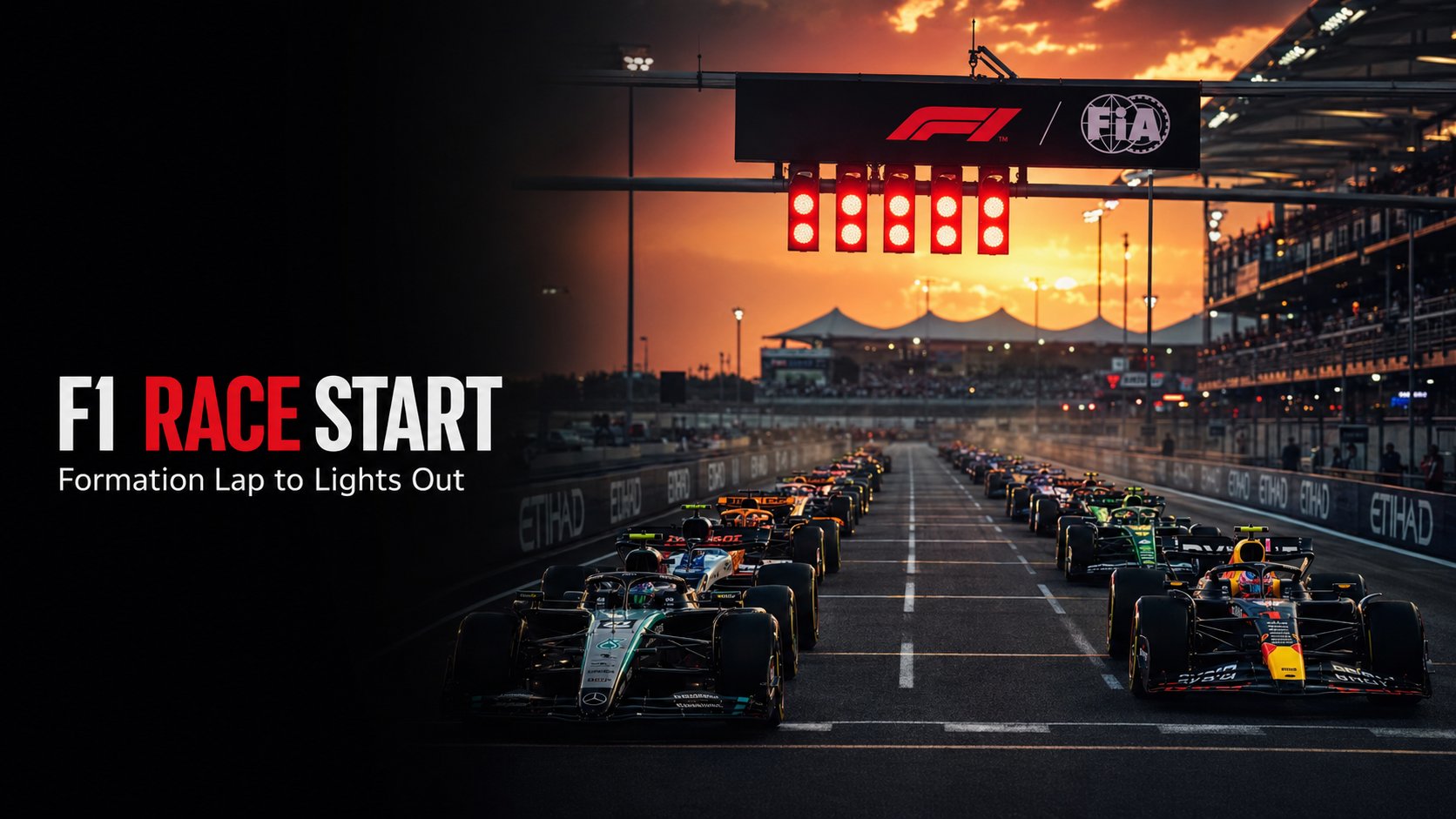
This is the iconic bit. Above the track, five pairs of red lights illuminate one at a time, one second apart. When all five are lit, the race is seconds away, and every driver is sitting on the clutch bite point, revs held, staring at the lights.
Then comes the cruel part. After the fifth light, there is a random pause, anywhere up to a few seconds, before all five lights go out at once. Because the delay is random, no driver can time it in advance; they can only react. And crucially, there is no green light. In F1, the signal to go is the red lights going out. The moment they do, the race is on.
The five red lights come on one at a time, hold for a random moment, then all go out together. There is no green light, lights out means go.
The getaway: a skill done by hand
Here is the part most people do not realise: the launch is not automated. Between 2001 and 2003, F1 cars had launch control, computer systems that fired the car off the line perfectly every time. It was banned for 2004 precisely because it took the skill out of the driver's hands, and it has stayed banned ever since.
So today, the getaway is done almost entirely by the driver. In the seconds before the start, the driver holds the clutch paddle at exactly the right point, the "bite point", where the clutch is just about to engage, with the engine revs held steady. The instant the lights go out, they release the clutch at precisely the right speed and feed in the throttle, trying to launch with maximum grip and without spinning the wheels or bogging the engine down. Too much wheelspin and the car goes nowhere; too little throttle and it hesitates. It is a delicate, high-pressure piece of car control, and the difference between a good and bad start, made in a fraction of a second, can be several places by the first braking zone. That is why the run down to the first corner, with the whole field bunched together, is one of the most thrilling and dangerous moments in the sport.
Jump starts and false starts
Because everything hinges on reaction, moving early is punished hard. A transponder loop buried under each grid slot reads a position sensor on the car, and if that sensor moves beyond a tiny tolerance before the lights go out, the system flags a jump start (false start) automatically. A marginal one brings a 5-secondpenalty; a big, obvious one earns a harsher drive-through.
That small tolerance is why some near-misses escape. At the 2020 Hungarian Grand Prix, Valtteri Bottas twitched his Mercedes forward on the grid after briefly releasing the clutch, but his movement stayed just inside the allowed margin, so no penalty was given. Drivers ride that exact edge, which is why a start that looks clean can still sit "under investigation" for a lap or two afterwards.
Aborted starts
Occasionally the start has to be stopped. If a driver is in trouble on the grid, a stall, say, they raise a hand to warn everyone behind, and race control aborts the start. The field peels off for an extra formation lap, and the stricken driver has to start from the back or the pit lane. It is rare, but it resets the whole tense sequence and runs it all again.
Watch a start unfold
The first lap is decided in a few seconds and rearranges everything after it.
The Formula Dream app runs a live Dashboard through every session: every car moving on the circuit map, and a timing tower with lap times, gaps and intervals, tyre compound and age, pit counts and positions gained or lost. It is the same information these measurements come from, arriving live. You also get live driver radio as it is broadcast, and every FIA document of the weekend as it is published.
Free, no subscription, no ads, independent. Not affiliated with Formula 1.
The cars do a formation lap and return to the grid. Five red lights come on one at a time, hold for a random moment, then all go out together, which is the signal to go. It is a standing start from a stop.
Why is there a delay before the lights go out?
The pause after the fifth light is random, so no driver can anticipate it. They have to react to the lights going out, which rewards the fastest, cleanest reaction rather than a memorised rhythm.
Do F1 cars have launch control?
No. Launch control was legal from 2001 to 2003 but was banned for 2004 to put the skill back in the driver's hands. Today the driver operates the clutch by hand to launch the car.
What is a jump start in F1?
Moving before the lights go out. A sensor under each grid slot detects it automatically, and the driver gets a penalty, usually 5 seconds for a marginal one, or a drive-through for a clear one.
What happens if a car stalls on the grid?
The driver raises a hand, the start is aborted, the field does an extra formation lap, and the stalled car starts from the back or the pit lane.
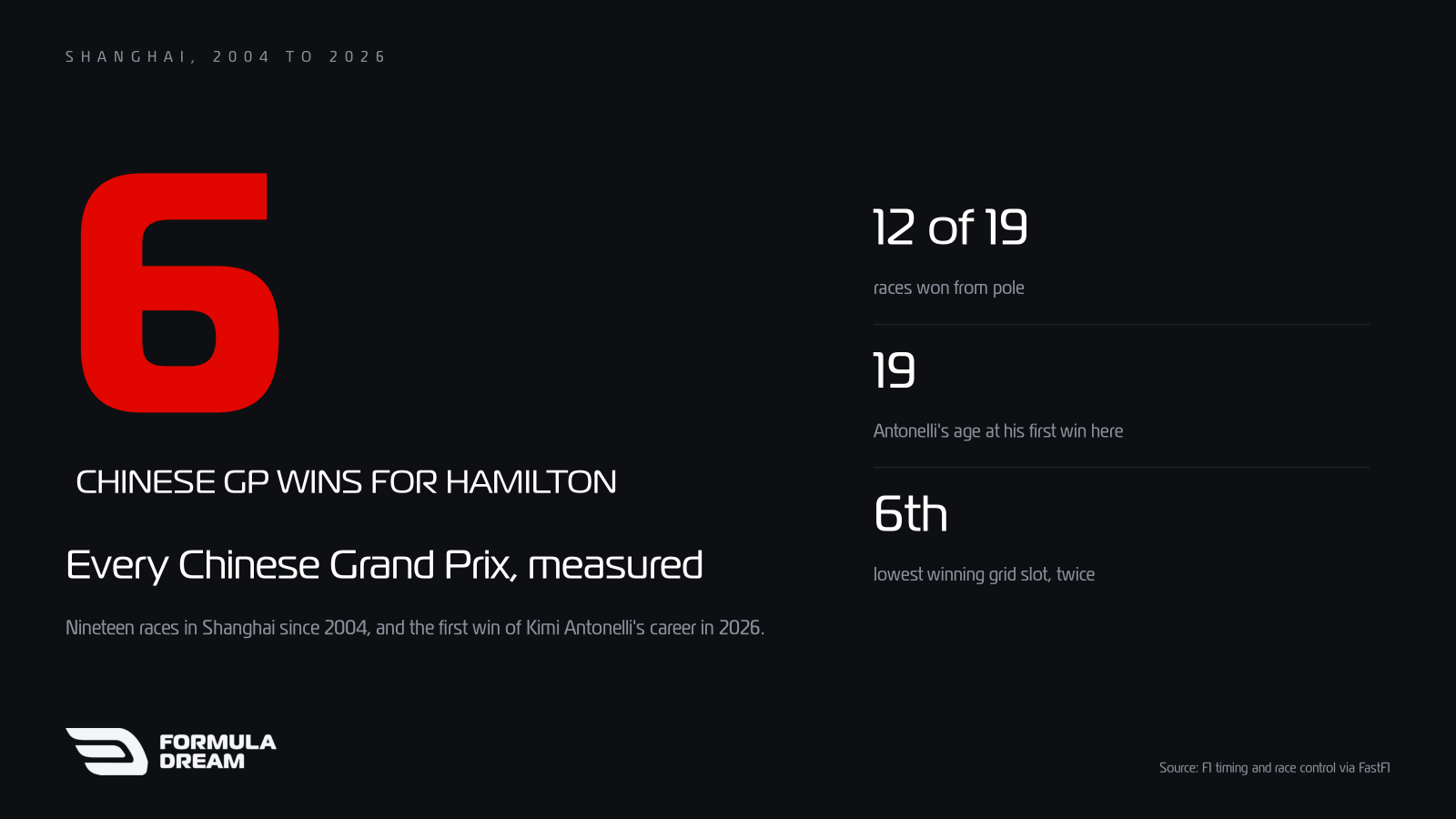
Nineteen Chinese Grands Prix have been held in Shanghai since 2004. Lewis Hamilton won six, pole won twelve, and in 2026 Kimi Antonelli took the first win of his career there, at 19, with Hamilton on the podium for Ferrari for the first time. Every winner, grid slot and safety car, measured.