F1 Penalties Explained: Time Penalties, Grid Drops and Points
F1 penalties explained, from 5 and 10-second time penalties to drive-throughs, stop-and-go, grid drops, penalty points on the super licence, and disqualification.
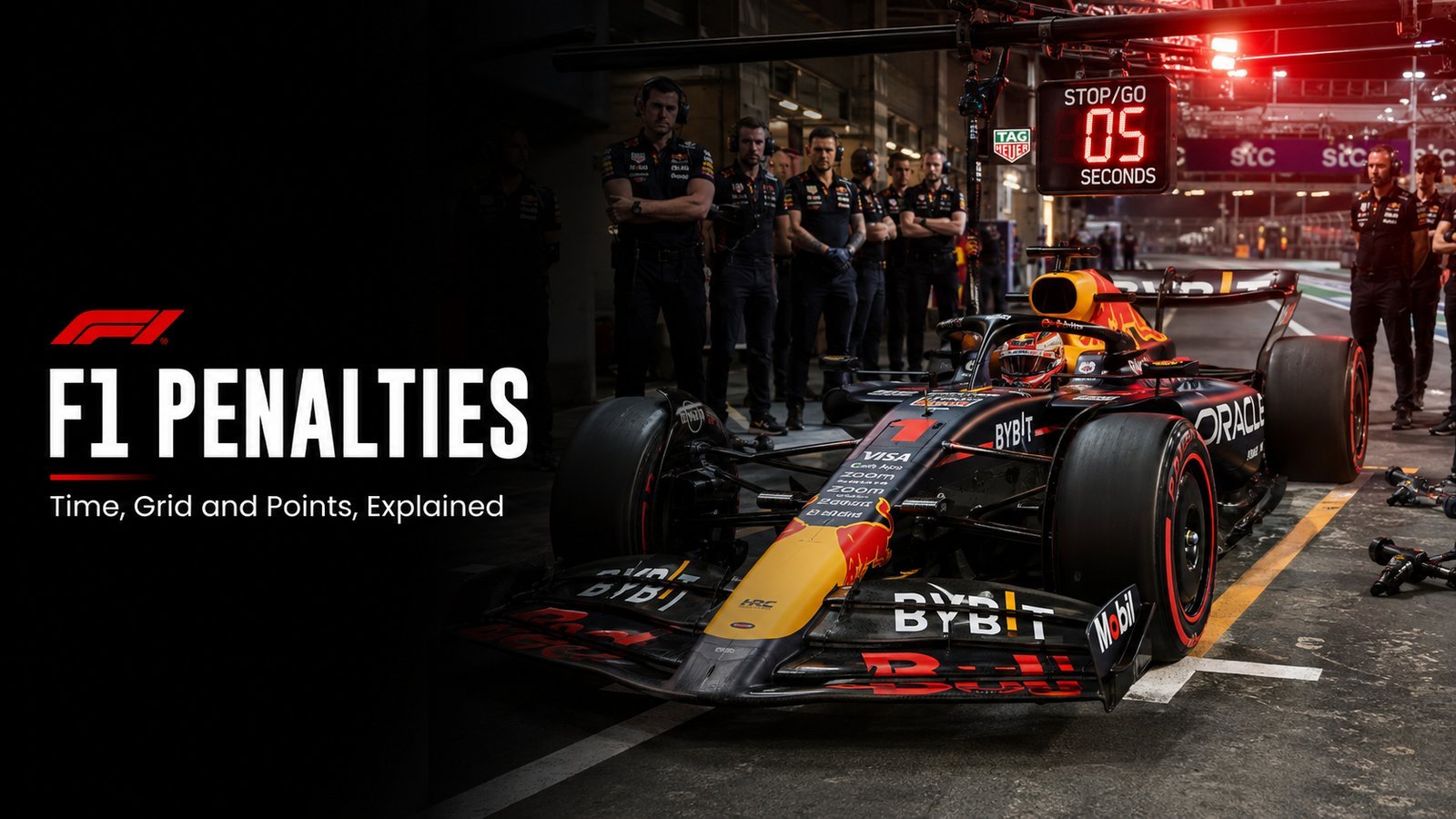
When a driver breaks the rules in Formula 1, the stewards have a whole ladder of penalties to choose from, ranging from a few seconds added to a race all the way up to a one-race ban. Which one they hand out depends on how serious the offence is and when it happened. Here is every F1 penalty, explained.
A penalty reaches the driver by radio, and the reply is usually the most quoted part of the weekend. Every message from the last race is in our Spanish Grand Prix 2026 race radio archive.
The stewards' options, from a light time penalty up to disqualification. Separately, 12 penalty points in 12 months triggers an automatic one-race ban.
Every F1 penalty at a glance
Penalty
What it is
Typical cost
5-second time penalty
Served at the next stop before mechanics touch the car, or added to the finishing time
5 seconds
10-second time penalty
Same mechanism, longer
10 seconds
Drive-through
Enter the pit lane, drive through at the limit, rejoin without stopping
Around 20 to 25 seconds
Stop-and-go
Stop in the box for a set time with no work allowed on the car
10 seconds plus the pit lane
Grid penalty
Drop a set number of places on the starting grid
Varies, commonly 3, 5 or 10 places
Penalty points
Added to the super licence, accumulating across 12 months
12 points in a year triggers a race ban
Disqualification
Removed from the results entirely
The whole race
The penalties available to F1 stewards, and roughly what each one costs.
Time penalties: 5 and 10 seconds
The most common penalty, usually for causing a collision or for leaving the track and keeping the advantage. The driver is given a 5-second or 10-second penalty, served in one of two ways:
If they still have a pit stop to make, the car must sit stationary in its box for the penalty time (5 or 10 seconds) before the mechanics are allowed to touch it, then the normal stop happens.
If they have no stop left, the time is simply added to their finishing time, which can drop them behind cars they crossed the line ahead of.
Drive-through and stop-and-go
These are harsher, served during the race, and reserved for more serious breaches.
A drive-through penalty means entering the pit lane, driving through at the pit-lane speed limit without stopping, and rejoining. It typically costs around 20 to 25 seconds.
A stop-and-go means entering the pit lane, stopping in the box for a set time (often 10 seconds), and then going, with the mechanics forbidden to work on the car while the penalty is served. It is the most costly in-race penalty short of disqualification.
Grid penalties
Some penalties are applied before a race rather than during it. A grid penalty drops a driver a number of places down the starting order for the next race. These are commonly given for using more power-unit or gearbox components than the season's allowance, or carried over for an offence late in the previous race.
Penalty points on the super licence
Alongside the in-race penalties, the stewards can add penalty points to a driver's FIA Super Licence. Accumulate 12 points within a rolling 12-month period and you trigger an automatic one-race ban. Each point drops off exactly 12 months after it was issued.
For 2026, the system was reformed so that penalty points are only handed out for genuinely dangerous, reckless or unsportsmanlike incidents, rather than for minor or borderline infringements, keeping the licence as a measure of real risk rather than bad luck.
Disqualification
At the top of the ladder is disqualification, shown by the black flag during a session or applied afterwards. A driver is thrown out of the result entirely, usually for a serious sporting breach or, most often, for a technical infringement found in post-race checks, a car that is underweight, has too much fuel used, or a part outside the rules.
When penalties get handed out
Many penalties come from incidents that happen under pressure, a clumsy overtake, a track-limits violation, or speeding under a safety car or VSC. The stewards review the evidence, hear from the driver if needed, and decide both the offence and the punishment. That is why you often see "under investigation" flash up on screen long before a verdict lands.
The driver finds out on the radio
A penalty is published as an FIA document, but the driver does not read documents at 300 km/h. They are told, by their engineer, mid-race, and their reaction is broadcast along with it.
That makes the radio the only record of what a penalty felt like from inside the car, as opposed to what it said on paper. Some of the most argued-about moments in the sport are a driver being informed of a decision and disagreeing with it in real time, and they are all in the team radio archive.
The penalty that needs no stewards at all
Most penalties are a judgement. A few are simply a measurement, and those are the ones that cost the most.
At the 2025 Chinese Grand Prix, Lewis Hamilton's car was checked after the race. The plank under the floor measured 8.6mm on the left, 8.6mm at the centreline and 8.5mm on the right, against the minimum of 9mm that applied in 2025, under Article 3.5.9 of that year's Technical Regulations. He was disqualified from the results.
There was no hearing about intent and no argument about fairness available. The plank either clears the limit or it does not, and his was short by less than half a millimetre. For 2026 the minimum is 8mm. The same weekend produced two further disqualifications for technical breaches.
This is the category of penalty teams fear most, because there is no mitigation. What the measurement is and why it exists is covered in why F1 cars spark.
Why a five second penalty is not five seconds
The most common penalty in the sport is also the most misunderstood.
A five-second penalty is normally served at the driver's next pit stop: the car stops in its box, and the crew may not touch it for five seconds before starting work. If the driver does not pit again, the five seconds are added to their final race time instead.
The practical cost varies enormously. Served at a stop, five seconds is five seconds. Added at the end of a race, it can be nothing at all if the driver has a ten second gap behind them, or it can lose three places if the field is compressed. The same penalty is worth wildly different amounts depending on where a driver is running, which is why you sometimes see a team tell a driver to build a gap rather than to attack.
The penalty that accumulates
Individual penalties are survivable. The ones that stack are not.
Penalty points attach to a driver's super licence rather than to a race result. Reach twelve within a twelve month period and it is an automatic one race ban. Points expire on a rolling basis exactly twelve months after they were issued, so a driver's total can fall as well as rise.
This is why a driver already carrying eight or nine points will visibly change how they race, and why a routine incident becomes a story when the commentary mentions the two points that came with it. The detail is in F1 penalty points and the race ban.
How often penalties actually happen
Track limits are the largest single source of deleted lap times and penalties, and the numbers are less even than you would expect.
We counted every deletion of the 2025 season. Kimi Antonelli had 42 lap times deleted, almost one for every race he started. The next highest was 27. In the identical Mercedes, George Russell lost 22, roughly half as many. Same car, same circuits, same rules, twice the deletions.
Every penalty in this article comes with a published document explaining it.
The Formula Dream app collects every FIA document of the weekend as it is released, which is where the decision behind a penalty actually appears, usually before the commentary catches up. It also runs a live Dashboard through every session with all the cars on the circuit map, a timing tower carrying lap times, gaps, intervals, tyre compound and age, flag and safety car alerts the moment race control calls them, and live driver radio as it is broadcast.
Free, no subscription, no ads, independent. Not affiliated with Formula 1.
Time penalties (5 or 10 seconds), drive-through and stop-and-go penalties, grid-position drops, penalty points on the super licence, and disqualification.
How is a 5-second penalty served?
Either the car stays stationary for 5 seconds at its next pit stop before the crew works, or, if no stop is left, 5 seconds are added to the driver's finishing time.
How many penalty points get a driver banned in F1?
Twelve penalty points within a rolling 12-month period trigger an automatic one-race ban. Points expire 12 months after they are issued.
What is the difference between a drive-through and a stop-and-go?
A drive-through means passing through the pit lane at the speed limit without stopping. A stop-and-go means stopping in the pit box for a set time (with no work allowed) before rejoining, so it costs more.
Why do drivers get disqualified after a race?
Usually for a technical breach found in scrutineering, such as an underweight car, excess fuel used, or a component outside the regulations.
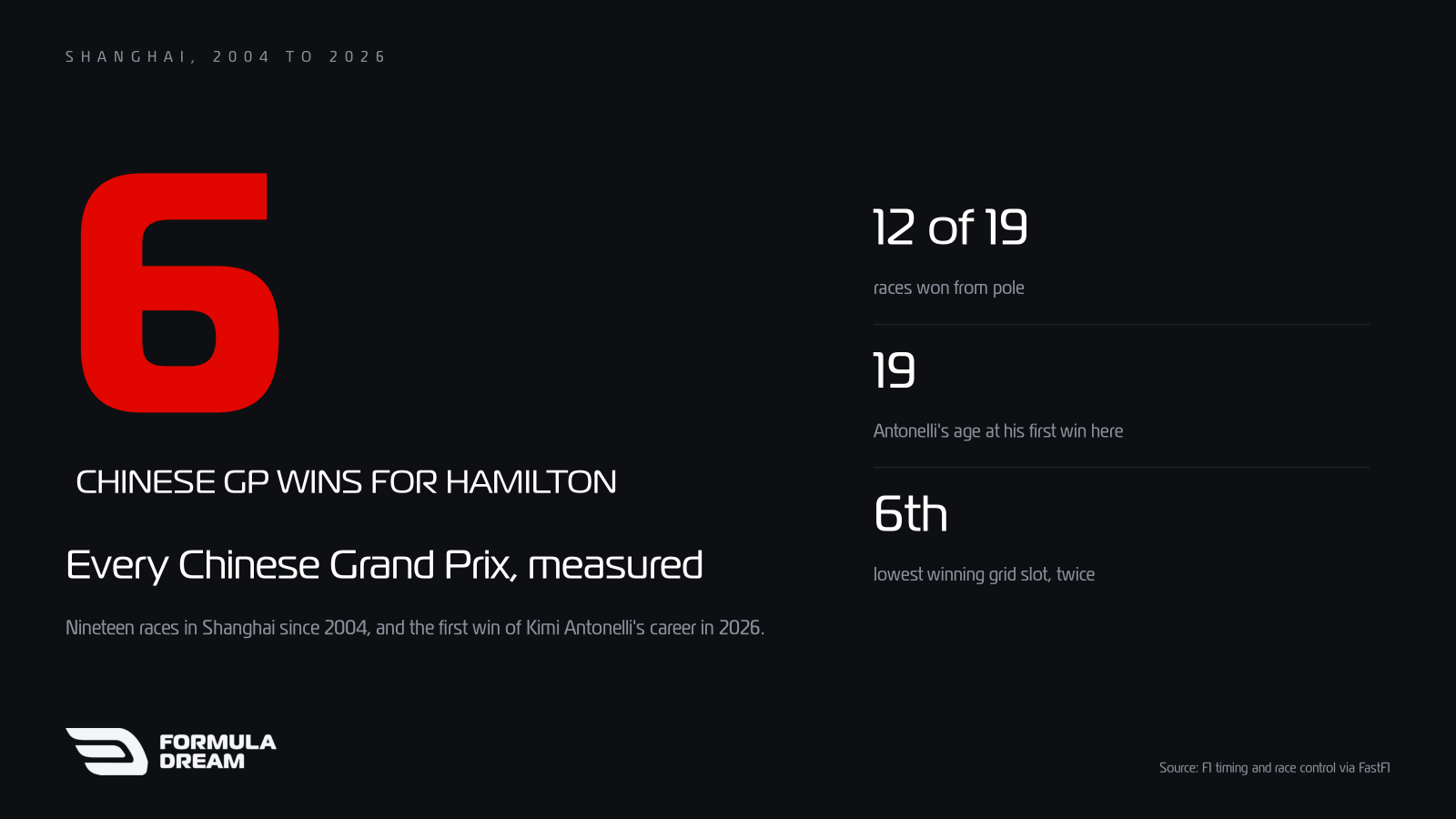
Nineteen Chinese Grands Prix have been held in Shanghai since 2004. Lewis Hamilton won six, pole won twelve, and in 2026 Kimi Antonelli took the first win of his career there, at 19, with Hamilton on the podium for Ferrari for the first time. Every winner, grid slot and safety car, measured.