How F1 Became So Safe: From a Deadly Sport to One Fatality in 30 Years
How F1 became so safe, the deadly decades when drivers died routinely, Jackie Stewart's crusade, the 1994 Imola weekend that changed everything, and the innovations that made the modern car survivable.
Today, an F1 driver can crash at 190 km/h, split their car in two, burst into flames, and climb out with only burned hands, as Romain Grosjean did in 2020. In the sport's early decades, a far smaller accident would simply have killed him. The transformation of Formula 1 from one of the deadliest activities on earth into one where a driver can survive almost anything is one of the great safety stories in all of sport. Here is how it happened.
The deadly decades
For much of its history, F1 was brutally lethal. Basic protections we now take for granted arrived shockingly late: helmets became compulsory only in 1953, fireproof overalls in
. Circuits were lined with trees, ditches, straw bales and unforgiving barriers, and in the 1960s and 1970s it was normal for
multiple drivers to die every single season
. Racing was glamorous and thrilling, and it regularly killed the people who did it.
The first man to seriously fight this was the three-time champion Jackie Stewart, who after a terrifying crash in 1966, trapped in his car soaked in fuel with no marshals able to help, campaigned relentlessly through the 1970s for barriers, seat belts and medical facilities, often against fierce resistance from those who thought danger was part of the sport. Alongside him, and for decades after, the FIA's medical delegate Professor Sid Watkins transformed the way the sport treated and prevented injury.
The weekend that changed everything: Imola 1994
For all that progress, the sport had a false sense of security by the early 1990s, with no driver killed at a Grand Prix for eight years. Then came the darkest weekend in F1 history. At Imola in 1994, the Austrian Roland Ratzenberger was killed in qualifying on the Saturday. The next day, in the race, the three-time world champion Ayrton Senna, one of the greatest drivers who ever lived, crashed at the Tamburello corner at over 200 km/h and died.
Losing a rookie and a legend on the same weekend, live on television around the world, shook Formula 1 to its core. It ended any complacency overnight and triggered the most thorough safety revolution the sport had ever undertaken, driven hard by Watkins and the FIA.
The revolution that followed
The changes since 1994 have been relentless, and they attack the problem from every angle:
The circuits. The FIA identified dozens of high-risk corners and rebuilt them, replacing concrete walls and gravel-lined danger zones with vast run-off areas that give a spinning car room to slow safely.
The barriers. Energy-absorbing barriers like SAFER (steel and foam) and TecPro replaced solid walls, soaking up the force of an impact instead of stopping a car dead.
The car. The carbon survival cell around the driver was strengthened and subjected to ever-tougher crash tests, so the structure stays intact even in enormous accidents.
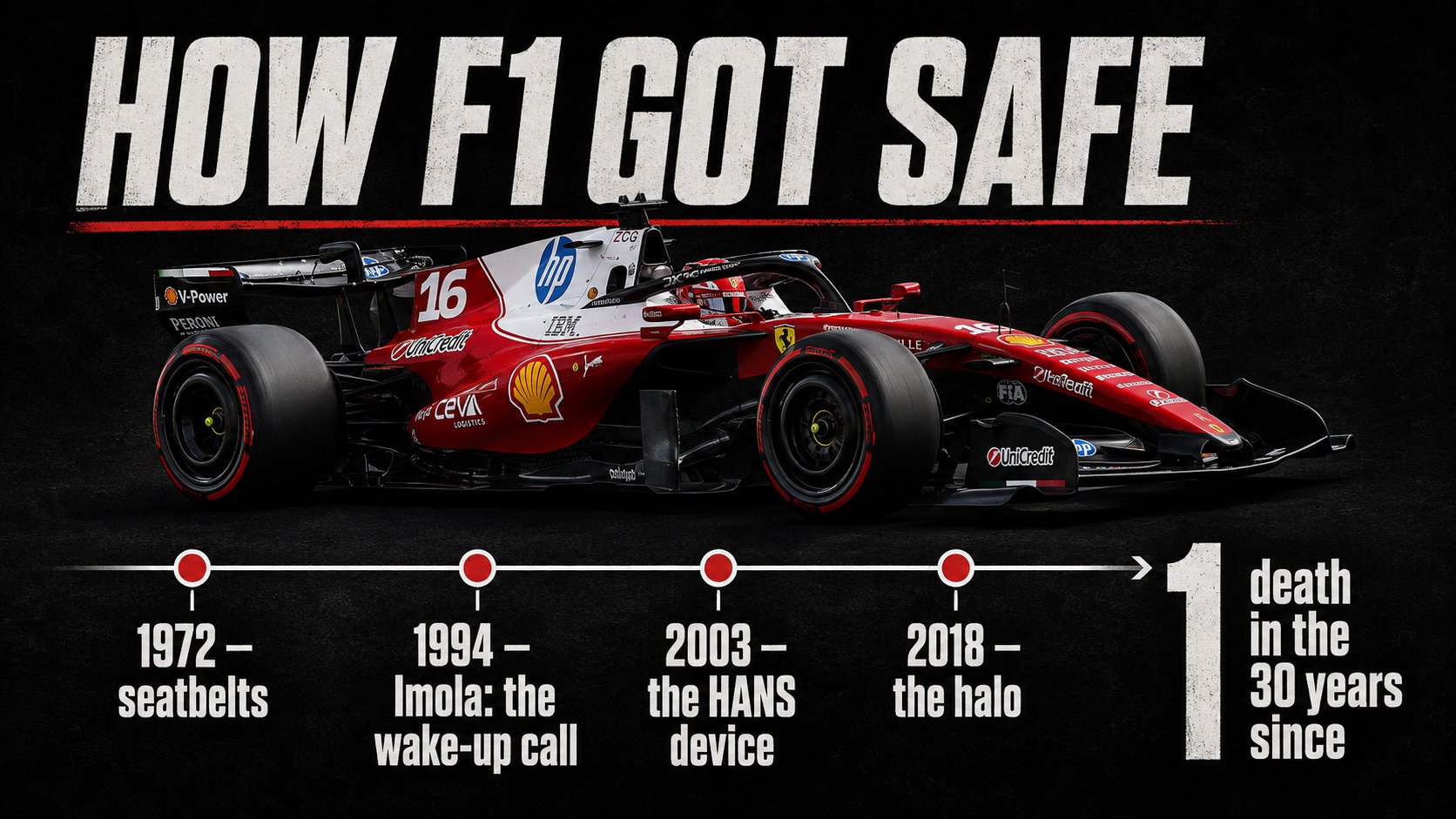
The driver. The HANS device arrived in 2003 to stop the head-and-neck injuries that had killed so many, and the halo in 2018 to protect the driver's exposed head from debris and other cars.
The response. Medical cars now follow the field on the opening lap and can reach a crash within about 30 seconds, and every race has a full trackside medical centre with surgeons and helicopters on standby.
The record that proves it worked
The result is staggering. In the three decades since the deaths of Senna and Ratzenberger in 1994, there has been only one fatality in Formula 1 championship competition: Jules Bianchi, who suffered fatal head injuries in a crash at the 2014 Japanese Grand Prix and died the following year. From a sport that killed several drivers a year, to one death in thirty years, while the cars got faster and faster. And Bianchi's death, too, drove change, accelerating the arrival of the halo.
The lesson the sport keeps learning
If there is one thread running through this whole story, it is that almost every major safety advance was resisted before it was accepted. Drivers and fans thought seat belts, then the HANS device, then the halo were unnecessary, ugly or against the spirit of the sport, right up until each one started saving lives. F1's safety is not the product of one breakthrough. It is the product of decades of unglamorous engineering, pushed through by people who refused to accept that dying was just part of racing.
Watch the safety systems in use
Modern safety is mostly invisible until an incident, and then it is decided in documents most fans never see.
The Formula Dream app collects every FIA document of the weekend as it is released, which is where the decision behind a penalty actually appears, usually before the commentary catches up. It also runs a live Dashboard through every session with all the cars on the circuit map, a timing tower carrying lap times, gaps, intervals, tyre compound and age, flag and safety car alerts the moment race control calls them, and live driver radio as it is broadcast.
Free, no subscription, no ads, independent. Not affiliated with Formula 1.
Through decades of change, especially after the 1994 Imola weekend: redesigned circuits with big run-off areas, energy-absorbing barriers, a strengthened carbon survival cell, the HANS device, the halo, and a fast, expert medical response.
What was the turning point for F1 safety?
The 1994 San Marino Grand Prix at Imola, where Roland Ratzenberger was killed in qualifying and Ayrton Senna died in the race on the same weekend. It triggered the sport's biggest ever safety overhaul.
How many drivers have died in F1 since 1994?
Only one in championship competition: Jules Bianchi, who died in 2015 from injuries in a 2014 crash. Before 1994, multiple drivers often died every season.
Who improved F1 safety the most?
Many people, but the champion Jackie Stewart campaigned for it through the 1970s, and the FIA's medical delegate Professor Sid Watkins led the modern medical and safety revolution for decades.
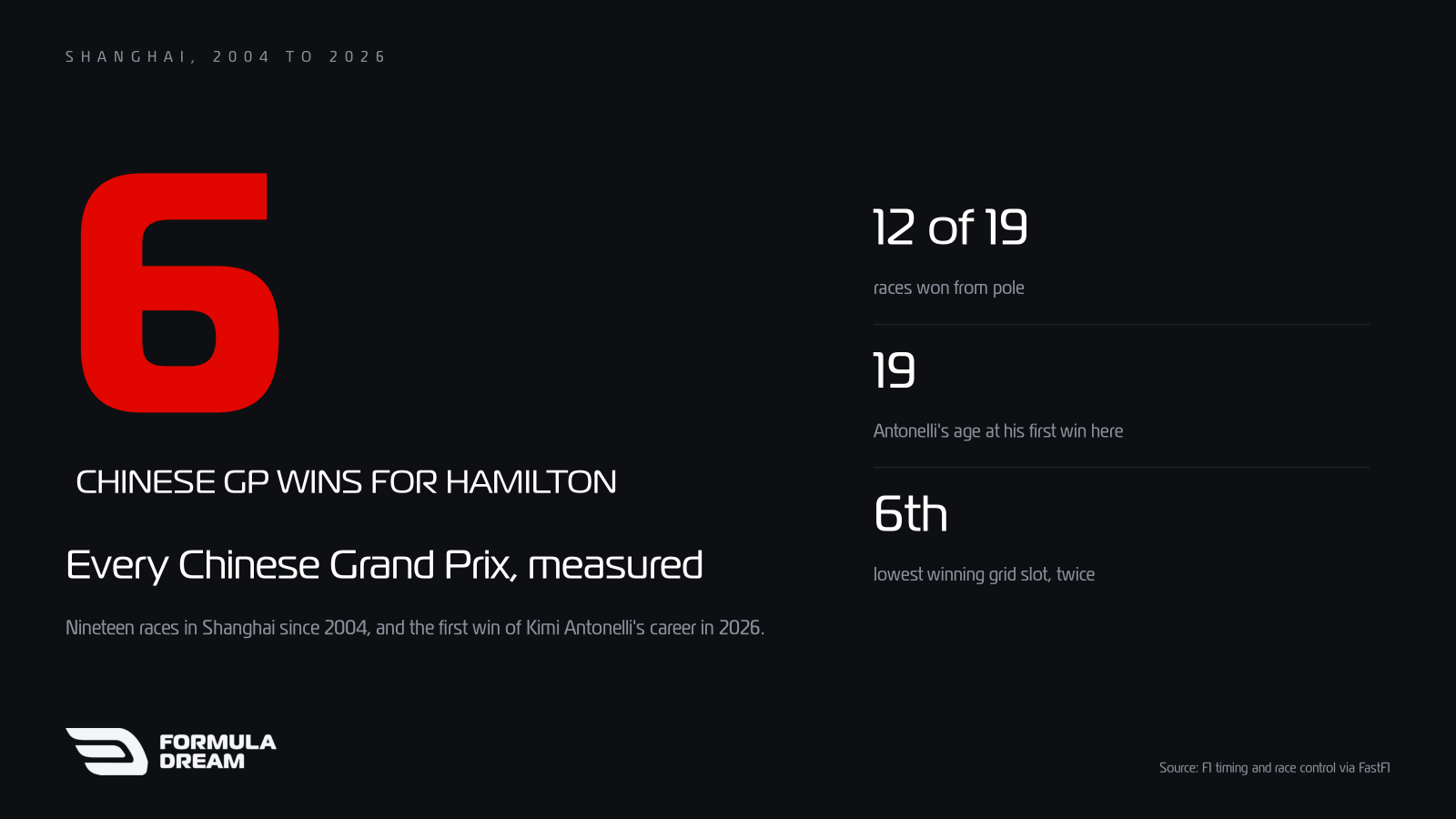
Nineteen Chinese Grands Prix have been held in Shanghai since 2004. Lewis Hamilton won six, pole won twelve, and in 2026 Kimi Antonelli took the first win of his career there, at 19, with Hamilton on the podium for Ferrari for the first time. Every winner, grid slot and safety car, measured.