How F1 Drivers Train: The Most Brutal Seat in Sport
How F1 drivers train, why sitting in the car is one of the most physically punishing jobs in sport, the neck work, the 50 degree heat, the half-marathon heart rate, and the weight they sweat off every race.
To the untrained eye, an F1 driver just sits down and steers. In reality, driving a Formula 1 car for two hours is one of the most physically punishing tasks in all of sport, closer to running a half-marathon in a sauna while someone tries to rip your head off. F1 drivers are elite athletes, and they have to be, because a body that fades in the final laps makes mistakes that cost races. Here is what the job actually does to them, and how they train for it.
The neck: the signature of an F1 driver
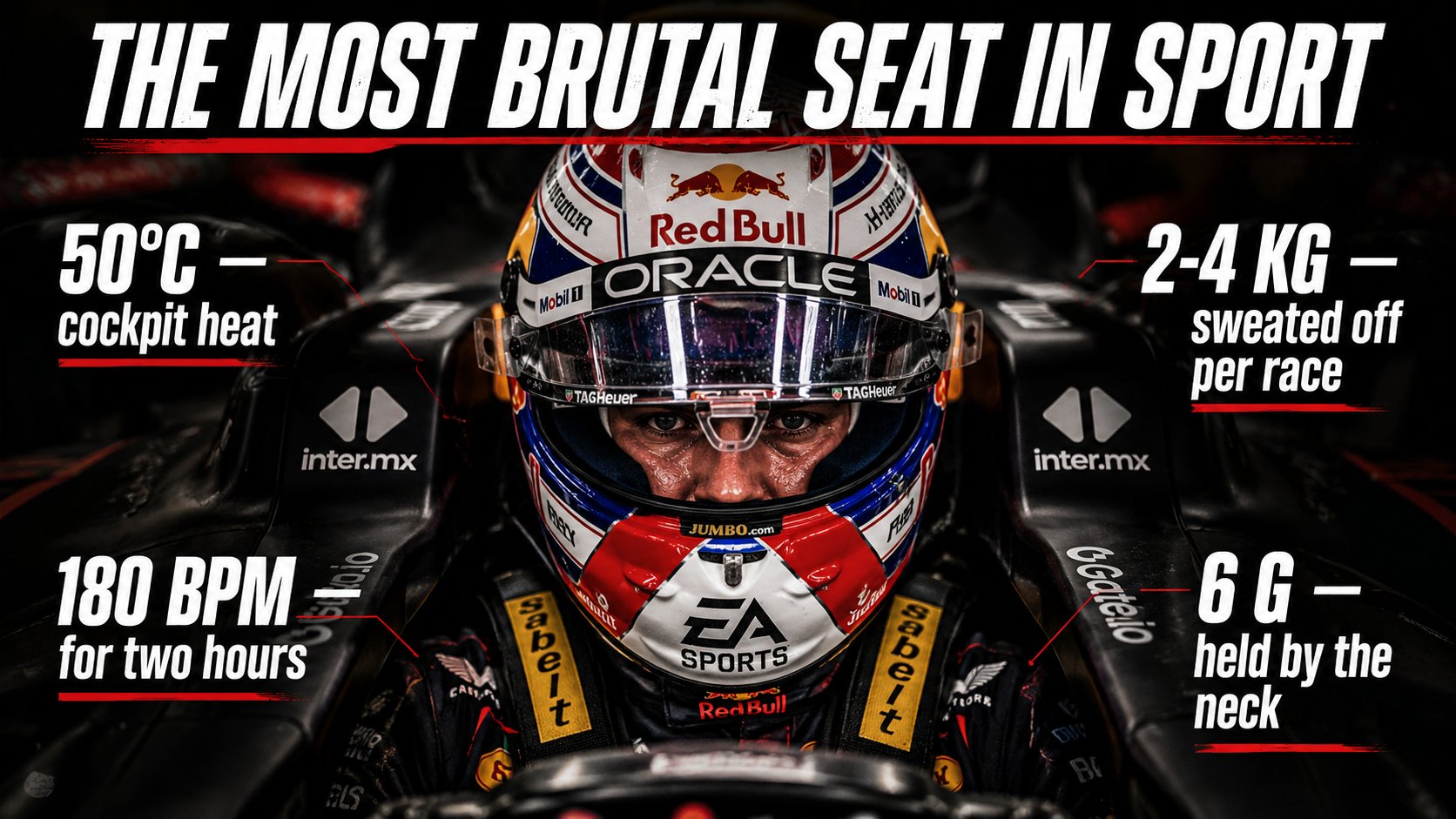
The most distinctive part of an F1 driver's fitness is the neck, because it is the one thing no seat belt can protect. In the fastest corners and under heavy braking, a driver pulls around
To cope, drivers train their necks harder than almost any other muscle group, often five or more times a week, using resistance bands, pulley systems and weighted helmets, holding their head steady against loads that would leave an untrained person in agony. It is why F1 drivers, slim as they are, tend to have visibly thick, muscular necks.
The heart: a half-marathon at race pace
An F1 cockpit is not a restful place. Across a race distance of nearly two hours, a driver's heart rate sits between roughly 150 and 180 beats per minute, and stays there. That is the intensity of running a half-marathon at race pace, sustained for the length of a Grand Prix, all while making split-second decisions at 300 km/h.
To build that engine, drivers spend hours on cardiovascular work, cycling, rowing and high-intensity interval training, so their hearts and lungs can hold that output without their concentration ever slipping.
The heat: sweating off two to four kilos
Then there is the heat. Sealed into a tight cockpit next to a power unit, in fireproof overalls and a helmet, a driver endures cockpit temperatures that regularly climb above 50 degrees Celsius. Over a race, they sweat off between two and four kilograms of body weight, and unlike a marathon runner, they cannot stop to drink whenever they like. They have only a single drinks bottle, piped to the helmet through a tube, and a limited amount of fluid to last two hours.
Dehydration on that scale saps strength, blurs focus and slows reactions, so part of a modern driver's training is deliberately building heat tolerance, and teams even test how a driver's body copes with heat stress as part of their assessment.
The core, and the mind
Underpinning it all is core strength. A strong, stable core is what lets a driver brace against the constant jolts, the braking and the cornering forces, keeping their body still so their hands and feet can be precise. And laced through everything is the mental side: an F1 driver has to make decisions and react in around 0.2 seconds, lap after lap. The real danger is fatigue, because a tired body reacts slower, brakes less precisely and concentrates less, and that is exactly when mistakes creep in during the closing laps. Fitness, for an F1 driver, is not about looking strong. It is about being just as sharp on the last lap as on the first.
A driver's body mass is not a private matter in Formula 1, because it is part of the car.
The minimum weight for 2026 is 768kg, and that figure includes the driver, their seat and their full kit. It excludes fuel. Drivers are weighed separately after qualifying and the race precisely because the two halves of that sum have to stay honest.
The consequence is that a driver carrying extra mass is carrying it as lap time, at roughly a tenth of a second per 10kg. That is the real pressure behind F1 fitness: a driver needs the muscle to survive the forces and cannot afford the weight that muscle costs. It is why the training is so specifically targeted at the neck and core rather than general bulk, and why nutrition is managed as tightly as the physical work.
It also cuts the other way during a race. Drivers can lose several kilograms in a hot Grand Prix through sweat alone, which is a performance gain and a serious dehydration problem at the same time. The weight rules are covered in how much an F1 car weighs.
What the neck is actually holding
The specific load is easy to underestimate.
A driver's head plus helmet weighs roughly 6.5kg. Our telemetry shows the fastest corners generating 5.6g through 130R at Suzuka and around 5.7g at Copse, and at six g that 6.5kg pulls on the neck like about 40kg trying to wrench it sideways.
That happens at every fast corner, on every lap, for up to two hours, and no belt can help because the head has to stay free to see. The full breakdown is in how many g's F1 drivers experience.
Hear what two hours of it sounds like
The training exists for the last twenty laps. You can hear when a driver reaches them.
The Formula Dream app carries live driver radio as it is broadcast, which is where this shows up in a driver's own words rather than in a summary. Alongside it, a live Dashboard puts every car on the circuit map with a timing tower carrying lap times, gaps, intervals, tyre compound and age, plus flag and safety car alerts as race control calls them, and every FIA document of the weekend as it is published.
Free, no subscription, no ads, independent. Not affiliated with Formula 1.
Yes. Driving an F1 car sustains a heart rate of 150 to 180 bpm for nearly two hours, subjects the body to 6g repeatedly, and is done in over 50 degrees of heat. It is one of the most physically demanding activities in sport.
Why do F1 drivers train their necks so much?
Because in fast corners and under braking they pull around 6g, which makes their head and helmet feel many times heavier and loads the neck enormously. They train it five or more times a week to hold their head steady.
How much weight do F1 drivers lose in a race?
Between two and four kilograms, mostly through sweat, because cockpit temperatures can exceed 50 degrees Celsius and drivers have only limited fluid available during the race.
What is an F1 driver's heart rate during a race?
Typically between 150 and 180 beats per minute, sustained for the whole race, roughly the same as running a half-marathon at race pace.
Nineteen Chinese Grands Prix have been held in Shanghai since 2004. Lewis Hamilton won six, pole won twelve, and in 2026 Kimi Antonelli took the first win of his career there, at 19, with Hamilton on the podium for Ferrari for the first time. Every winner, grid slot and safety car, measured.