How Much Does an F1 Car Weigh in 2026? | Formula Dream
Guides
How Much Does an F1 Car Weigh? The 2026 Diet, Explained
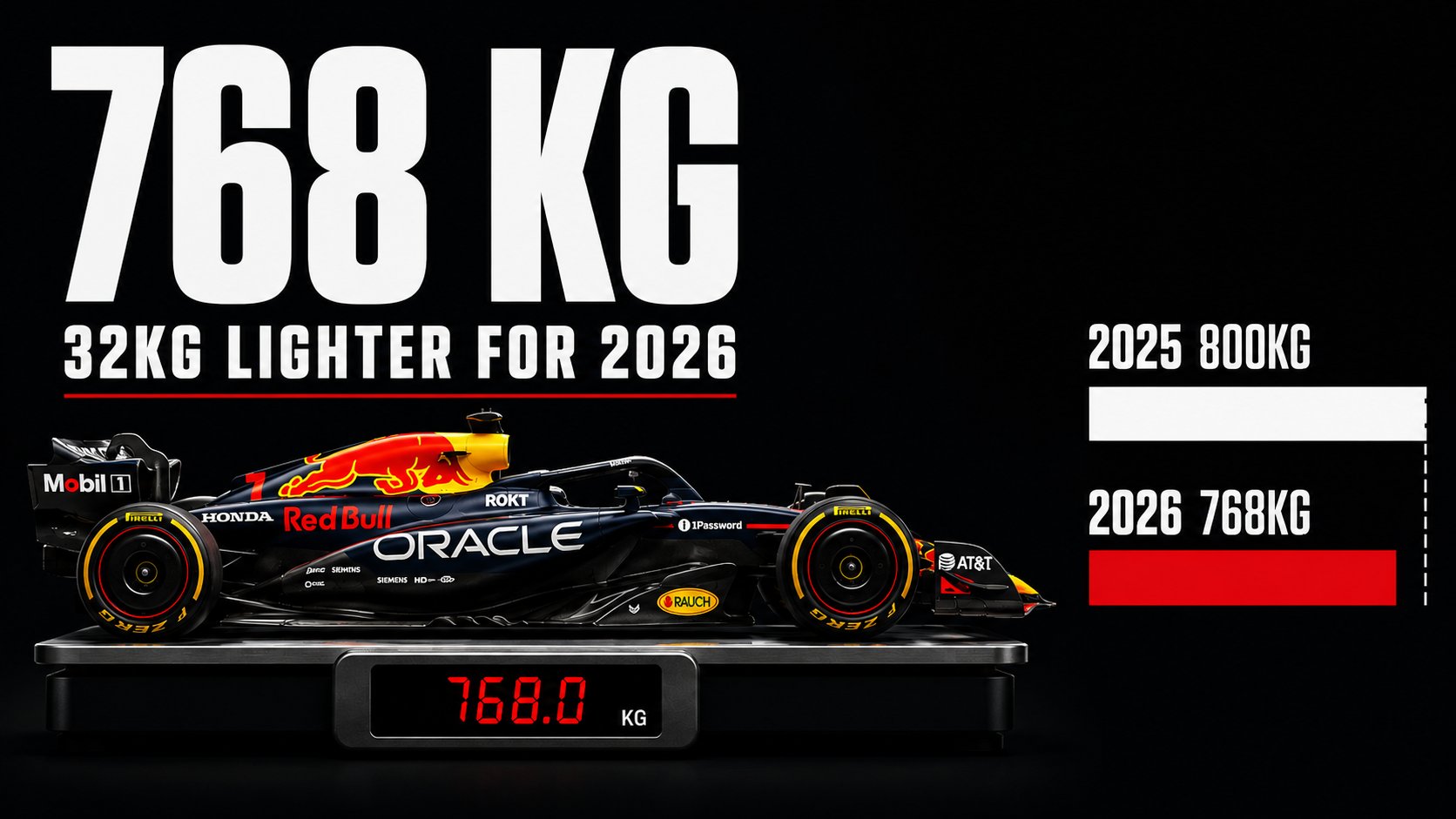
The 2026 minimum is 768kg, 32kg lighter than 2025 and the first real reversal after two decades of F1 cars getting steadily heavier. Here is what changed and why it matters.
The minimum weight of a Formula 1 car in 2026 is 768kg. That is 32kg lighter than the 800kg limit that applied in 2025.
It is a small-sounding number with a lot behind it, because it is the first meaningful reversal after years of F1 cars getting heavier: the limit reached 798kg when the ground effect cars arrived in 2022, and 800kg in 2025. The sport finally decided to do something about it.
Here is what that figure actually includes, how the weight was found, and why a few dozen kilograms matter this much.
The minimum weight is not the weight of the car on its own. Under Article C4.1 of the 2026 Technical Regulations it is written as 724kg plus the Nominal Tyre Mass, the average weight of a set of new dry tyres, measured by Pirelli before the season. That is the widely quoted 768kg. In qualifying and sprint qualifying the base figure is 2kg higher, at 726kg.
The weight that is checked against it, the "Car Mass", is:
The car, including its tyres
The driver, with their seat and driving equipment, but not the safety harness
Any driver ballast
It excludes fuel. A car is weighed to this standard without its fuel load, which is why a car at the start of a race is considerably heavier than its stated minimum.
Including the driver is a deliberate fairness measure. Without it, a lighter driver would be a free performance advantage, and teams would have an incentive to select drivers on body mass rather than skill.
The rules also set a floor for the driver: under Article C4.5.2 the driver plus any driver ballast must weigh at least 82kg, so a lighter driver carries ballast in the cockpit. And when the FIA declares a Heat Hazard, the minimum rises by 5kg for the race and 2kg in other sessions, to allow for cooling equipment.
Why there is a minimum at all
Lighter is faster, in every direction. A lighter car accelerates harder, brakes later, changes direction more willingly and is kinder to its tyres. Given a free hand, teams would build the lightest car they could and keep going.
A minimum weight stops that becoming a spending race with a safety cost. Chasing weight means exotic materials, thinner sections and less margin, and the cheapest kilogram to remove is often the one holding something together. The floor exists so that the trade stops somewhere sensible.
If a car comes in under the limit, the team adds ballast, dense material bolted low in the chassis to make up the difference. That is not a penalty, it is an opportunity: ballast can be positioned to move the car's centre of gravity, so a genuinely light car is a design advantage even when the scales read the same as everyone else's.
Coming in under the minimum at scrutineering is a different matter and risks disqualification.
Years of getting heavier
The reason 768kg is notable is the trend it interrupts.
Modern F1 cars had been getting steadily heavier for years, reaching 798kg in 2022. The causes are mostly good ones, which is what made the trend so hard to stop:
Hybrid power units. The turbo-hybrid is vastly more complex than the engines it replaced, with an energy store, control electronics and motor generator units all adding mass.
Safety. The survival cell, side impact structures, the halo and successive crash test increases all weigh something, and none of it is optional.
Larger cars. Wider tracks, longer wheelbases and bigger tyres, all adopted for performance and spectacle.
Ground effect floors since 2022, which are large, complex structures.
Drivers have complained about it consistently. Heavier cars are less agile, harder to place on a narrow circuit, and less rewarding to drive. It is also why some historic tracks feel tight in a way they did not fifteen years ago: the cars grew.
How 2026 found 32kg
The weight did not come off by asking nicely. The cars were made physically smaller:
Maximum wheelbase cut by 200mm, to 3,400mm
Width cut by 100mm, to 1,900mm
Front tyres 25mm narrower, and rears 30mm narrower
Less car means less material. It also means a more agile machine on the same circuits, which was the point: the FIA described the target as a nimbler car, not merely a lighter one.
The change is aggressive enough that teams have found it genuinely difficult, with reports through development that most cars would start the season overweight. Being over the minimum is legal, it is just slow, and the time it costs is real.
Does weight actually cost lap time?
Yes, and by more than most people assume. Arguing about the 2026 limit in 2025, Red Bull's Christian Horner put it at "every 10kg is about 0.35 seconds" a lap. The exact figure depends on the circuit.
On that basis the 32kg reduction is worth around a second a lap, which in a modern grid is an enormous margin. It also compounds: a lighter car is easier on its tyres, so it loses less through a stint as well, which matters given how degradation drives strategy.
That said, 2026 cars are still slower overall than 2025 cars, because the weight saving is swamped by the loss of aerodynamic downforce. We measured pole laps as 3.046% slower at the ten circuits raced in both seasons, with no exceptions. The car got lighter and still lost time, which tells you how much of an F1 lap is bought with downforce rather than mass. The comparison is in are F1 cars getting faster.
Why drivers get weighed
You will see drivers weighed after qualifying and the race. This is not curiosity, it is the same rule being enforced from the other end.
Because the minimum includes the driver, a team could otherwise run a car underweight and make it up with a heavier driver on the scales at scrutineering, or vice versa. Weighing the driver separately, with their kit, keeps the two halves of the sum honest. It is also why hydration and weight loss across a race are a real engineering consideration rather than a curiosity, and drivers can lose several kilograms during a Grand Prix, which is covered in how F1 drivers train.
Watch what the weight buys
Weight is one of those specifications that only becomes real as lap time, in the last ten laps of a stint.
The Formula Dream app runs a live Dashboard through every session: every car on the circuit map, and a timing tower with lap times, gaps and intervals, tyre compound and age, plus flag and safety car alerts as race control calls them. Watching lap times hold or fall away across a stint is where a light car and a heavy one separate. You also get live driver radio as it is broadcast, and every FIA document of the weekend as it is published, including the scrutineering reports where weight is actually checked.
Free, no subscription, no ads, independent. Not affiliated with Formula 1.
The 2026 minimum is 768kg, written in the rules as 724kg plus the weight of a set of tyres, down from 800kg in 2025. It includes the car, its tyres and the driver with their seat and equipment, but excludes fuel.
Does the minimum weight include the driver?
Yes. The driver, their seat and their kit are all included, which stops a lighter driver being a free performance advantage. The driver plus any ballast must weigh at least 82kg.
Why did F1 make the cars lighter for 2026?
To reverse years of weight gain and produce a more agile car. It was done largely by shrinking the car: 200mm off the maximum wheelbase, 100mm off the width, and narrower tyres.
How much lap time is 10kg worth in F1?
About 0.35 seconds a lap, according to Red Bull's Christian Horner, depending on the circuit. On that basis the 32kg saved for 2026 is worth around a second.
What happens if an F1 car is underweight?
It risks disqualification. Teams that build under the limit add ballast to make up the difference, which is an advantage rather than a problem because ballast can be placed low to improve the centre of gravity.
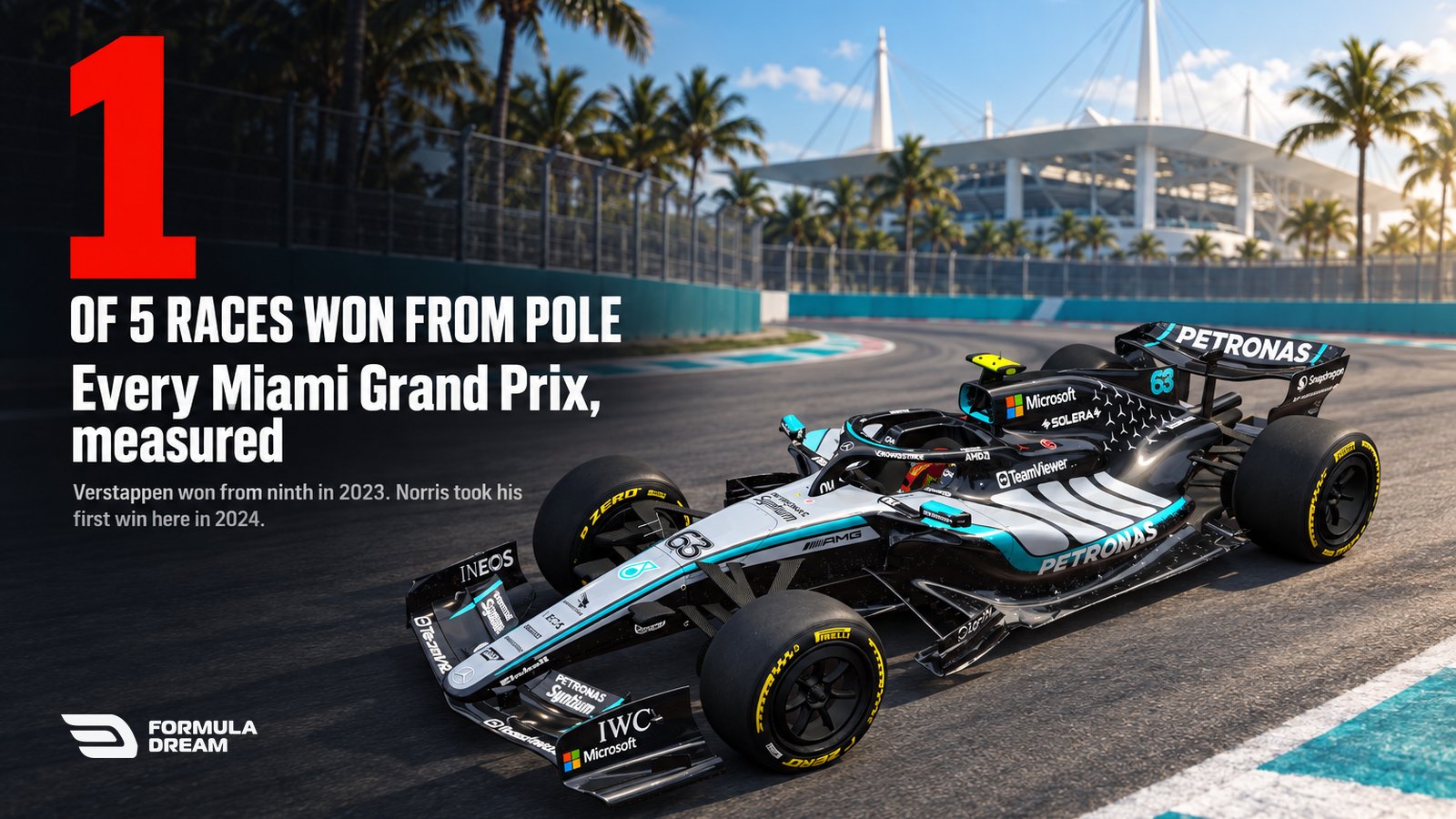
Every Miami Grand Prix winner, measured: five races, and pole has won only one of them
Five Miami Grands Prix have been held since 2022, and only one was won from pole: Kimi Antonelli's in 2026. Max Verstappen won from ninth in 2023, and Lando Norris took his first win there in 2024. Every winner, grid slot and safety car, measured.