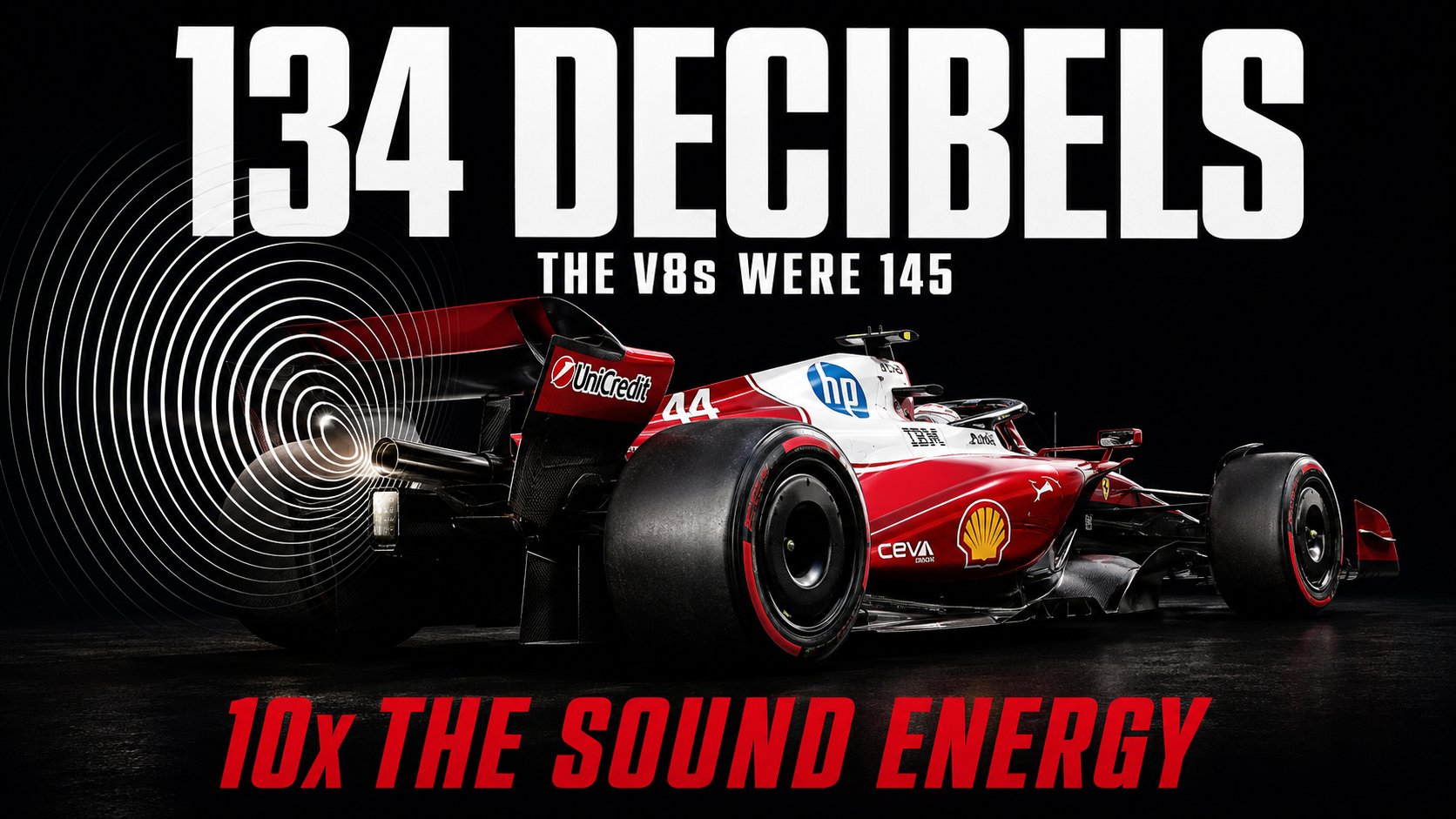
A modern Formula 1 car measures around 134 decibels. The V8s they replaced measured about 145.
Eleven decibels does not sound like much. It is enormous. Decibels are logarithmic, so every 10dB step is a tenfold change in sound intensity and roughly a halving of how loud something seems to a human ear. An 11dB drop means the V8s were putting out well over ten times the sound energy, and sounded around twice as loud.
The other sound of a race weekend is the radio, and that one you can play back. Every message from the most recent race is in our
That is the real answer to why the complaints started in 2014 and never entirely stopped. Here is what changed and why.
The numbers
V8 era (to 2013): around 145dB
V6 turbo hybrid (2014 onwards): around 134dB
Recent cars at full speed: still close to 130dB
For scale, 134dB is not quiet by any ordinary standard. It is above the threshold at which sound becomes physically painful, which is why ear protection at a circuit is not an affectation. The cars did not become quiet. They became quieter than something extraordinarily loud.
Why the hybrids are quieter
Three things happened at once in 2014, and they compound.
The turbocharger. This is the biggest single factor and the least obvious. A turbo sits in the exhaust stream, and its turbine wheel is driven by exhaust gas. That means it intercepts a large amount of the acoustic energy and pressure waves that would otherwise have exited straight out of the pipe as noise. A turbo is, incidentally, a muffler. The old naturally aspirated engines had nothing in the way.
Fewer cylinders and lower revs. A V6 fires less often per revolution than a V8, and modern power units rev lower than the screaming V10s of the 2000s. Both lower the pitch and change the character of the sound, which is much of what people are actually reacting to when they say it sounds wrong.
The energy recovery system. Some of the energy that used to leave the car as heat and noise is now captured and reused. That is not incidental, it is the entire point.
The trade nobody argues with
The change was not made for its own sake. It bought something significant.
The current power unit achieves roughly 50% thermal efficiency, against about 30% for the V8s it replaced. That means half the energy in the fuel reaches the wheels, which makes it one of the most efficient engines ever built by anyone, for any purpose.
Noise, in engineering terms, is wasted energy. A loud engine is partly an engine throwing energy away as sound and heat. The V10s and V8s sounded magnificent in large part because they were wasteful.
So the honest framing is a trade: the sport gave up a substantial amount of spectacle for a genuine engineering achievement, and it made that trade deliberately.
Why the sound still bothers people
Volume is only part of it, and arguably the smaller part.
What changed more is character. A high-revving naturally aspirated engine produces a pure, piercing note that rises cleanly with revs. A turbocharged V6 produces something lower, flatter and more muffled, with the turbo smoothing the edges off the sound. You can be standing at a circuit, with the sound still physically painful, and find it less thrilling than something quieter but sharper.
There is also the matter of what people are comparing against. The V8 era is the direct comparison, but the sound most often invoked is the V10, which was louder still and higher pitched. The memory being defended is usually two engine formulas old.
What 2026 changes
The 2026 rules keep the turbo hybrid architecture and push further in the same direction, with the electrical side of the power unit taking a much larger share of total output and the MGU-H removed entirely.
More electrical deployment does not make a car louder. The direction of travel is towards efficiency and electrification, in step with the road car industry the manufacturers actually sell into, which is the commercial logic that has kept this formula in place despite the complaints.
What has changed for 2026 is elsewhere: less downforce, smaller and lighter cars, and active aerodynamics replacing DRS. The sound is not the part being fixed.
Will F1 go back to V10s?
It gets raised periodically, including by senior figures in the sport, and it has never happened.
The obstacle is not nostalgia, it is manufacturers. Building a large naturally aspirated engine has nothing to do with what any of the current power unit suppliers make or sell, and F1 depends on those manufacturers being willing to spend enormous sums competing. A formula they have no commercial reason to enter is a formula with no entrants.
Any return to a louder engine would need to arrive with sustainable fuel doing the environmental work instead of hybridisation. That conversation exists. It has not produced a rule.
What it sounds like from inside
Every decibel figure here is measured from trackside, which is the one place a driver never stands. The closest you can get to the noise as they experience it is team radio, because the engine is the background of every message: the car is audible behind the voice, rising and falling with the throttle while somebody tries to talk over it.
It is also why radio is clipped and hard to hear, and why engineers use short hard words that survive the noise. The team radio archive has the audio alongside a transcript for exactly that reason.
Hear it for yourself
The engine note is only one part of what a session sounds like, and the more interesting audio is usually the radio.
The Formula Dream app carries live driver radio as it is broadcast, alongside a live Dashboard with every car on the circuit map and a timing tower showing lap times, gaps, intervals, tyre compound and age, plus flag and safety car alerts as race control calls them. You also get every FIA document of the weekend as it is published.
Free, no subscription, no ads, independent. Not affiliated with Formula 1.
Around 134 decibels for the current turbo hybrid cars, compared with roughly 145 decibels for the V8s used until 2013. Both are loud enough to require ear protection at a circuit.
Why are F1 cars quieter now?
Mainly the turbocharger, which sits in the exhaust stream and absorbs a large amount of the acoustic energy that used to exit as noise. Fewer cylinders and lower revs also lower the pitch, and the hybrid system recovers energy that was previously wasted as heat and sound.
Is 11 decibels a big difference?
Yes, much bigger than it sounds. Decibels are logarithmic, so 10dB represents a tenfold change in sound intensity and roughly a halving of perceived loudness. The V8s were putting out more than ten times the sound energy of the current cars.
Are the 2026 F1 cars louder?
No. The 2026 rules keep the turbo hybrid layout and increase the electrical share of the power output, so the direction is towards efficiency rather than noise.
Will F1 bring back V10 engines?
It is discussed periodically but faces a commercial obstacle rather than a technical one. Manufacturers compete in F1 because the technology relates to what they sell, and a large naturally aspirated engine does not.
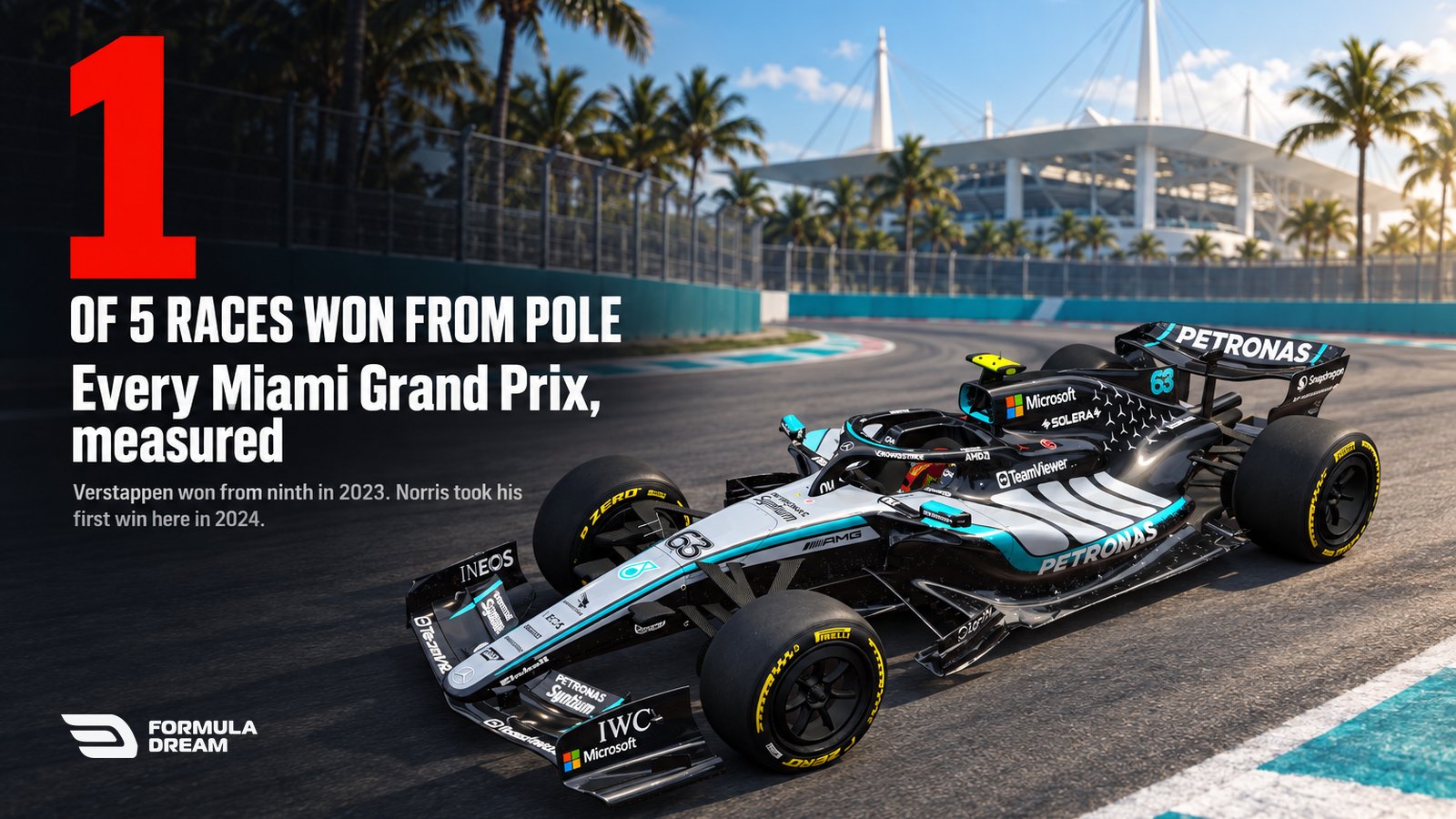
Every Miami Grand Prix winner, measured: five races, and pole has won only one of them
Five Miami Grands Prix have been held since 2022, and only one was won from pole: Kimi Antonelli's in 2026. Max Verstappen won from ninth in 2023, and Lando Norris took his first win there in 2024. Every winner, grid slot and safety car, measured.