F1 Power Unit 2026 Explained: How It Works | Formula Dream
Guides
F1 Power Unit Explained: The Most Efficient Engine on Earth
The 2026 F1 power unit explained: the turbo V6, the far more powerful MGU-K, why the MGU-H was dropped, how electric power fades at high speed, and why F1 engines are so efficient.
People still call it "the engine", but that word badly undersells what powers a modern Formula 1 car. It is a power unit: a petrol engine fused with an electric motor-generator into a hybrid system that is, by one crucial measure, the most efficient engine humanity has ever built. It makes around 1,000 horsepower, and it does so while wasting less of its fuel than any other engine on the planet. Here is how the 2026 power unit works, what changed from the hybrid engines that came before, and why that efficiency is such a big deal.
1,600cc turbocharged V6, 90 degrees, four valves per cylinder
MGU-K output
350 kW, up from 120 kW
MGU-K maximum torque
500 Nm
MGU-H
Removed entirely
Engine rev limit
None set in the 2026 rules
Fuel energy flow limit
3,000 MJ per hour
Energy recovery per lap
8.5 MJ, reduced to 7 MJ at some circuits
Fuel
Advanced sustainable fuel
2026 Formula 1 power unit rules, from the FIA Technical Regulations and Formula 1.
There is no rev limit any more
From 2014 to 2025 an F1 engine was capped at 15,000 rpm. The 2026 Technical Regulations set no crankshaft rev limit at all. What limits the engine instead is fuel: the energy flowing into it may not exceed 3,000 MJ per hour, and below 10,500 rpm the permitted flow is lower still. So we went and looked at what the engines actually do.
Taking the fastest lap for every driver in second practice at Monza in 2026, the highest engine speed recorded anywhere on the circuit was 12,826 rpm. That is at the fastest venue on the calendar, on a qualifying-style lap, and well below the old 15,000 rpm ceiling. A year earlier, with that ceiling still in force, the same measurement at Monza topped out at 12,743 rpm. Removing the rev limit changed almost nothing.
Engines are geared and mapped for the power band that actually produces lap time, and with the fuel flow capped, revving higher buys little. Anyone quoting 15,000 rpm as "what an F1 engine revs to" is quoting an old rule, not the car.
The internal combustion engine
At the heart of the power unit is a 1.6-litre turbocharged V6 petrol engine. Compared to the screaming V8s, V10s and V12s of the past it is small and, on its own, relatively modest. But the turbocharger forces far more air into it, and the hybrid system bolted alongside makes up the rest. This part, the ICE, now provides only about half of the power, which makes it literally half the machine.
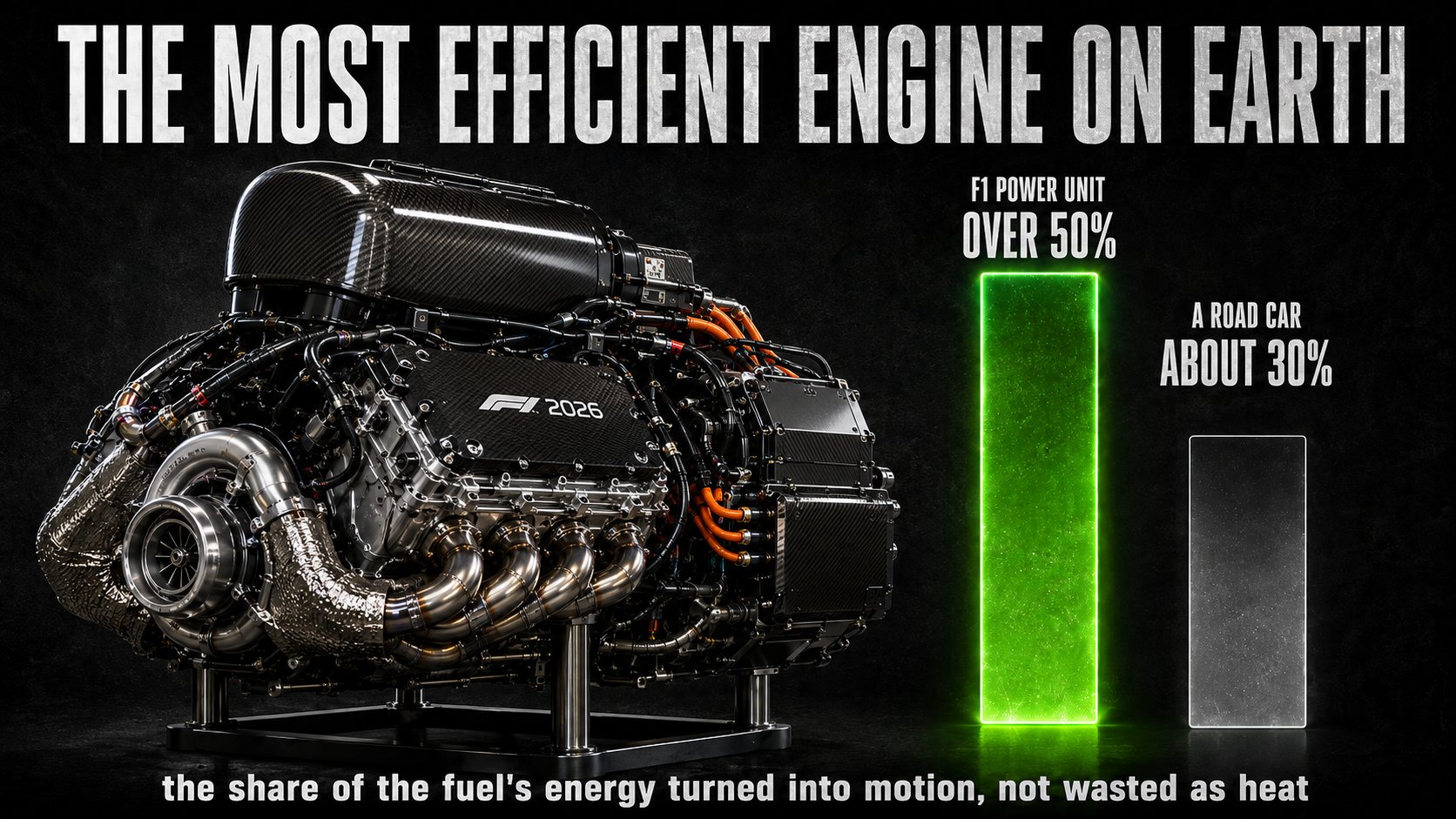
A complete F1 power unit: the compact turbo V6 fused with the turbocharger, the energy recovery motors and the battery into one of the most complex machines in the sport.
The ERS: the hybrid half
Attached to the engine is the Energy Recovery System (ERS), which captures energy that would otherwise be thrown away, stores it in a battery, and redeploys it as an electric boost. From 2014 to 2025 it did this through two devices, and from 2026 it uses only the first:
The MGU-K (Motor Generator Unit, Kinetic). Under braking, a car carries huge kinetic energy that normally turns into wasted heat in the brakes. The MGU-K harvests some of it and turns it into electricity. On acceleration it runs in reverse, adding an electric shove to the engine.
The MGU-H (Motor Generator Unit, Heat), until 2025. This one sat on the turbocharger. It harvested energy from the hot exhaust gases spinning the turbo, and could also run in reverse to spin the turbo up on demand, eliminating "turbo lag", the delay before boost arrives.
Together, the engine plus the ERS make up the complete power unit, producing around 1,000 horsepower.
The 2026 rules add a twist most fans never hear about: the electric power fades with speed. Under Article C5.2.8 of the Technical Regulations, the power the MGU-K may use to drive the car is capped at 1,800 kW minus 5 kW for every km/h, and the cap falls four times as steeply from 340 km/h. So the full 350 kW is only available up to 290 km/h, it is down to 100 kW at 340 km/h, and there is none at all from 345 km/h. With Overtake Mode active the full 350 kW holds until about 337 km/h and then runs out at 355 km/h. The MGU-K is not allowed to launch the car either: at a standing start it only kicks in from 50 km/h.
Why the efficiency is the real story
Here is the part that almost nobody outside engineering circles appreciates, and it is genuinely remarkable. The measure that matters for an engine is thermal efficiency: what percentage of the energy in the fuel actually turns into useful work, rather than being lost as heat and noise. A good road-car petrol engine manages around 30 percent. The old naturally-aspirated F1 V8s peaked at about 29 percent. In 2017, Mercedes' F1 power unit became the first to crack 50 percent on the dyno.
Think about what that means: more than half of the energy in the fuel is being turned into forward motion, not wasted. That makes the F1 power unit the most thermally efficient engine ever put into a car, by a distance. When people say F1 has no relevance to road cars, this is the answer: the sport pushed hybrid and combustion efficiency further than any car maker's road-car division ever had reason to.
How the energy gets used
All that harvested energy is not free power on tap, because the battery holds only so much. Drivers and engineers manage deployment carefully, saving the electric boost for the places it helps most, typically the run onto a straight where it can set up an overtake. DRS no longer exists: in 2026 a car within a second of the one ahead gets extra energy through Overtake Mode instead. Spend it all too early and the car goes flat before the end of the straight, a problem known as "de-rating". Managing that energy well is worth real lap time, and it is a hidden layer of strategy in every race.
None of that management is visible on television, but you can hear it. Teams call engine and deployment settings by number, and a driver will be moved between them several times in a race. Max Verstappen's engineer at the 2023 Bahrain Grand Prix, changing a setting and asking him to report back on what it did to the car:
"Go back to strat 8, Max, and let me know if the downshifts change."
That is the power unit being reconfigured mid-race, in five words. The full radio from that race is on the 2023 Bahrain Grand Prix page.
The big 2026 reset
The 2026 regulations reshape the power unit more than anything in over a decade:
The MGU-H is gone. It was brilliant but fiendishly complex and expensive, so it was dropped to make the engine simpler and cheaper to build.
Far more electric power. The MGU-K's output nearly triples, from 120 kW to 350 kW.
A roughly 50/50 split. With the combustion engine at around 400 kW and the electric side at 350 kW, power is split almost evenly between petrol and electric, a huge shift from the previous generation, whose combustion engine alone made 550 to 560 kW.
Advanced sustainable fuel. The fuel must be made solely from certified sustainable components, kept separate from non-sustainable fuels at all times.
Double the energy recovery. The limit on energy harvested in a lap rises to 8.5 MJ.
There is a strategic reason behind the simpler rules, too. Dropping the costly, complicated MGU-H lowered the barrier to entry so much that it helped draw a wave of new manufacturers to the sport for 2026, with Audi arriving as a works team, Ford partnering Red Bull, Honda committing to Aston Martin, and General Motors' Cadillac joining the grid, starting out with Ferrari power units. A simpler, more road-relevant, more sustainable power unit is exactly what convinced them F1 was worth entering.
Hear the power unit working
Engine modes, energy deployment and lift-and-coast instructions are all called over the radio, in real time.
The Formula Dream app carries live driver radio as it is broadcast, which is where those calls happen, alongside a live Dashboard with every car on the circuit map and a timing tower showing lap times, gaps, intervals, tyre compound and age. You also get every FIA document of the weekend as it is published, including the power unit element allocations that decide grid penalties.
Free, no subscription, no ads, independent. Not affiliated with Formula 1.
The 2026 power unit is also quieter than what came before it, which remains one of the most argued about consequences of the hybrid era. We measured it in how loud are F1 cars.
Frequently asked questions
What is an F1 power unit?
A hybrid engine made of a 1.6-litre turbocharged V6 combined with an Energy Recovery System (ERS) that harvests and redeploys energy. Together they produce around 1,000 horsepower.
Why is the F1 engine so efficient?
Its hybrid system recovers energy that would otherwise be wasted, from braking and, until 2025, from exhaust heat. In 2017 the Mercedes power unit passed 50 percent thermal efficiency, meaning more than half the fuel's energy becomes motion, making it the most efficient car engine ever built.
What is the difference between the MGU-K and MGU-H?
The MGU-K recovers energy from braking and adds an electric boost on acceleration. The MGU-H recovered energy from the turbocharger's exhaust heat and could spin the turbo up to remove lag. It was removed for 2026, so the current power unit uses only the MGU-K.
What changes about the F1 engine in 2026?
The MGU-H is dropped, electric power nearly triples to 350 kW, the split between petrol and electric moves to roughly 50/50, and the engines run on advanced sustainable fuel. The simpler rules helped attract new manufacturers like Audi, Ford and Cadillac.
What is the rev limit of an F1 engine?
The 2026 Technical Regulations set no crankshaft rev limit. From 2014 to 2025 engines were capped at 15,000 rpm. At Monza in 2026 the highest engine speed we measured on a fast lap was 12,826 rpm.
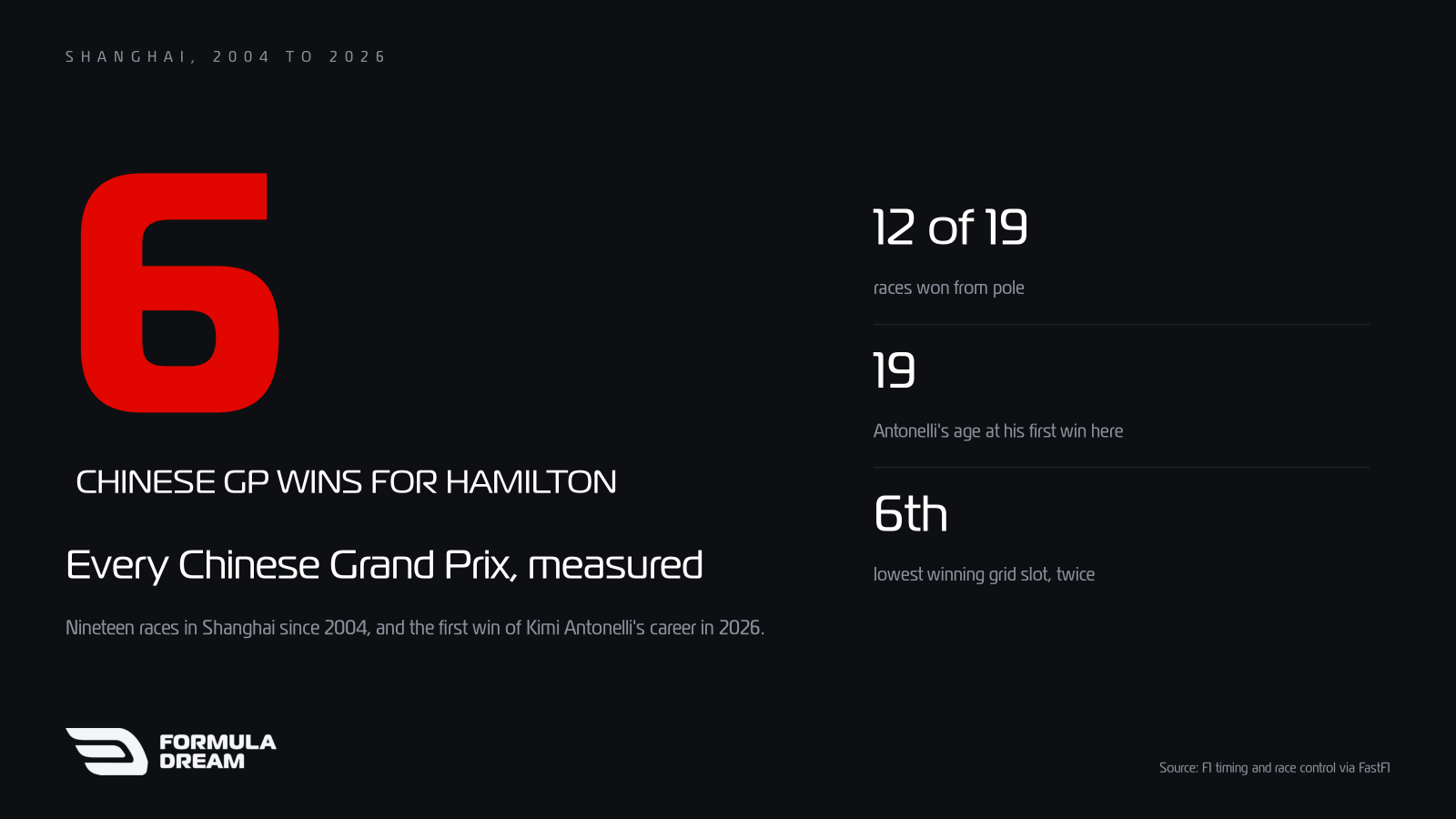
Nineteen Chinese Grands Prix have been held in Shanghai since 2004. Lewis Hamilton won six, pole won twelve, and in 2026 Kimi Antonelli took the first win of his career there, at 19, with Hamilton on the podium for Ferrari for the first time. Every winner, grid slot and safety car, measured.