Italian GP FP2 Results: Russell Leads a Mercedes Front Row Threat
George Russell topped FP2 at Monza with a 1:22.559, and Mercedes backed it up with the best long-run pace in the field. Full results, race pace and telemetry.
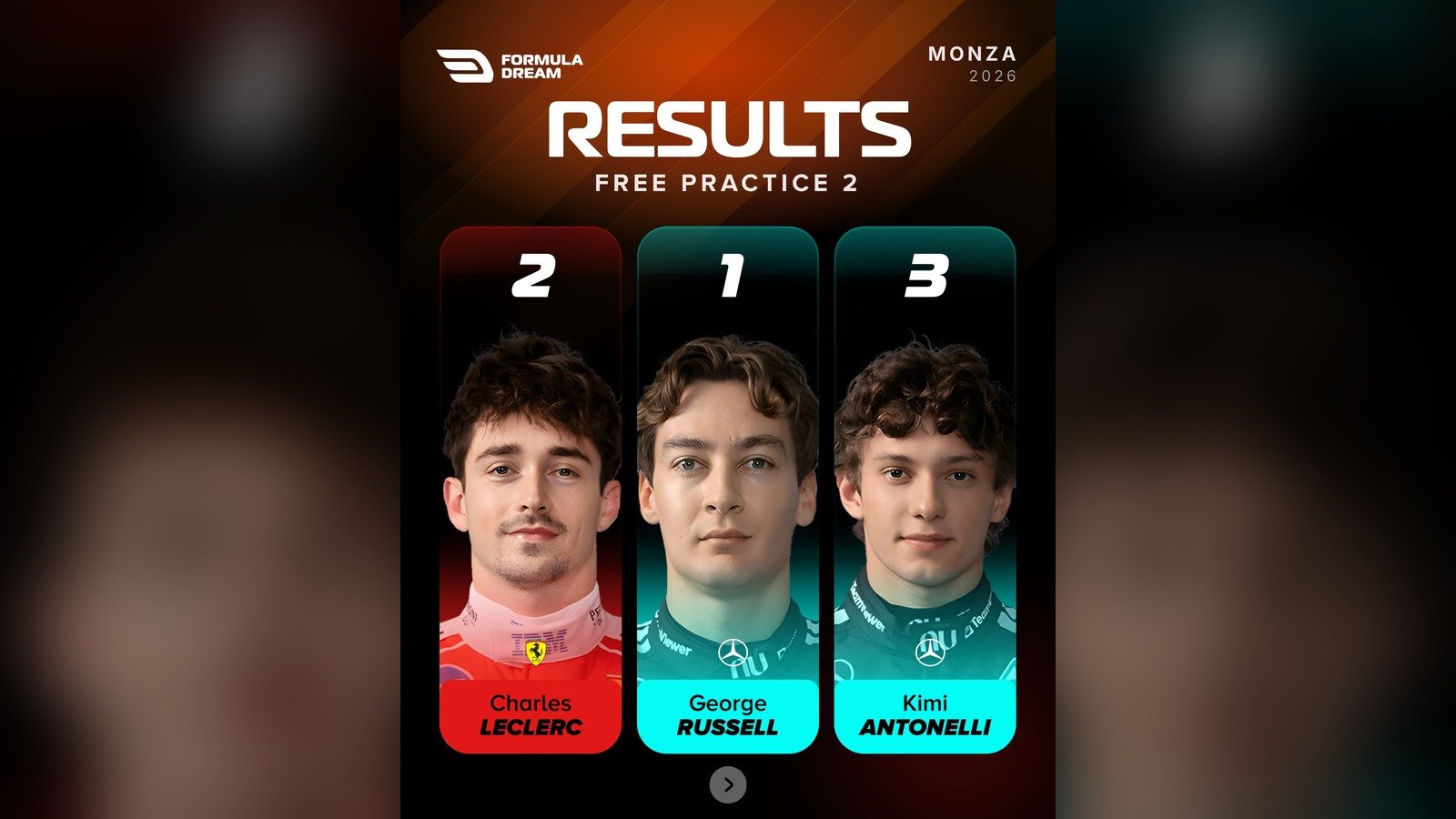
George Russell topped second practice for the Italian Grand Prix with a 1:22.559, beating Charles Leclerc by 0.120s and Kimi Antonelli by 0.141s. Mercedes took first and third, Ferrari split them, and the top six covered less than half a second.
The one-lap order is close enough to be almost meaningless. The long runs are not, and they say something the timing screen does not. Mercedes ran race-pace stints on the hard tyre that were quicker than Ferrari's race-pace stints on the soft, which is the wrong way round if Ferrari are the quicker car.
Italian Grand Prix FP2 classification, top ten. Deleted laps excluded.
Behind them: Franco Colapinto was 11th at +1.060, Liam Lawson 12th at +1.101, Nico Hulkenberg 13th at +1.173 and Pierre Gasly 14th at +1.214. Gabriel Bortoleto took 15th at +1.217, the only driver in the field to set his best time on the hard tyre. Alexander Albon was 16th at +1.294 and Carlos Sainz 17th at +1.341, with Esteban Ocon 18th at +1.848.
The last four were some way adrift: Fernando Alonso 19th at +2.468, Sergio Perez 20th at +2.523, Valtteri Bottas 21st at +2.590 and Lance Stroll 22nd at +2.694.
Every regular driver was back after four teams ran rookies in the morning, so unlike FP1 this is a complete grid.
Pierre Gasly is the unlucky one. He set a 1:23.803 that would have moved him up the order and lost it to track limits at Turn 6. Hamilton lost a 1:26.254 at Turn 1.
The race pace is the real result
This is the part worth your attention, and it is the part the broadcast cannot show you.
To read it properly you have to throw away most of the session. Out-laps, in-laps, deleted laps and anything slower than 106% of the session best all go, because they describe traffic and pit work rather than the car. What is left is 229 clean laps out of 618.
Long-run pace in FP2. Clean laps only, with tyre compound and run length shown.
Median lap times over the long runs:
Antonelli, hard, 16 laps: 1:25.993
Lawson, hard, 12 laps: 1:26.046
Russell, hard, 10 laps: 1:26.148
Leclerc, soft, 8 laps: 1:26.153
Hamilton, soft, 8 laps: 1:26.317
Norris, hard, 5 laps: 1:26.361
Verstappen, medium, 5 laps: 1:26.605
Image gallery, 3 slides
1 / 3
Tyre stints, positions 1 to 8. Antonelli's 19-lap hard run is the longest of the session.
Read the compound column. Antonelli, Lawson and Russell set those times on the hard tyre. Leclerc and Hamilton set theirs on the soft. The soft is the faster tyre, and both Ferraris were still slower than three cars on the hardest compound available.
Antonelli's run is the standout for a second reason. Over 16 laps, with the tyre ageing from 6 laps old to 22, his degradation came out at +0.003 seconds per lap. That is a flat line. On a hot track, on the hard tyre, with the tyre more than a third of a race distance old, the Mercedes was not falling away at all.
A caveat that matters: fuel loads are not published, and a team running lighter will look better. Nobody outside the garages knows what was in the cars. But the compound difference is a fact rather than an assumption, and it points the same way as the sector times.
Where Russell beat Leclerc
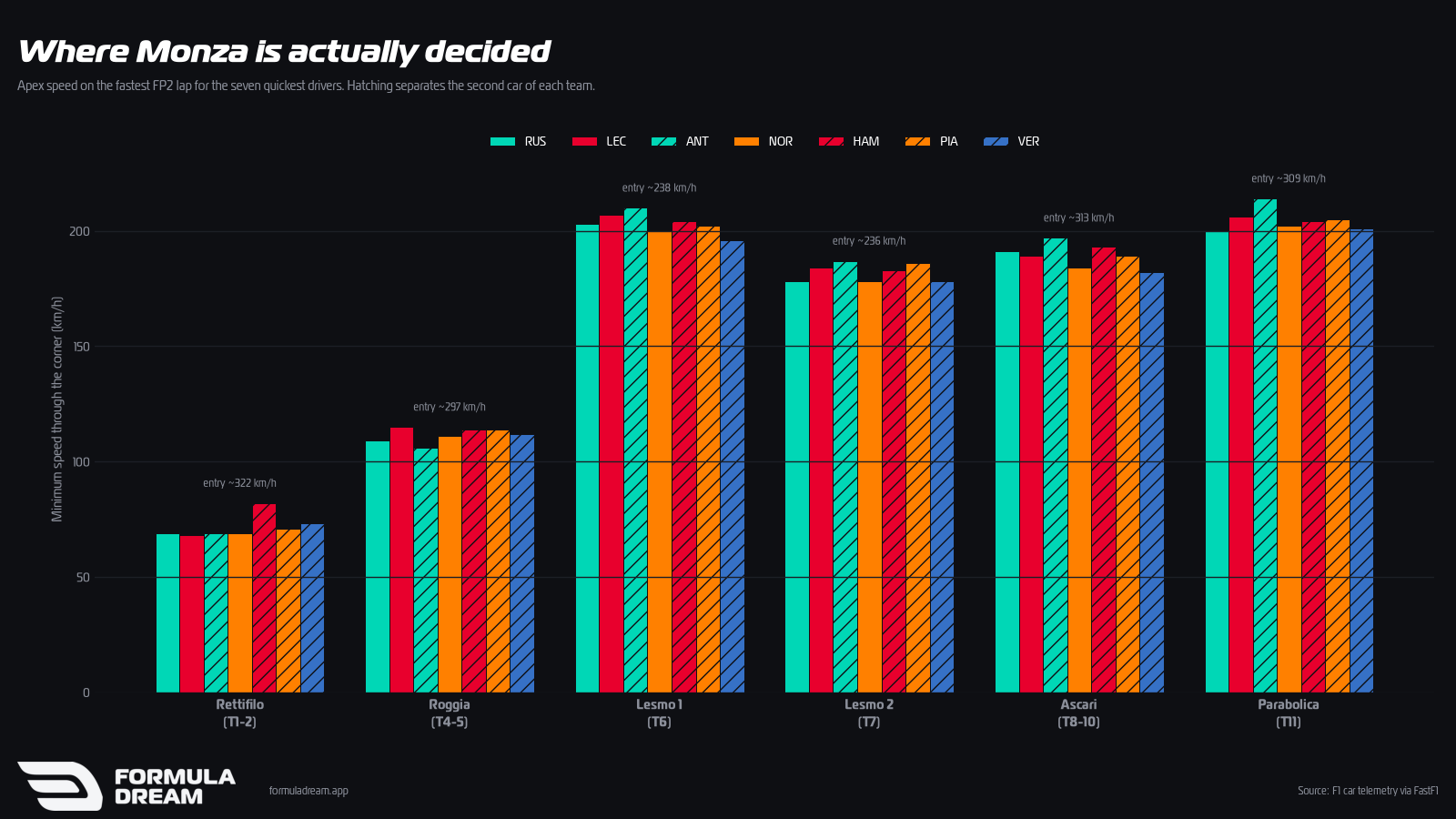
Their fastest laps were 0.120s apart. The telemetry shows that gap was not built where you would expect at Monza.
Russell against Leclerc on their fastest FP2 laps. The delta trace shows where the time actually moved.
Monza has six braking events in 5.8km and almost nothing else. Both drivers were at full throttle for roughly three quarters of the lap: 71.6% for Russell, 75.8% for Leclerc, with Russell on the brakes 12.9% of the lap against Leclerc's 10.6%.
Follow the delta trace and the shape of the lap is clear. Russell built his advantage steadily through the first two sectors, reaching a maximum of +0.282s just after the Variante Ascari. Then Leclerc took almost all of it back. Through the final sector the gap collapsed from 0.28s to under 0.05s before Russell recovered a little into the line.
The sector bests confirm it:
Sector 1: Russell, 27.044s
Sector 2: Antonelli, 27.784s
Sector 3: Leclerc, 27.546s
Image gallery, 2 slides
1 / 2
Speed trap, fastest eleven. Sainz quickest at 334 km/h.
Mercedes owned the first two thirds of the lap. Ferrari owned the last third, which at Monza is the Parabolica and the run to the line. Straight-line speed separated nobody: Carlos Sainz was fastest through the trap at 334 km/h, with Hamilton and Russell level on 331. The top twelve in the speed trap were covered by 9 km/h, so on the circuit most associated with straight-line speed the lap is being decided in the corners instead.
Stitch the fastest sectors in the session together and you get a composite lap of 1:22.374, 0.185s under Russell's actual time. Russell, Leclerc and Hamilton all set their best sectors on their best lap, so none of them left anything obvious behind.
The track got hotter and everyone got faster
This is the counterintuitive bit, and it is a useful lesson in reading practice.
FP2 was hotter than FP1. Air temperature rose from a 30.2 to 31.9C range up to 33.3 to 34.4C. Track temperature went from a peak of 53.8C to a peak of 57.5C. Hotter track surfaces usually cost lap time, because the tyre overheats and grip falls away.
Everyone went faster anyway. The field improved by an average of 0.741 seconds.
Improvement from FP1 to FP2 for drivers who ran both sessions.
That is track evolution beating temperature. Every lap lays more rubber into the racing line, and on a circuit that hosts relatively little running the surface improves quickly through a Friday. Teams also switched to qualifying preparation, and the compound counts show it plainly: 298 soft-tyre laps in FP2 against 126 in FP1.
The interesting part is who did not improve.
Ocon found the most, +1.445s
Field average: +0.741s
Leclerc: +0.329s
Hamilton: +0.165s
Lawson: -0.227s, the only driver slower in FP2
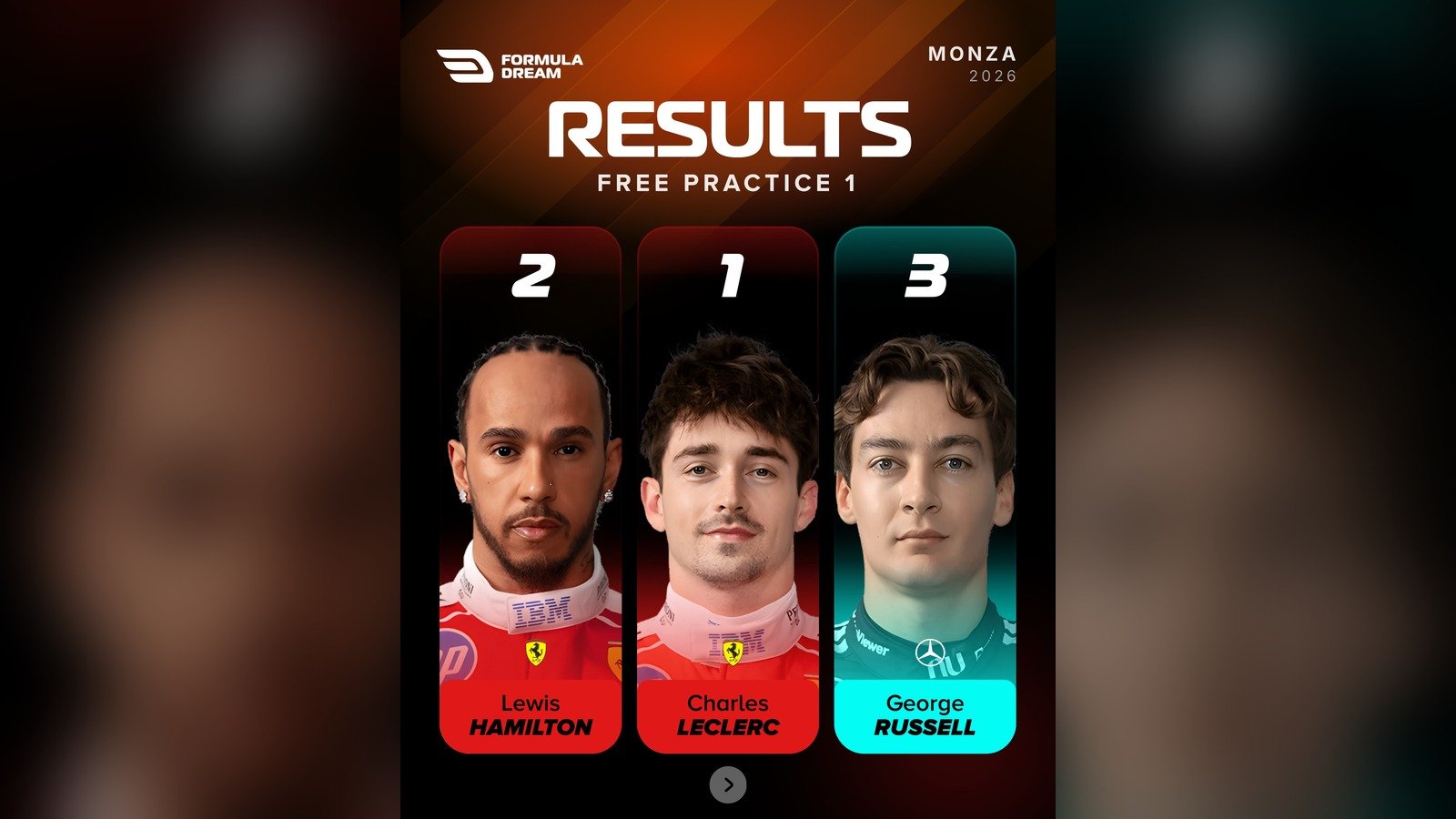
Ferrari improved the least of anyone bar Lawson. When the track came to everybody, they gained less than half what the field gained. That is the mechanism behind the swing from a Ferrari 1-2 in the morning to Mercedes first and third in the afternoon, and it is a warning against reading too much into a headline FP1 time.
These are the slowest Monza practice cars in five years
Put this year's FP2 next to the same session in each of the last four, and the 2026 rules reset shows up in the plainest possible terms.
FP2 fastest lap at Monza, 2022 to 2026.
2026: Russell, 1:22.559
2025: Norris, 1:19.878, 2.681s faster
2024: Hamilton, 1:20.738, 1.821s faster
2023: Sainz, 1:21.355, 1.204s faster
2022: Sainz, 1:21.664, 0.895s faster
Every one of the last four years was quicker than today, and 2025 was quicker by well over two and a half seconds. In percentage terms this year is about 3.4% slower than 2025, which lines up closely with the 3.046% we measured across the ten circuits raced in both seasons.
That is the 2026 regulations doing exactly what they were designed to do. The cars are lighter but carry roughly 30% less downforce, and the power unit split between combustion and electrical energy changed at the same time. Monza punishes the loss differently from most circuits, because so much of the lap is spent at full throttle where downforce matters least, and the cars are still nearly three seconds slower.
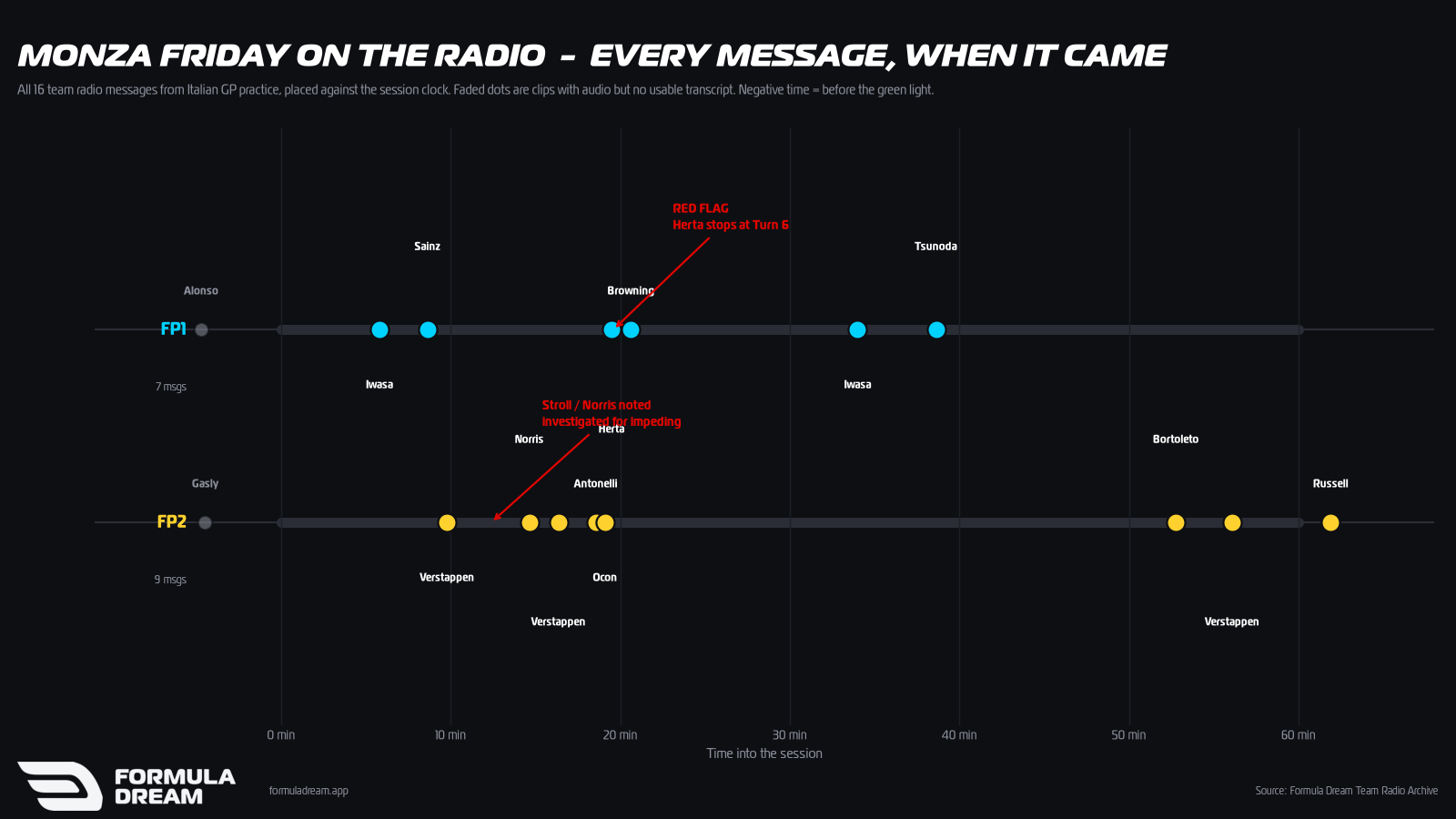
The stewards noted an incident at Turn 1 involving Lance Stroll and Lando Norris, and confirmed it will be investigated after the session for impeding. Stroll drifted across Norris in the braking zone.
Impeding in practice normally draws a reprimand or a grid penalty depending on severity and repetition. It is worth watching, because a grid drop from a Friday incident would change the shape of Sunday.
Track limits were quieter than the morning but still busy, with 12 deleted laps against 16 in FP1. Turn 1 was again the main offender.
What this means for qualifying
The honest summary is that four teams have a case.
Mercedes look strongest on the evidence available. Fastest lap, third fastest lap, best long-run pace, near-zero degradation on the hard tyre, and the best sector 1 and sector 2 in the session.
Ferrari are close and they are quick in the final sector, which is where a Monza lap is won or lost against the clock. They topped FP1 on mediums. Their race pace is the question.
McLaren are quietly there, fourth and sixth, four tenths off, without having looked spectacular at any point.
Red Bull are not. Verstappen was ninth, 0.818s off, and Lawson was the only driver in the field slower in FP2 than FP1.
FP3 and qualifying are on Saturday. If you want the layout that produces these numbers, the corner-by-corner breakdown is in the Monza track analysis, and we went through the car telemetry from both sessions in the Monza practice data analysis.
Watch the long runs, not the headline
Everything above came from timing and telemetry data, not from the broadcast, because the broadcast does not show you tyre age or a long-run median.
The Formula Dream app runs a live Dashboard through every session: every car on the circuit map, and a timing tower with lap times, gaps and intervals, tyre compound and age, plus flag and safety car alerts as race control calls them. That is the difference between seeing a lap time and knowing whether it was set on a two-lap soft or a sixteen-lap hard. You also get live driver radio as it is broadcast, and every FIA document of the weekend as it is published, which is where the Stroll investigation and every deleted lap appear first.
Free, no subscription, no ads, independent. Not affiliated with Formula 1.
George Russell, with a 1:22.559. Charles Leclerc was second for Ferrari, 0.120s back, and Kimi Antonelli third for Mercedes, 0.141s back.
Who had the best race pace in Italian GP FP2?
Mercedes. Kimi Antonelli's long-run median was 1:25.993 on the hard tyre with essentially no degradation over 16 laps, quicker than both Ferraris managed on the softer compound.
Why were the FP1 and FP2 results so different at Monza?
Two reasons. Four teams ran rookie drivers in FP1, so Verstappen, Gasly, Albon and Perez did not appear. And the track improved sharply, with the field gaining 0.741s on average, while Ferrari gained only a fraction of that.
Were Lance Stroll and Lando Norris investigated?
Yes. The stewards noted a Turn 1 incident involving both cars and confirmed it would be investigated after the session for impeding, after Stroll drifted across Norris in the braking zone.
How much of a Monza lap is spent at full throttle?
Roughly three quarters. On their fastest FP2 laps Russell was at full throttle for 71.6% of the lap and Leclerc for 75.8%, with only six braking events in the whole 5.8km.