A Formula 1 car arrives at the Variante del Rettifilo at about 322 km/h and takes the corner at 72. That is a drop of 251 km/h, and it happens roughly six times a lap in different sizes.
We pulled the car telemetry from both Italian Grand Prix practice sessions at Monza, 1,163 laps in total, and went through it corner by corner. What follows is the engineering picture underneath the timing screen: where the speed goes, which cars are strongest where, and what the data says about the first Monza weekend run without DRS.
The reputation is straight-line speed. The reality is that Monza is defined by how violently the cars stop.
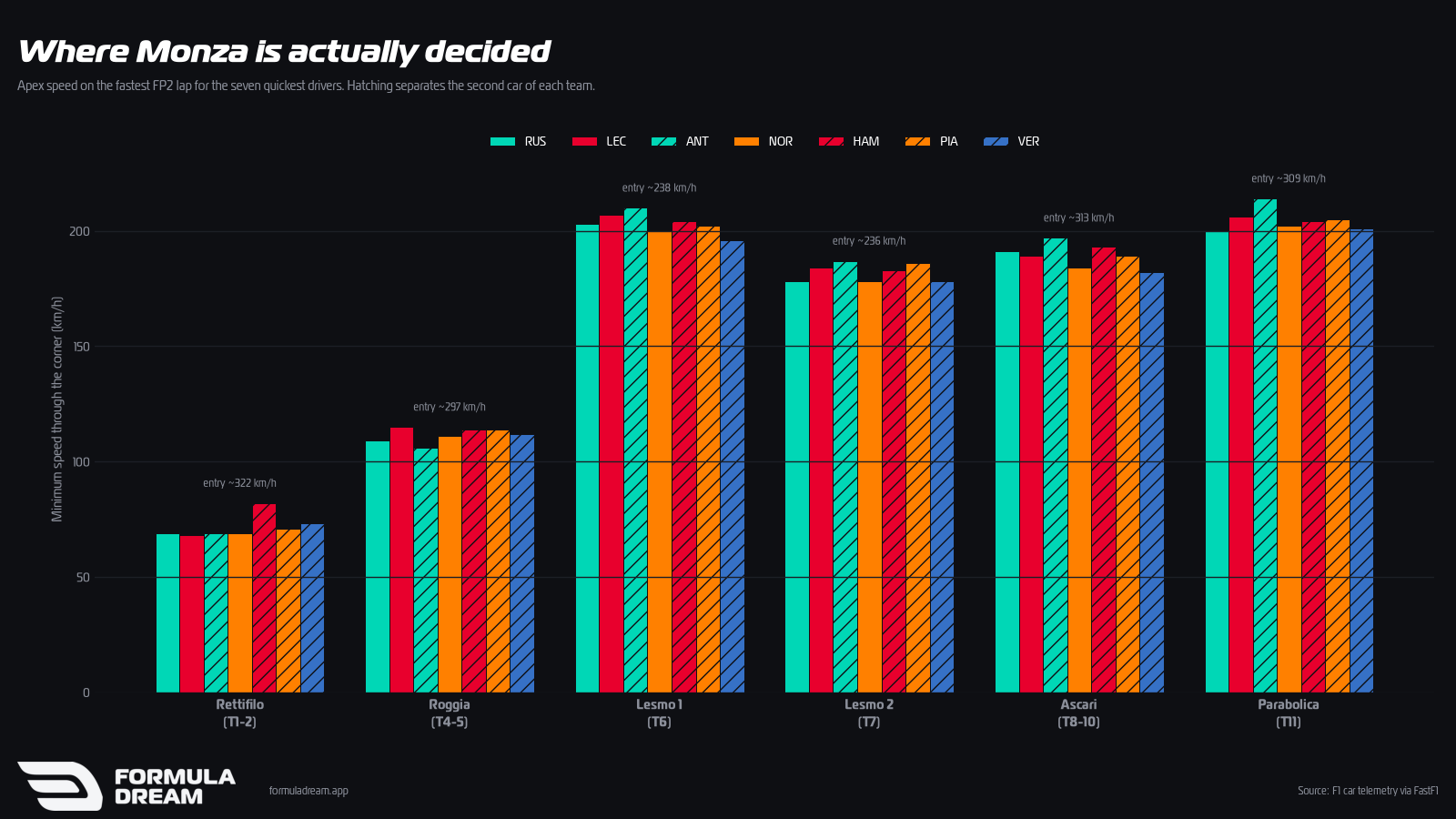
Taking the seven quickest drivers in FP2 and averaging their fastest laps, this is what each corner asks:
Variante del Rettifilo (T1-2): 322 km/h down to 72. A 251 km/h drop.
Variante della Roggia (T4-5): 297 down to 112. A 186 km/h drop.
Variante Ascari (T8-10): 314 down to 189. A 125 km/h drop.
Parabolica (T11): 310 down to 205. A 105 km/h drop.
Lesmo 2 (T7): 236 down to 182. A 54 km/h drop.
Lesmo 1 (T6): 239 down to 203. A 36 km/h drop.
The first chicane is the single largest speed change of the lap and one of the biggest in the sport. The car sheds roughly three quarters of its speed in a little over 100 metres.
Russell against Leclerc. The six braking events are the only places the lap time moves.
Everything else follows from that. Full throttle occupies 71% to 78% of the lap depending on the driver, and the cars sit in eighth gear for between 29% and 47% of it. There is very little middle ground at Monza: the car is either flat out or being stopped hard.
Speed trap rankings. The top twelve are covered by 9 km/h.
Where the cars differ
Entry speeds are nearly identical across the top seven. At the Rettifilo they arrive within 7 km/h of each other, from Russell's 325 down to Verstappen's 318. Straight-line speed is not separating this field.
The differences appear at the apex, and they are consistent enough to describe each car.
Mercedes are strongest in the fast corners. Kimi Antonelli carried the highest minimum speed of anyone through Lesmo 1 (210 km/h), Ascari (197) and the Parabolica (214). His Parabolica number is 14 km/h higher than his own team mate's. Those three corners are the fastest on the circuit, and they are exactly where Mercedes took the quickest second sector of the session.
Red Bull are weakest in them. Verstappen was slowest of the seven at Lesmo 1 (196), Lesmo 2 (178, tied) and Ascari (182). Not by a huge amount, but at every single one. That is a car lacking the load to hold a fast corner, and it matches a ninth place finish 0.818s off the pace.
Ferrari sit in between and do their best work late. Leclerc took the fastest final sector in FP2 and had the second-highest Parabolica speed. The Parabolica leads onto the pit straight, so speed carried through it is speed carried all the way to the line.
The Hamilton anomaly at Turn 1
One number in the data does not fit the others.
Through the Rettifilo, six of the seven fastest drivers had a minimum speed between 68 and 73 km/h. Leclerc was 68, Russell 69, Antonelli 69, Norris 69, Piastri 71, Verstappen 73.
Lewis Hamilton's was 82 km/h.
That is 13 km/h more than his team mate through the slowest corner on the circuit, and it is not explained by entry speed, because he arrived at 322 km/h like everyone else. He simply did not slow down as much.
A higher minimum speed through a chicane usually means a straighter line through it, using more of the kerb and more of the exit. It is the fastest way through when it works, and it is also why Turn 1 generated more deleted laps than any other corner across both sessions. Hamilton lost four laps to track limits in FP1 and another in FP2, more than anyone.
The lap this telemetry comes from was legal and stood. It is worth noting as an observation about how he is attacking that corner rather than a conclusion about anything else, but it is the most distinctive line in the top seven and it is the corner most likely to cost someone a lap time on Saturday.
The first Monza Friday without DRS
This is the part that makes 2026 telemetry read differently from every previous year.
The DRS channel is flat zero for every driver on every lap we examined. Not intermittent, not low. Zero, all the way around, for all seven cars.
That is what you would expect, because the 2026 regulations removed DRS and replaced it with active aerodynamics. The front and rear wings now move together under ECU control between a low-drag straight-line configuration and a high-downforce cornering configuration, originally described as X-mode and Z-mode. The overtaking assistance that DRS used to provide is now a separate driver-triggered energy deployment, which the FIA has settled on calling Overtake.
You can see it in the race control feed rather than the car data. At 10:51:36 during FP1, after the red flag period was cleared, race control posted "OVERTAKE ENABLED". That single line is the 2026 replacement for everything DRS used to be, and it is the first time that message has appeared at a Monza Friday.
The practical effect at this circuit is that low-drag setup choices matter more and the old DRS-train dynamics do not apply. Whether that changes the racing on Sunday is the question of the weekend.
Engine numbers
The 2026 power units run to a lower rev ceiling than the screaming V10s Monza is remembered for, and the data shows where they actually operate.
Peak RPM across the seven fastest laps ranged from 12,297 (Leclerc) to 12,520 (Norris), with most cars between 12,300 and 12,400. All of them used the full eight-gear spread, first through eighth, on a single lap. That is unusual: many circuits never see first gear, but the Rettifilo's 72 km/h apex demands it.
Time spent in eighth gear is a decent proxy for how a team has geared the car for Monza:
Piastri: 47.4%
Norris: 45.9%
Verstappen: 40.8%
Russell: 40.3%
Hamilton: 39.8%
Leclerc: 35.8%
Antonelli: 29.1%
McLaren spent nearly half the lap in top gear. Antonelli spent under a third. That is a real difference in gearing and wing level, and it is consistent with the corner speeds: the Mercedes was set up to carry speed through the fast corners rather than to maximise the straights.
What the composite lap says
Add up the fastest sector times set by anyone in FP2 and you get 1:22.374. Russell's actual fastest lap was 1:22.559.
The gap of 0.185s is the time available to a driver who put together a perfect lap, and nobody did. Russell, Leclerc and Hamilton all set their best sectors on their best lap, so they left nothing obvious behind individually. The composite is faster because it takes Russell's first sector, Antonelli's second and Leclerc's third, which is three different cars.
The same calculation in FP1 gave 1:22.826 against Leclerc's 1:23.008, a gap of 0.182s. Almost identical, in a session that was interrupted by a red flag and included four rookie drivers.
Method
Everything above comes from Formula 1's own timing and car telemetry, accessed through the open-source FastF1 library, for the 2026 Italian Grand Prix FP1 and FP2 sessions on 4 September.
Laps analysed: 545 in FP1 and 618 in FP2, 1,163 in total.
Deleted laps excluded throughout. Sixteen were deleted in FP1 and twelve in FP2, and including them would have changed the FP1 order.
Corner speeds are minimum speed inside a fixed distance window around each corner, taken from each driver's fastest valid lap. Entry speed is the maximum speed recorded before the apex in that window.
Full-throttle percentage is the share of telemetry samples at 99% throttle or above, which is the standard way to avoid counting brief lifts.
Long-run pace used clean laps only: no in-laps, no out-laps, no deleted laps, and nothing slower than 106% of the session best.
Two honest limits. Fuel loads are not published, so no practice lap time is a clean measure of car performance, and any comparison between teams carries that caveat. And telemetry is sampled rather than continuous, so braking distances derived from the brake channel are sensitive to sample timing. We have not published braking distances for that reason. Minimum speeds are direct minima and do not have the problem.
See the data live, not after
Everything in this article was reconstructed after the sessions ended. The interesting version is watching it happen.
The Formula Dream app runs a live Dashboard through every session: every car on the circuit map, and a timing tower carrying lap times, gaps and intervals, tyre compound and age, plus flag and safety car alerts as race control calls them. That is where you see a driver find two tenths in a sector, or a long run holding pace while another falls away. You also get live driver radio as it is broadcast, and every FIA document of the weekend as it is published, which is where deleted laps, steward decisions and messages like "Overtake enabled" appear first.
Free, no subscription, no ads, independent. Not affiliated with Formula 1.
If the traces above are unfamiliar, F1 telemetry explained walks through what speed, throttle and brake channels actually show and how to read them together.
Frequently asked questions
How fast do F1 cars go at Monza?
The fastest speed-trap reading in Italian GP practice was 341 km/h, set by Paul Aron in FP1. In FP2 the quickest was Carlos Sainz at 334 km/h, with the top twelve covered by just 9 km/h.
What is the slowest corner at Monza?
The Variante del Rettifilo, the first chicane. The fastest drivers took it at between 68 and 82 km/h, having arrived at about 322 km/h, making it a speed drop of roughly 251 km/h.
How much of a Monza lap is full throttle?
Between 71% and 78% of the lap depending on the driver. Antonelli was highest at 77.5% and Piastri lowest at 71.0% on their fastest FP2 laps.
Does F1 still have DRS in 2026?
No. The DRS channel reads zero throughout the 2026 Italian GP practice telemetry. DRS was replaced by active aerodynamics, where front and rear wings move together between low-drag and high-downforce settings, plus a separate driver-triggered deployment the FIA calls Overtake.
What gear do F1 cars use at Monza?
All eight. The long straights are taken in eighth, where cars spend between 29% and 47% of the lap, while the first chicane is slow enough to require first gear.
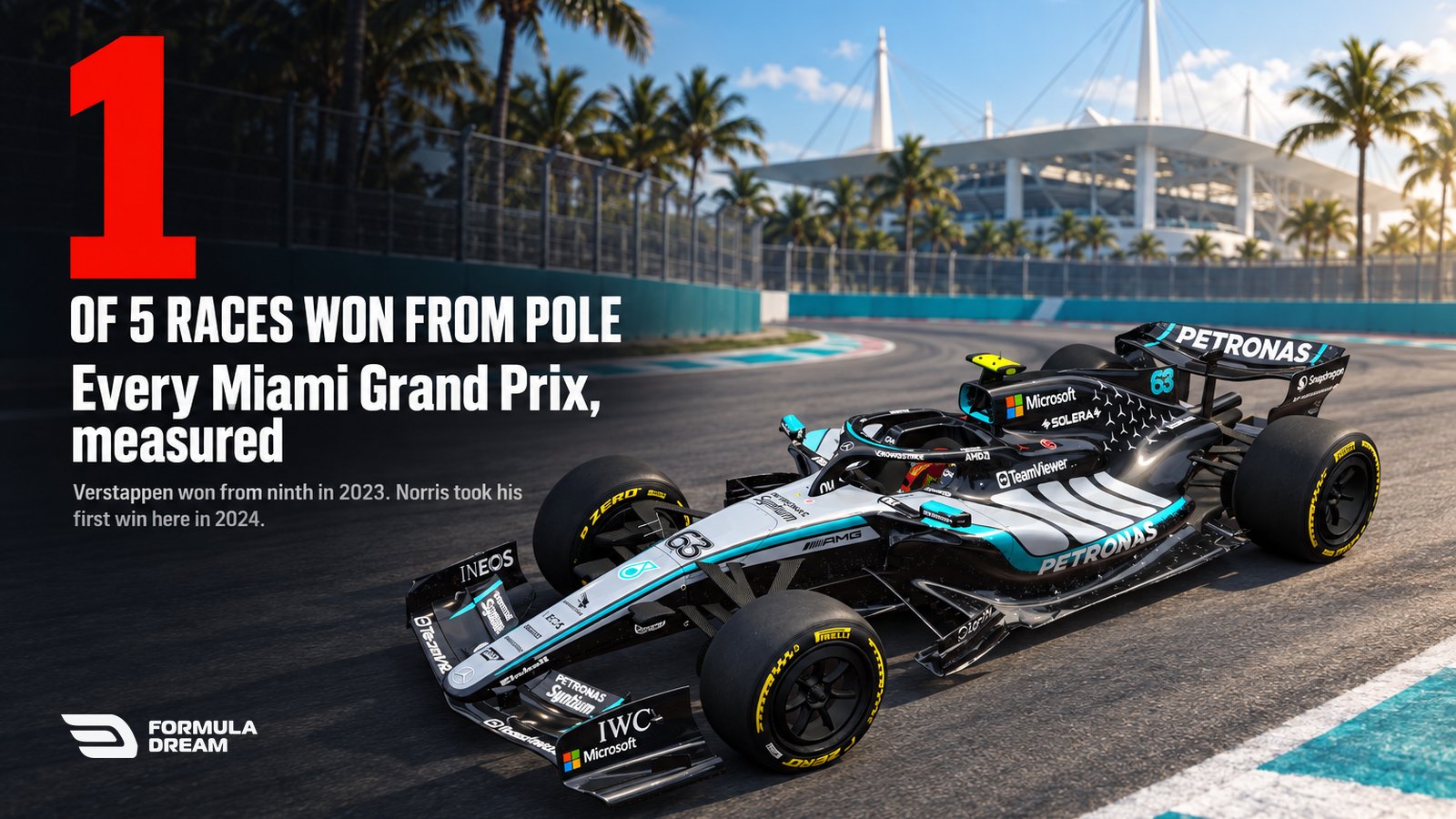
Every Miami Grand Prix winner, measured: five races, and pole has won only one of them
Five Miami Grands Prix have been held since 2022, and only one was won from pole: Kimi Antonelli's in 2026. Max Verstappen won from ninth in 2023, and Lando Norris took his first win there in 2024. Every winner, grid slot and safety car, measured.