Italian GP Race Preview: What Friday's Data Says About Sunday
Ferrari topped Friday on mediums, Mercedes had the race pace, and Monza has not seen a safety car in three years. What the measured data says about the race.
Monza has gone three consecutive races without a single safety car deployment. That one fact shapes everything about Sunday.
We pulled the timing and telemetry from Friday practice at the 2026 Italian Grand Prix, and the race history for the three previous editions. Here is what the numbers actually support, separated from what people are saying.
Monza is a one-stop race, and it is not close
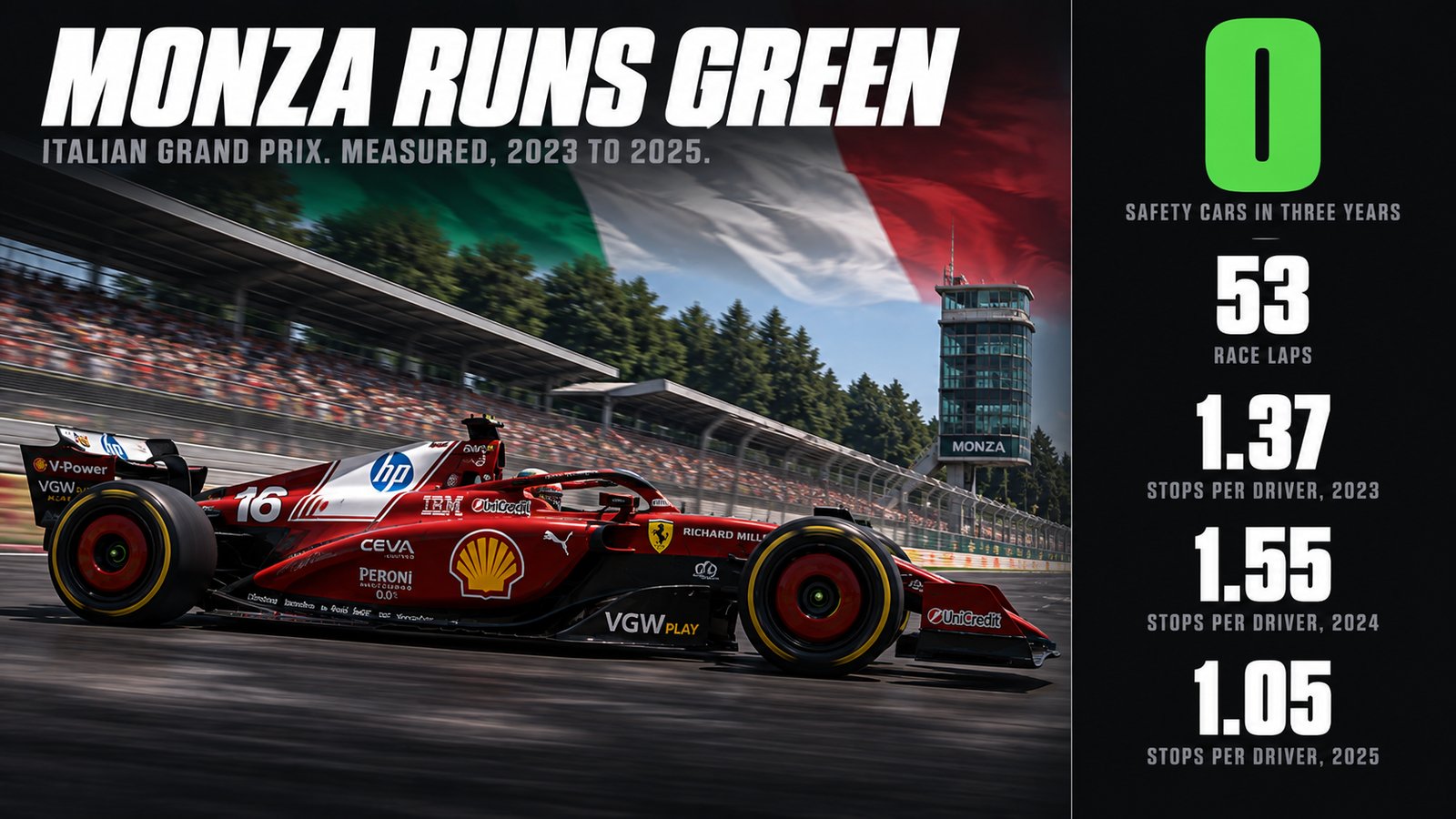
Measured across the last three Italian Grands Prix:
Italian Grand Prix race data, 2023 to 2025, from F1 timing data.
One stop is the most common answer in all three years, and there has not been a safety car deployment in any of them. All three were dry.
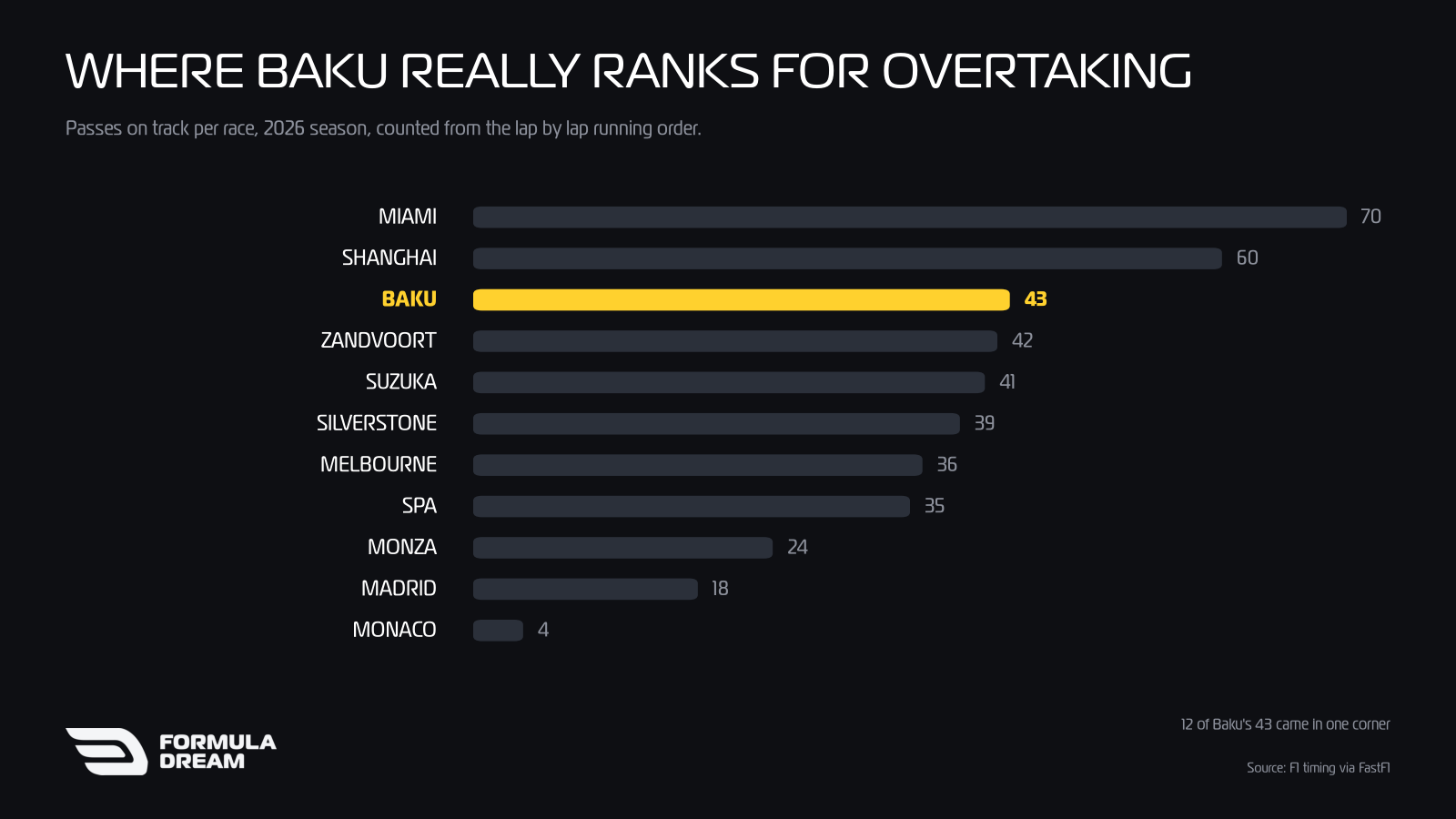
That matters more than it sounds. Across the whole 2026 season we measured an average of 2.05 pit stops per driver per race, and the races that produced the most stops were the ones with interruptions: Monaco averaged 4.05 stops in a dry race purely because it kept producing safety cars. Monza does the opposite. It is wide, it has enormous run-off, and cars that go off usually rejoin. The full season numbers are in how many pit stops in an F1 race.
So the base case for Sunday is a one-stop race that runs green from start to finish. If that holds, track position and tyre life decide it, not strategy calls.
Ferrari were quickest on Friday. Mercedes were quicker where it counts.
The headline from Friday is that Ferrari topped FP1 with a 1-2, Charles Leclerc ahead of Lewis Hamilton, and both did it on the medium tyre while the cars behind were on softs.
Then FP2 inverted it. George Russell led, with Leclerc second and Kimi Antonelli third.
The long runs are where it gets interesting, because they contradict the qualifying picture:
Antonelli, hard tyre, 16 laps: median 1:25.993
Lawson, hard, 12 laps: 1:26.046
Russell, hard, 10 laps: 1:26.148
Leclerc, soft, 8 laps: 1:26.153
Hamilton, soft, 8 laps: 1:26.317
Three cars on the hard tyre ran quicker than both Ferraris on the soft. The soft is the faster compound, so that is the wrong way round if Ferrari have the better race car.
One caveat we will not skip: fuel loads are never published, so a team running lighter looks better. What is not an assumption is the compound each car was on, and that points one way.
The number nobody else measured
Between FP1 and FP2 the field improved by an average of 0.741 seconds as the track rubbered in.
Ferrari did not. Hamilton found only 0.165s and Leclerc 0.329s, the smallest gains of anyone except Liam Lawson, who was slower in FP2 than FP1.
That is the mechanism behind the swing from a Ferrari 1-2 in the morning to Mercedes first and third in the afternoon. The FP1 result was flattering, and the reason is measurable rather than a matter of opinion. The full breakdown is in the Monza practice data analysis.
Red Bull have a problem they have named
Max Verstappen finished FP2 ninth, 0.818s off the pace, having sat out FP1 while Ayumu Iwasa drove his car.
On the FP2 radio he reported no grip, brakes that were not working and a car jumping on the front axle, describing it as "like driving on ice". Our corner-by-corner telemetry agrees: Verstappen carried the lowest minimum speed of the seven quickest drivers at Lesmo 1, Lesmo 2 and Ascari, the three fastest corners on the circuit. Red Bull technical director Pierre Wache confirmed a balance issue afterwards.
The grid is set, and it is not the one anyone predicted
Qualifying ran on Saturday afternoon and produced the shock of the season. Pierre Gasly took pole for Alpine with a 1:21.786, 0.060 clear of George Russell, for the first pole in Alpine's history and the first of his career, at the circuit where he won his only Grand Prix in 2020. Both Alpines made the top eight, and the whole top ten is covered by half a second.
That matters for everything below, because a preview written on Friday assumed a Mercedes on pole. The car now leading the field is the lowest-drag one on the grid, which changes who is vulnerable into Turn 1 and who has the tow. The full session is in the Italian GP qualifying results.
What to actually watch
The first chicane on lap one. Monza's Variante del Rettifilo takes cars from about 322 km/h down to 72, the largest speed change of the lap, and it arrives after a long run from a standing start with the field still packed. It is the single most likely place for the race to be decided or ruined.
Track limits. Friday produced 28 deleted laps across two practice sessions, overwhelmingly at Turn 1 and Turn 5. A circuit that generates that many deletions in practice generates them in a race.
Whether the safety car finally shows up. Three consecutive Italian Grands Prix without one is a streak, not a law. If it breaks on Sunday, the one-stop base case breaks with it, and everything above changes.
Follow the race with the data on screen
Everything in this preview came from timing and telemetry rather than the broadcast, because the broadcast does not show you tyre age or a long-run median.
The Formula Dream app runs a live Dashboard through the race: every car on the circuit map, and a timing tower with lap times, gaps and intervals, tyre compound and age, plus flag and safety car alerts as race control calls them. On a one-stop race the whole story is tyre age against gap, and that is exactly the column the television feed leaves out. You also get live driver radio as it is broadcast, and every FIA document of the weekend as it is published, which is where track limit warnings and penalties appear first.
Free, no subscription, no ads, independent. Not affiliated with Formula 1.
One, usually. Across 2023, 2024 and 2025 the most common number of stops per driver at Monza was one in every year, with a mean between 1.05 and 1.55. None of those three races had a safety car deployment.
How many laps is the Italian Grand Prix?
53 laps in both 2024 and 2025, and 51 in 2023.
Who was fastest in Italian GP practice in 2026?
Charles Leclerc topped FP1 with a 1:23.008 on the medium tyre, leading a Ferrari 1-2. George Russell topped FP2 with a 1:22.559, with Leclerc second and Kimi Antonelli third.
Does Monza get safety cars?
Rarely. There was no safety car deployment in the 2023, 2024 or 2025 Italian Grand Prix. The circuit is wide with large run-off areas, so cars that go off usually rejoin without needing a recovery.
Why did Ferrari drop from first to fifth between sessions?
They improved the least. The field found an average of 0.741 seconds between FP1 and FP2 as the track rubbered in. Hamilton found 0.165s and Leclerc 0.329s, so everyone else moved past them.
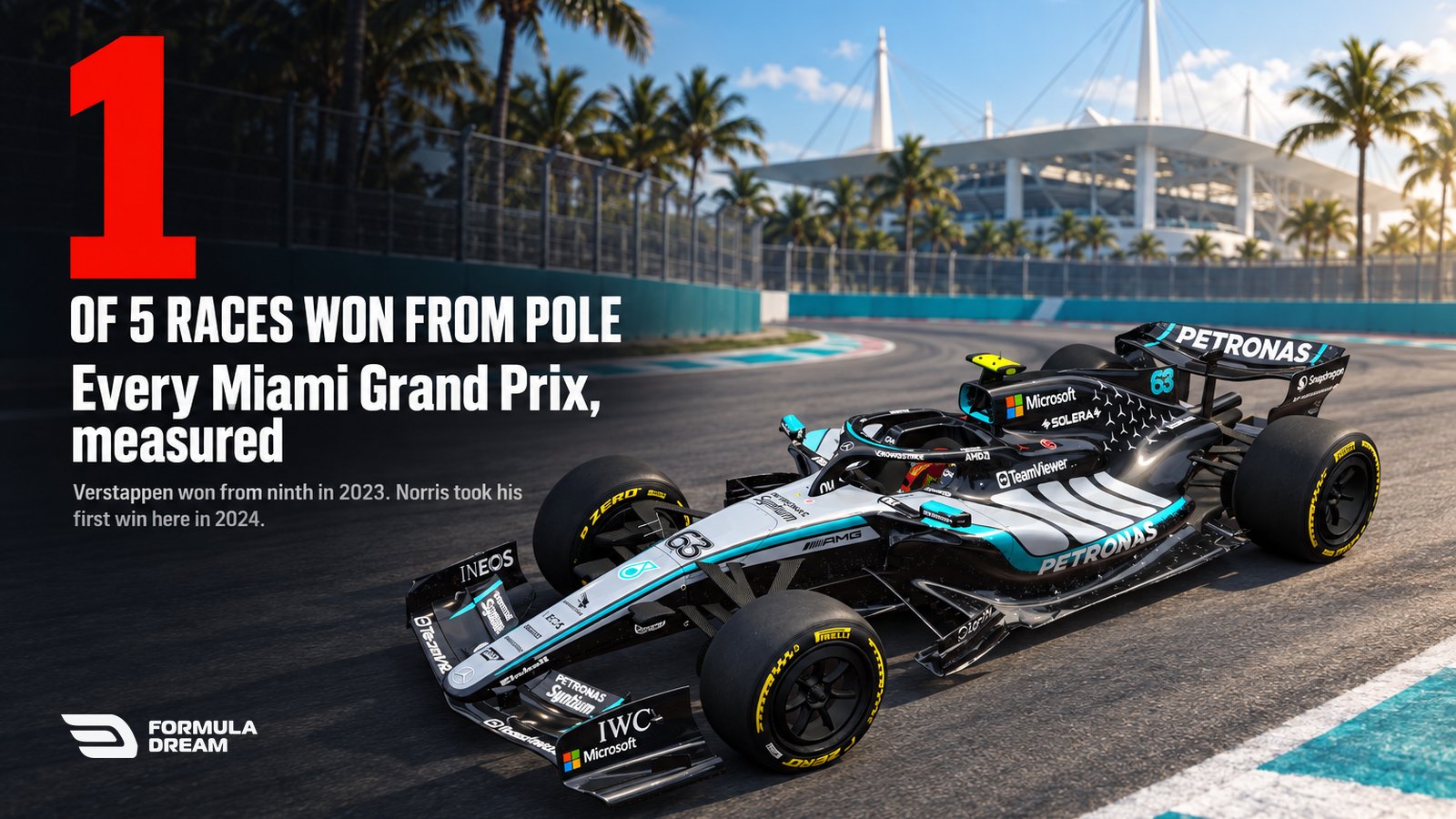
Every Miami Grand Prix winner, measured: five races, and pole has won only one of them
Five Miami Grands Prix have been held since 2022, and only one was won from pole: Kimi Antonelli's in 2026. Max Verstappen won from ninth in 2023, and Lando Norris took his first win there in 2024. Every winner, grid slot and safety car, measured.