How Many Pit Stops Are in an F1 Race? Pit Stops Explained
F1 pit stops explained, how a crew of 20 changes four wheels in under two seconds, the 1.80s world record, why banning refuelling made them so fast, and why an unsafe release is so dangerous.
Most F1 races have one to three pit stops, and at least one is compulsory in dry conditions. There is no maximum. A team can stop as often as it likes, and the only reason they do not is that every stop costs about 22 seconds of race time.
The stationary part of a stop takes under two seconds, which is the number everyone quotes. It is also the smallest part of the cost.
Here is how many stops a race actually has, what one really costs, and how a crew changes four wheels in the time it takes to read this sentence.
There is no limit on pit stops in Formula 1, and no fixed number. In practice a dry Grand Prix is usually a one or two stop race, occasionally three when tyre wear is severe.
What forces the minimum is a tyre rule rather than a pit stop rule. Under Article B6.3.6 of the 2026 Sporting Regulations, in a dry race every driver must use at least two different dry tyre specifications, and at least one of them must be a mandatory race specification the FIA names two weeks before the event. Since a driver cannot change tyres without stopping, that requirement makes one stop compulsory. A driver who does not comply is disqualified.
Two things follow from that, and they catch people out:
If it rains, the requirement disappears. Once intermediate or wet tyres are used, the two-compound rule no longer applies, so a driver could in principle run the whole race without stopping.
The minimum is one, not two. Formula 1 trialled a mandatory two-stop race at Monaco in 2025 to force some strategy into a circuit where overtaking barely happens. It was widely disliked, and there is no such rule in the 2026 regulations, so Monaco is back to the normal requirement.
We counted every stop of the 2026 season
Most answers to this question are a shrug: one or two, depending on the tyres. We counted instead, across the first twelve races of 2026. That is 257 driver-races.
Stops
Driver-races
Share
0
9
3.5%
1
91
35.4%
2
85
33.1%
3
42
16.3%
4
17
6.6%
5 or more
13
5.1%
Pit stops per driver per race, 2026 season to date, measured from timing data.
The average is 2.05 stops per driver per race. The most common single answer is one stop, at 35.4%, but two stops is almost exactly as likely at 33.1%. Anyone telling you an F1 race is "a one-stopper" is describing a third of the field.
The nine zero-stop entries are not strategic masterstrokes, they are retirements: a driver who stops on track never visits the pit lane.
The circuit changes the answer more than the tyres do
The spread between races is far wider than the average suggests.
Monaco: 4.05 stops per driver on average, the highest of the season, with one driver stopping seven times.
Zandvoort: 3.09
Barcelona: 2.41
Spa: 1.36
Shanghai: 1.17
Miami: 1.09, the lowest.
Miami to Monaco is a difference of nearly three stops per driver at the same points in the same season, with the same tyre supplier.
Here is the part that surprised us. Monaco was dry. Race control recorded a 0% chance of rain and track temperatures in the high forties. The reason Monaco produced four stops a driver is that it produced repeated safety cars, and a safety car makes a pit stop cheap. Under normal racing a stop costs the driver something in the region of 20 seconds of track position. Behind a safety car the field is bunched and slowed, so the same stop costs a fraction of that, and teams take a free tyre whenever it is offered.
Zandvoort tells the same story from the other direction: it rained, there was a red flag and safety cars, and it produced the second-highest count of the year.
So the honest answer to "how many pit stops in an F1 race" is that tyre wear sets the plan and interruptions decide what actually happens. A race that runs green from start to finish tends toward one or two. A race with a safety car tends to more, whatever the tyres were going to allow.
The one race where the FIA decides for you
There is a single exception to all of the above, and it is worth knowing because it is the only time the rulebook overrides the strategists.
Qatar is the only Grand Prix where a maximum stint length has been imposed. In 2023 the FIA and Pirelli set a limit of 18 laps per set of tyres, on safety grounds, after micro-lacerations caused by the circuit's kerbs were found in the tyre sidewalls. On a 57 lap race that is a forced three-stop. In 2025 Pirelli set a 25-lap limit, agreed with the FIA, Formula 1 and the teams, after tyres from the 2024 race, particularly the left front, had reached maximum wear. That forces a minimum of two.
The measurement that makes this interesting is the year in between. 2024 had no limit at all, and produced more stops than the regulated year: a mean of 3.05 per driver, against 2.89 in 2023. Left to themselves, teams stopped three times anyway. Lusail was already a three-stop circuit; the rule only removed the option of gambling on fewer. We measured why in the Lusail circuit guide: its slowest corner is taken at 99 km/h, the highest minimum speed of any circuit we have measured, so the tyre is loaded continuously and never gets a slow corner in which to recover.
The rest of the calendar, measured
The 2026 figures above cover the first twelve rounds. We have since measured the remaining circuits from their most recent races, which is a fair guide to what to expect even though the cars have changed.
Circuit
Mean stops per driver
Most common
Note
Lusail, Qatar
2.89 to 3.05
3
Mandated tyre limit in two of three years
Interlagos
1.90 to 2.00
2
The only other genuine two-stop
Yas Marina
1.35 to 1.90
1
Two of three races had no safety car
Las Vegas
1.25 to 2.05
1 and 2
No settled pattern across three races
Mexico City
1.10 to 1.50
1
One safety car in each of the last two
Monza
1.05 to 1.55
1
No safety cars 2023 to 2025; a red flag in 2026
COTA
1.05 to 1.15
1
Exactly one safety car in each of two years
Range across the most recent races at each circuit, from F1 timing data.
Read that against the 2.05 season average and the pattern is clear. Only two circuits on the entire calendar are genuine two-stop races, Lusail and Interlagos, and they are the two that combine heavy tyre load with a high chance of interruption. Everything else is a one-stop that occasionally becomes something else because of a safety car.
What a pit stop actually costs
This is the number that decides strategy, and it is not two seconds.
We measured every stop across a season. Under green flag conditions a pit stop costs 21.88 seconds of race time, counting the whole detour: the slow-down, the pit lane at the 80km/h limit, the stationary time and the acceleration back to speed.
Under a virtual safety car it costs 18.13 seconds, and behind a full safety car just 14.24 seconds, because the rest of the field is going slowly too. That is why teams dive for the pits the instant a safety car appears, and why a badly timed caution can wreck a race that was going perfectly. The full method and the per-circuit numbers are in what an F1 pit stop actually costs.
So when a team chooses between one stop and two, they are weighing roughly 22 seconds of guaranteed loss against the lap time a fresher set of tyres will give back. That trade is the whole of race strategy.
The call itself is deliberately short, because the whole grid hears the world feed. "Box, box, box" is three syllables that cannot be confused with anything else over engine noise. Teams also rehearse the stop in practice, which is where you get instructions like this one to Esteban Ocon in 2023 Bahrain practice:
"OK, Superman, box box, practice pit stop, no launch."
"No launch" means roll away normally instead of performing a race start on the way out. You can hear the practice stops being set up on the 2023 Bahrain practice page, and the real thing under strategy pressure on the race page.
How fast is the stop itself?
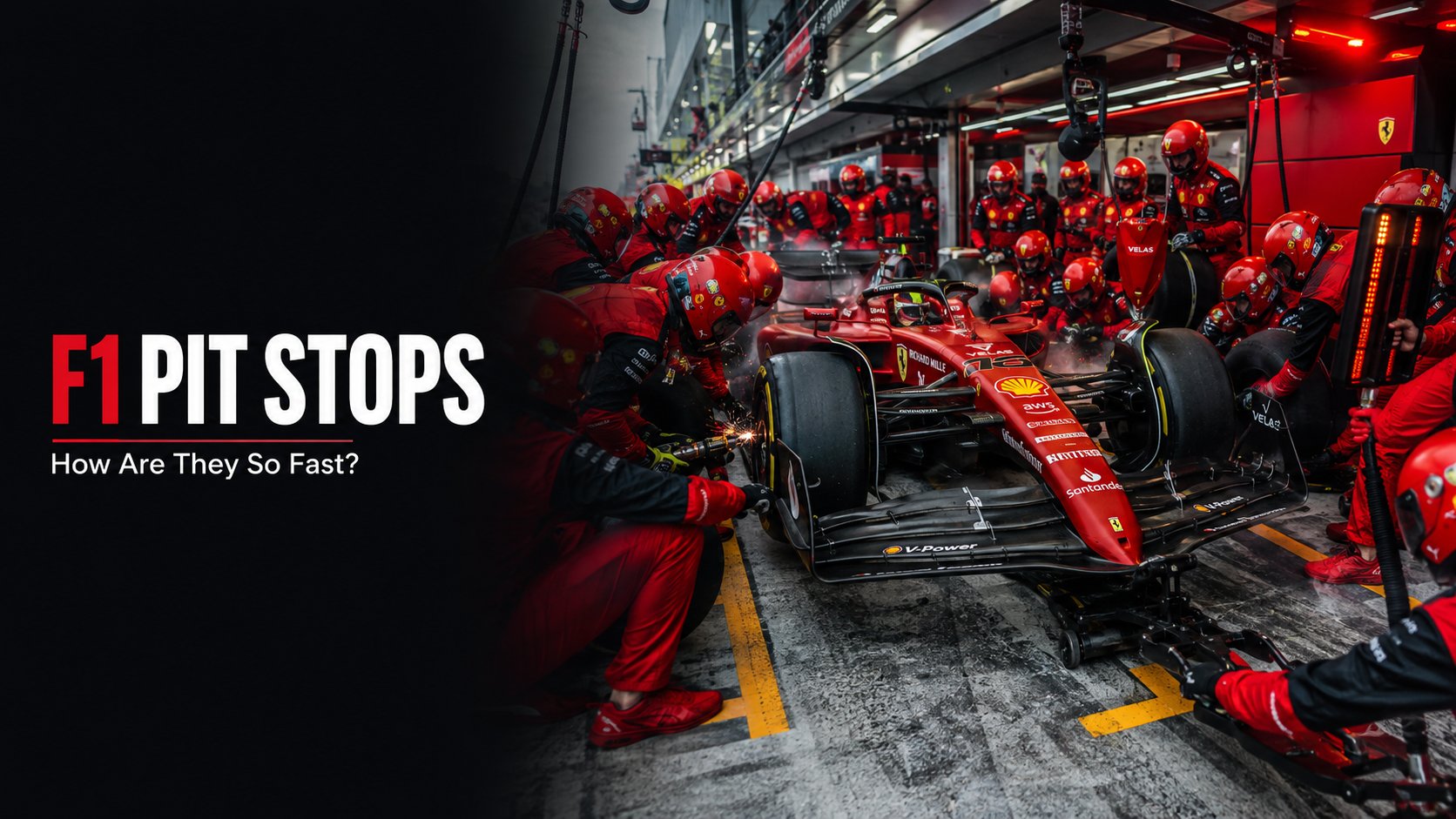
The world record is 1.80 seconds, set by McLaren on Lando Norris's car at the 2023 Qatar Grand Prix, when the crew stripped off one set of medium tyres and fitted another in less time than it takes to read this sentence. A typical competitive stop lands somewhere around two to three seconds for the stationary part, measured from the car stopping to it being released. For context, twenty years ago a good stop took six or seven seconds. The trend has only gone one way.
Why they got so fast: no more fuel
The single biggest reason a modern stop is so quick is what it no longer does: since 2010, refuelling has been banned. A stop today is purely a tyre change, with the odd front-wing tweak, so there is no waiting for tens of litres of fuel to flow into the car.
Refuelling was banned for two reasons. The first was safety. High-pressure fuel and hot cars are a dangerous mix, and it had gone wrong badly before: at the 1994 German Grand Prix, a fuel-hose failure engulfed Jos Verstappen, father of Max, and his mechanics in flames, and as recently as 2009 a spill set Kimi Räikkönen's car alight in the pit lane. The second reason was cost: shipping heavy refuelling rigs to every race around the world was expensive. Taking fuel out of the stop made it both safer and dramatically faster.
Who is in the pit crew?
A standard stop uses around 20 people, each with a single, rehearsed job. The regulations do not set a number; they require everyone working on the car in a stop to wear a helmet and eye protection.
Three per wheel (12 total): one on the wheel gun, one to pull the old tyre off, one to push the new one on.
Two jack operators, front and rear, who lift the car the instant it stops and drop it the instant the wheels are on.
A stop/go signal operator (traditionally the "lollipop", now usually an automated traffic light) who tells the driver when to brake, hold and go.
Front-wing adjusters and spare crew ready to react to a problem.
Why they are so fast: the engineering
Three things make the speed possible:
A single central nut. Each wheel is held on by one big central locking nut, not the four or five bolts on a road car, so it comes off and goes on in a fraction of a second.
Custom pneumatic wheel guns. Purpose-built tools far more powerful than anything in a normal garage, spinning that nut off and back on almost instantly.
Relentless choreography. Every crew member practises their exact movement hundreds of times, and teams run pit-stop drills throughout every race weekend. The whole crew moves as one rehearsed machine.
Why an unsafe release is so dangerous
Speed is nothing without safety, and this is where the danger lives. An unsafe release is letting a car go in an unsafe condition, such as with a wheel not properly attached, or into the path of another car. Under Article B1.6.2, releasing a car in an unsafe condition during the race brings a stop-and-go penalty, and releasing it into danger is penalised at the stewards' discretion. But the penalty is the least of it. A loose wheel leaving the pit box at speed is a genuine hazard: Mark Webber once left his Red Bull box with a wheel not properly attached, and it bounced down the pit lane and broke a cameraman's collarbone and ribs. In 2018, Ferrari's automated system was fooled into signalling a release before Kimi Räikkönen's wheel was secured, and he drove away over one of his own mechanics, breaking the man's leg in two places.
It is precisely to prevent this that the Technical Regulations require dual-stage retaining devices that hold the wheel nut on even if it comes loose, with a way for the wheel operator to see an incorrectly fitted nut (Article C10.9). The two-second stop is a marvel, but the reason it is policed so hard is that when it goes wrong, people get hurt.
Why pit stops win races
A perfect stop is not just for show. Half a second gained or lost in the pit lane can be the difference between coming out ahead of a rival or stuck behind them, which is exactly what the undercut and overcut are built around. Combined with the right tyre choice and the timing of a safety car, the pit stop is where a huge number of races are quietly won and lost.
Watch the stops as they happen
Pit strategy is the part of a race that is decided while you are looking somewhere else.
The Formula Dream app runs a live Dashboard through every session: every car on the circuit map, and a timing tower with lap times, gaps, intervals, tyre compound and age and pit counts, plus flag and safety car alerts the moment race control calls them. That is where you see an undercut coming. You also get live driver radio as it is broadcast, which is where the stop is called, and every FIA document of the weekend as it is published, including unsafe release decisions.
Free, no subscription, no ads, independent. Not affiliated with Formula 1.
The pit lane has a rulebook of its own, covering the speed limit, unsafe releases and where a car may and may not be worked on. It is in F1 pit lane rules explained.
Frequently asked questions
How many pit stops are in an F1 race?
Usually one to three, and 2.05 per driver on average in the first twelve races of 2026. There is no maximum, but in dry conditions a driver must use two different dry tyre specifications, which makes at least one stop compulsory. If intermediate or wet tyres are used that requirement no longer applies.
How many pit stops are allowed in F1?
There is no limit. A team can stop as many times as it wants. Each stop costs about 22 seconds of race time under green flags, which is what keeps the number low.
Does Monaco still have a mandatory two-stop rule?
No. It was trialled in 2025 and removed from the 2026 regulations, so Monaco uses the standard requirement of at least one stop.
How fast is an F1 pit stop?
The world record is 1.80 seconds, set by McLaren at the 2023 Qatar Grand Prix. A normal competitive stop is around two to three seconds stationary.
Why are F1 pit stops so fast?
A single central wheel nut, custom high-power pneumatic wheel guns, a crew that rehearses each role hundreds of times, and, above all, no refuelling since 2010, so a stop is a pure tyre change.
Why was refuelling banned in F1?
On safety grounds, after fuel fires like the one that engulfed Jos Verstappen in 1994, and to cut the cost of shipping refuelling equipment around the world. It was banned from 2010.
How many people are in an F1 pit crew?
Around 20 for a standard stop: three per wheel (12), two jack operators, a signal operator, plus front-wing adjusters and spare crew. The regulations do not set a maximum.
What is an unsafe release in F1?
Releasing a car in an unsafe condition, such as with a loose wheel, or into the path of another car. An unsafe car released during the race brings a stop-and-go penalty. It is genuinely dangerous: loose wheels and premature releases have injured mechanics and a cameraman, which is why wheel nuts must now have retaining devices.
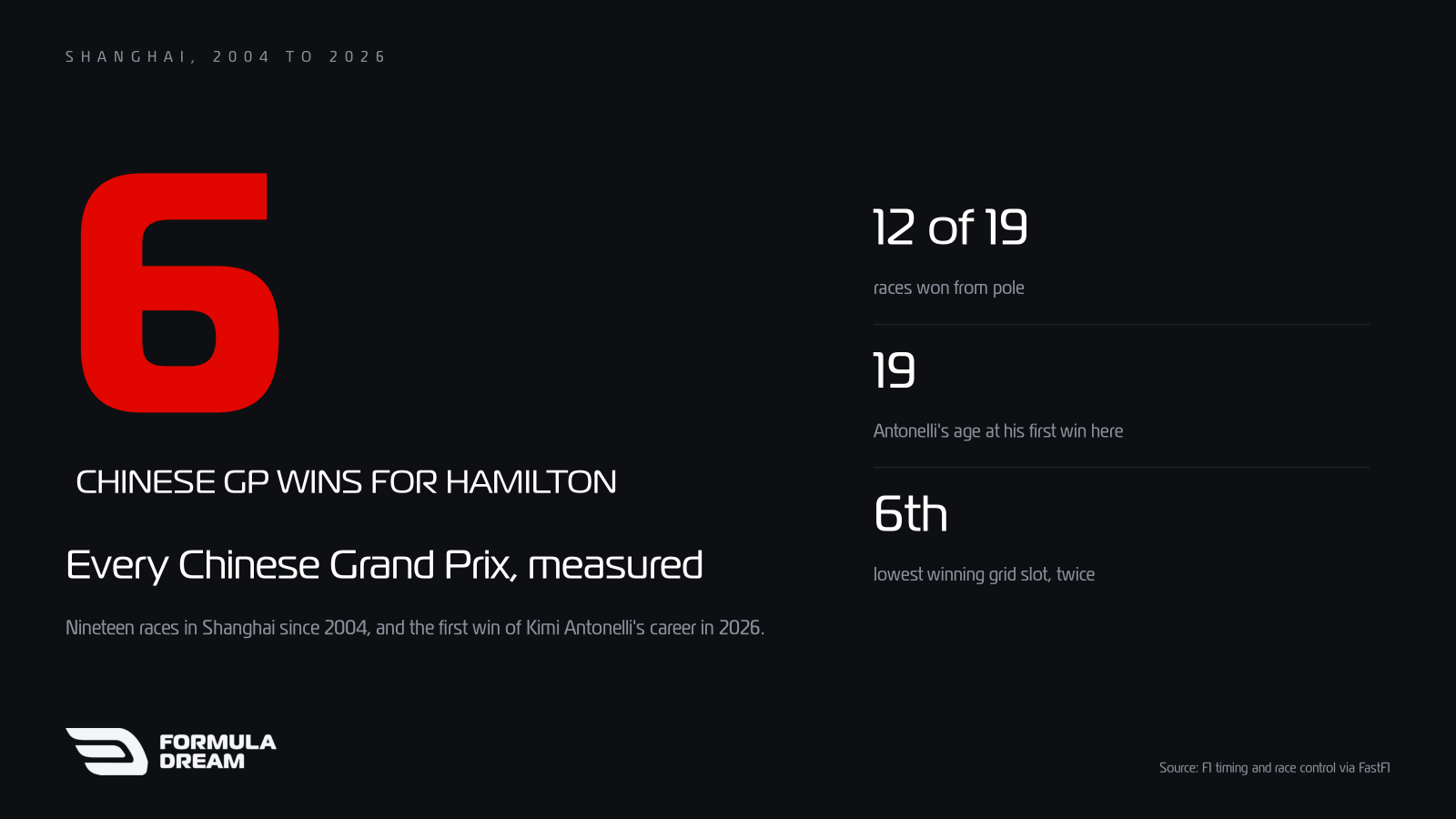
Nineteen Chinese Grands Prix have been held in Shanghai since 2004. Lewis Hamilton won six, pole won twelve, and in 2026 Kimi Antonelli took the first win of his career there, at 19, with Hamilton on the podium for Ferrari for the first time. Every winner, grid slot and safety car, measured.