Mercedes W17: The 2026 F1 Car Explained and Measured
Guides
Mercedes W17: The 2026 Car, and What It Actually Does
The W17 is smaller, narrower and lighter than the car before it, and it has taken ten of the first thirteen poles. We measured where its advantage actually comes from.
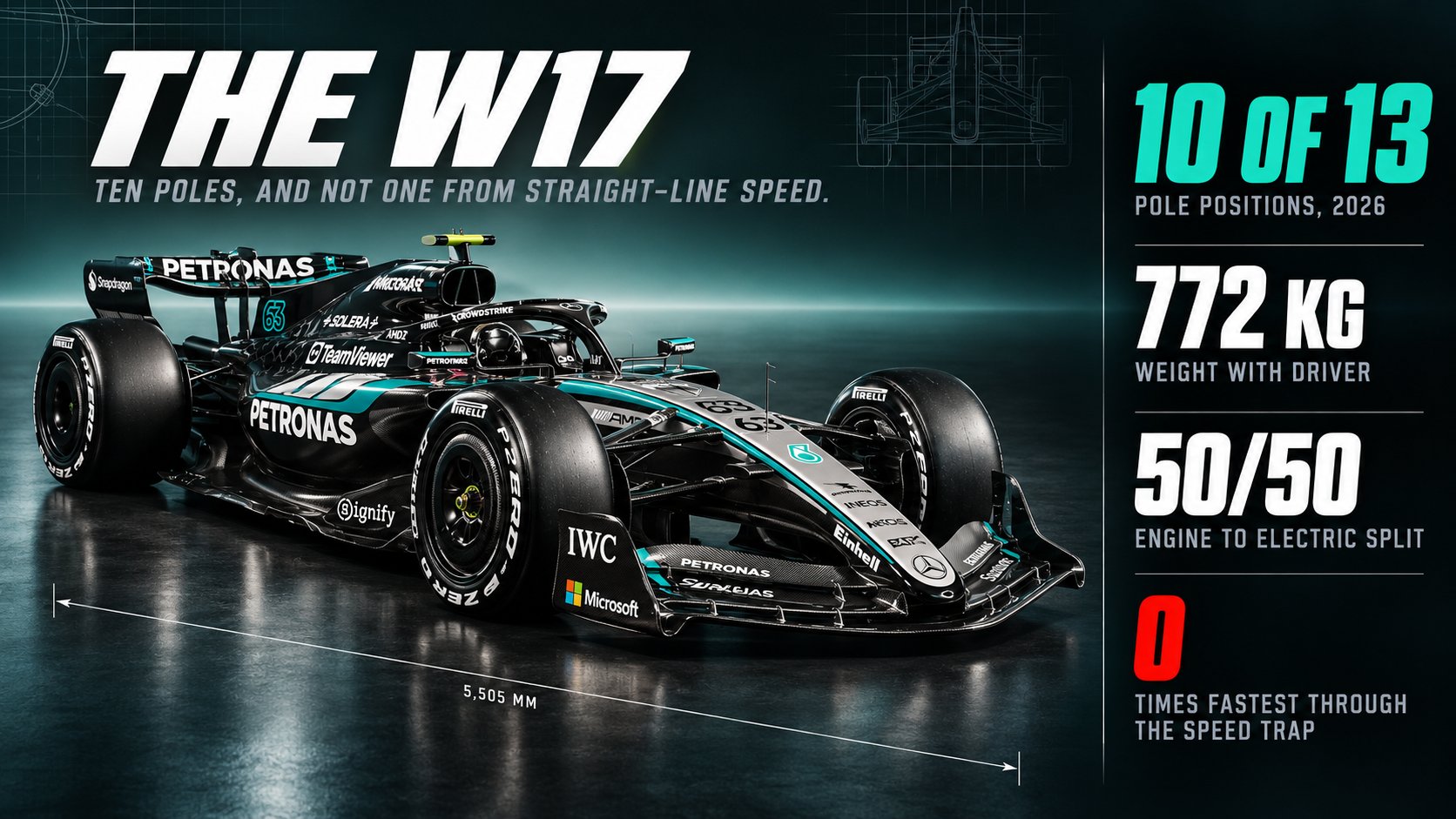
The Mercedes-AMG F1 W17 E Performance is the car Mercedes built for the biggest regulation change in a decade. Thirteen rounds in, it has taken ten pole positions and not one of them came from being fastest in a straight line.
Here is the car, and then the measurements that show what it is actually good at.
Mercedes W17 specifications, as published by the team.
It is smaller, narrower and lighter than the car it replaced, which is true of the whole 2026 grid. The regulations shrank the cars deliberately, on the reasoning that smaller cars race each other better.
The two changes that matter most are under the bodywork and on top of it. The power unit drops the MGU-H entirely and roughly triples the electrical output of the MGU-K, moving the split between engine and battery close to 50/50. The wings became active aerodynamics, motorised front and rear, replacing DRS with a low-drag mode every car can use on every straight. We broke both down in the 2026 F1 regulations explained.
What the season record says
Through thirteen rounds the W17 has taken ten pole positions, six for Antonelli and four for Russell. Ferrari and Red Bull have taken none.
The streak finally broke at Monza, where Pierre Gasly put an Alpine on pole by 0.060 seconds, which was Alpine's first pole in the team's history. That session is in the Italian GP qualifying results.
The advantage is not the engine
This is the part worth measuring, because the obvious explanation is wrong.
If a car takes ten of thirteen poles, the intuitive reading is that it has the best power unit. The speed trap data does not support it.
The highest speed trap reading of the 2026 season belongs to Esteban Ocon at Barcelona, 358 km/h, in an Alpine. At Monza, the circuit where straight-line speed matters more than anywhere, the top twelve cars through the trap were covered by 9 km/h and the quickest of them was a Williams. Mercedes were not at the top of that list.
Straight-line speed is where this grid has converged. It is not where the poles are coming from.
The advantage is corners, at both extremes
The stronger evidence is which circuits the W17 wins on, because it is winning on all of them.
Mercedes took pole at Spa and at Monaco in the same season. Those are the two most different circuits in Formula 1, and we have the measurements to say how different:
Spa
Monaco
Average lap speed
238.8 km/h
163.0 km/h
Full throttle
80%
51%
Braking events
6
10
The two circuits at opposite ends of the 2026 calendar, measured from pole lap telemetry. Full throttle is share of lap distance.
A car that is quickest at 238.8 km/h and quickest at 163.0 km/h is not benefiting from a circuit type. It is quick everywhere, and the only thing common to both laps is cornering.
At Monza final practice we measured the minimum speed every fast driver carried through each corner. Antonelli carried the highest apex speed of the seven quickest through Lesmo 1 at 210 km/h, Ascari at 197 and the Parabolica at 214, which are the three fastest corners on the circuit, and his Parabolica figure was 14 km/h higher than his own team mate's.
The two cars, in the metal
Both W17s in their launch specification, Antonelli's number 12 and Russell's number 63.
Image gallery, 2 slides
1 / 2
You can turn every 2026 car around in the browser in our 3D Showroom.
What it has not turned into
One honest caveat, because pole is not the same as a championship.
The 2026 field is further apart than it has been in years. We measured the gap between the fastest and slowest team in qualifying at 4.66%, against 1.99% in 2025, and it is still 3.85% if you remove the new eleventh team entirely. Mercedes are at the front of a grid that has spread out, which flatters any pole tally.
Qualifying pace and race pace are also different problems. Our long-run measurements at Monza put Antonelli quickest on race pace too, at a 1:25.993 median on the hard tyre with essentially flat degradation over 16 laps, but the 2026 season has produced races that did not follow their grids.
Monza then produced the strongest evidence for the car and the weakest for the pole tally at the same time. Mercedes did not take pole there, and won anyway: Antonelli started nineteenth after a power unit penalty, averaged 1:24.663 over the final stint against Russell's 1:25.366 on the harder tyre, and passed his own team mate for the lead on lap 50. Read the Italian GP race results and the stint data.
The W17's advantage shows up on Saturday, in a column most broadcasts do not dwell on.
The Formula Dream app runs a live Dashboard through every session: every car on the circuit map, and a timing tower with lap times, gaps and intervals, tyre compound and age, plus flag and safety car alerts as race control calls them. In qualifying the useful column is sector times, because that is where you see a car gaining in the corners rather than on the straights, which is exactly how this car works. You also get live driver radio as it is broadcast, and every FIA document of the weekend as it is published.
Free, no subscription, no ads, independent. Not affiliated with Formula 1.
The Mercedes-AMG F1 W17 E Performance, usually shortened to W17. Its power unit is the Mercedes-AMG F1 M17 E Performance.
Who drives the Mercedes W17?
George Russell, car number 63, and Kimi Antonelli, car number 12.
How much does the Mercedes W17 weigh?
772 kg including the driver, coolant and oil. It is 5,505 mm long, 1,900 mm wide and 950 mm high, with a 3,400 mm wheelbase, making it smaller and lighter than the car it replaced.
How many poles has Mercedes taken in 2026?
Ten of the first thirteen rounds. Kimi Antonelli has six and George Russell four. Ferrari and Red Bull have taken none.
Is the Mercedes W17 the fastest car in a straight line?
No. The highest speed trap reading of the 2026 season is 358 km/h by Esteban Ocon in an Alpine at Barcelona, and at Monza the top twelve cars were covered by 9 km/h. The W17's advantage is in the corners.
What changed on the 2026 Mercedes compared with 2025?
It is smaller, narrower and lighter, it uses active aerodynamics with motorised front and rear wings instead of DRS, and its power unit drops the MGU-H while roughly tripling the electrical output of the MGU-K.
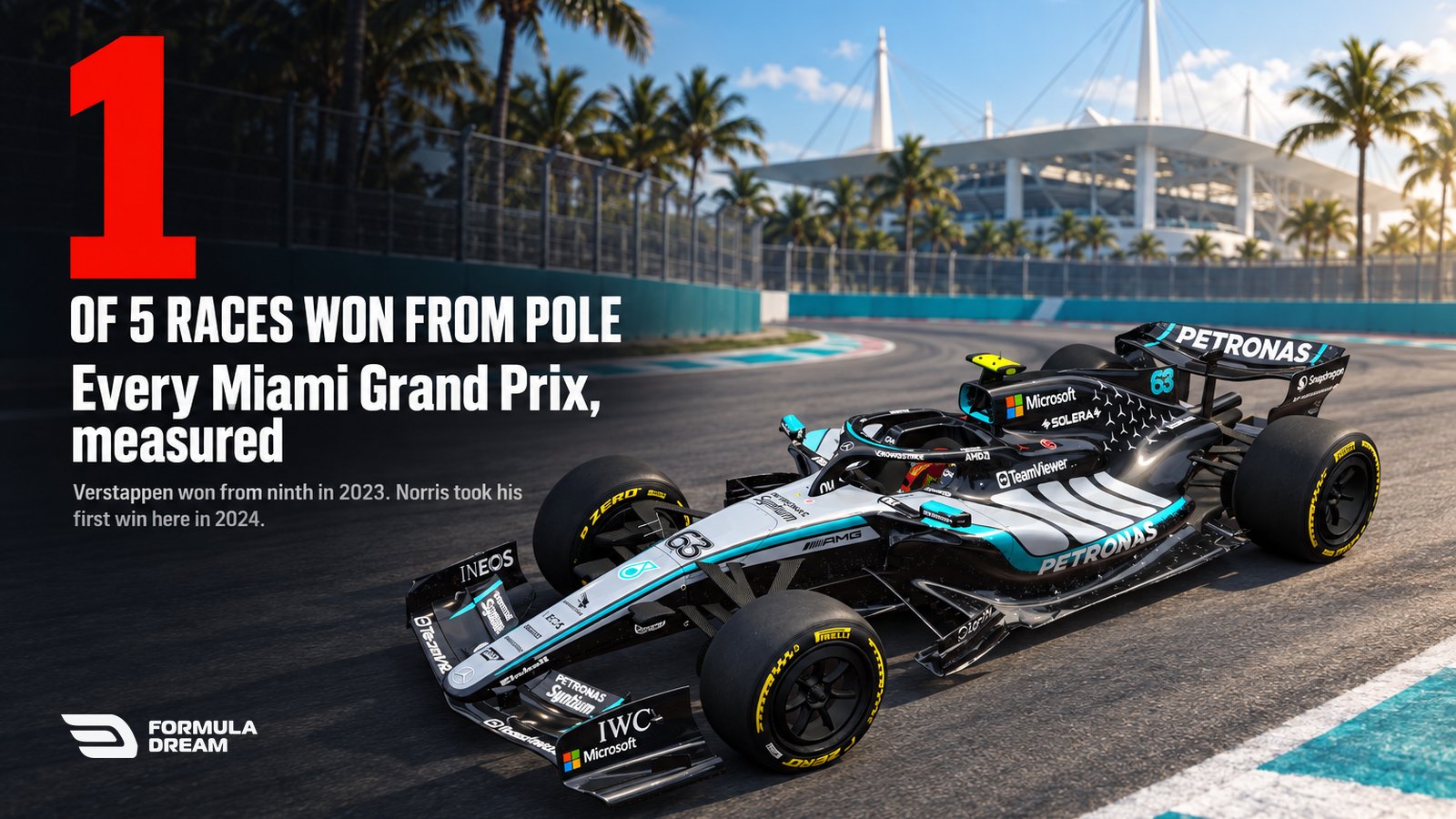
Every Miami Grand Prix winner, measured: five races, and pole has won only one of them
Five Miami Grands Prix have been held since 2022, and only one was won from pole: Kimi Antonelli's in 2026. Max Verstappen won from ninth in 2023, and Lando Norris took his first win there in 2024. Every winner, grid slot and safety car, measured.