Ferrari SF-26: The 2026 F1 Car Explained and Measured
Guides
Ferrari SF-26: The 2026 Car, and What It Has Actually Done
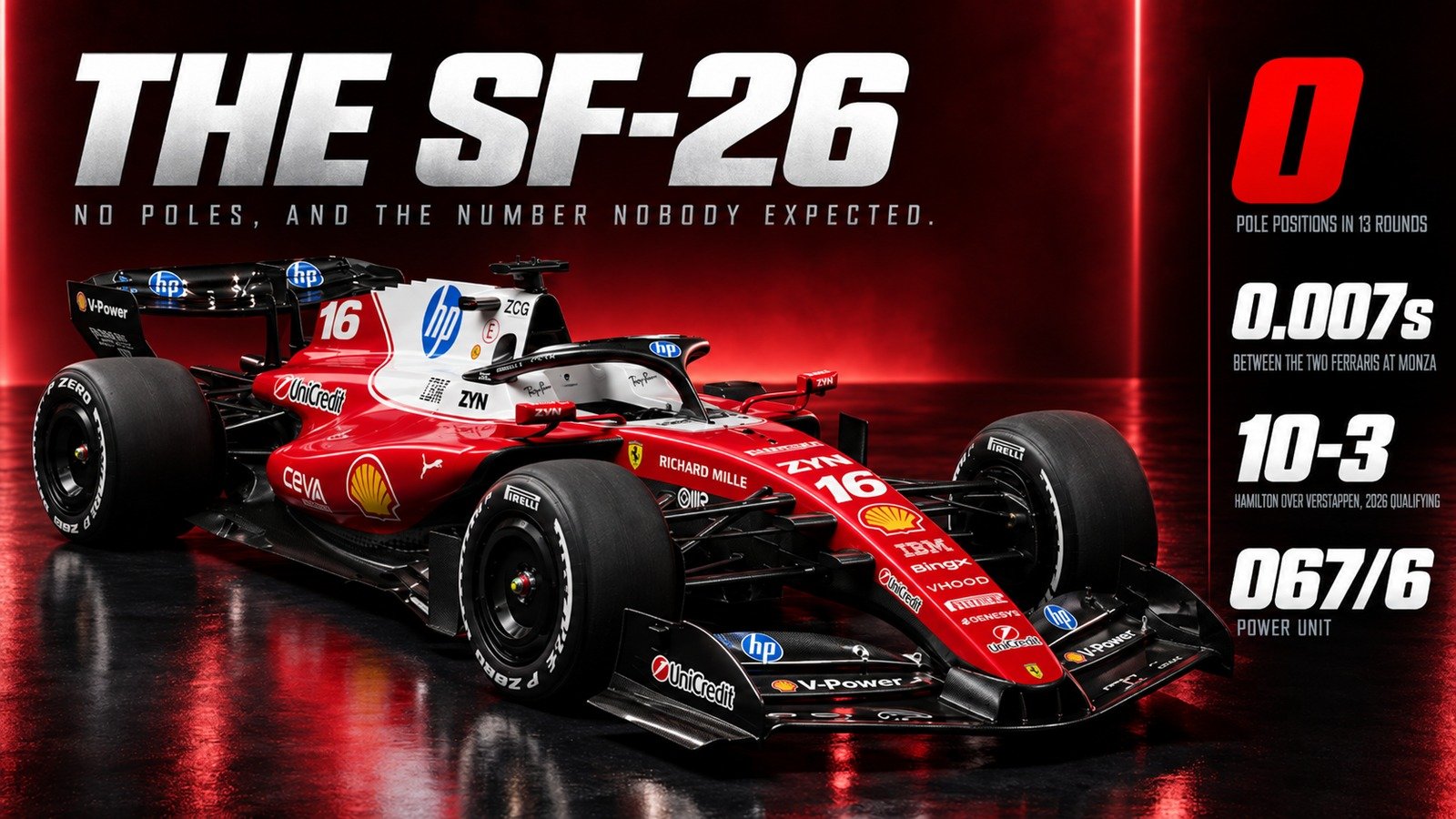
Red and white, pushrod at both ends, and no pole positions in thirteen rounds. But Hamilton is out-qualifying Verstappen 10-3, which is the number nobody expected.
The Ferrari SF-26 has not taken a single pole position in thirteen rounds of 2026. In the same period Lewis Hamilton has out-qualified Max Verstappen ten times to three.
Both of those are measured facts, and holding them together is the only honest way to describe this car.
Ferrari SF-26, as launched. The 2026 cars are shorter and around 30 kg lighter than the generation before them.
Two details set it apart from its predecessors.
It is red and white. The stark white engine cover is a deliberate reference to the 312T of the 1970s, and it matters for a practical reason too: almost every illustration of a "2026 Ferrari" you will see online is entirely red, and is therefore wrong.
It runs pushrod suspension at the rear, which makes it the first Ferrari since the F10 to do so. Front and rear are both pushrod, a genuine departure.
The power unit follows the 2026 formula: no MGU-H, an MGU-K delivering close to three times its previous output, and a split between engine and battery approaching 50/50. The full rule change is in the 2026 F1 regulations explained.
Thirteen rounds, no poles
This is the plain fact about the SF-26's season.
Mercedes have taken ten of the first thirteen poles, McLaren two and Alpine one. Ferrari have taken none. Neither has Red Bull. The pole-by-pole record is in Mercedes took 10 of 13 poles.
At Monza, in front of their own crowd, the two Ferraris qualified fourth and fifth. That sounds like a gap until you look at the times.
Qualifying time
Gap to pole
Leclerc
1:22.004
+0.218
Hamilton
1:22.011
+0.225
Italian Grand Prix qualifying, from F1 timing data.
Seven thousandths of a second between the two Ferraris, and both within a quarter of a second of a pole that went to an Alpine. This is not a slow car. It is a car that keeps arriving fourth.
The number nobody expected
Here is the finding that runs against four years of form.
We counted every qualifying session Hamilton and Verstappen have both entered since 2018, 148 of them. Across the nine seasons it is astonishingly level, 68 to 67 in Verstappen's favour in dry conditions. But the current season is not level at all.
In 2026, Hamilton leads Verstappen 10 sessions to 3, by a median of 0.124 seconds. That reverses four consecutive seasons in which Verstappen led, including a 2022 in which he won every single one of their dry sessions 17 to nothing.
Hamilton's first year at Ferrari, in 2025, was widely described as a nightmare, and the team finished fourth in the constructors' championship. The second year reads very differently. The full nine-season record is in Hamilton vs Verstappen, the head to head.
What the car is actually good at
At Monza we measured the minimum speed every quick driver carried through each corner on their best lap.
Leclerc took the fastest third sector of the entire qualifying session, a 27.081. That is the part of the Monza lap containing the Parabolica, the long final corner where a car has to hold the throttle while loaded up, and it is the most downforce-dependent sector of the circuit.
That fits the shape of Ferrari's season. This is a car that works in the corners rather than one that wins on the straights, which at Monza of all places is a slightly awkward thing to be good at, and it is why fourth and fifth is where they landed.
What it looks like
Ferrari's 2026 car in the 3D Showroom, where you can rotate it and get closer than any photograph allows.
Every car on the 2026 grid is in there, and the shapes are genuinely different from one another this season. We measured how different in every 2026 F1 car in 3D: the gap between the fastest and slowest team more than doubled this year, from 1.99% of lap time to 4.66%.
Follow Ferrari's weekend with the data on screen
Fourth and fifth on the grid is where strategy decides a race rather than pace.
The Formula Dream app runs a live Dashboard through every session: every car on the circuit map, and a timing tower with lap times, gaps and intervals, tyre compound and age, plus flag and safety car alerts as race control calls them. You also get live driver radio as it is broadcast, which at Ferrari is where the strategy arguments happen in public, and every FIA document of the weekend as it is published.
Free, no subscription, no ads, independent. Not affiliated with Formula 1.
The Ferrari SF-26. It is powered by Ferrari's 067/6 hybrid power unit and was launched on 23 January 2026.
Who drives the Ferrari SF-26?
Charles Leclerc, car number 16, and Lewis Hamilton, car number 44, in his second season with the team.
What colour is the 2026 Ferrari?
Red and white. The SF-26 carries a stark white engine cover, a deliberate reference to the 312T of the 1970s. Illustrations showing an all-red 2026 Ferrari are inaccurate.
How many poles has Ferrari taken in 2026?
None, across the first thirteen rounds. Mercedes have taken ten, McLaren two and Alpine one.
Is Hamilton faster than Leclerc at Ferrari?
They are extremely close. At Monza they qualified within 0.007 seconds of each other, Leclerc fourth and Hamilton fifth.
What is different about the SF-26 compared with the 2025 Ferrari?
It is shorter and roughly 30 kg lighter, it runs pushrod suspension at the rear for the first time since the F10, it uses active aerodynamics instead of DRS, and its power unit drops the MGU-H while roughly tripling the MGU-K output.
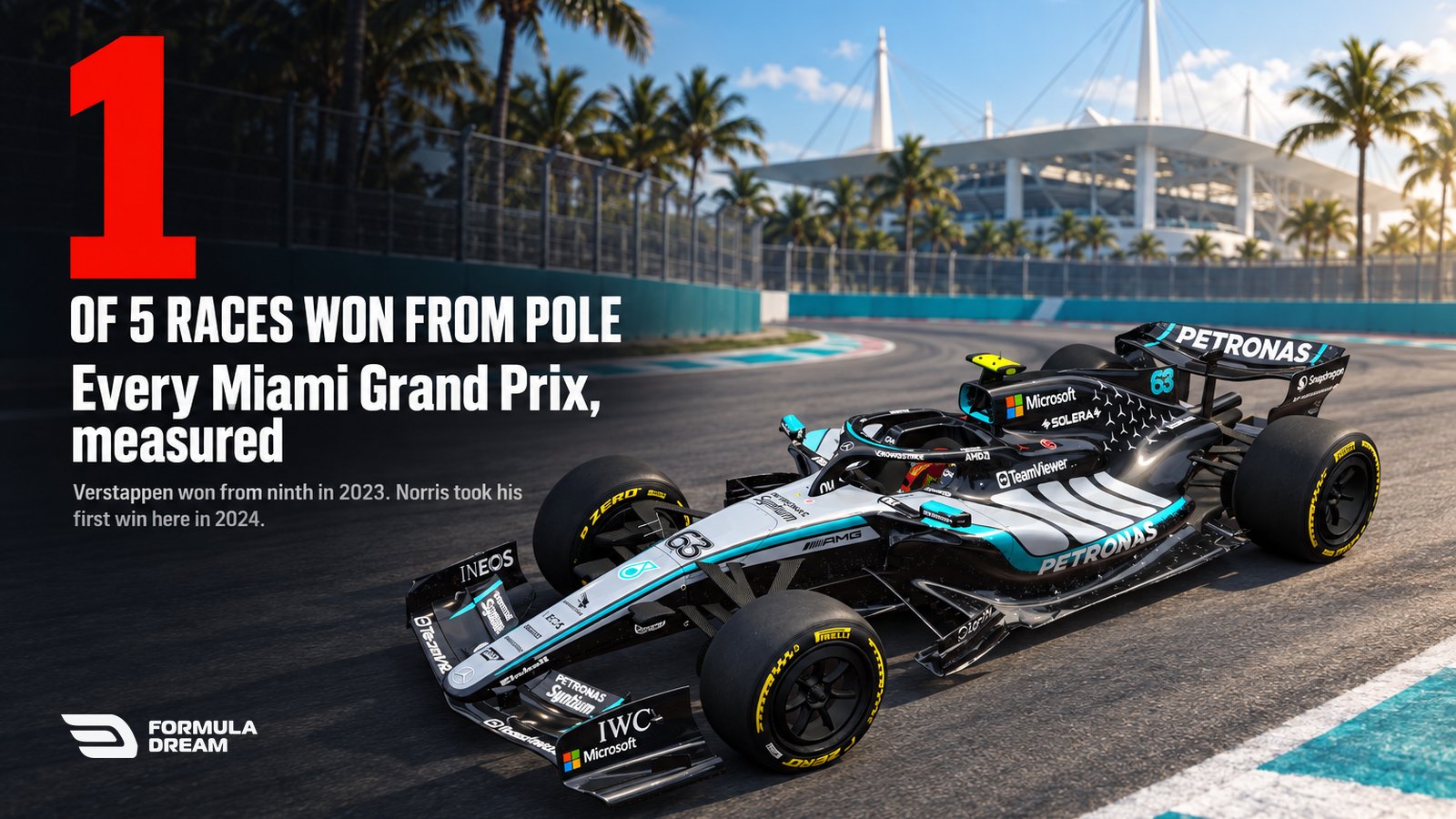
Every Miami Grand Prix winner, measured: five races, and pole has won only one of them
Five Miami Grands Prix have been held since 2022, and only one was won from pole: Kimi Antonelli's in 2026. Max Verstappen won from ninth in 2023, and Lando Norris took his first win there in 2024. Every winner, grid slot and safety car, measured.