What Drivers Talk About at Every F1 Circuit, Measured
Every F1 circuit has its own vocabulary, and we measured it
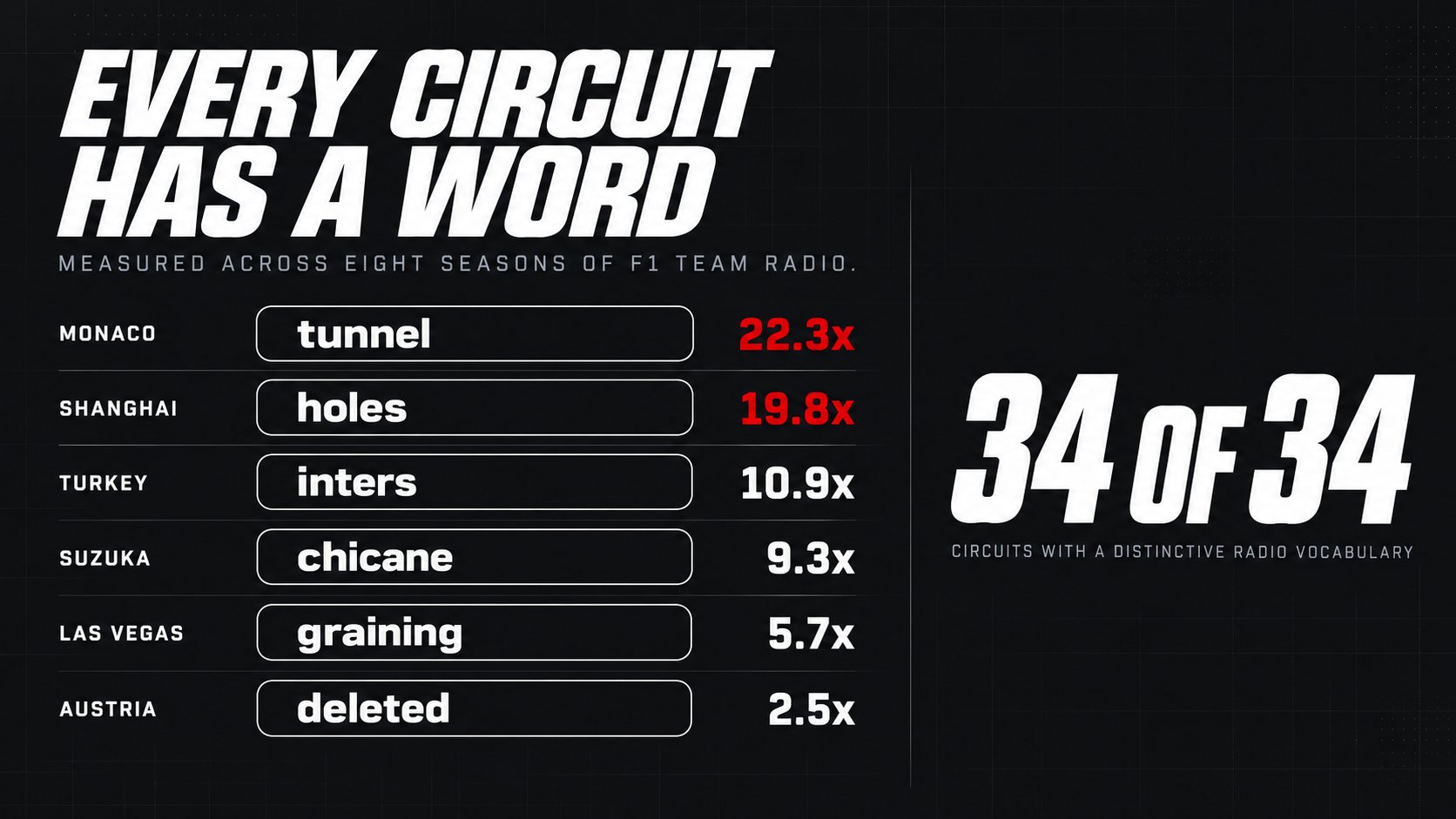
Drivers at Monaco say tunnel twenty two times more often than drivers anywhere else. Shanghai says holes. Austria says deleted. Every circuit leaves a fingerprint in the radio.
At Monaco, the word "tunnel" appears twenty two times more often on team radio than it does across the rest of Formula 1. At Shanghai, the word is "holes", at nearly twenty times the normal rate. In Austria it is "deleted". In Turkey it is "inters".
We took every word spoken across our archive of transcribed team radio and compared each circuit against the corpus as a whole. Thirty four circuits have enough traffic to test, and all thirty four have a distinctive vocabulary. Some of it is exactly what you would guess. Some of it is not.
How this was measured
For each circuit we counted every word in every transcribed message, then compared the rate at that circuit against the rate across the whole archive. A word qualifies as distinctive if it is used at least
as often as the corpus average and appears at least
12 times
at that circuit. Circuits need at least 300 messages to be included at all.
Three things were done to stop the result being noise, and they are worth stating because they change what the numbers mean:
Driver names were removed. They were the strongest signal and the least interesting one. One driver having a famous incident somewhere pushes their name to seventeen times the normal rate and tells you nothing about the circuit.
Common words were removed, along with anything under four letters.
A minimum count is enforced. Without it, a single message can invent a pattern. Twelve separate uses is a low bar but it is a real one.
This measures broadcast radio, the messages Formula 1 chose to air, not everything said in a car.
The circuits that describe themselves
Circuit
Word
Uses
Rate vs corpus
Monaco
tunnel
14
**22.3x**
Shanghai
holes
12
**19.8x**
Turkey
inter
47
10.9x
Suzuka
chicane
22
9.3x
Turkey
visor
14
5.8x
Portimao
deleted
16
5.8x
Las Vegas
graining
13
5.7x
Canada
raining
23
5.3x
Zandvoort
inter
25
5.1x
Monaco
wall
34
4.5x
Portimao
limits
20
4.6x
Qatar
limits
24
3.9x
Baku
wall
21
3.9x
Barcelona
gravel
15
3.7x
Spa
water
14
3.6x
Mexico City
coast
13
3.8x
Mexico City
lift
20
3.3x
Caption: Words used at least twice as often at that circuit as across the whole archive, driver names excluded.
Some of these are simply the circuit naming itself. Monaco has the only tunnel in Formula 1, so of course Monaco radio says tunnel. Suzuka's chicane is the famous last corner, and drivers refer to it by name because it does not need any other description.
The interesting ones are the circuits that describe a problem.
Shanghai's word is "holes"
Twelve uses at nearly twenty times the corpus rate, alongside elevated "wind" and "tailwind". That is a circuit whose surface drivers talk about in a way they do not talk about anywhere else, and a wind direction that matters enough to be called on the radio.
Mexico's words are "lift" and "coast"
Not a complaint about the track at all. Mexico City sits at high altitude, thin air cools an engine and its brakes far less effectively, and the standard answer is to lift off the throttle early and coast to shed temperature. Both words are elevated, "temps" is elevated, and together they are a circuit telling you what its actual challenge is. Nobody is talking about the corners.
A cluster of circuits share one word: "deleted"
Portimao at 5.8x, Qatar at 3.1x, Austria at 2.2x with "limits" at 2.5x, and the United States at 3.0x on "limits". These are the track limits circuits, and the radio shows it as clearly as any stewards' document. Austria adds "flags" and "penalty" to the same picture.
That is a genuine cross-circuit pattern rather than one venue's quirk, and it lines up with what we found separately in the Monza race data, where 14 of 21 deleted lap times came at a single corner. The mechanics of why are in track limits explained.
And a cluster shares the weather
Turkey is the extreme: "inter" at 10.9x, "inters" at 7.3x, "condition" at 6.8x and "visor" at 5.8x. Canada is "raining" at 5.3x and "rain" at 3.5x. Zandvoort is "inter" at 5.1x with "minutes" at 3.9x, and Spa is "water" at 3.6x with "heavy" at 4.0x and "minutes" at 3.5x.
"Minutes" showing up at wet circuits is the giveaway. It is not weather vocabulary. It is drivers and engineers counting down a delay.
Abu Dhabi's vocabulary is not about driving at all
"Season" at 9.4x. "Year" at 9.0x. "Years" at 8.0x. "Pleasure" at 9.6x. "Proud". "World".
Abu Dhabi is the last race of the year, and its radio is full of farewells, thank yous and championship arithmetic. It is the only circuit in the archive whose distinctive words are almost entirely about something other than the car.
What this does not show
Not every distinctive word is a complaint, and we are not going to pretend otherwise.
Plenty of what surfaces is incidental. Australia's list contains "purple" and "white", which are timing screen colours rather than anything about Albert Park. Some entries are transcription artifacts: a misspelling of a driver's first name survives our name filter at two circuits and means nothing.
We also cannot separate what drivers say from what Formula 1 chose to broadcast. A wet race produces more dramatic radio and more of it gets aired, which would inflate weather vocabulary at wet circuits even if drivers said the same amount. The direction of that bias is knowable; its size is not.
So the honest claim is narrower than "we know what drivers complain about". It is: every circuit's broadcast radio has a measurable fingerprint, and at a good number of them that fingerprint is a real feature of the place.
Read any of it yourself
Every message counted here is in the team radio archive, searchable by circuit, session and driver, with the original audio and a transcript that colours itself by who is speaking. If you want to check Monaco's tunnel or Shanghai's holes, the Monaco 2026 radio and Chinese Grand Prix radio pages are the place to start.
The archive is also browsable a season at a time, each one listing every Grand Prix it covers: 2018, 2019, 2020, 2021, 2023, 2024, 2025, 2026. 2022 is absent from the source data, which is why it is missing from the list and from every count in this article.
Hear the next one live
A circuit's vocabulary is only obvious in aggregate. Live, it is just a driver saying something about a corner.
The Formula Dream app carries live driver radio as it is broadcast, with the transcript running alongside it and the driver and engineer colour coded. It also runs a live Dashboard through every session, currently in beta, with every car on the circuit map and a timing tower showing lap times, gaps, intervals, tyre compound and age, plus every FIA document of the weekend as the stewards publish it.
Free, no subscription, no ads, independent. Not affiliated with Formula 1.
What do F1 drivers talk about on the radio at Monaco?
The tunnel, more than anywhere else by a distance: the word appears 22.3 times more often at Monaco than across the rest of the archive. Walls come next at 4.5 times the normal rate, followed by graining.
Which F1 circuit has the most distinctive team radio?
Monaco and Shanghai produce the two strongest single signals, "tunnel" at 22.3x and "holes" at 19.8x. Every one of the 34 circuits with enough messages shows some distinctive vocabulary.
Do drivers complain about track limits more at some circuits?
Yes, measurably. Portimao, Qatar, Austria and the United States all show "limits" or "deleted" at three to six times the normal rate, which matches where track limits penalties actually cluster.
Why do Mexico City drivers talk about lifting and coasting?
Altitude. Thin air cools the power unit and brakes far less effectively, so drivers lift off the throttle early and coast to manage temperature. "Lift", "coast" and "temps" are all elevated there.
What is unusual about Abu Dhabi team radio?
Its distinctive words are not about driving. "Season", "year", "years", "pleasure" and "proud" are all eight to nine times more common there, because it is the last race of the year and the radio fills with farewells and championship talk.
Word frequencies were measured across our own archive of transcribed broadcast team radio covering the 2018 to 2026 seasons. Coverage is not even across those years and 2022 is absent.
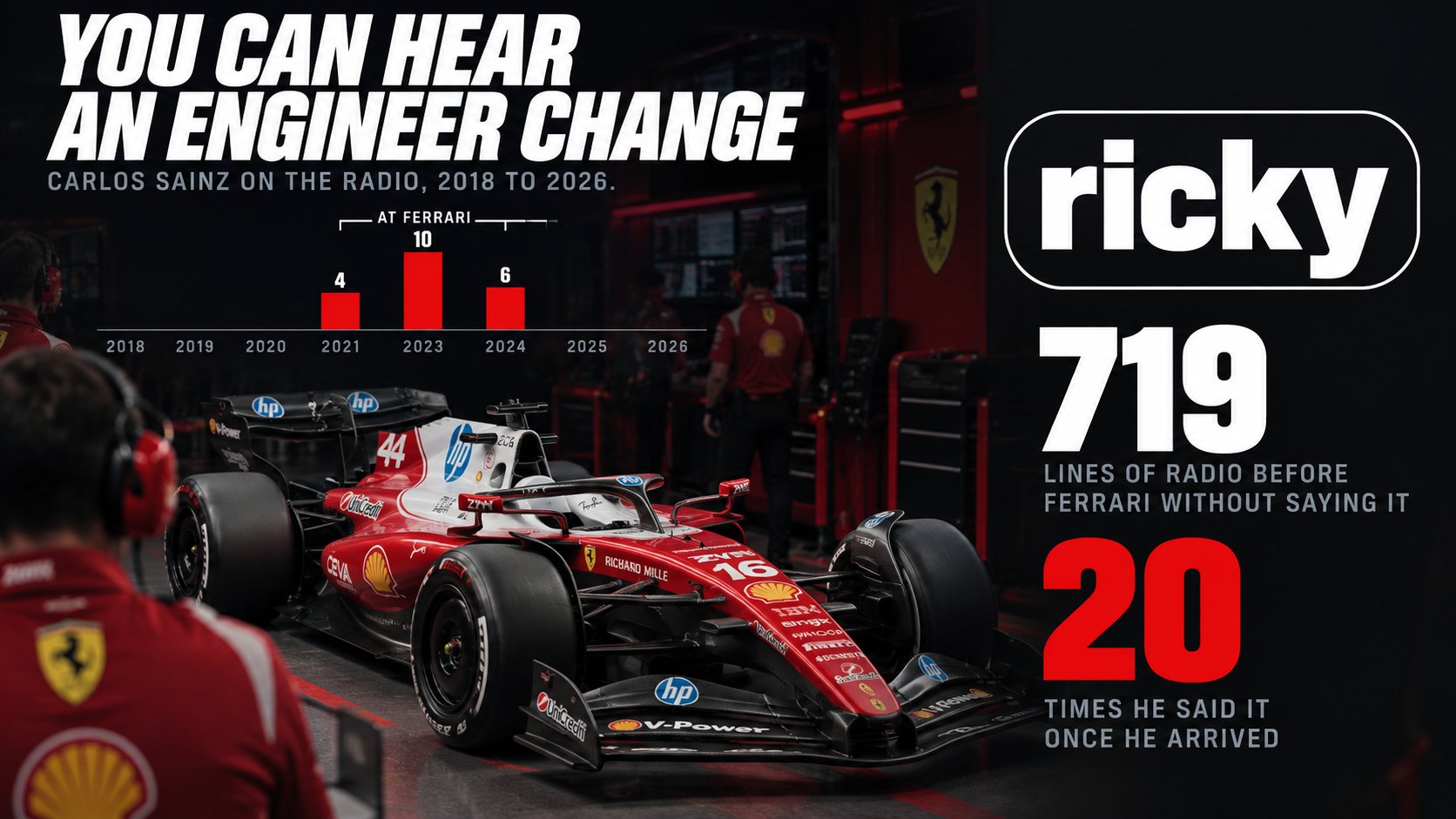
You can watch a race engineer change hands in the radio archive
Drivers address their race engineer by first name, so the archive quietly records who was in whose ear. Two of those pairings begin and end inside our data, and you can see both happen.