The Circuit of the Americas is the most deliberately assembled track in Formula 1, and the numbers show it.
COTA borrows on purpose. Its esses are modelled on Silverstone's Maggotts and Becketts, the long left at Turn 11 nods to Hockenheim, and the multi-apex Turn 16 to 18 sequence echoes Istanbul Park's Turn 8. We measured the fastest qualifying lap from the last two United States Grands Prix to see what that adds up to.
Circuit of the Americas, fastest qualifying lap measured from car telemetry.
COTA, drawn from the car rather than traced: the path of Max Verstappen's 2025 pole lap, 324 km/h at its fastest and 80 km/h at its slowest.
What the drivers said on this circuit is in our United States Grand Prix 2025 race radio, every broadcast message with the audio and a transcript coloured by who is speaking.
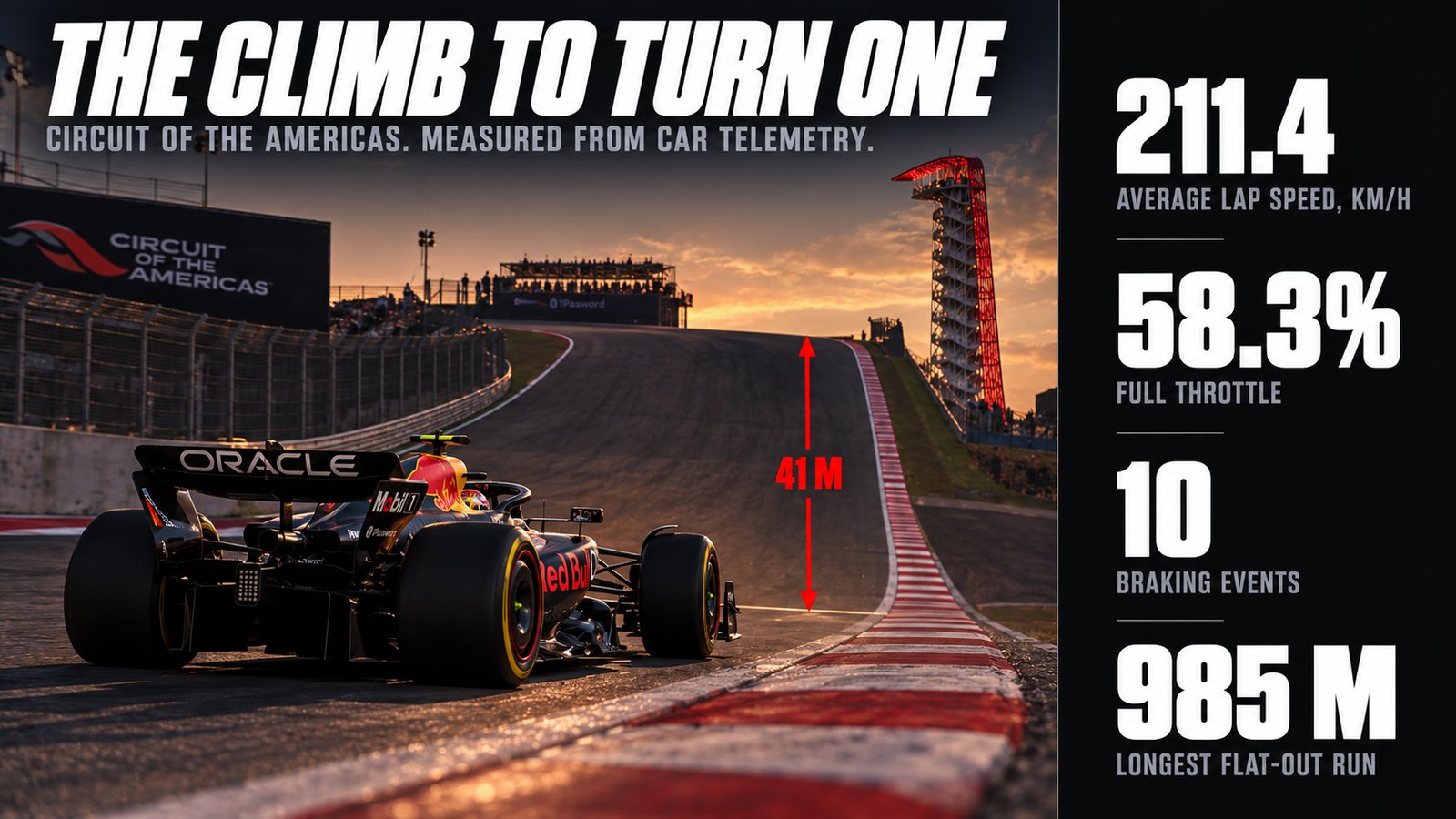
211.4 km/h average puts COTA almost exactly level with Baku, which we measured at 211.3, and comfortably clear of Singapore at 197.0. It sits in the middle of the calendar, and that is the point of it: a circuit designed to test everything rather than reward one thing.
The 2024 and 2025 figures are within half a kilometre per hour of each other. For a circuit with a famously bumpy surface, that is a remarkably repeatable lap.
Turn 1 climbs before it turns
The single most distinctive thing about COTA does not show up in a lap time.
The run from the grid to Turn 1 rises steeply, around 41 metres of elevation, into a blind, tightening left-hander. Drivers cannot see the apex on approach, and the braking point sits on a gradient that changes how the car settles. It is the highest point of the circuit and the hardest corner to get right, which is why the first lap at Austin produces so many pictures.
The slowest point of the whole lap is 80 km/h. That is faster than Singapore's 65 or Monza's 72, and it tells you COTA has no genuinely tight corner. Even its slowest sequence keeps the car moving.
The esses are where the lap is won
Turns 3 to 6 are the reason drivers rate this circuit.
A rapid left-right-left-right sequence taken at high speed, they demand exactly what Maggotts and Becketts demand at Silverstone: commitment, precision, and a car that changes direction without complaint. Lose the rhythm at the first one and every subsequent corner compounds the error.
That section is why COTA rewards a well-balanced car rather than a powerful one, and it explains the 58.3% full-throttle figure. On a 5.4 km lap with a long back straight, being at full throttle for only 58% of the time means a great deal of the lap is spent turning.
For comparison, we measured Spa at 68% and Monaco at 37%. COTA sits between them, closer to Baku's 61.5%.
Race day: a one-stop with a safety car
Year
Laps
Mean stops per driver
Most common
Safety cars
2025
56
1.05
1
1
2024
56
1.15
1
1
United States Grand Prix race data, from F1 timing data.
Both races were dry, both were clear one-stops, and both produced exactly one safety car deployment. That is a different pattern from Monza, which has had none in three years, and from Monaco, which produced enough to push its average to 4.05 stops.
One safety car is the awkward number. It is frequent enough that teams must plan for it, and rare enough that they cannot rely on it. Our season-wide pit stop measurements are in how many pit stops in an F1 race.
What 2026 changes
The current cars carry roughly 30% less downforce than the generation that set the laps above, and pole times this season are running about 3% slower at circuits raced in both years, which we measured in are F1 cars getting faster.
COTA should feel that in the esses more than anywhere. A high-speed direction-change sequence is exactly where downforce does its work, so expect the middle sector to lose more than the straights.
The other change is that DRS no longer exists. COTA's long back straight into Turn 12 was one of the most reliable overtaking spots on the calendar, and it was a DRS zone. What replaces it is active aerodynamics plus a driver-triggered deployment the FIA calls Overtake, which we confirmed from the car data in what is DRS in F1.
The the Circuit of the Americas circuit hub pulls together everything we hold for this venue in one place: every qualifying gap drawn as real distance, the track domination maps where we have them, and the team radio from previous races here.
What the drivers said here
The radio is the part of a weekend that does not make the highlights. We hold every message Formula 1 broadcast from the Circuit of the Americas in 2025, 51 of them across the whole weekend, transcribed with the original audio and the driver and engineer colour coded, on the the Circuit of the Americas 2025 team radio page.
It is worth a scroll before a race here, because the complaints repeat. Drivers tend to raise the same two or three things about a circuit every year, and reading last season back is the quickest way to know what to listen for in this one.
The Formula Dream app runs a live Dashboard through every session: every car on the circuit map, and a timing tower with lap times, gaps and intervals, tyre compound and age, plus flag and safety car alerts as race control calls them. At a circuit with one safety car in each of the last two races, the alert that matters is the one you get before the strategy changes. You also get live driver radio as it is broadcast, and every FIA document of the weekend as it is published.
Free, no subscription, no ads, independent. Not affiliated with Formula 1.
The Circuit of the Americas measured 5.431 km on the racing line from car telemetry on the fastest 2025 qualifying lap. The United States Grand Prix is 56 laps.
How fast is COTA?
The fastest 2025 qualifying lap averaged 211.4 km/h with a peak of 324 km/h. That places it almost exactly level with Baku at 211.3 km/h and well ahead of Singapore at 197.0.
Why is COTA Turn 1 so famous?
Because it climbs before it turns. The run from the grid rises around 41 metres into a blind, tightening left-hander, so drivers brake on a gradient without being able to see the apex.
How many pit stops at the United States Grand Prix?
One. The mean was 1.05 stops per driver in 2025 and 1.15 in 2024, both clear one-stop races.
Does COTA get safety cars?
Both the 2024 and 2025 races had exactly one safety car deployment, and both were dry.
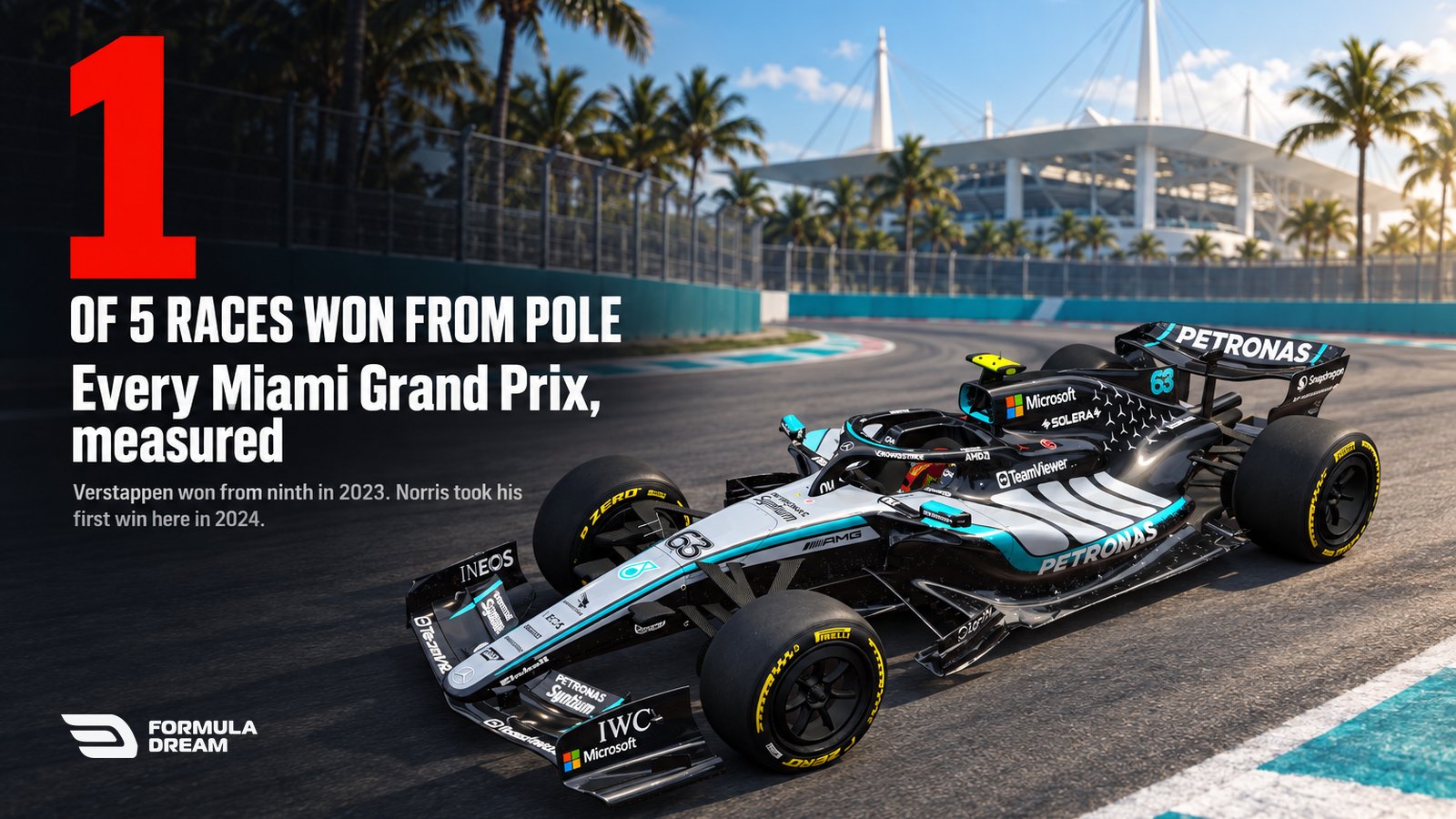
Every Miami Grand Prix winner, measured: five races, and pole has won only one of them
Five Miami Grands Prix have been held since 2022, and only one was won from pole: Kimi Antonelli's in 2026. Max Verstappen won from ninth in 2023, and Lando Norris took his first win there in 2024. Every winner, grid slot and safety car, measured.