The F1 Cost Cap Explained: How the Budget Limit Reshaped the Sport
The F1 cost cap explained in full, the spending war that bankrupted teams, the limit brought in for 2021, what counts and what doesn't, the aero-testing handicap that works alongside it, and how Red Bull got caught.
For most of Formula 1's history, the sport ran on a brutally simple rule: the team that spent the most usually won, and the teams that could not keep up went out of business. The gap became grotesque. By the late 2010s, the giants at the front, Mercedes and Ferrari, were spending north of $400 million a year, while the strugglers at the back were trying to survive on under $150 million. It was not a fair fight, and it was not sustainable. In 2021, F1 finally did something about it, with a cost cap. Here is how it works, why it exists, and the famous case of the champions who broke it.
To understand why the cap matters, you have to remember what the sport looked like without it. Three new teams joined the grid in 2010, HRT, Caterham (originally Lotus) and Marussia (later Manor), lured in partly by the promise of a budget cap that never actually arrived. Left to compete against manufacturer giants with unlimited spending, they had no chance. HRT folded at the end of 2012.Caterham collapsed in 2014, at one point sold for a symbolic $1.60 and surviving the season finale only through a crowdfunding campaign. Manor limped on before finally going under in 2017. Three teams, gone, not because they were slow by choice, but because the sport had become a spending contest they could never win.
That is the backdrop the cost cap was built against. Even Mercedes boss Toto Wolff later admitted the cap "protects us from ourselves".
What the cost cap is
The cost cap is a legally binding limit on how much a team can spend on making its car go faster across a season. Go over it and you face penalties. The point is to stop F1 being a pure financial arms race, so that a smart, well-run team with a smaller budget can genuinely compete with a giant.
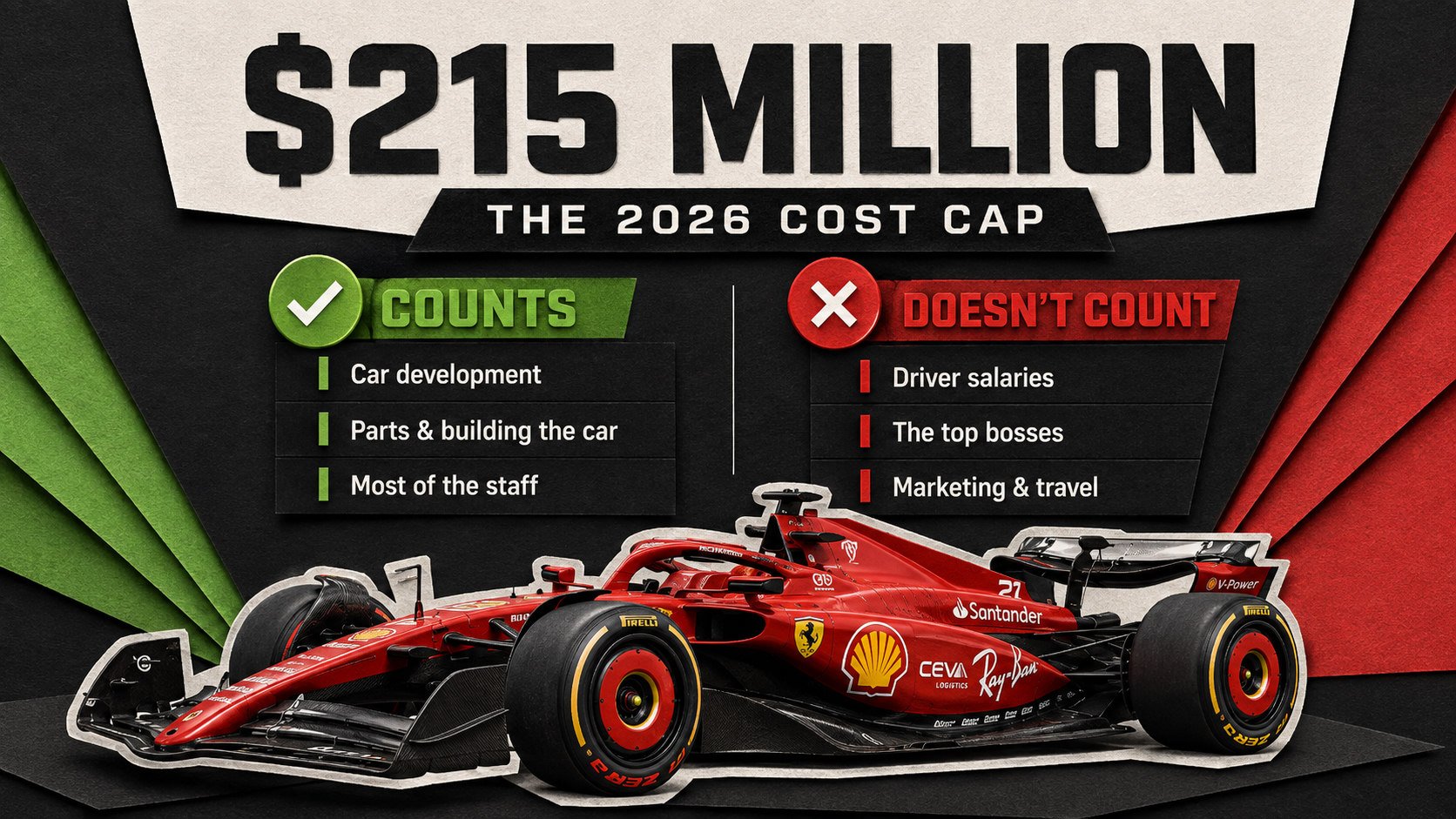
It came in for 2021 at around $145 million and was deliberately reduced over the following years, tightening the screw. For 2026 the figure is roughly $215 million, but that number is misleading: a large part of the increase is because costs that used to sit outside the cap are now counted inside it, not because teams are suddenly allowed to spend far more.
What counts, and what doesn't
This is the part that surprises people. The cap covers the things that make the car quick, but it deliberately leaves out some of the biggest cheques a team writes.
The single biggest exclusion is driver salaries. A team can pay a superstar forty or fifty million a year and it does not touch their cap at all, which is why the largest single payment many teams make does not count. The pay of the three highest-paid staff, along with marketing, travel, legal, HR and hospitality, is also outside the cap. What is inside is the machinery of performance: design, research, development, parts, manufacturing, and most of the people who build and run the cars.
The other lever: the aero-testing handicap
The cost cap does not work alone. Alongside it, F1 introduced the Aerodynamic Testing Restrictions, a clever sliding scale that hands out wind-tunnel and simulation time in inverse proportion to how well you are doing. The team that wins the constructors' championship gets the least aero testing the following year, around 70 percent of the baseline, while the team that finishes last gets the most, around 115 percent. In other words, the further back you are, the more you are allowed to develop your car to catch up. It is a gentle, ongoing handicap that works with the cost cap to pull the field together, and it is why a struggling team can climb back faster than it once could.
The Red Bull case: what happens if you breach it
The cap got its first real test in 2022, over the 2021 season, and it snared the reigning champions. Red Bull were found to have breached the cap. It was classed as a "minor" overspend, they went over by about £1.86 million, roughly 1.6 percent, and much of the dispute came down to how they had accounted for things like catering and staff sick pay. It was not a case of some huge secret budget, but a rule is a rule.
The punishment showed the cap had teeth. Red Bull were hit with a $7 million fine and, far more painfully, a 10 percent cut to their aerodynamic testing allowance. That second penalty bites hardest, because it stacks on top of the handicap system above and directly slows a team's development. Tellingly, Red Bull still dominated the following season, which sparked a long debate about whether the penalty was tough enough, but the principle was established beyond doubt: the cap is enforced, it is audited by an independent administration, and not even the champions are exempt.
Has it worked?
Mostly, yes. The grid is closer than it was, no team has gone bust since the cap arrived, and the sport is financially healthier, healthy enough that new entrants now want in rather than run screaming. It is not perfect. Excluding driver salaries still lets the richest teams hoard the best drivers, and clever accounting around the edges will always be tested. But combined with the sweeping 2026 regulations, the cost cap has changed the fundamental question of F1 from "who can spend the most?" to "who can spend it best?", and that is a far better sport.
Follow what the money buys
The cost cap is an argument about development, and development shows up as lap time.
The Formula Dream app carries the standings, results and full weekend timeline in Race Center, so the championship picture stays current without hunting for it. During a session it runs a live Dashboard with every car on the circuit map, a timing tower carrying lap times, gaps, intervals, tyre compound and age, live driver radio as it is broadcast, and every FIA document of the weekend as it is published.
Free, no subscription, no ads, independent. Not affiliated with Formula 1.
The cap governs what a team may spend across a season. What the car itself is worth is a separate question, and we broke it down part by part in how much an F1 car costs.
Breaking the cap has its own consequences, which have already been applied once in the sport's history. We set out what the penalties actually are in F1 cost cap penalties explained.
Frequently asked questions
What is the F1 cost cap?
A binding limit on how much a team can spend on performance-related activity in a season, introduced in 2021 to stop F1 being decided purely by budget. For 2026 it is around $215 million.
Why was the cost cap introduced?
Because the spending gap between the richest and poorest teams had become enormous, with top teams spending over $400 million while smaller teams went bankrupt. HRT, Caterham and Manor all folded in the years before the cap.
What is excluded from the F1 cost cap?
Driver salaries, the pay of the three highest-paid staff, marketing, travel, legal, HR and hospitality. The cap covers car design, development, parts, manufacturing and most operational staff.
What happened when Red Bull breached the cost cap?
For a minor breach of the 2021 cap (about 1.6% over), Red Bull were fined $7 million and had their aerodynamic testing time cut by 10%, which slows car development. It was the first major test of the cap's enforcement.
What are the aero testing restrictions?
A separate sliding scale that gives more wind-tunnel and simulation time to teams lower down the championship and less to those at the top, as a handicap to help the field converge. It works alongside the cost cap.
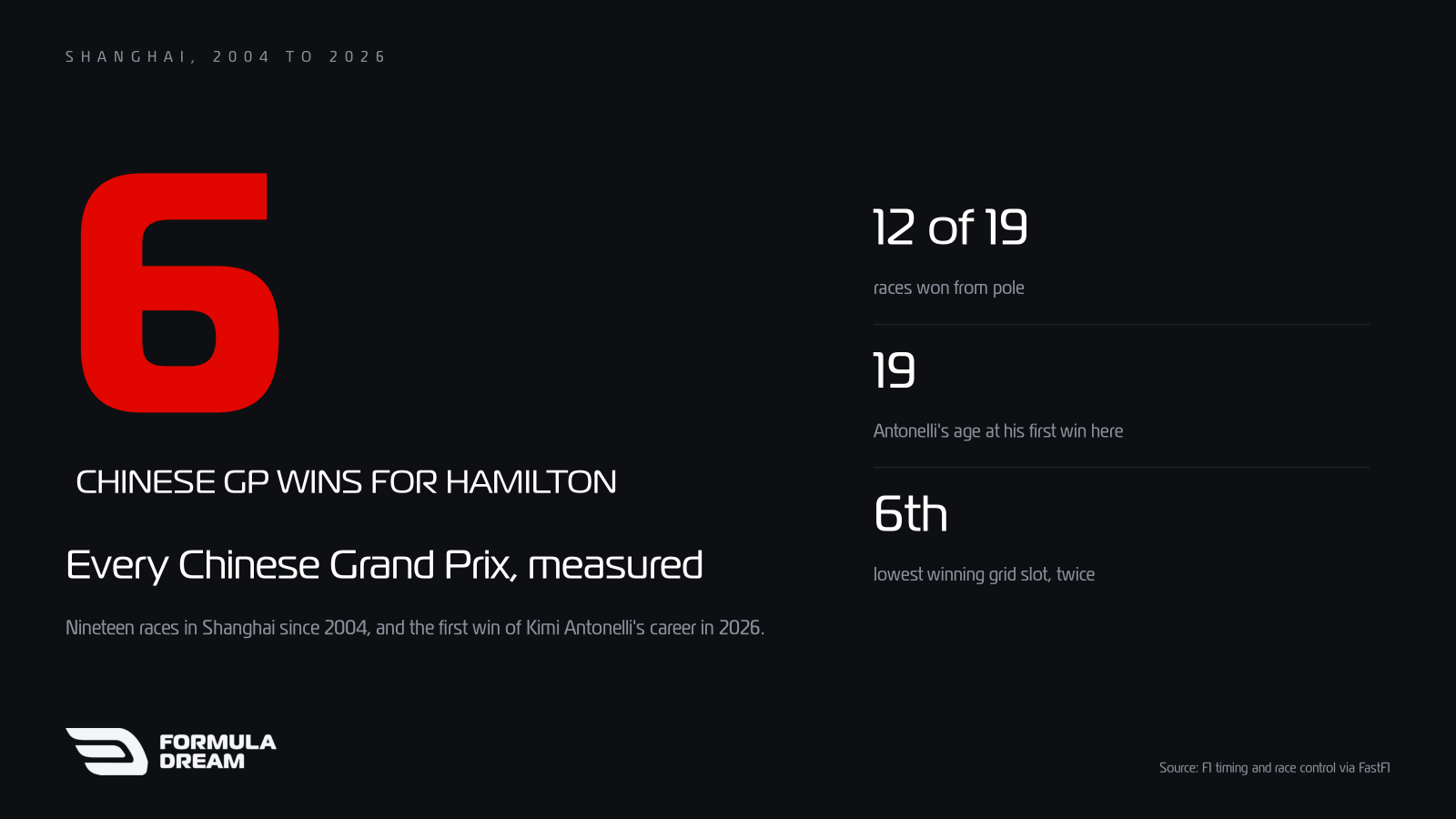
Nineteen Chinese Grands Prix have been held in Shanghai since 2004. Lewis Hamilton won six, pole won twelve, and in 2026 Kimi Antonelli took the first win of his career there, at 19, with Hamilton on the podium for Ferrari for the first time. Every winner, grid slot and safety car, measured.