How Much Does an F1 Car Cost in 2026? | Formula Dream
Guides
How Much Does an F1 Car Cost? A Part by Part Breakdown
Roughly $15 to $22 million on the estimates, but no team publishes a price. What the parts are reckoned to cost, what real crashes cost teams, and the $215 million cap that governs it all.
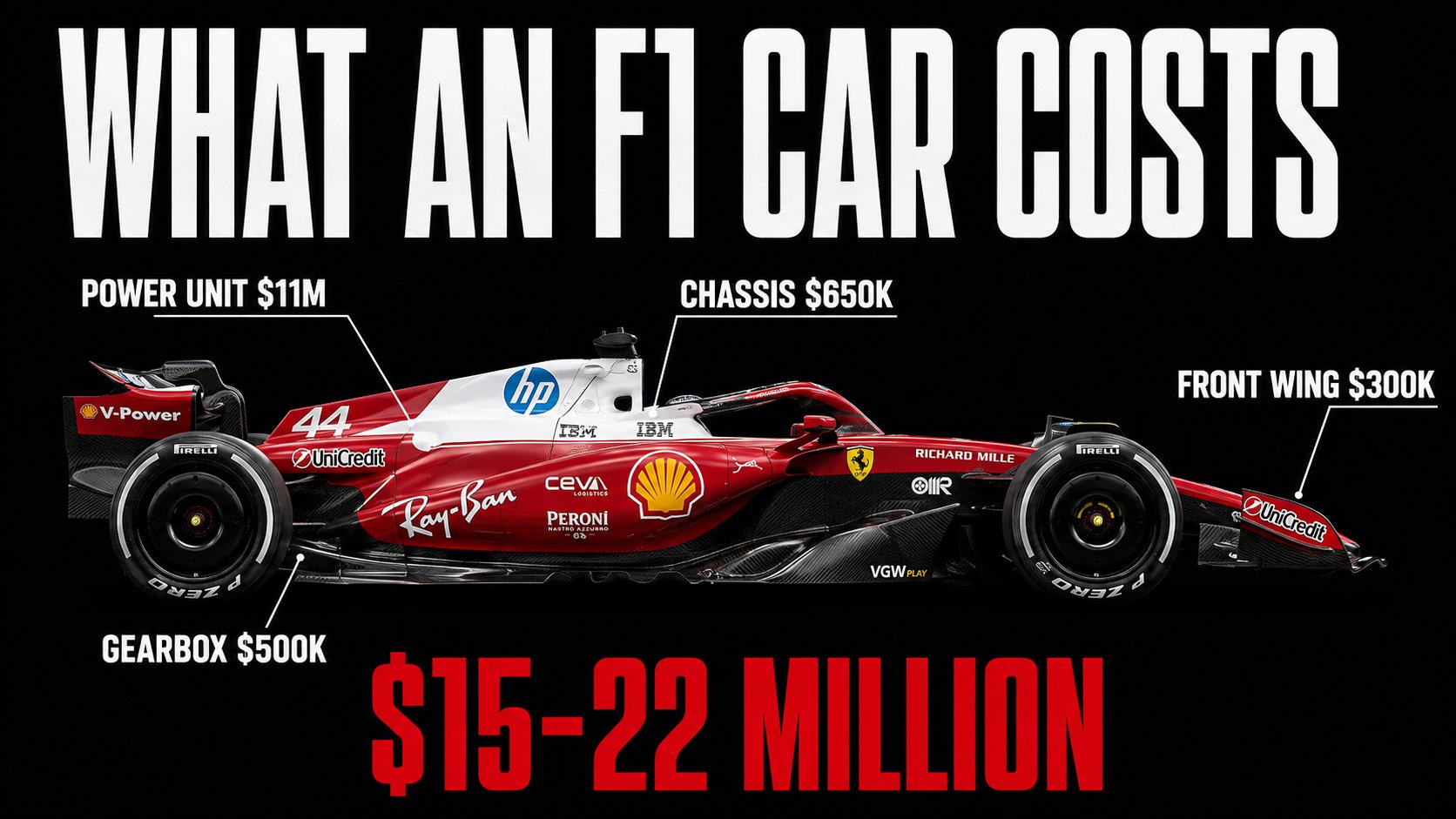
A Formula 1 car is usually estimated to cost between $15 million and $22 million to build, with the power unit alone reckoned at $8 million to $11 million. No team publishes an official figure, so those are estimates, not invoices.
A mistake in one of these is reported over the radio before it reaches a spreadsheet. Every message from the last race is in our
What is published is the money that actually governs a team: for 2026 the FIA's cost cap is US$215 million a season, and a separate cap of US$190 million applies to each power unit manufacturer.
Two honest caveats before the breakdown, because most pages answering this question skip both.
No official figure exists. No team publishes a build cost for one car. Anyone quoting a precise figure to the dollar is guessing with confidence.
The question is slightly wrong. Teams do not build a car, they run a programme: a season of development, spares, upgrades and rebuilds. A single chassis is an accounting abstraction. What actually constrains a team is the cost cap, and that is a very different number.
What the individual parts are estimated to cost
These are the figures you will see quoted, and they are consistent from source to source, but none of them comes with a team's name attached:
Power unit: $8 million to $11 million. By far the most expensive thing on the car.
Chassis (the monocoque): around $650,000. The carbon fibre survival cell the driver sits in.
Gearbox: around $500,000.
Front wing: around $300,000. Worth remembering the next time you watch one disintegrate on lap one.
Steering wheel: $50,000 to $80,000. A bespoke carbon control unit with a screen, covered in paddles, dials and buttons.
The pattern is that the engine dominates and everything else, individually, is small by comparison. That is why power unit regulations matter so much more to team finances than bodywork does, and why engine penalties exist to stop teams simply buying more of them.
What a crash really costs
The most reliable numbers on this subject do not come from parts lists. They come from team principals complaining about their repair bills.
The best documented is Haas in 2022. After Mick Schumacher's heavy qualifying crash at the Saudi Arabian Grand Prix, team principal Guenther Steiner put the bill at "between half a million to a million" dollars: "all the suspension is gone, except the front left", he said, along with the bodywork, a radiator and the gearbox.
Later that season Schumacher crashed on his way back to the pits at Suzuka. In his book, Steiner put the cost at $700,000: "We lose a car after five minutes and now have to build another. How many people could we employ with $700,000?" Across the whole of 2022, he wrote, Schumacher's crash damage cost the team $2 million.
That is why a crash costs more than the parts. Everything is bespoke and slow to make, and under the cost cap every dollar spent rebuilding is a dollar not spent developing the car.
The number that actually governs a team
Since 2021 the meaningful figure has not been the car, it is the cost cap.
For 2026, Article D4.1.2 of the FIA's Financial Regulations sets the cap at US$215,000,000 for a season of 24 races or fewer, rising by US$1.8 million for every race beyond 24, and adjusted for inflation. For a British team that works out at about £170 million, and for a team reporting in euros about €199 million.
Crucially it does not cover everything. Article D5.1.1 lists what is left out, including:
Marketing
Race drivers' pay, and their travel and accommodation
Reserve and academy drivers
The three highest-paid individuals in the team
Heritage activities, finance costs and corporate income tax
That is why a team can pay a driver tens of millions without it touching the development budget. The full picture is in the F1 cost cap explained.
Power unit manufacturers have their own cap under a separate set of regulations. Under Article E2.3.1 it is US$190 million a year from a manufacturer's first season in F1, and US$148.5 million in each of the three years before that.
Why the cap makes damage strategic
Money spent rebuilding is money not spent developing. A team having a heavy crash season is quietly losing performance in the second half of the year, because the repairs eat the upgrade budget. This is the single most underrated consequence of the cap, and it is exactly what Steiner was complaining about in 2022.
Development is the real product. The car you see in March and the car you see in November are substantially different objects. Most of a team's spending buys the difference between them, not the original.
So what is the honest answer?
If someone asks what an F1 car costs, the accurate reply is layered:
To build one, once: an estimated $15 to $22 million, dominated by the power unit, with no official figure to check it against.
To run a team for a season: capped at US$215 million in 2026, plus everything the cap leaves out.
To crash one badly: anything from several hundred thousand dollars to a million, on Haas's real bills.
The single car figure is the one people want and the least useful of the three.
Follow where the money actually goes
Every dollar of that budget is spent trying to move a car a few tenths up the timing screen, which is where you can see whether it worked.
The Formula Dream app runs a live Dashboard through every session: every car on the circuit map, and a timing tower with lap times, gaps and intervals, tyre compound and age, plus flag and safety car alerts as race control calls them. Race Center carries the standings that decide prize money. You also get live driver radio as it is broadcast, and every FIA document of the weekend as it is published, including the technical and scrutineering reports on these parts.
Free, no subscription, no ads, independent. Not affiliated with Formula 1.
It is usually estimated at $15 million to $22 million to build, with the power unit accounting for $8 million to $11 million. No team publishes an official build cost, so every figure is an estimate.
What is the most expensive part of an F1 car?
The power unit, at an estimated $8 million to $11 million. Nothing else on the car comes close on the usual estimates: the chassis around $650,000 and the gearbox around $500,000.
How much does an F1 crash cost?
Real figures from Haas give a sense of it. Guenther Steiner put Mick Schumacher's 2022 Jeddah qualifying crash at half a million to a million dollars, his Suzuka crash at $700,000, and his crash damage across the 2022 season at $2 million.
What is the F1 cost cap in 2026?
US$215 million for a season of up to 24 races, plus $1.8 million for each additional race, adjusted for inflation. Drivers' pay, marketing and the three highest-paid people in the team are excluded. Power unit manufacturers have a separate cap of US$190 million.
How much does an F1 front wing cost?
Around $300,000 on the commonly quoted estimate, which is why a first-lap incident that removes one is more costly than it looks. Teams do not publish the figure.
Every Miami Grand Prix winner, measured: five races, and pole has won only one of them
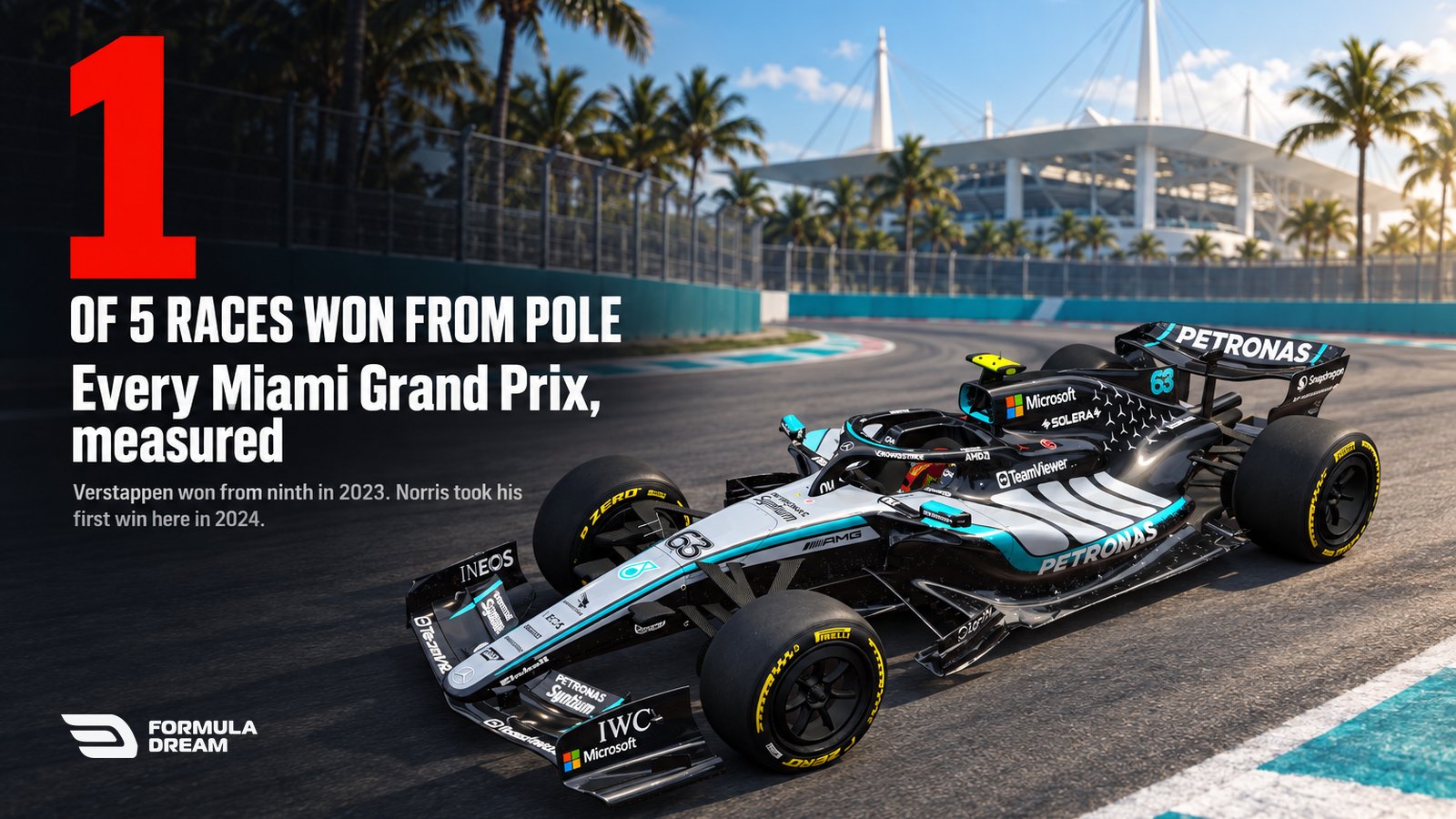
Five Miami Grands Prix have been held since 2022, and only one was won from pole: Kimi Antonelli's in 2026. Max Verstappen won from ninth in 2023, and Lando Norris took his first win there in 2024. Every winner, grid slot and safety car, measured.