F1 Flags Explained: What Every Flag Means | Formula Dream
Guides
F1 Flags Explained: What Every Flag Means
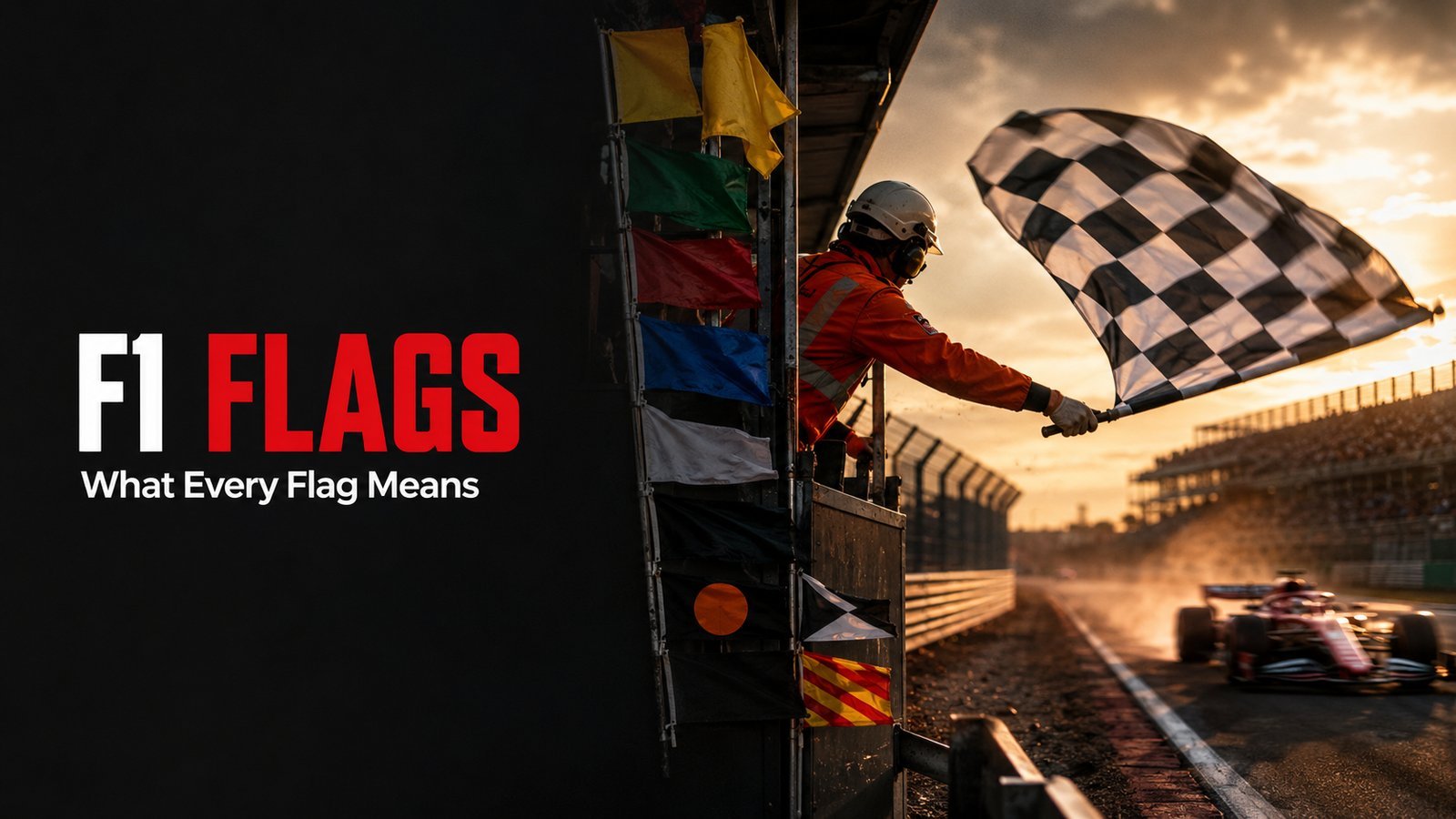
Every F1 flag explained, from green and yellow to blue, red, black and the chequered flag, what each one means, how drivers must react, and who actually waves the flag at the finish.
Flags are how marshals talk to drivers at 300 km/h. Long before a driver hears anything on the radio, a flag at the side of the track, and a matching light panel, tells them whether it is safe to race, whether to slow down, or whether their day is over.
The short version: green means the track is clear, yellow means danger and no overtaking, yellow with red stripes means a slippery surface, blue means a faster car is about to pass, red stops the session, white warns of a much slower vehicle, black orders a driver into the pits and out of the session,
The definitions below are quoted from Appendix H of the FIA International Sporting Code, the rulebook for flags across motorsport.
Here is each one in full, and what a driver has to do about it.
Every F1 flag at a glance
Flag
What it means
Green
Track is clear
Yellow
Hazard ahead, slow down, no overtaking
Double yellow
Serious hazard, slow significantly, be prepared to stop
Yellow with red stripes
Slippery surface ahead, oil or water on the track
Blue
A faster car is about to pass you
Red
Session stopped
White
A much slower vehicle on this part of the track
Black
Stop at your pit on the next lap; your session is over
Black with orange disc
Your car has a dangerous fault, pit to fix it
Black and white
Warning: repeat it and you may be penalised
Chequered
The session is over
The F1 flags and their meanings. Each is explained in full below.
Green flag
The track is clear and racing conditions are on. You see the green flag at the start of a session and at the end of a hazard zone, signalling that whatever caused a yellow has been cleared and drivers can race and overtake normally again.
Yellow flag
A warning of danger ahead, and the most important flag to read correctly. It comes in two levels:
Single waved yellow: a hazard at the side of the track. Drivers must slow down and be prepared to change direction. No overtaking.
Double waved yellow: a hazard blocking the track, or marshals working on the circuit. Drivers must reduce speed significantly, be ready to stop, and again there is no overtaking.
Under Appendix H, overtaking is not allowed from the first yellow flag until the green flag after the incident. In practice and qualifying a double yellow means more than slowing: "it must be evident that a driver has not attempted to set a meaningful lap time", so drivers abandon the lap. Passing under yellows or failing to slow brings penalties, so drivers back off hard the moment they see one. If the hazard is big enough, race control will escalate from flags to a virtual safety car or a full safety car.
Yellow flag with red stripes
Shown motionless rather than waved, this warns of "a deterioration of grip due to oil or water on the track" beyond the flag. Appendix H says it should normally stay out for at least four laps, unless the surface returns to normal sooner. It is not a no-overtaking flag. It is a heads-up that the next corner may not have the grip the driver expects.
Blue flag
The blue flag means a faster car is about to pass. In practice and qualifying, Appendix H says it means "a faster car is close behind you and is about to overtake you". In the race it is shown to a car about to be lapped, and "the driver concerned must allow the following car to pass at the earliest opportunity". There is no fixed number of flags before a penalty: the stewards judge each case, and the recent blue flag penalties have all been five seconds.
It is also the most argued-about flag in the sport, because it asks a driver to give up their own race for somebody else's. We go into that properly in F1 blue flags explained.
Red flag
The session is stopped. A red flag comes out for a serious crash, dangerous weather, or a track that is unsafe to race on. Drivers slow right down and return to the pit lane, and the session is suspended until it is safe to resume.
A red flag also hands every driver a free tyre change, which is why it can completely reshape a race. The details are in F1 red flag rules.
The 2026 Italian Grand Prix is the clearest recent example. Charles Leclerc crashed at Parabolica on lap 2, the race was suspended on lap 3, and all twenty one remaining cars took new tyres for nothing. Kimi Antonelli restarted twelfth and won it from nineteenth on the grid. Every radio message from that race, including both Mercedes being told to keep it clean within a minute of each other, is on the Monza 2026 radio page.
White flag
Appendix H defines the white flag as a warning that "there is a much slower vehicle on the sector of track controlled by that flag point", for example a damaged car limping back to the pits. It is a heads-up to be alert, not a demand to stop.
Worth knowing if you watch other series: in NASCAR and IndyCar the white flag means one lap remaining. In F1 it does not.
Black flag
The most serious flag a driver can be shown. Displayed with the car's number, the black flag tells the driver they "must stop at his pit" on their next approach to the pit entry, and in F1 that means their session is over: it is how a driver is excluded while a session is still running.
It is now genuinely rare. Most modern disqualifications arrive after the race through the stewards rather than as a flag during it, which is why the black flag has become one of the sport's more theoretical signals.
Black-and-orange flag
Sometimes called the "meatball" flag for the orange disc in its centre, this is shown with a car number. Appendix H says it informs the driver that the car has mechanical problems likely to endanger themselves or others, and that they must stop at the pits on the next lap, typically for a loose part, a leak or hanging bodywork. Once the problem is fixed to the chief scrutineer's satisfaction the car may rejoin. It is a safety instruction, not a penalty.
Black-and-white flag
A diagonally split black-and-white flag, shown with a car number, is a warning, effectively a yellow card. Appendix H says it "should be shown once only" and warns a driver "for unsportsmanlike behaviour or for an action which may result in a penalty if repeated".
In modern F1 it is almost always about track limits. Race control's own messages record 54 black-and-white flags in Grands Prix from 2024 to the 2026 Italian Grand Prix (15 in 2024, 28 in 2025 and 11 so far in 2026), and 48 of them were for track limits. The rest were for moving under braking, weaving on a straight, rejoining unsafely, ignoring blue flags and driving erratically.
Chequered flag
The one everyone knows. Appendix H says it "signifies the end of any practice session or race" and must be waved until all competing cars have crossed the line. Under Article B5.16.1 of the 2026 Sporting Regulations it is the end-of-session signal, shown as soon as the leader has covered the full distance.
Who actually waves the chequered flag?
Often not a marshal. At many Grands Prix the flag is handed to a guest, a celebrity, an athlete or a local dignitary, and the tradition goes back decades: Juan Manuel Fangio waved it in Argentina in 1978, and Pele in Brazil in 2002. Race officials still decide when it comes out.
It has gone wrong more than once. Fangio waved the flag a lap early in 1978. At the 2014 Chinese Grand Prix an official showed it two laps early and the race was classified after 54 laps instead of 56, and at the 2019 Japanese Grand Prix an error on the electronic board ended the race a lap short. The most famous case was the 2018 Canadian Grand Prix, where model Winnie Harlow waved the flag a lap early and the result was taken two laps back. She had been told to wave it.
The rule for exactly this situation is written into the Sporting Regulations. If the end-of-session signal comes early, Article B5.16.2 says the race is deemed to have finished when the leader last crossed the line before it was given.
Why flags still exist when everyone has a radio
It is a fair question in a sport this connected. The answer is redundancy.
Radio can fail, and a driver's attention is finite. Marshal posts sit every few hundred metres around a circuit, so a flag reaches a driver at the exact point on the track where the hazard matters, without anyone having to describe where it is. The light panels that now sit alongside the flags do the same job in a way that is visible in rain, spray and low sun. A driver does not need to process a sentence. They need to know, in the next quarter of a second, whether to lift.
See the flags as they are called
Flags are called by race control, and the calls are published as they happen.
The Formula Dream app runs a live Dashboard through every session, with flag and safety car alerts the moment race control issues them, all the cars on the circuit map, and a timing tower with gaps, intervals, tyre compound and age. You also get live driver radio as it is broadcast, which is where you hear a driver react to a yellow before the graphics catch up, and every FIA document of the weekend as it is published, including the stewards' decisions behind each penalty.
Free, no subscription, no ads, independent. Not affiliated with Formula 1.
Every one of these flags is shown by a marshal standing at a post beside the circuit, and the way that network operates is genuinely under-appreciated. We wrote about it in what F1 marshals actually do.
Frequently asked questions
What do the flags mean in F1?
Each flag is a signal from the marshals: green means the track is clear, yellow means danger and no overtaking, yellow with red stripes means a slippery surface, blue means a faster car is about to pass, red stops the session, white warns of a much slower vehicle, black orders a driver into the pits for good, and the chequered flag ends the session.
What is the difference between single and double yellow flags?
A single waved yellow warns of a hazard beside the track, so slow down and no overtaking. A double waved yellow means the hazard is on the track or marshals are present, so drivers must slow significantly and be ready to stop.
What is the black-and-orange flag in F1?
The "meatball" flag tells a driver their car has a mechanical fault or damage and they must pit to fix it. It is a safety measure, not a punishment.
What does the blue flag mean in F1?
In a race it tells a car about to be lapped to let the faster car through at the earliest opportunity. In practice and qualifying it warns that a faster car is close behind. Stewards decide penalties case by case.
What is the black-and-white flag in F1?
A warning, shown once, for unsportsmanlike behaviour or for an action that could bring a penalty if repeated. In modern F1 it is mostly shown for track limits: 48 of the 54 shown in Grands Prix from 2024 to the 2026 Italian Grand Prix.
Who waves the chequered flag in F1?
Often an invited guest rather than a marshal, from Juan Manuel Fangio in 1978 to Pele in 2002, with race officials deciding when it is shown. At the 2018 Canadian Grand Prix model Winnie Harlow waved it a lap early, so the result was taken two laps back.
What does the yellow flag with red stripes mean in F1?
It warns of a slippery surface ahead, from oil or water on the track. It is shown motionless and normally stays out for at least four laps unless the surface returns to normal.
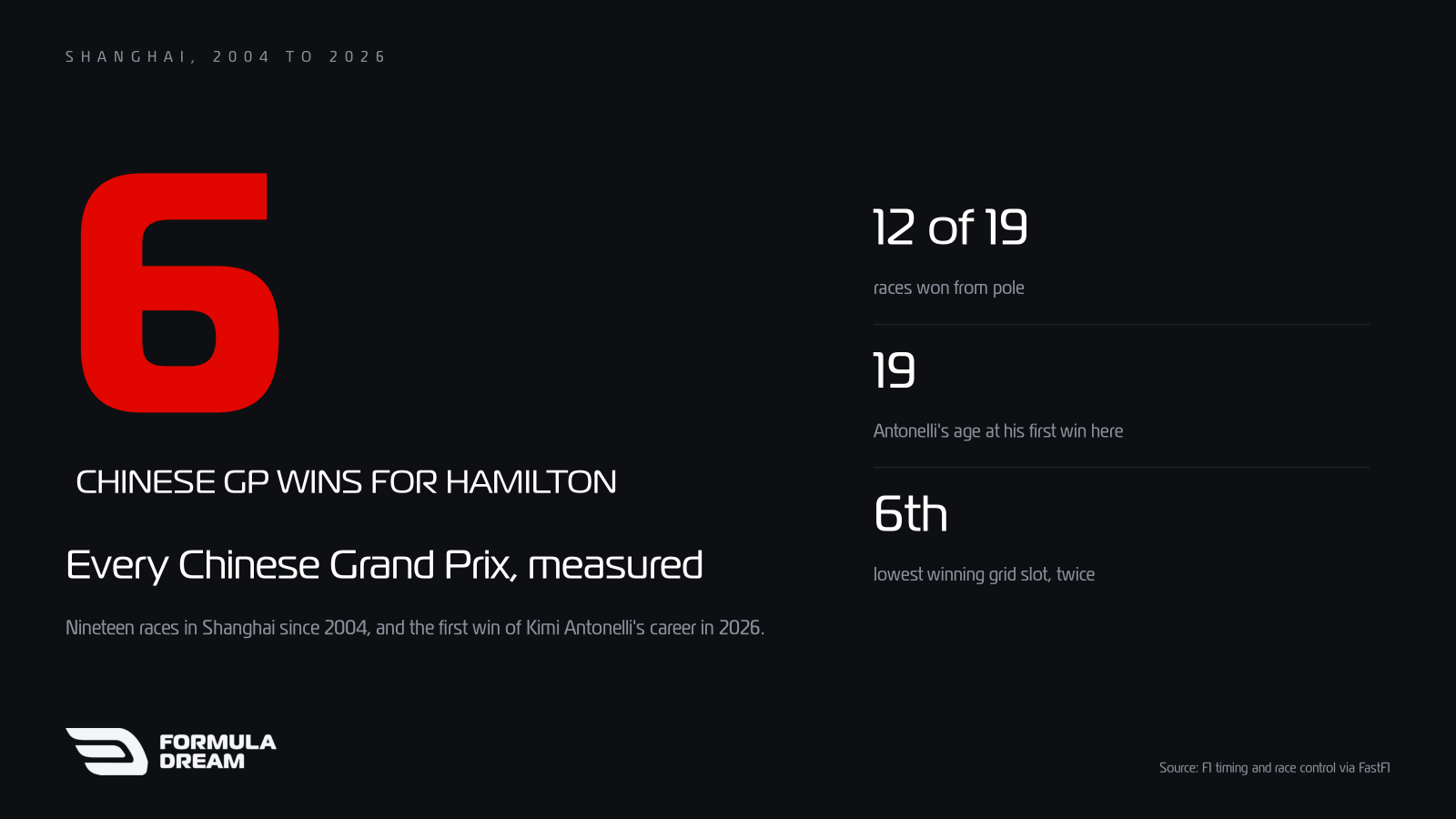
Nineteen Chinese Grands Prix have been held in Shanghai since 2004. Lewis Hamilton won six, pole won twelve, and in 2026 Kimi Antonelli took the first win of his career there, at 19, with Hamilton on the podium for Ferrari for the first time. Every winner, grid slot and safety car, measured.