F1 Marshals: The 838 Unpaid People Who Run Every Grand Prix
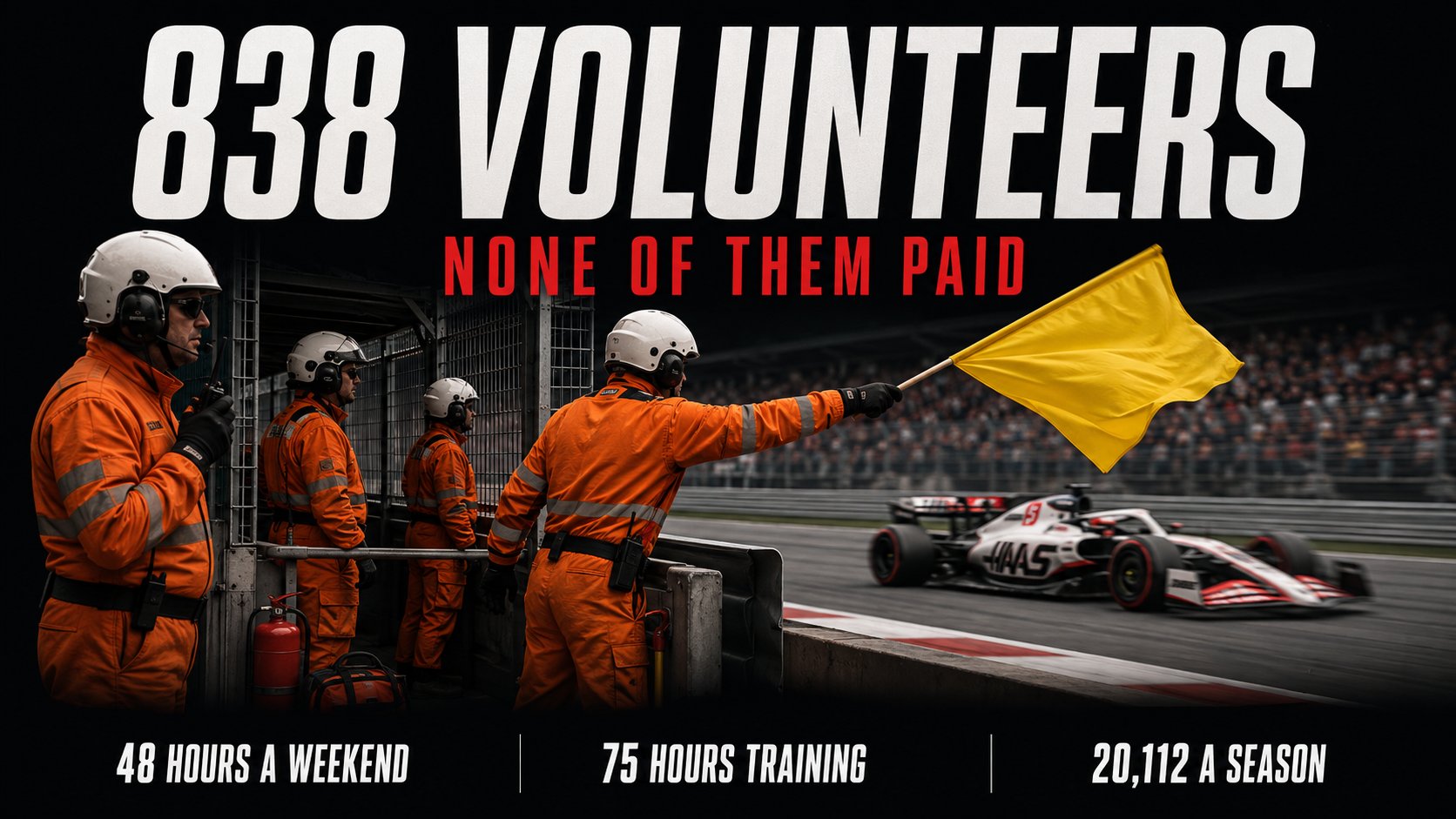
An FIA report put numbers on it. It takes an average of 838 volunteers to run a Grand Prix, they train 50 to 75 hours a year, and two thirds take annual leave to be there.
two thirds of them take annual leave or unpaid holiday
in order to be there.
What the numbers actually are
From the FIA's own accounting:
838 volunteers on average per Grand Prix, the majority of them marshals.
20,112 people across a full season.
48 hours worked by the average volunteer across a race weekend.
50 to 75 hours of intensive training per person, every year.
€11.1 million a year spent on recruiting and training them.
$15.5 million more per year is what it would cost to replace them with professional labour at industry rates.
That last figure is the one worth sitting with. It is not a measure of what marshals are worth. It is a measure of what the sport does not pay.
What marshals actually do
"Marshal" covers several distinct jobs, and the roles are more specialised than the orange overalls suggest.
Flag marshals operate the physical flags at posts around the circuit. This is the visible role, and it is the sport's oldest communication system: a signal delivered at the exact point on the track where the hazard is, without anyone needing to describe where it is. What each flag means is covered in F1 flags explained.
Observers watch an assigned section and report to race control. They are the eyes that decide whether a yellow flag becomes a safety car.
Incident officers manage the response when something happens in their sector.
Extrication teams are trained to remove an injured driver from a car without making an injury worse. This is the role that most obviously requires real training and the one nobody thinks about until it matters.
Recovery crews clear debris and move stranded cars, frequently while the session is live and cars are still passing.
Why volunteers rather than staff
The honest answer is history and practicality rather than principle.
Motorsport marshalling grew out of club racing, where volunteering was simply how the sport functioned, and it never converted to a paid model as the money arrived. Marshals are drawn from national motorsport clubs, are licensed and graded by experience, and progress through a system that takes years.
There is also a practical argument. A Grand Prix needs several hundred trained people for three days, twice a year at most venues. Employing that workforce permanently makes little sense, and a professional casual workforce would need the same 50 to 75 hours of annual training with far less continuity. The people who do it have often done it for decades.
None of which changes the fact that a sport generating billions relies on people using their holiday allowance.
Why they matter more than they look
Two of our own measurements make the case.
Their signals are the fastest information in the sport. A flag reaches a driver at the point of the hazard, before radio, before graphics. That matters because of how quickly conditions change: a safety car deletes about 71% of the field spread within a lap, and the decision chain that produces it starts with an observer at a post.
They work in the conditions that are most dangerous. Wet running is the clearest case. We measured cars on intermediates as 13.2% slower than on slicks, and the reason sessions get suspended is that drivers cannot see through the spray. Marshals are standing in that, next to a live track, in the same conditions described in what happens when it rains in F1.
The extrication teams exist for the accidents that modern safety has made survivable. When Romain Grosjean's car hit a barrier at 192 km/h and caught fire in 2020, the halo and the survival cell kept him alive, and people ran towards the fire.
How someone becomes a marshal
It is genuinely open, which surprises people.
The route runs through a national motorsport authority, the FIA-affiliated body in a given country. New marshals typically start at club-level events, complete training modules, and are graded as they accumulate experience. Progression to an F1 event usually requires years at smaller meetings first.
The training is the serious part: 50 to 75 hours a year, covering flag procedure, fire response, extrication and incident management. Volunteers fund their own travel and accommodation in many cases, and, as the FIA's figures show, most spend their own leave doing it.
Watch the calls they trigger
Almost everything race control does starts with someone at a post.
The Formula Dream app runs a live Dashboard through every session with flag and safety car alerts the moment race control issues them, alongside every car on the circuit map and a timing tower carrying lap times, gaps, intervals, tyre compound and age. You also get live driver radio as it is broadcast, where drivers report conditions marshals are already dealing with, and every FIA document of the weekend as it is published, including the incident reports.
Free, no subscription, no ads, independent. Not affiliated with Formula 1.
No. Marshals are volunteers. An FIA report found that two thirds of them take annual leave or unpaid holiday in order to work a Grand Prix, and that replacing them with professional labour would cost at least $15.5 million more per year.
How many marshals are at an F1 race?
It takes an average of 838 volunteers to run a Grand Prix, the majority of them marshals, which is a workforce of 20,112 across a 24-race season.
What do F1 marshals do?
The roles include flag marshals, observers reporting to race control, incident officers, extrication teams trained to remove injured drivers, and recovery crews who clear debris and move stranded cars, often while the session is running.
How much training do F1 marshals do?
Between 50 and 75 hours of intensive training per person per year. The FIA puts the annual cost of recruiting and training its volunteer workforce at €11.1 million.
How do you become an F1 marshal?
Through your national motorsport authority. Most people start at club-level events, complete training modules and are graded by experience, with several years at smaller meetings before working a Formula 1 weekend.
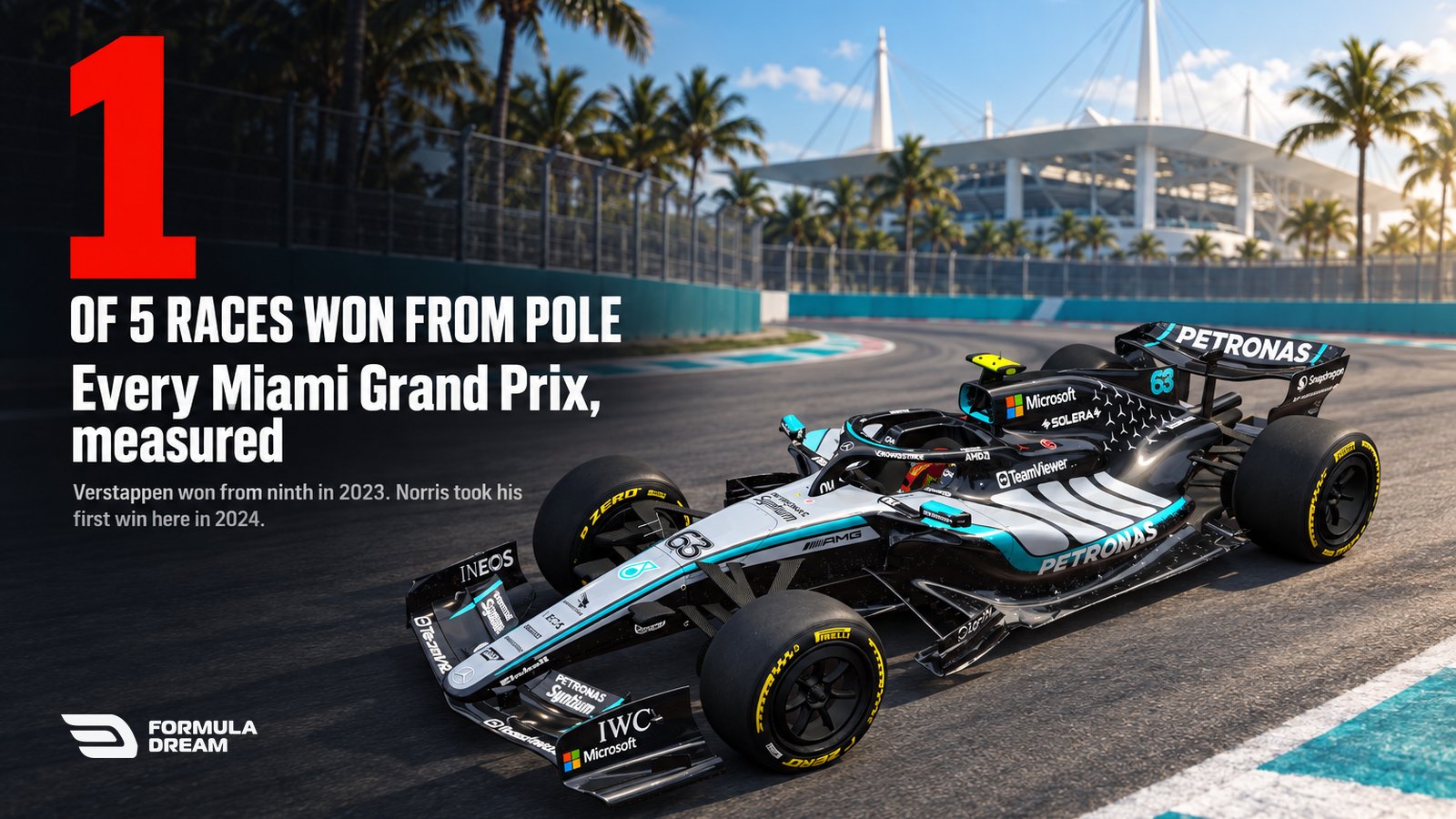
Every Miami Grand Prix winner, measured: five races, and pole has won only one of them
Five Miami Grands Prix have been held since 2022, and only one was won from pole: Kimi Antonelli's in 2026. Max Verstappen won from ninth in 2023, and Lando Norris took his first win there in 2024. Every winner, grid slot and safety car, measured.