F1 Safety Car vs Virtual Safety Car | Formula Dream
Guides
F1 Safety Car vs Virtual Safety Car Explained
The safety car and virtual safety car explained through the 2021 Abu Dhabi title decider, why one bunches the field and the other freezes the gaps, and how that single difference swings races.
Lewis Hamilton had the 2021 World Championship in his hands. He led the Abu Dhabi finale comfortably into lap 53 of 58, on course for a record eighth title. Then Nicholas Latifi crashed, the Safety Car came out, and everything changed. Max Verstappen dived into the pits for fresh soft tyres while Hamilton, leading, stayed out on old hards. The Safety Car bunched the whole field up behind it, wiping out Hamilton's lead, and on the final lap Verstappen swept past on his fresher rubber to win the race and the title. (The FIA later found the restart had been handled against its own rules, but the strategic point stands.)
That one afternoon shows exactly why the difference between the two ways F1 slows a race down, the Safety Car and the Virtual Safety Car (VSC)
, can decide a championship. Here is how each works.
The Safety Car
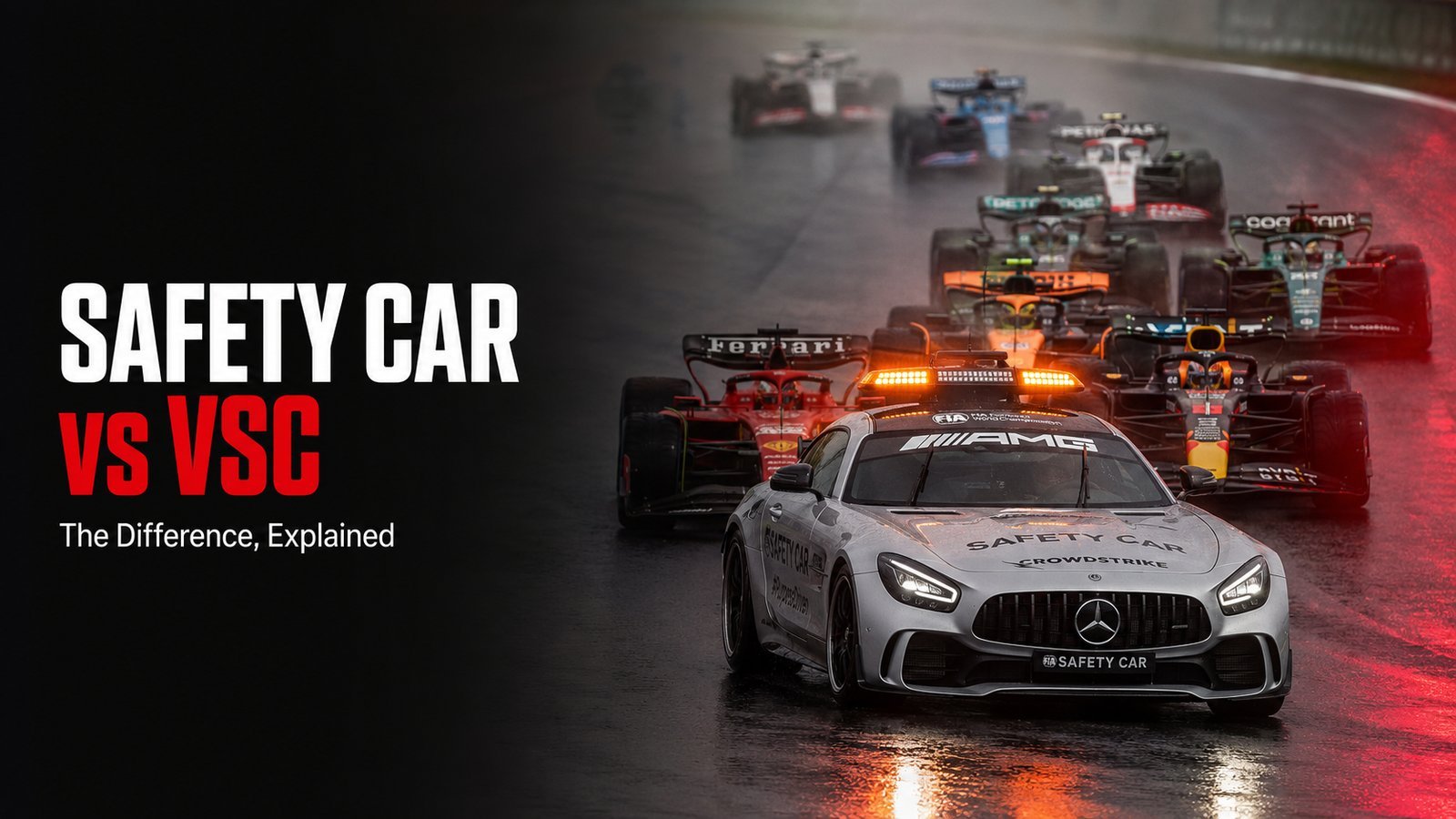
The Safety Car is a real car, an Aston Martin or Mercedes, that drives onto the circuit and leads the whole field around at a reduced pace. It comes out for serious incidents: a big crash, cars or debris on the track, barrier repairs, or conditions dangerous enough that marshals must work while cars are still running.
While it is out, drivers line up behind it and cannot overtake, and the pit lane stays open. Crucially, the field bunches up: everyone closes right up behind the Safety Car, so any gaps built up over the race vanish. When the track is clear, the Safety Car peels into the pits and racing resumes at the line, often with a frantic restart, exactly the scenario that undid Hamilton.
The Virtual Safety Car
The Virtual Safety Car is not a car at all. It is a system shown on the drivers' dashboards and trackside panels, used for less serious incidents that can be cleared quickly without sending a physical car out.
Under a VSC, drivers follow nothing. Instead they must slow to a delta time, a minimum lap time roughly 30 to 40 percent slower than racing pace, and hold it everywhere on the lap. Because everyone slows by the same amount, the gaps stay exactly the same. If a driver was 10 seconds ahead when the VSC began, they are still 10 seconds ahead when it ends. Overtaking is banned, and once the incident is cleared a short countdown returns everyone to racing at once.
The big difference: bunching vs gaps
This is the part that matters, and it is worth seeing side by side:
Under a Safety Car the field bunches up and the gap between cars collapses. Under a VSC every gap is frozen. Illustrative example.
That single difference changes everything about strategy:
Under a Safety Car, a pit stop is far "cheaper", because the whole field is running slowly, you lose much less time diving into the pits than at racing speed. A well-timed stop can gain several places almost for free, and the bunched-up restart hands the cars behind a chance to pounce. That is what Verstappen exploited in 2021, and it is why a Safety Car is one of the biggest strategic swings in racing. It plays straight into the undercut and overcut maths.
Under a VSC, the swing is much smaller. A stop is still slightly cheaper than normal, but because nobody's gap changes, there is no free bunch-up, so the lottery element is largely removed.
What both have in common
Whichever is out, the same core rules apply: no overtaking, slow to the required pace, and respect the delta or the Safety Car's speed. Break them, by speeding under a VSC or passing illegally, and you get a penalty. These situations often begin with yellow flags, and if the track cannot be made safe to run on at all, race control goes further and red-flags the session.
See how the gaps change
The whole point of a safety car or VSC is what it does to the gaps between cars. Our Gap Visualizer turns those time gaps into real metres of track, so you can see exactly how much a bunched-up restart closes the field.
Watch the calls as they happen
Safety car and VSC periods are where races turn, and they are called with almost no warning.
The Formula Dream app runs a live Dashboard through every session: every car moving on the circuit map, and a timing tower with lap times, gaps and intervals, tyre compound and age, pit counts and positions, plus flag and safety car alerts the moment race control calls them. You also get live driver radio as it is broadcast, and every FIA document of the weekend collected as it is published, which is where the stewards' decisions that change results actually appear.
Free, no subscription, no ads, independent. Not affiliated with Formula 1.
What is the difference between the safety car and the virtual safety car?
The Safety Car is a real car that leads the field and bunches everyone up, erasing the gaps. The Virtual Safety Car is a delta-time system that slows everyone equally, so the gaps stay the same. Both ban overtaking.
Why is a pit stop "cheaper" under the safety car?
Because the whole field is circulating slowly, so the time lost diving into the pits is much smaller than at full racing speed, which can gain a driver several places, as Verstappen's stop did in Abu Dhabi 2021.
What is a delta time under the VSC?
A minimum lap time, around 30 to 40 percent slower than racing pace, that every driver must stay above at all times, which is what keeps the gaps unchanged.
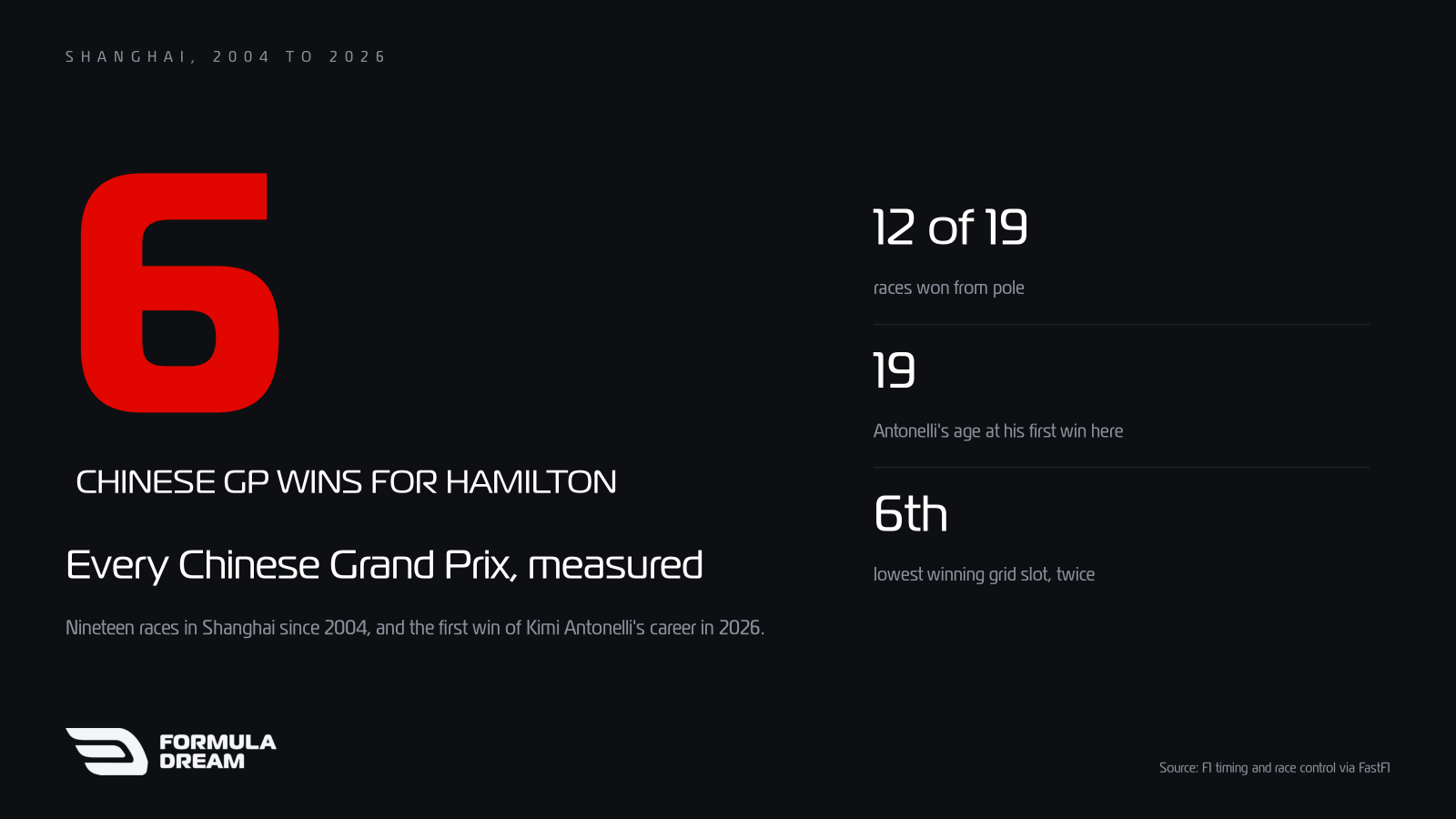
Nineteen Chinese Grands Prix have been held in Shanghai since 2004. Lewis Hamilton won six, pole won twelve, and in 2026 Kimi Antonelli took the first win of his career there, at 19, with Hamilton on the podium for Ferrari for the first time. Every winner, grid slot and safety car, measured.