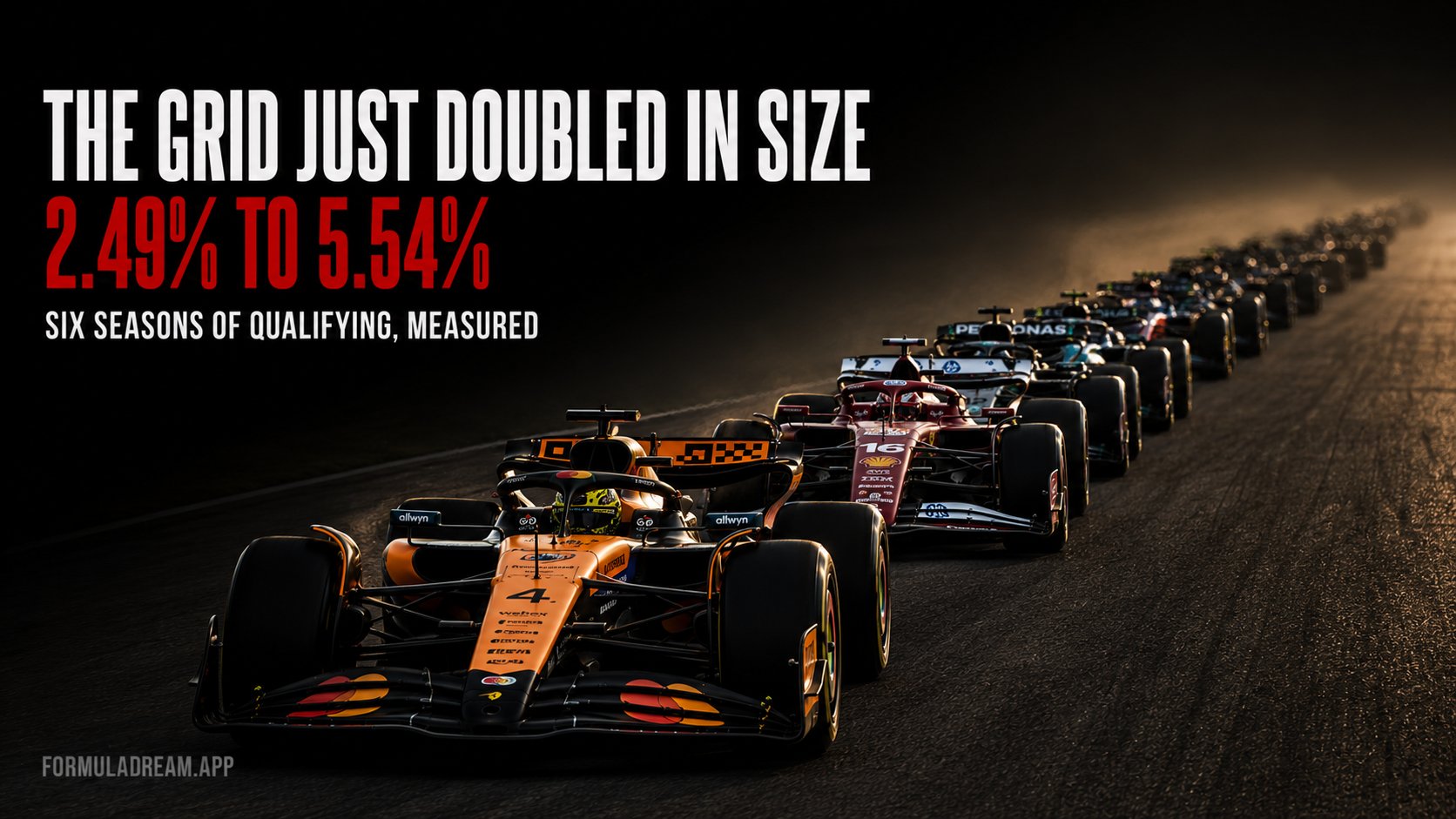
In 2025, the gap from pole position to the slowest car in qualifying was 2.49% of lap time. It was the tightest grid in six seasons, and it had got tighter every single year since 2021.
In 2026 that gap is 5.54%. More than double, and the widest in the period.
The interesting part is that the last regulation reset did nothing of the sort.
The gap from pole to the slowest car in qualifying, by season
Qualifying is where the field sorts itself out honestly. Low fuel, everyone pushing, no strategy, no traffic management. The gap from pole to the slowest car is the cleanest available measure of how big the performance range across the grid actually is.
We took every driver's best lap from every qualifying session between 2021 and 2026, and measured the spread as a percentage of the pole time, so Monaco and Spa can sit in the same table. Wet sessions are excluded. That leaves 110 dry sessions.
Two measures, because they answer different questions. Pole to last is the full range of the grid. Pole to tenth is how close the competitive part of the field is.
Five years of convergence
2021: 3.97%
2022: 3.55%
2023: 3.01%
2024: 2.82%
2025: 2.49%
2026: 5.54%
The field converged in every single one of the first five years. That is what a stable rulebook does: the teams at the back copy the teams at the front, the good ideas propagate, and the range narrows. By 2025 the entire grid, from the fastest car to the slowest, fitted inside two and a half percent.
Then it doubled.
The front of the grid barely moved
Splitting the two measures shows where the change actually happened.
The full grid spread compared with the gap from pole to tenth place
Pole to 10th went from 0.96% in 2025 to 1.46% in 2026
Pole to last went from 2.49% to 5.54%
The competitive part of the field spread out by about half a percentage point. The full grid spread out by three.
So this is not a story about the front-runners pulling away from each other. It is a story about the bottom of the grid falling off the back. In 2025 the slowest car was 2.49% off pole. In 2026 it is more than twice that.
For context on what that means in seconds, on a 90 second lap 5.54% is roughly five seconds. In 2025 it was about two and a quarter.
Aerodynamics converge. Engines do not.
Here is the part that makes this more than a news item.
The 2022 regulation reset did not spread the field out at all. It went from 3.97% to 3.55%, a slight convergence.
The change in qualifying spread caused by the 2022 and 2026 regulation resets
Two resets, two completely different outcomes. The difference is what was reset.
2022 changed the aerodynamics. Aerodynamic concepts are visible. Rivals photograph your floor in the pit lane, reverse-engineer it in a wind tunnel, and copy it within a season. Aero advantages leak, which is why the field kept converging through that cycle.
2026 changed the power unit as well. An engine cannot be copied from a photograph. It is homologated, development is tightly restricted by the rules, and a manufacturer who gets it wrong cannot simply look at what the others did and reproduce it. An engine deficit is close to permanent within a regulation cycle.
That is consistent with everything else we have measured about 2026. The cars are 3% slower than 2025, they are retiring nearly twice as often, and the reliability problems reported all season have been overwhelmingly power unit and battery failures rather than aerodynamic ones.
Is it just the new team?
That is the first objection to everything above, and it is a fair one. Cadillac joined for 2026, and a brand new team is usually slow, so a pole-to-last figure would widen even if nothing else had changed.
We have now measured it two ways to find out.
First, by team rather than by driver. Take each team's single fastest legal lap of the session and compare the quickest team with the slowest. This is a more robust measure than pole to last, because a driver who never sets a representative lap no longer distorts it: his team-mate's time covers the team. Across ten circuits raced dry in both seasons:
2025: 1.99% from fastest team to slowest
2026: 4.66%
Second, by deleting the slowest team from every 2026 session and comparing only the remaining ten with 2025's ten, like for like on grid size:
2026, new entry removed: 3.85%
The gap still roughly doubles. Cadillac is a contributor, not the cause. It is also not purely a Cadillac story: across those ten circuits the slowest team was Cadillac six times and Aston Martin four.
Every one of the ten circuits moved the same way on both measures, and every one of the ten was also slower in 2026, by a mean of 2.93%. For a partial season that is about as consistent as this kind of measurement gets.
What this changes about watching 2026
Expect a bigger gap between the top teams and the rest. Five seconds of grid spread means backmarkers are lapped sooner and more often.
Do not expect it to close quickly. The 2022 cycle converged because aero copies. This one may not, or not at the same rate.
Watch pole to tenth, not pole to last. The competitive fight is still reasonably close at 1.46%. The headline 5.54% is being driven by the teams at the very back.
A close championship and a close grid are different things.2025 had three drivers winning 8, 7 and 7 races and the tightest grid we measured. 2026 can still produce a title fight while the field itself is spread out.
Method
Data: FastF1 qualifying sessions, 2021 to 2026. Each driver's fastest lap of the session, including all segments.
Wet sessions excluded, identified by intermediate or wet tyres appearing. 110 dry sessions remain.
Spreads are expressed as a percentage of that session's pole time, and the seasonal figure is the median across sessions, so one shambolic session cannot drive a year.
A session needs at least 16 drivers with a time to be included.
Accounting check: pole to last is greater than or equal to pole to tenth in every single session. Trivially true if the data is read correctly, which is why it is worth verifying.
2026 covers 11 dry sessions against 17 to 23 for the full seasons. It is a partial season and the figure will move.
Grid size changed in 2026, from 20 cars to 22 with Cadillac's entry. A brand new team is likely to be at the back and will therefore widen the pole-to-last measure. We have since separated that out with a second measurement, described below: the spread survives with the new team removed entirely.
The explanation for why aerodynamics converge and engines do not is reasoning, consistent with the data but not proved by it.
Grid convergence is a season-level number made of individual qualifying gaps.
The Formula Dream app runs a live Dashboard through every session: every car moving on the circuit map, and a timing tower with lap times, gaps and intervals, tyre compound and age, pit counts and positions gained or lost. It is the same information these measurements come from, arriving live. You also get live driver radio as it is broadcast, and every FIA document of the weekend as it is published.
Free, no subscription, no ads, independent. Not affiliated with Formula 1.
Singapore Sprint 2026 Results: Russell Crashes From the Lead
Russell took the lead at turn one and crashed at the final corner of the same lap. Verstappen won, Hamilton charged to second, and the McLarens hit each other.