F1 Ground Effect and Porpoising Explained | Formula Dream
Guides
F1 Ground Effect and Porpoising Explained: The Idea Too Powerful to Trust
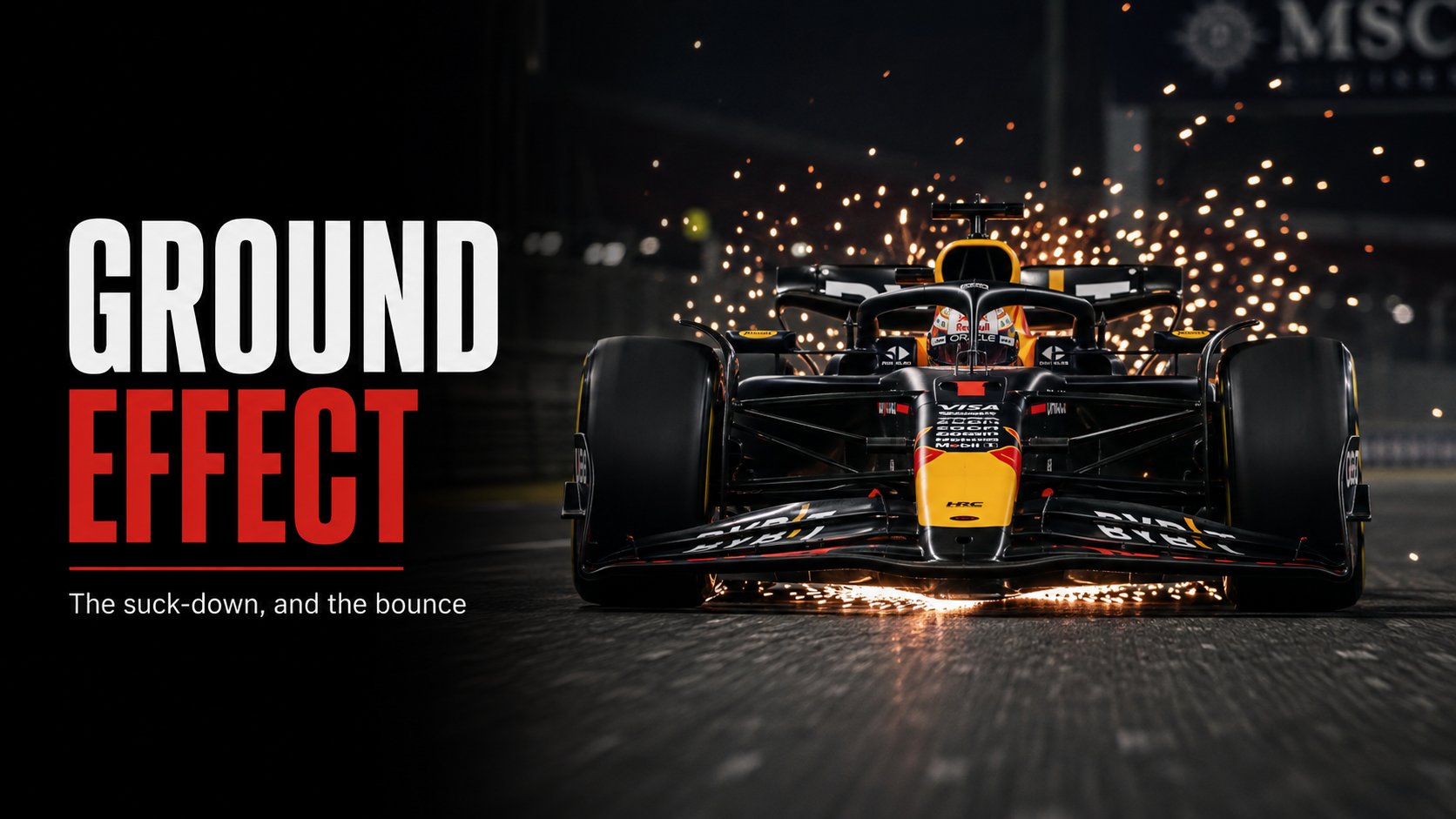
Ground effect and porpoising explained, how the floor sucks an F1 car to the track, the Lotus cars and fan car that made it famous, why it was banned in 1983, and why its 2022 return made the cars bounce.
Ground effect is the most powerful idea in Formula 1 aerodynamics, and for a long time it was considered too dangerous to allow. It has produced championship-winning cars and one of the most outrageous machines the sport has ever seen, it was banned for nearly forty years, and when it finally returned in 2022 it made the cars bounce so violently it hurt the drivers. Here is the full story of ground effect, how it works, and the strange phenomenon called porpoising that came back with it.
What is ground effect?
Ground effect is a way of making downforce using the floor of the car rather than its wings. The underside of the car is shaped into channels, called
, that the air has to squeeze through as it passes beneath the car. Forcing the air through a narrowing gap speeds it up, and faster-moving air has lower pressure. That creates a powerful zone of low pressure under the car that effectively
sucks it down onto the track
, pressing the tyres into the surface for enormous grip.
Air squeezed under the floor speeds up and drops in pressure, sucking the car down. Run too low and that airflow stalls, and the car springs up, the bounce known as porpoising.
The reason engineers love it is efficiency. A wing makes downforce but pays for it with a lot of drag. Ground effect makes its downforce almost for free, with very little drag penalty, and it leaves a cleaner wake behind the car. It is, on paper, the perfect way to make an F1 car stick. The problem is that it is fierce, twitchy and unforgiving, and F1 has learned that the hard way, twice.
The original era: Lotus, and a car with a fan
Ground effect arrived in F1 in the late 1970s, and the man behind it was Colin Chapman of Lotus, one of the sport's great innovators. His Lotus 78 of 1977 was the first true ground-effect car, using sidepods shaped as Venturi tunnels with sliding "skirts" that sealed the low-pressure zone to the ground. Its successor, the Lotus 79, perfected the idea and was untouchable, carrying Mario Andretti to the 1978 World Championship.
The most extreme response came from Brabham. Designer Gordon Murray built the BT46B "fan car", which used a large fan at the back, officially to cool the engine, but which also sucked the air out from under the car to generate colossal downforce. It won its only race, the 1978 Swedish Grand Prix, in the hands of Niki Lauda, and was then quietly withdrawn under pressure from the other teams. It remains one of the most notorious cars in F1 history: so good it was effectively legislated out of existence.
Why it was banned
As teams pushed ground effect further, cornering speeds climbed to frightening levels, and so did the danger. The low-pressure seal depended on the skirts staying in perfect contact with the track. If that seal was suddenly broken, over a bump, a kerb, or a failure, the downforce could vanish in an instant, pitching the car off the road at enormous speed. After a series of accidents, the FIA acted: sliding skirts were banned in 1981, and from 1983 the cars were required to have flat bottoms, which killed ground effect entirely. It stayed banned, in effect, for almost four decades.
The 2022 return, and why
F1 brought ground effect back for 2022, and it did so for a specific reason: to fix overtaking. The wing-dependent cars of the previous era threw out so much dirty air that following closely was almost impossible. Because ground effect makes its downforce from the floor and leaves a cleaner wake, the hope was that cars could once again race each other closely. It was a deliberate return to an old idea to solve a modern problem.
What is porpoising?
The return of ground effect brought back an old side effect that the modern teams had forgotten about: porpoising, the violent up-and-down bouncing the 2022 cars suffered at high speed. It is a self-feeding loop, and once you see the cycle it makes complete sense.
Above roughly 160 km/h, ground effect pulls the car lower and lower, because the closer the floor gets to the track, the harder it sucks. But get the floor too close and the airflow underneath suddenly stalls, the downforce collapses in an instant, and the suspension springs the car back up. Higher up, the floor works again, sucks the car back down, and the whole thing repeats, four to six times every second. The result is a fast, jarring bounce down every straight.
The 2022 fallout: it actually hurt
Porpoising was not just ugly to watch, it was a genuine health problem. The bouncing shook the drivers so hard it caused back pain and blurred vision, making it harder to brake and steer accurately. Mercedes were the worst affected, because their car concept was especially sensitive to ride height, and Lewis Hamilton climbed out of the 2022 Azerbaijan Grand Prix in Baku visibly in pain, clutching his back. It became serious enough that the FIA intervened on safety grounds, issuing a mid-season technical directive to force teams to run their cars in a way that limited the bouncing, and then, for 2023, raising the edges of the floor by 15mm to stop teams running so aggressively low. It cost lap time, but it largely tamed the problem.
Ground effect remains the foundation of the current cars and continues, in modified form, into 2026. But 2022 was the season the sport rediscovered an old truth: the most powerful idea in F1 aerodynamics has always come with a vicious edge.
See the floor working
Ground effect is invisible from the outside. Its consequences, in lap time and tyre behaviour, are not.
The Formula Dream app runs a live Dashboard through every session: every car moving on the circuit map, and a timing tower with lap times, gaps and intervals, tyre compound and age, pit counts and positions gained or lost. It is the same information these measurements come from, arriving live. You also get live driver radio as it is broadcast, and every FIA document of the weekend as it is published.
Free, no subscription, no ads, independent. Not affiliated with Formula 1.
A way of generating downforce using shaped Venturi tunnels under the car's floor that speed up the airflow, creating low pressure that sucks the car onto the track. It makes a lot of downforce with very little drag.
Why was ground effect banned in F1?
On safety grounds. In the original era it produced huge cornering speeds and relied on a delicate seal to the ground. If that seal broke suddenly the downforce could vanish and pitch the car off the road, so flat bottoms were mandated from 1983.
What is porpoising?
The violent high-speed bouncing that returned with ground effect in 2022. Ground effect pulls the car down until the airflow under the floor stalls, downforce vanishes, the car springs up, and the cycle repeats several times a second.
How was porpoising fixed?
The FIA issued a safety directive in 2022 and, for 2023, raised the edges of the floor by 15mm to stop teams running the cars so close to the ground. It cost some performance but largely solved the bouncing.
Who invented ground effect in F1?
Colin Chapman's Lotus team pioneered it in the late 1970s with the Lotus 78 and the title-winning Lotus 79. Brabham's Gordon Murray took it to an extreme with the 1978 "fan car".
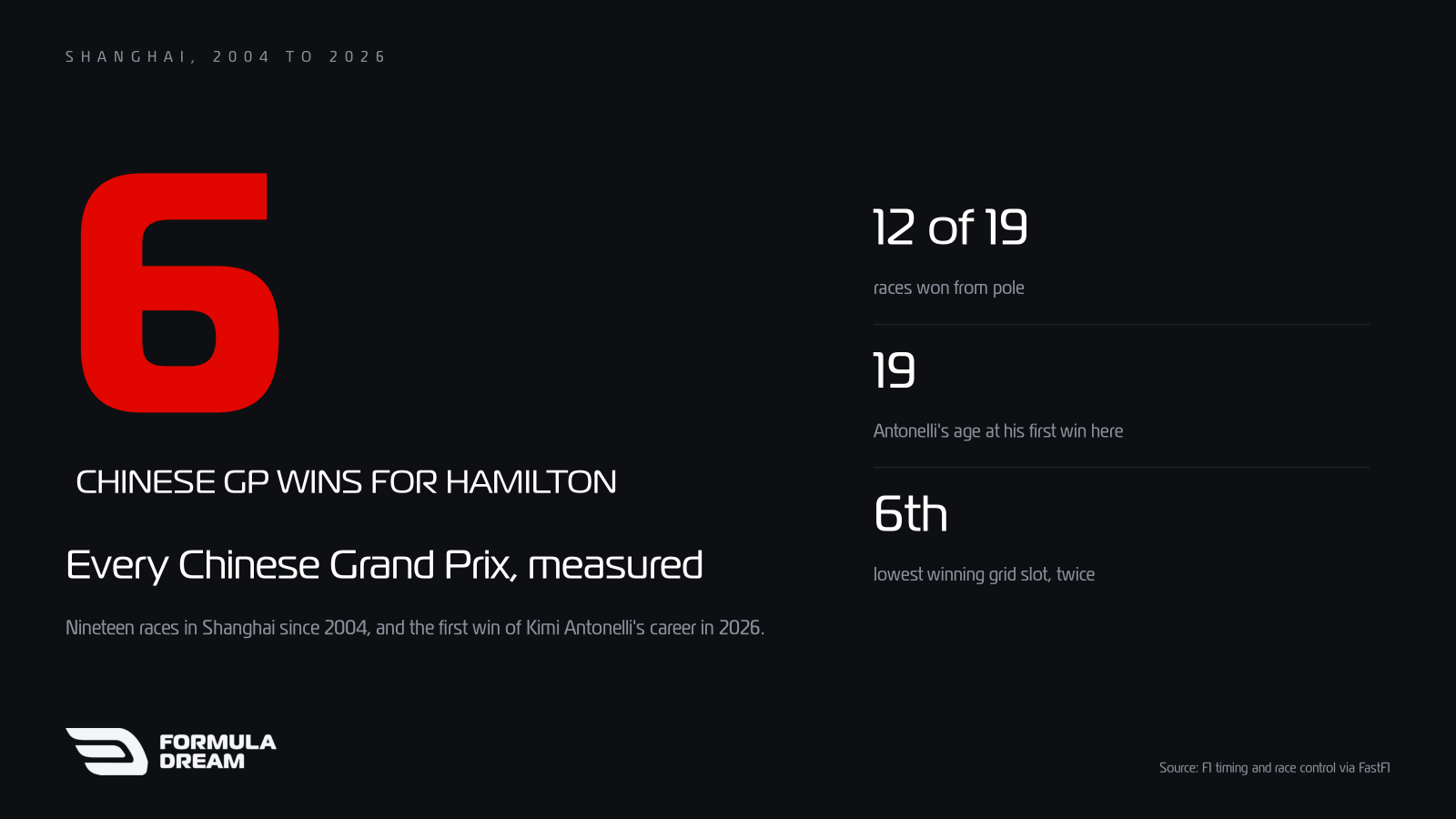
Nineteen Chinese Grands Prix have been held in Shanghai since 2004. Lewis Hamilton won six, pole won twelve, and in 2026 Kimi Antonelli took the first win of his career there, at 19, with Hamilton on the podium for Ferrari for the first time. Every winner, grid slot and safety car, measured.