What Is Dirty Air in F1? Meaning Explained | Formula Dream
Guides
What Is Dirty Air in F1? Why Overtaking Is So Hard
Dirty air explained through the 2010 title Alonso lost stuck behind a slower car, why the wake robs a following car of grip, the real downforce numbers, and how the rules keep chasing it.
On 14 November 2010, Fernando Alonso arrived at the season finale in Abu Dhabi leading the championship. He left it without the title. The reason was not a mechanical failure or a crash. It was a Renault. Alonso got stuck behind Vitaly Petrov, a driver in a far slower car, for roughly 40 laps, could not find a way past, and finished seventh. Sebastian Vettel won the race and the championship by four points. Alonso had the pace to pass all afternoon. What he did not have was clean air.
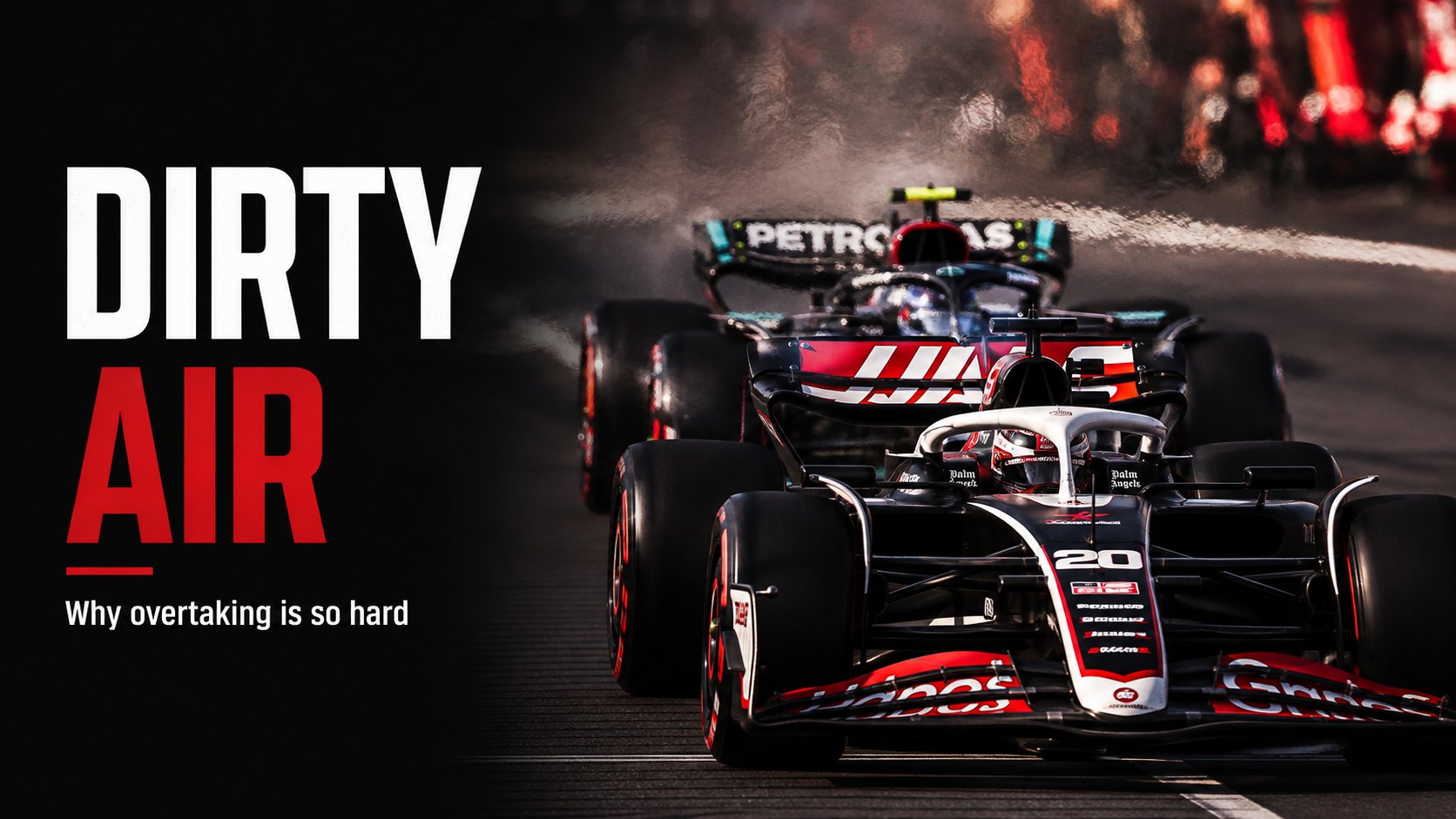
That race is the clearest lesson in the single biggest reason overtaking in Formula 1 is so hard: dirty air. Here is what it is, why it wrecks a following car, and how the sport keeps trying, and failing, to fix it for good.
An F1 car makes downforce by carefully shaping the air that flows over and under it, through the front wing, the floor and the rear wing. But doing that leaves a mess behind: a churning, turbulent wake of vortices, low-pressure pockets and unsteady, low-energy air. That disturbed air trailing off the back of the car is what everyone calls dirty air. The smooth, undisturbed air a leading car gets to enjoy is "clean air".
Why it wrecks the car behind
Here is the mechanism, and it matters because it explains the whole problem. A following car's aerodynamics are tuned to work in smooth, fast, predictable airflow. Drive into the leader's wake and that assumption breaks down, front to back:
The front wing goes first. It is the car's most sensitive aero surface and the first thing to hit the dirty air. Starved of clean flow, it makes less downforce, so the front tyres lose grip and the car understeers, washing wide exactly when the driver is trying to stay tight to the car ahead.
The floor and rear follow. Less clean air reaching the floor and rear wing means less downforce there too, so the whole car slides.
Cooling suffers. The same hot, turbulent air the following car is breathing chokes its radiators, pushing engine and brake temperatures up, so the driver often has to back off just to keep the car healthy.
The result is a cruel loop: the closer you get, the more grip you lose, the more your tyres overheat and slide, and the further back you drop. Getting close enough to attack is the very thing that takes the attack away. That is precisely why DRS was introduced in 2011, the season straight after Alonso's defeat, as an artificial straight-line boost to paper over the aero penalty. DRS was never a fix for dirty air. It was a plaster over it, and for 2026 it was removed altogether.
How much grip does it actually cost?
A lot, and the numbers are stark. Formula 1's own simulations of the 2021 cars showed a car 20 metres behind another losing around 35 percent of its downforce, and 46 percent when running closer still. Losing a third or more of your grip while trying to race someone is close to impossible, which is why that era produced so many "DRS trains", long processions of cars unable to pass.
Formula 1 attacked the problem at its source with the 2022 regulations, a rules package specifically designed to reduce dirty air. The key was moving most of the car's downforce to the floor using ground effect, which throws off a smaller, cleaner wake than big exposed wings do, and reshaping the bodywork to fire the remaining turbulence up and over the following car rather than straight into it. In those same simulations the 2022 car lost only 4 percent at 20 metres and 18 percent close behind. It worked, at first, and then the teams went to work clawing the lost performance back.
The difference on track was immediate. At the 2022 Bahrain Grand Prix, the season opener under the new rules, Charles Leclerc and Max Verstappen swapped the lead back and forth over three laps in a way the previous cars simply could not have managed, braking side by side into the same corner lap after lap. But the fix faded. The FIA's single-seater director, Nikolas Tombazis, said in November 2025 that a following car kept around 80 to 85 percent of its downforce at 20 metres at the start of 2022, but more like 70 percent by 2025, as development ate into the benefit. It is not a problem you solve once; it is one the rulebook has to keep chasing, which is a big part of what the 2026 regulations, with their active aerodynamics, are trying to do all over again.
The same wake, a different story on the straights
One curious twist: the very same turbulent wake that ruins grip in the corners actually helps a following car on the straights, where it cuts drag and adds speed. There it has a friendlier name, the slipstream, or the tow. One phenomenon, two opposite effects, depending only on whether the driver is turning or going straight.
We measured what dirty air actually costs
Almost every explanation of dirty air, including the percentages above, comes from wind tunnel or CFD figures about downforce. That answers a question nobody watching a race is actually asking. The question is: how much slower does it make you?
So we measured it across a season of real lap times.
Running within one second of another car costs 0.49 seconds a lap. Get right onto the gearbox, inside half a second, and it costs 0.61. Back off to three seconds and the cost is gone entirely.
That last number is the important one, because it is what proves the effect is real rather than an artefact of slower cars happening to run together. If the loss were just a case of traffic, it would not fall away so cleanly with distance. It does.
The cost is also wildly circuit dependent. At the Hungaroring, a track of medium-speed corners taken in a permanent state of turning, dirty air costs about 1.3 seconds a lap. At Monza, which is mostly straights, it costs effectively nothing. This is why some races produce processions and others do not, and it has more to do with the shape of the circuit than the mood of the drivers.
The 2022 ground effect rules were introduced specifically to reduce this problem, and the 2026 rules had another go: simpler aerodynamic surfaces, less downforce overall, and wings that switch between Corner Mode and Straight Mode. Before the season, the FIA expected the new cars to keep around 90 percent of their downforce 20 metres behind another car. Neither set of rules has made following free.
Our measurements still show a clear cost at close range in the current cars. Less aerodynamic load overall means there is less to lose, but the mechanism has not gone away: the car in front still leaves a wake, and the car behind still has to drive through it. What changed most is the tool used to get past. DRS is gone, replaced by active aero and the Overtake boost, which we cover in what replaced DRS.
Watch the gaps live
Dirty air is a story about one number, the gap to the car ahead, and it moves constantly.
The Formula Dream app runs a live Dashboard through every session: every car on the circuit map, and a timing tower with lap times, gaps and intervals, tyre compound and age, plus flag and safety car alerts as race control calls them. That is where you watch a driver stall a second behind and start losing their tyres. You also get live driver radio as it is broadcast, which is where the complaints about the car ahead actually arrive, and every FIA document of the weekend as it is published.
Free, no subscription, no ads, independent. Not affiliated with Formula 1.
One second sounds tiny until you see it as real distance, and our Gap Visualizer draws the gap between any two cars to scale, as actual metres of track.
Frequently asked questions
What is dirty air in F1?
The turbulent wake of disturbed, low-energy air that trails behind an F1 car. A following car that drives into it loses downforce, starting with the front wing, and slides.
How much downforce does a following car lose?
In Formula 1's simulations, a 2021 car lost around 35 percent of its downforce 20 metres behind another, and the 2022 design cut that to 4 percent. The FIA says real cars kept 80 to 85 percent at 20 metres in 2022, falling to around 70 percent by 2025, and it expected about 90 percent for the 2026 cars.
Why did F1 have DRS?
DRS was introduced in 2011 to compensate for the grip a chasing car loses in dirty air. It came in directly after the 2010 finale, where Alonso lost the title stuck behind a slower car he could not pass. It masked the problem rather than solving it, and it was removed for 2026, replaced by active aerodynamics and Overtake Mode.
How much lap time does dirty air cost?
We measured 0.49 seconds a lap within one second of the car ahead, and 0.61 seconds inside half a second. At three seconds back the cost disappears. It varies hugely by circuit: about 1.3 seconds a lap at the Hungaroring, and effectively nothing at Monza.
Is dirty air always bad?
No. In the corners it robs the following car of grip. But on the straights the same wake cuts drag and helps the following car go faster, which is called the slipstream or tow.
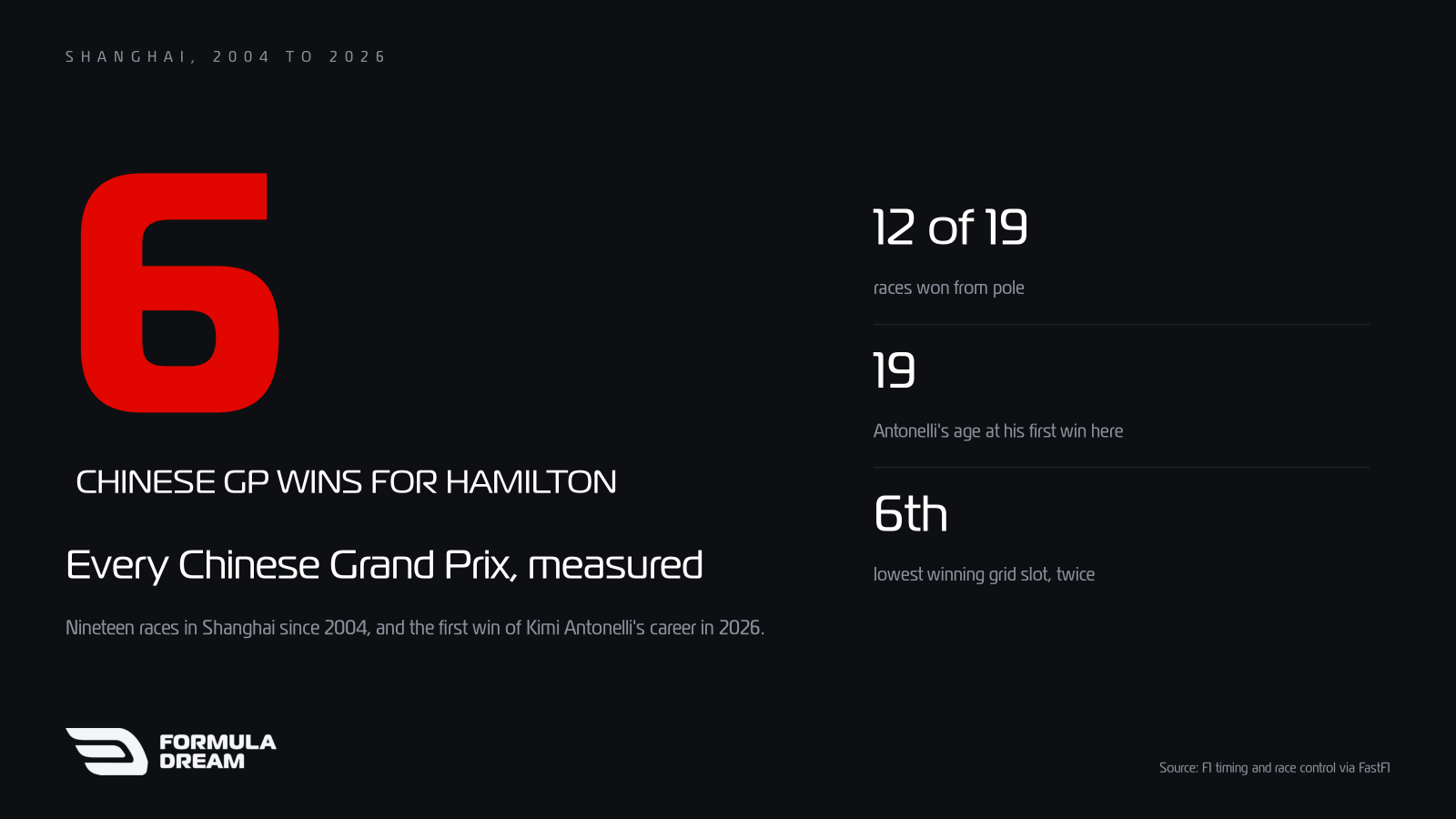
Nineteen Chinese Grands Prix have been held in Shanghai since 2004. Lewis Hamilton won six, pole won twelve, and in 2026 Kimi Antonelli took the first win of his career there, at 19, with Hamilton on the podium for Ferrari for the first time. Every winner, grid slot and safety car, measured.