F1 Tyre Blankets: The Ban That Keeps Not Happening
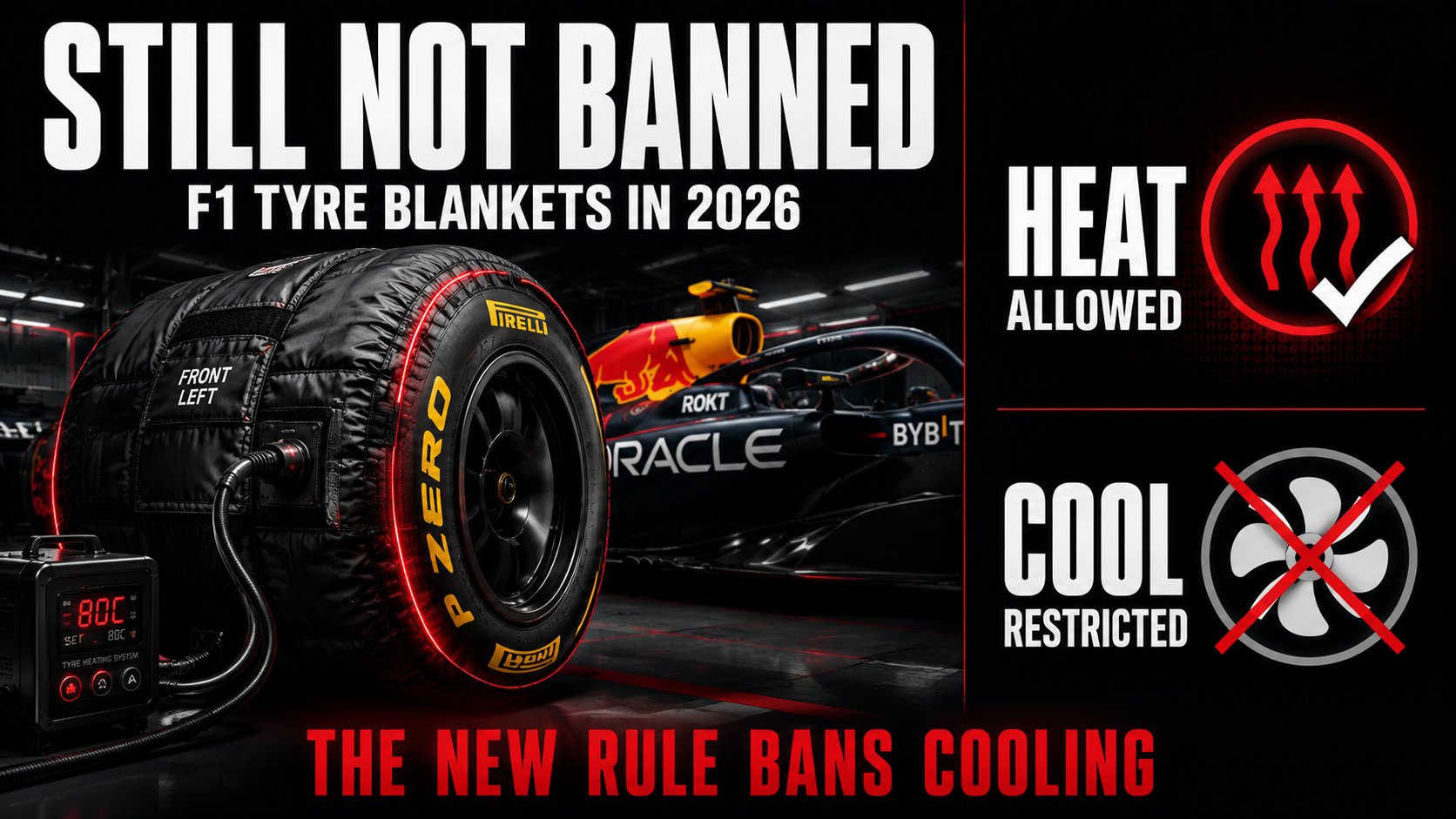
Tyre blankets have been about to be banned for years and are still legal in 2026. The rule that did change went the other way, and closed a cooling loophole.
Formula 1 has been about to ban tyre blankets for years. In 2026 they are still legal, and they remain the only tyre heating device the rules permit.
The rule that actually changed for this season went in the opposite direction to the one everyone was expecting. Rather than restricting how teams heat tyres, the FIA closed a loophole in how they were cooling them.
Here is why blankets exist, why removing them is harder than it sounds, and what did change.
A blanket is an electric heating jacket wrapped around a wheel and tyre in the garage, bringing the rubber up to temperature before it ever touches the track.
It exists because a cold slick tyre has almost no grip. Racing tyres are built to work in a specific temperature window, and below it the rubber is hard and slippery. Send a car out on genuinely cold slicks and the first lap is treacherous: no front grip into the first corner, no rear grip out of it, and a real chance of putting the car in a wall before the tyre has warmed up.
Blankets remove that problem entirely. The tyre arrives at the car already in its window, so a driver can push from the moment they leave the pit box, which matters enormously in qualifying and at every pit stop.
Why anyone wants them banned
Three arguments, and they are all reasonable.
Cost and logistics. Blankets need generators, transport and freight, at every race, for every team. Given that logistics account for around half of F1's carbon footprint, removing a heavy piece of equipment from twenty garages is a genuine saving.
Road relevance. No road car has heated tyres. A tyre engineered to work from cold is a more useful thing to develop, and it is the direction Pirelli's road business points.
Racing. Cold tyres would make out-laps and the first laps after a stop genuinely difficult, which adds variance. Drivers emerging on cold rubber next to cars on warm rubber creates overtaking opportunities that currently do not exist.
Why it keeps being deferred
Because the drivers do not want it, and their objection is a safety one rather than a preference.
A car leaving the pit lane on cold slicks is slow and unpredictable while the rest of the field is at racing speed. The risk is not the driver on cold tyres losing time, it is that driver being a hazard to everyone else, particularly at a circuit with walls. Lewis Hamilton has publicly called the prospect dangerous, and he has not been alone.
Pirelli's position has been that the transition needs to be gradual rather than abrupt, which is why the approach has been a glidepath: progressively reducing the maximum temperature a blanket may reach, so tyres are asked to do more of their own warming each season while the compounds are developed to cope. Every time the endpoint has been scheduled, it has been pushed back after feedback.
That is an unusually honest bit of governance. The sport decided the destination was right and that arriving too quickly would hurt someone.
What actually changed for 2026
Here is the part almost nobody covered.
Blankets remain the only permitted tyre heating device, under the design prescriptions in Article C10.8.4. No ban. But the FIA amended the regulation, approved on 11 June 2025 for the 2026 season, to close a gap in how it was written.
The old rule addressed heating and maintaining temperature. It did not address cooling. The new wording does:
"Any device, system or procedure (except for driving of the car) whose purpose and/or effect is to heat, cool, or maintain the temperature of the complete wheels, hubs, or brakes is prohibited."
Two things changed. Cooling is now explicitly banned, and the restriction expanded from hubs and brakes to the complete wheel.
Why cooling was worth a rule
This seems backwards until you think about what temperature actually does to a tyre.
Hot is not simply better. A tyre that goes above its window loses grip, blisters and degrades faster, and managing that is most of what tyre strategy involves. We measured degradation rates by compound and found the soft losing 0.048 seconds per lap of tyre age in 2025 against the hard's 0.011, with the whole hierarchy collapsing in 2026. Heat is what drives those numbers, and it is covered in how fast F1 tyres degrade.
So a team able to bring a wheel assembly to the grid slightly cooler, or to pull heat out of a hub or brake between sessions, has a real advantage in how long the tyre survives. With the rules silent on cooling, that was worth engineering, and teams engineered it.
Closing it is a good example of how F1 regulation actually works. The rule was not wrong, it was incomplete, and the loophole existed in the space the words did not cover. It is the same pattern as technical directives, where the FIA clarifies an interpretation rather than rewriting a regulation.
What to watch
Until blankets go, the interesting moments are the ones where warm-up still matters:
The out-lap. A driver leaving the pits is on tyres at the bottom of their window, and the first sector after a stop is where an undercut is won or lost. We measured that pitting one lap earlier than a rival works only 34% of the time, largely because that cold out-lap eats the advantage.
Safety car restarts. Long periods at low speed pull heat out of the tyres, so the restart is run on rubber colder than racing temperature, which is why so many incidents happen there.
The wet. Intermediates and full wets behave differently again, and a car on the wrong tyre for the conditions is fighting temperature as much as grip.
Watch tyre temperature play out live
Tyre state is the single most useful thing on a timing screen and the least visible on a broadcast.
The Formula Dream app runs a live Dashboard through every session: every car on the circuit map, and a timing tower with lap times, gaps and intervals, tyre compound and age, pit counts and positions, plus flag and safety car alerts as race control calls them. Watching an out-lap next to a rival's flying lap is how the whole warm-up question becomes visible. You also get live driver radio as it is broadcast, which is where drivers report tyres coming in or falling away, and every FIA document of the weekend as it is published.
Free, no subscription, no ads, independent. Not affiliated with Formula 1.
No. They remain legal in 2026 and are the only tyre heating device the regulations permit. A ban has been proposed and deferred repeatedly.
Why does F1 use tyre blankets?
Because a cold slick has very little grip. Blankets bring the tyre into its working temperature window before it leaves the garage, so a driver can push immediately on an out-lap or after a pit stop.
Why has the tyre blanket ban been delayed?
Mainly safety. Drivers have argued that cars leaving the pits on cold slicks while the field is at racing speed is dangerous, and Pirelli has pushed for a gradual transition. The approach has instead been to lower permitted blanket temperatures over time.
What changed about tyre rules for 2026?
Cooling was explicitly banned. The regulation now prohibits any device, system or procedure whose purpose or effect is to heat, cool or maintain the temperature of the complete wheels, hubs or brakes. The old wording covered heating but not cooling.
Would banning tyre blankets improve the racing?
Possibly. Cold out-laps and cold restarts would add variance and create overtaking chances that do not exist now. The counterargument is that the same unpredictability is a safety risk on circuits lined with walls.
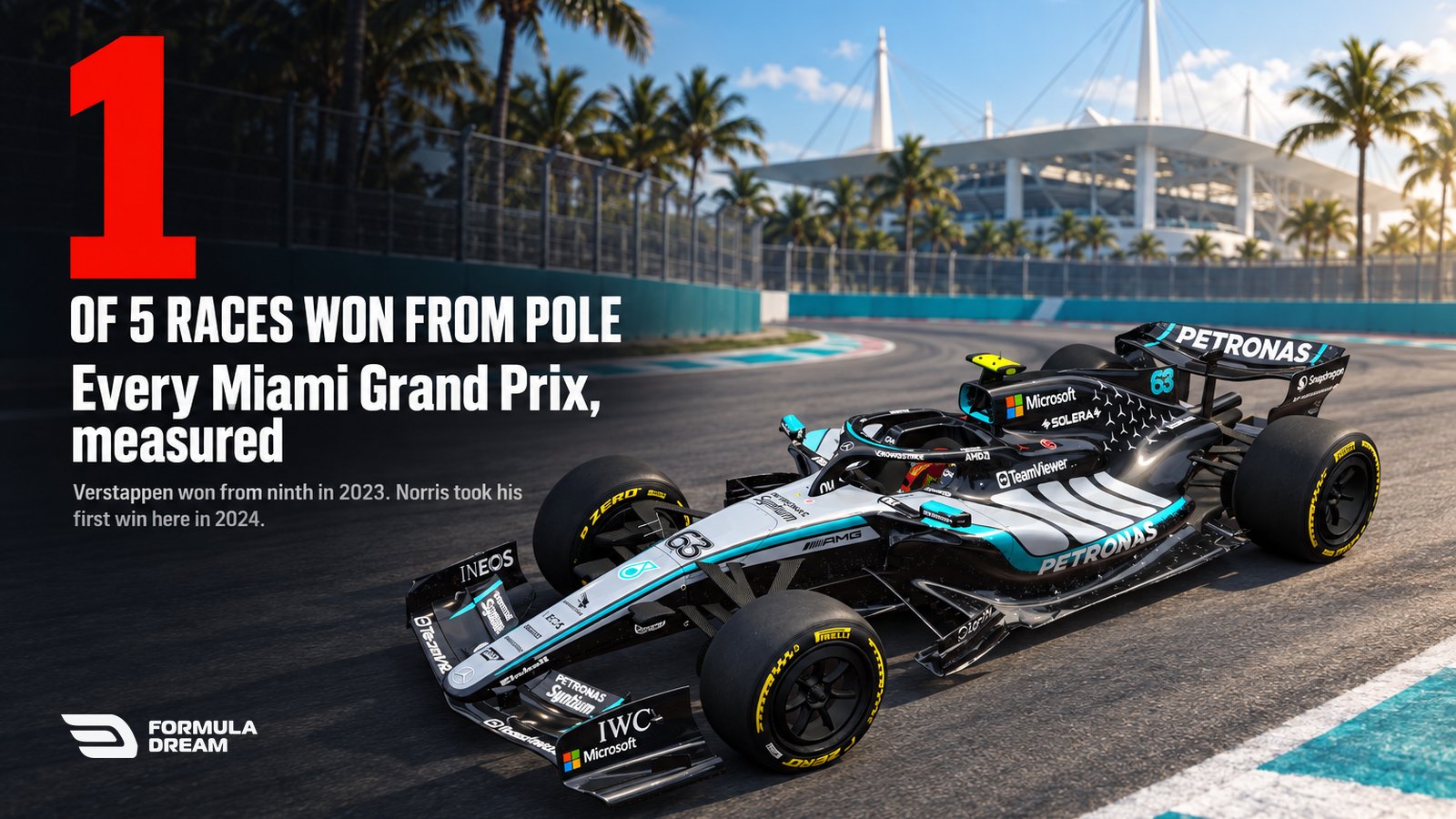
Every Miami Grand Prix winner, measured: five races, and pole has won only one of them
Five Miami Grands Prix have been held since 2022, and only one was won from pole: Kimi Antonelli's in 2026. Max Verstappen won from ninth in 2023, and Lando Norris took his first win there in 2024. Every winner, grid slot and safety car, measured.