The F1 Steering Wheel Explained: A $100,000 Computer You Drive With
The F1 steering wheel explained, why it costs up to $100,000, what every paddle, dial and button actually does, the display the driver reads at 300 km/h, and how it became a command centre.
An F1 steering wheel does not just steer the car. It is the driver's entire command centre, a carbon-fibre computer covered in paddles, dials, buttons and a full-colour screen, and it costs as much as a house deposit. A driver operates dozens of its controls while racing at 300 km/h, often mid-corner, making constant adjustments that a road driver would never dream of. Here is what all of it does, and why it is one of the most remarkable objects in the sport.
What it costs, and what it is made of
An F1 steering wheel costs somewhere between $50,000 and $100,000
to be as light and strong as possible, weighs only around
1.2 to 1.5 kilograms
despite everything packed into it, and is
shaped individually to each driver's hands
. It is not really a steering wheel in the road-car sense at all, it is closer to the control column of a fighter jet, and it detaches from the column completely so the driver can climb in and out of the tight cockpit.
The paddles behind it
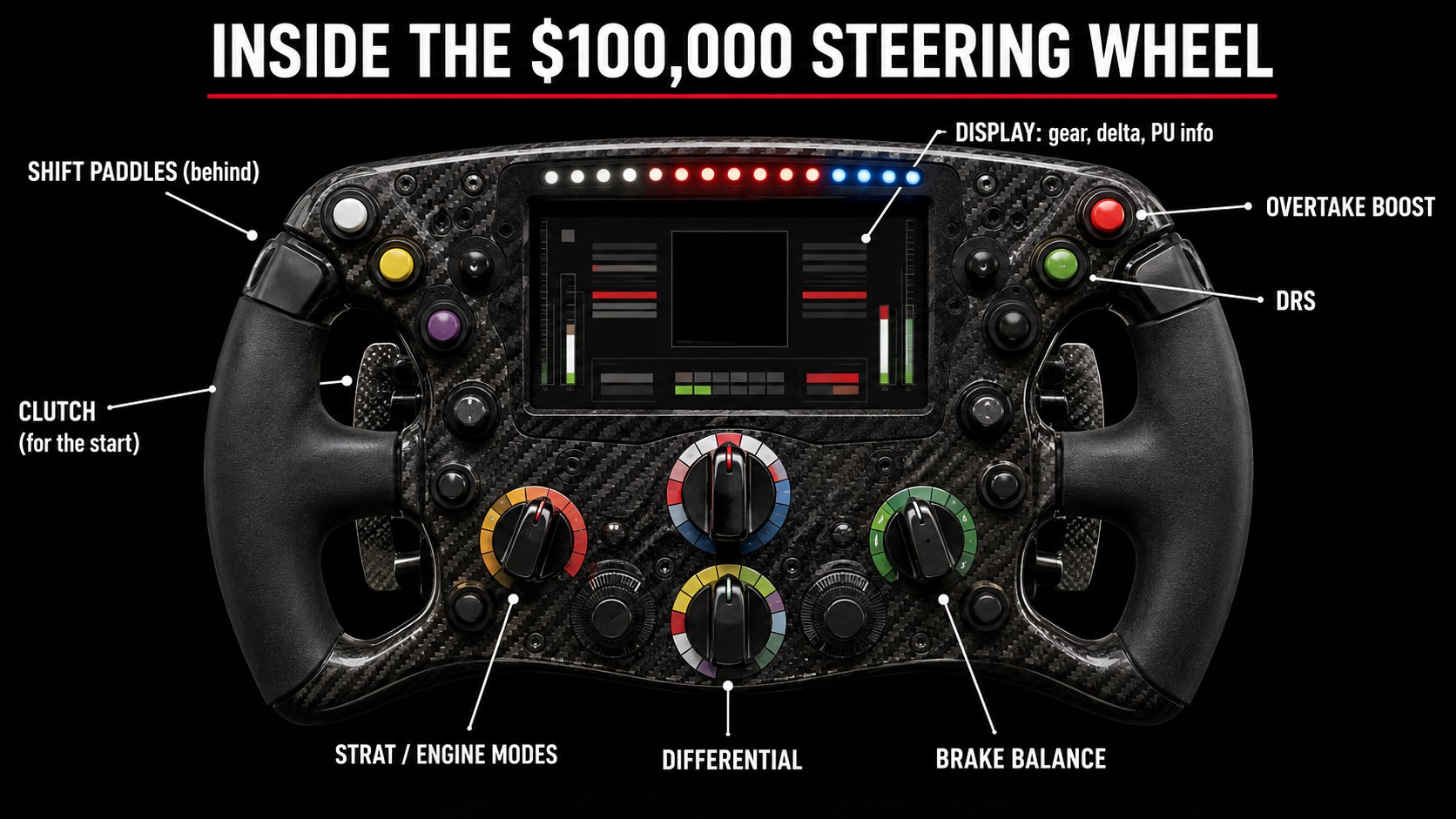
Reach behind the wheel and you find the paddles, the controls a driver uses most:
The shift paddles. The right paddle changes up a gear, the left changes down. There is no gear stick and no clutch pedal, gears are changed thousands of times a race with a flick of a fingertip, up to four times through a single corner.
The clutch paddles. A second set of paddles operates the clutch, used almost entirely for one thing: the race start. Since launch control was banned, the driver has to feather these by hand to find the bite point and launch cleanly off the line.
The dials and buttons on the front
The face of the wheel is where it gets bewildering. There are dozens of buttons and rotary dials, each dial clicking between preset positions, and together they let the driver reconfigure the car on the move:
The strat (strategy) dial cycles the power unit between modes for different situations: a defensive mode, a flat-out attack or overtake mode, a fuel-saving mode, and more.
The differential dials change how the power unit's drive is split across the rear axle on corner entry, mid-corner and exit, effectively tuning the car's handling turn by turn.
Brake balance adjusts how braking force is shared front to rear, which a driver shifts constantly as the fuel load drops and the tyres wear.
The overtake button dumps a burst of stored electrical energy for extra power on a straight, often used together with DRS.
Plus the everyday essentials: the DRS button, the pit-lane speed limiter, the radio button, and even a drinks button that pumps fluid to the driver through a tube in the hot cockpit.
The screen in the middle
In the centre sits a full-colour display that shows the driver everything they need without looking away from the track: the current gear, lap and sector times, a delta showing whether they are faster or slower than a target, what the power unit and energy system are doing, and messages from the pit wall. A row of shift lights across the top flashes to tell the driver the exact instant to change gear. The driver can scroll through pages of live telemetry using buttons on the wheel, all while cornering at over 5g.
The mental load is the real story
Here is what makes it genuinely astonishing. All of this, the dozens of adjustments, the mode changes, the reading of the display, happens while the driver is racing on the absolute limit, braking from 300 km/h, placing the car within centimetres, and often fighting another car wheel to wheel. An F1 driver will make dozens of deliberate changes to the car's settings every single lap, from memory, without looking down. It is less like driving a car and more like flying a jet, playing a video game and running a spreadsheet, all at once, at 300 km/h. The steering wheel is where the sport's physical and mental demands meet, and it is why the people who master it are among the most complete athletes on earth.
Hear the wheel being used
Every mode, differential and brake balance change on that wheel is called over the radio.
The Formula Dream app carries live driver radio as it is broadcast, which is where this shows up in a driver's own words rather than in a summary. Alongside it, a live Dashboard puts every car on the circuit map with a timing tower carrying lap times, gaps, intervals, tyre compound and age, plus flag and safety car alerts as race control calls them, and every FIA document of the weekend as it is published.
Free, no subscription, no ads, independent. Not affiliated with Formula 1.
Around $50,000 to $100,000 to produce. It is made from carbon fibre, weighs roughly 1.2 to 1.5 kilograms, and is shaped to each individual driver's hands.
Why does an F1 steering wheel have so many buttons?
Because the driver has to reconfigure the car constantly while racing: changing engine modes, differential settings, brake balance and energy deployment, plus operating DRS, the pit limiter, the radio and more, all without leaving the cockpit.
How do F1 drivers change gear?
With paddles behind the steering wheel, the right for upshifts and the left for downshifts. There is no gear stick or clutch pedal; a separate set of clutch paddles is used mainly for the start.
What does the screen on an F1 steering wheel show?
The current gear, lap and sector times, a delta to a target time, power unit and energy information, pit messages, and shift lights telling the driver when to change gear.
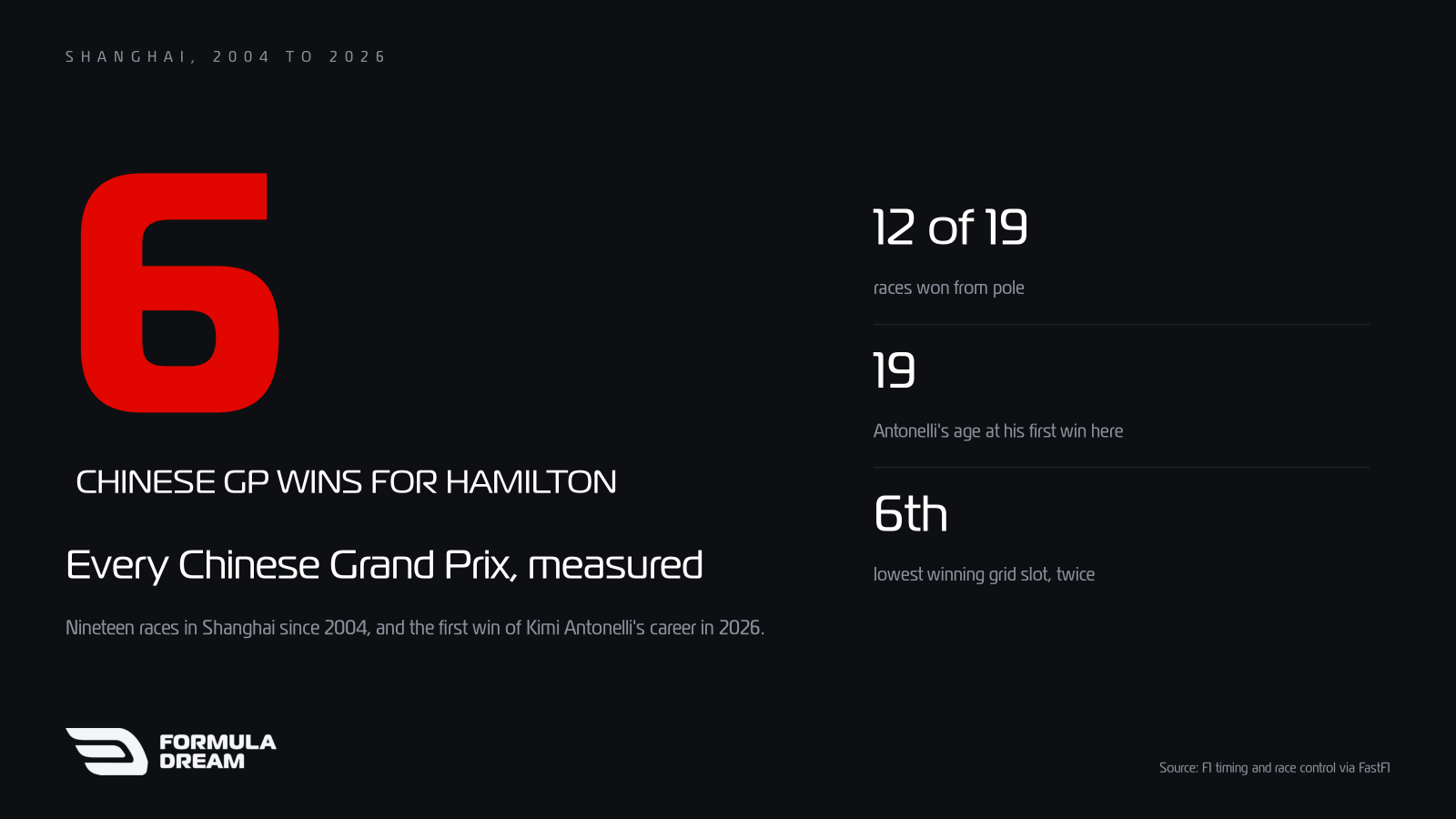
Nineteen Chinese Grands Prix have been held in Shanghai since 2004. Lewis Hamilton won six, pole won twelve, and in 2026 Kimi Antonelli took the first win of his career there, at 19, with Hamilton on the podium for Ferrari for the first time. Every winner, grid slot and safety car, measured.