F1 Track Limits Explained: The White Line Rule and Why It's a Mess
F1 track limits explained, the white line rule, how race penalties escalate, why vast asphalt run-off caused the 2023 Austria chaos, the gravel debate, and the tech trying to police it.
At the 2023 Austrian Grand Prix, the stewards investigated more than 1,200 possible track-limits breaches, deleted 83 lap times during the race, and did not confirm the final result until nearly five hours after the chequered flag. Esteban Ocon alone collected four separate penalties adding up to 30 seconds. One painted white line turned a Grand Prix into a paperwork marathon.
Track limits warnings are read out to drivers mid-race, and the replies are rarely polite. Every message from the last race is in our
That is track limits at its most chaotic, and it exposes a genuinely awkward problem the sport has never fully solved: a sport that measures lap times to a thousandth of a second cannot reliably agree on when a car has left the road. Here is the rule, why it goes wrong, and what F1 is doing about it.
What are track limits?
Track limits define the edge of the racing surface, and the rule itself is simple: the boundary is the white line painted along the outside of the circuit, and a driver has left the track only when all four wheels are fully beyond that white line. If any part of a single tyre is still touching or over the line, the car is legal.
Drivers push right to that edge because every extra centimetre of track means a wider, faster line through a corner. Run beyond it and they have gained time they were not entitled to, which is exactly what the rule exists to stop.
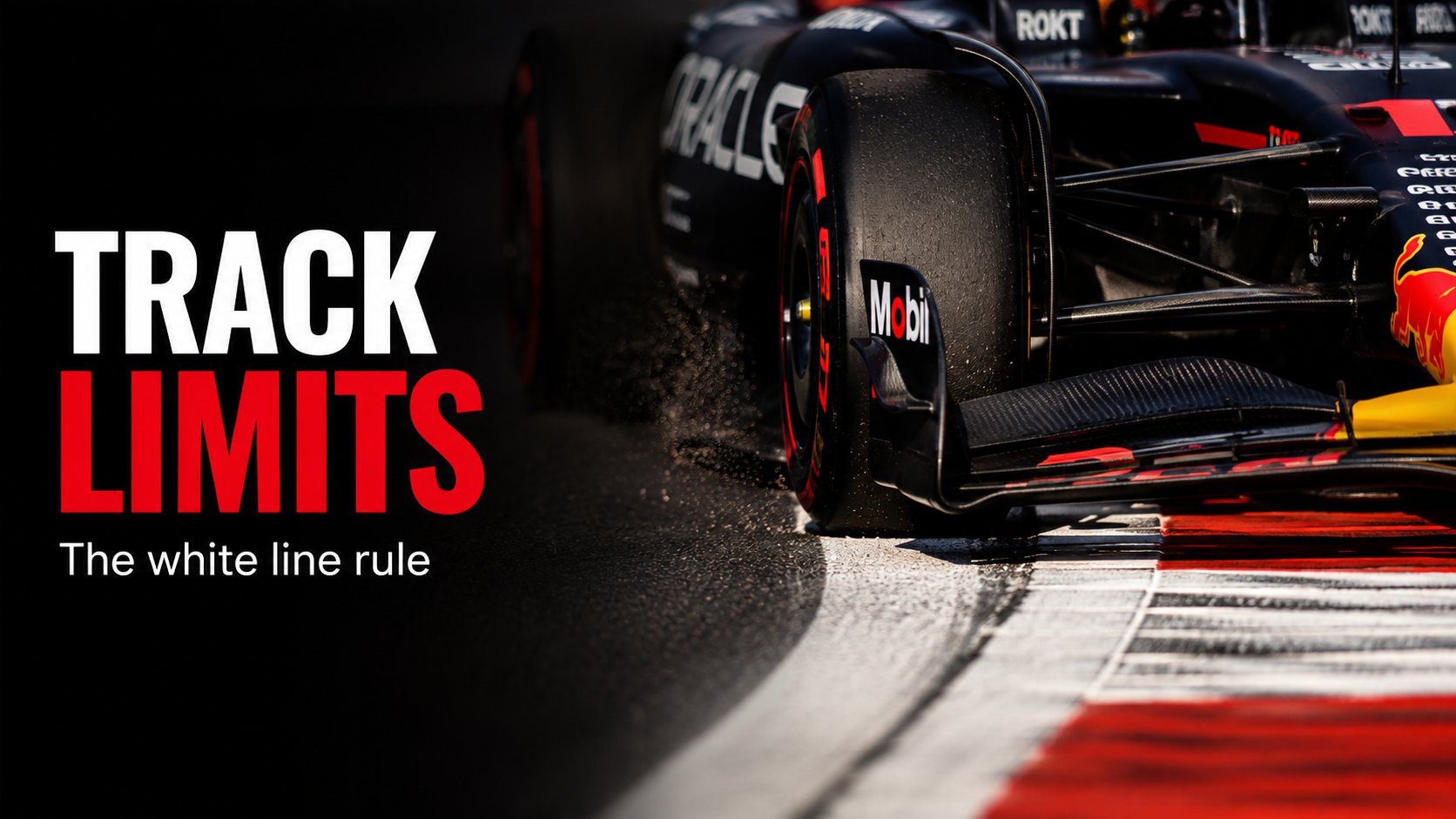
The whole rule in one picture: a tyre still touching the white line keeps you legal. Only when all four wheels are completely beyond it have you left the track.
We counted every deletion of the 2026 season
Track limits get argued about constantly and counted almost never. Race control publishes every deleted lap time as a message, so we counted them: 296 lap times deleted for track limits across 12 rounds, qualifying and race combined.
Lap times deleted for track limits, 2026 season. Measured from F1 timing data.
Circuit
Deletions
Worst corner
Montreal
57
Turn 14
Monaco
56
Turn 10
Silverstone
32
Turn 9
Budapest
32
Turn 7
Miami
26
Turn 15
Spielberg
20
Turn 3
Barcelona
18
Turn 10
Zandvoort
16
Turn 3
Melbourne
14
Turn 3
Spa
9
Turn 4
Shanghai
8
Turn 14
Suzuka
8
Turn 13
Lap times deleted for track limits, 2026 season, qualifying and race combined.
The problem is not spread across circuits, and it is not even spread across corners. Monaco's Turn
10 produced 40 deletions on its own, and Montreal's Turn 14 produced 30. Those two corners
account for roughly a quarter of every track limits deletion in the season.
Two things in that table are worth sitting with.
Monaco is second on the list, which sounds absurd for a circuit lined with barriers. It is second
because of one corner: the Nouvelle Chicane at Turn 10, where the punishment for going straight on is a
faster lap rather than a wall. Where a mistake is free, drivers take it.
Suzuka and Shanghai produced eight deletions each across a whole weekend. Both are old-school
circuits where leaving the road costs you time or grip. That is the entire argument in two rows: track
limits are not a driver behaviour problem, they are a circuit design problem.
The real culprit: asphalt run-off
Here is the part most fans miss. Track-limits abuse is not really about naughty drivers, it is about track design. Modern circuits increasingly use vast paved asphalt run-off areas at the edge of corners, instead of the old grass and gravel. Asphalt is much safer: a driver who makes a mistake or crashes can slow down or continue without being launched or beached. But it has a side effect, it means running wide carries no immediate consequence. At corners like Austria's Turns 9 and 10, drivers can simply use the extra paved space to carry more speed, knowing the only penalty is an abstract lap deletion later, not a spin into the gravel. The white line becomes the only thing stopping them, and so hundreds of cars tiptoe over it.
The gravel debate
This is why you increasingly hear calls to bring back gravel. The argument is simple: a gravel trap or a strip of grass punishes a mistake instantly and naturally. Run wide and you lose time, or spin, or get stuck, no stewards required. It makes the white line enforce itself. The counter-argument is safety: gravel can flip a car or fling it back across the track, and asphalt gives far more room to recover from a big accident. F1 is caught between the two, and the current trend is a compromise, adding gravel or tougher kerbs back at the specific corners where track limits are abused most, while keeping asphalt where safety demands it.
The rules: qualifying and the race
In practice and qualifying, the punishment is clean and immediate: the driver loses that lap time. Run all four wheels off on a flying lap and the stewards delete it, which is why a qualifying time can flash up and then vanish, sometimes dropping a driver several grid places.
During the race, deleting a lap makes no sense, so track limits are handled with an escalating warning system, counted per driver:
The first two offences bring warnings.
A third offence earns a black-and-white flag, the sport's official "final warning".
A fifth brings a 10-second penalty, and a sixth resets the cycle.
Drivers are told where they stand, because the count is theirs to manage. Here is Charles Leclerc's engineer during the 2023 Abu Dhabi Grand Prix, keeping the tally out loud:
"And just a reminder, we have two strikes for track limits."
Two strikes means the next one is the black-and-white flag. You can hear that message, and the other 54 from the race, on the 2023 Abu Dhabi Grand Prix radio page.
The technology trying to fix it
Because human marshals cannot watch dozens of cars at every corner, F1 has turned to technology. At the Red Bull Ring, the FIA introduced a "blue line" painted just outside the white one, which gives the automated cameras and AI a clearer reference to judge the marginal calls of a wheel being on or over the limit. Some circuits have even trialled pressure-sensor pipes buried at the track edge that register when a car runs across them. The offences are increasingly detected automatically; the remaining problem is doing it fast enough, and consistently enough, that verdicts do not still arrive hours after the flag.
Why it stays controversial
Even with the technology, track limits generate endless debate. Enforcement can feel inconsistent between corners and circuits, verdicts often land after a lap or even after the race, so a result can change once the racing is over, and at some tracks a single corner becomes a lottery with a huge list of deleted times by the end of the weekend. The rule itself is simple. Policing it, fairly and instantly, has turned out to be one of the trickiest problems in the sport.
See the deletions as they land
Track limits decisions arrive as published documents, often minutes after the lap.
The Formula Dream app collects every FIA document of the weekend as it is released, which is where the decision behind a penalty actually appears, usually before the commentary catches up. It also runs a live Dashboard through every session with all the cars on the circuit map, a timing tower carrying lap times, gaps, intervals, tyre compound and age, flag and safety car alerts the moment race control calls them, and live driver radio as it is broadcast.
Free, no subscription, no ads, independent. Not affiliated with Formula 1.
The white line at the edge of the circuit marks the limit. A driver has left the track only when all four wheels are completely beyond that line.
What happens if you exceed track limits in qualifying?
The lap time is deleted. Any time set on a lap where the driver put all four wheels off the track does not count.
What is the penalty for track limits in a race?
It escalates per driver: two warnings, then a black-and-white flag on the third offence, a 5-second penalty on the fourth, and a 10-second penalty on the fifth.
Why do drivers keep exceeding track limits?
Mostly because of asphalt run-off. Paved run-off areas are safe but carry no instant penalty for running wide, so drivers use the extra space for speed and only the white line stops them. Gravel or grass would punish the mistake naturally.
Why are track limits so controversial?
Because enforcement can feel inconsistent between corners and circuits, penalties often arrive after the lap or the race, and a sport that times to a thousandth of a second still struggles to detect instantly when a car is off the track.
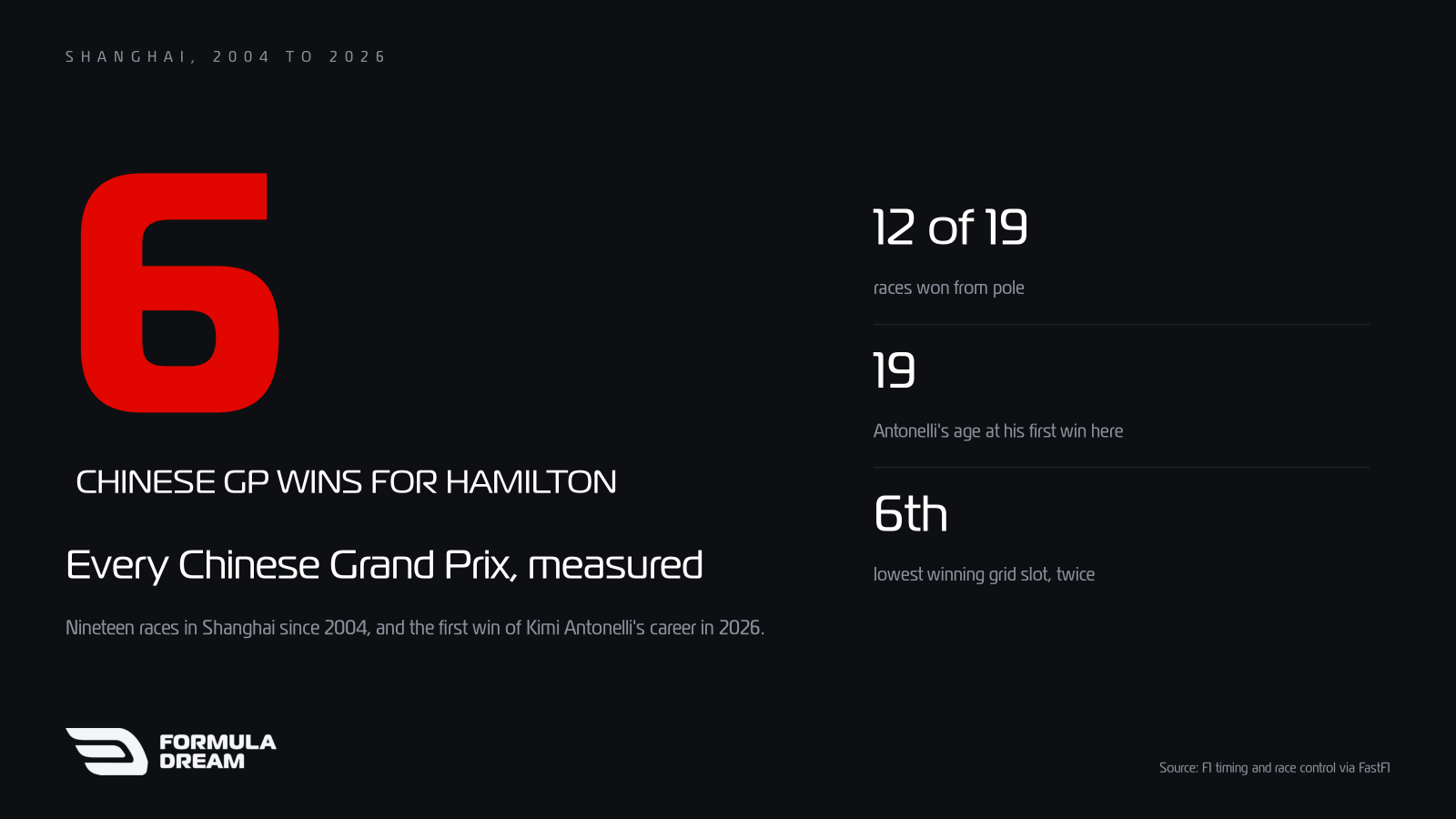
Nineteen Chinese Grands Prix have been held in Shanghai since 2004. Lewis Hamilton won six, pole won twelve, and in 2026 Kimi Antonelli took the first win of his career there, at 19, with Hamilton on the podium for Ferrari for the first time. Every winner, grid slot and safety car, measured.