Is IndyCar Faster Than F1? Speeds Compared | Formula Dream
Guides
F1 vs IndyCar: Which Is Faster, and What's the Difference?
F1 vs IndyCar compared, which is actually faster, why F1 dominates road courses while IndyCar rules the ovals, the spec-versus-bespoke divide, and the enormous gap in cost.
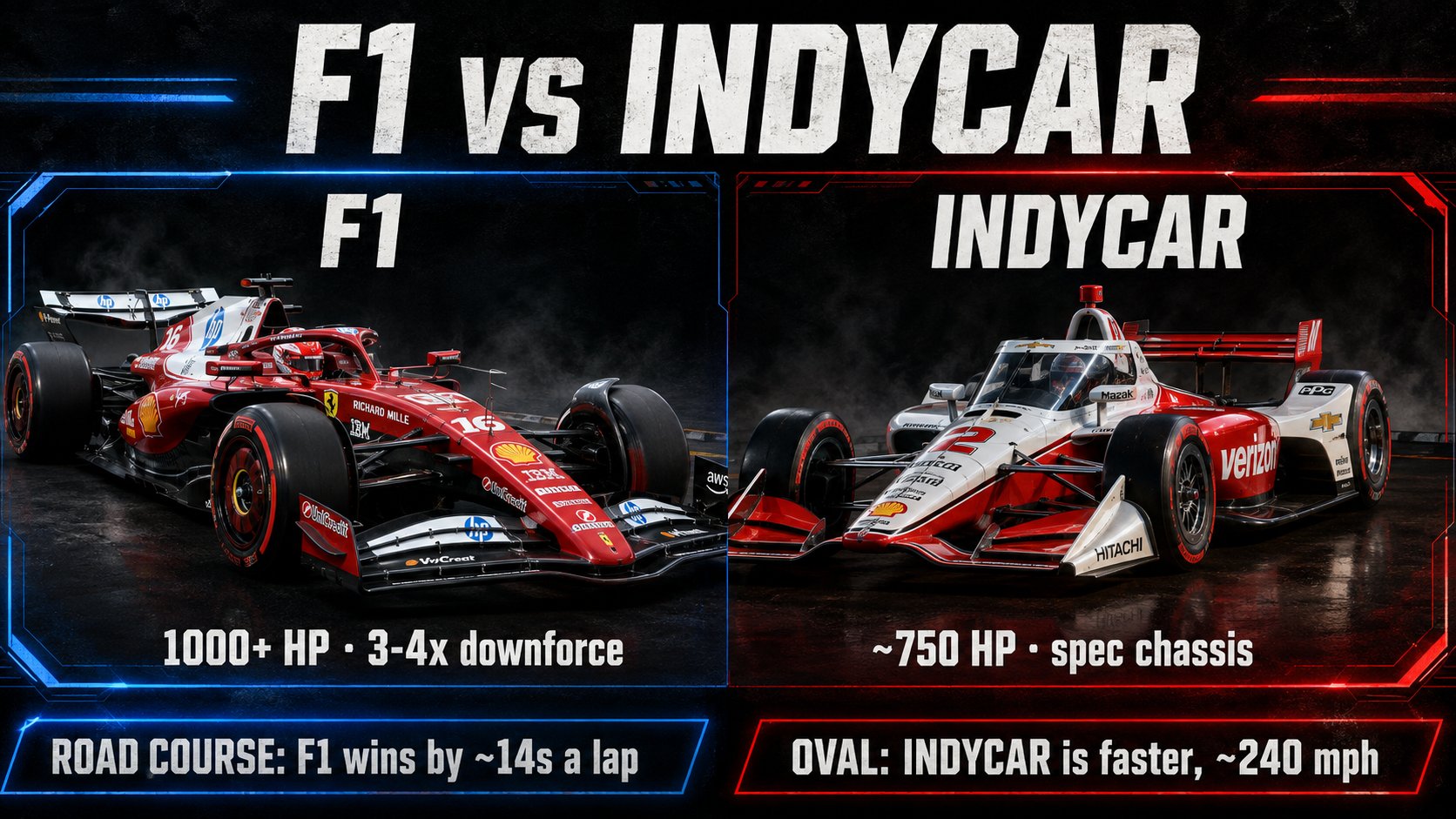
Is IndyCar faster than F1? On an oval, yes. On a road course, no, and not by a little. Alex Palou took pole for the 2026 Indianapolis 500 at an average of 373.8 km/h, faster than any F1 car recorded at any speed trap all season. But when both series qualified at the Circuit of the Americas in 2019, F1's pole lap was 14 seconds quicker.
Formula 1 and IndyCar are the two great pinnacles of open-wheel racing, and fans love to argue about which is quicker. The honest answer is: it depends entirely on where you race them. On a twisting road course, an F1 car is not just faster, it is from another planet. On a giant oval, the IndyCar has the edge. Here is how the two compare, and why they are really two very different sports.
The cleanest road course comparison is the Circuit of the Americas in Austin, where both series qualified in 2019. Will Power took IndyCar pole in March with a 1:46.018. Valtteri Bottas took F1 pole in November with a 1:32.029. That is 14 seconds a lap in the same year. Fourteen seconds. In motor racing terms, that is not a gap, it is a chasm.
But flip to a superspeedway oval, the kind of track F1 never visits, and the picture reverses. IndyCars are built to sustain enormous speeds there: at Indianapolis in 2026 the pole-sitter averaged more than 232 mph over four laps, higher than the fastest speed trap reading of any F1 car all season, 358 km/h, about 222 mph. On the ovals, IndyCar is king.
The 2026 numbers, both measured
The usual version of this argument uses figures from different years and different sources. Here are both sides from the same season.
IndyCar, 2026 Indianapolis 500:
Pole, Alex Palou: 232.248 mph four-lap average, which is 373.8 km/h
Fastest race lap, Conor Daly: 225.126 mph, or 362.3 km/h
Race average: 162.021 mph, or 260.7 km/h
Formula 1, 2026 season, measured from telemetry:
Fastest circuit by average lap speed, Monza: 253.6 km/h
Highest speed trap reading anywhere, Esteban Ocon at Barcelona: 358 km/h
Slowest circuit, Monaco: 163.0 km/h
Read the first line of each. An IndyCar averaged 373.8 km/h over four laps of qualifying at Indianapolis. The fastest average lap an F1 car managed anywhere in 2026 was 253.6 km/h at Monza. That is a difference of 120 km/h, and it is not close.
So IndyCar wins? No, and this is the part that matters
The comparison above is real and it is also deeply misleading, because Indianapolis is a 2.5-mile oval with four corners taken at nearly full throttle.
An F1 car has never been asked to average 373 km/h because Formula 1 does not race on superspeedways. Put both cars on a road course and the result inverts completely. F1 cars carry vastly more downforce, brake later and harder, and change direction faster. At the Circuit of the Americas in 2019 the gap between the two pole laps was 14 seconds.
The honest summary is this: IndyCar is faster in a straight line and on ovals. Formula 1 is faster everywhere there is a corner. They are not competing at the same thing, which is why the question has no single answer.
One number makes the point better than any argument. An F1 car's top speed in 2026 was 358 km/h, which is below the average speed an IndyCar sustained around Indianapolis for a whole lap. The F1 car is slower flat out and would still lap a road course far quicker, because top speed is the least important measure of a racing car.
Why F1 dominates the corners
The reason F1 destroys IndyCar on a road course comes down to two things: downforce and power-to-weight.
An F1 car generates far more aerodynamic downforce than an IndyCar in road trim. That means it can corner at speeds that would throw an IndyCar off the road, and since a lap is mostly corners, that advantage compounds relentlessly. On top of that, F1's 2026 hybrid power unit makes around 1,000 horsepower in a car with a minimum weight of 768 kilograms including the driver, and its electric motor alone can add up to 350 kW, about 470 horsepower. IndyCar's hybrid system, by Honda's own figures, adds up to 60 horsepower to a 2.2-litre twin-turbo V6 limited to 12,000 rpm. More grip and more power for less weight is why F1 is so much faster everywhere except the oval straights.
Spec versus bespoke: the real philosophical divide
The deepest difference is not speed, it is how the cars are made. IndyCar is a spec series: every team races the same standardised Dallara chassis, with engines from Honda or Chevrolet. That is a deliberate choice to keep costs down and the racing close, because when everyone has near-identical machinery, the driver and the team's execution matter more than their budget.
F1 is the opposite. Every team designs and builds its own car from the ground up, its own chassis, its own aerodynamics, its own philosophy. F1 is as much an engineering competition between the teams as a driving competition between the drivers, which is why the fastest car often wins regardless of who is driving it. One series is a test of who can build the best car; the other is a test of who can drive a shared car the best.
The gulf in cost
That difference shows up brutally in the budgets. A top F1 team spends hundreds of millions of dollars a year, even with the cost cap reining it in. In IndyCar, RACER reported in 2025 that running a single car for a season typically costs $6 million to $8 million, with the richest teams closer to $11 million per car. F1 is the wealthy, global, technological spectacle; IndyCar is the leaner, more accessible, driver-focused championship. Neither is "better", they are chasing different things.
So which is better?
It is the wrong question, because they are different sports wearing similar clothes. F1 is the outright pinnacle of automotive engineering and speed, a global championship where money and technology are weapons. IndyCar offers closer, more unpredictable racing on a wilder variety of circuits, ovals, road courses and street tracks, where a smaller budget can still win. If you want the fastest cars and the biggest technology war, it is F1. If you want tight, spec-formula racing and the terror of the ovals, it is IndyCar. The best fans watch both.
Follow an F1 weekend properly
Comparisons are easier when you can see what an F1 session actually contains.
The Formula Dream app runs a live Dashboard through every session: every car moving on the circuit map, and a timing tower with lap times, gaps and intervals, tyre compound and age, pit counts and positions gained or lost. It is the same information these measurements come from, arriving live. You also get live driver radio as it is broadcast, and every FIA document of the weekend as it is published.
Free, no subscription, no ads, independent. Not affiliated with Formula 1.
It depends on the track. On road courses F1 is far faster: at the Circuit of the Americas in 2019 its pole lap was 14 seconds quicker than IndyCar's. On ovals IndyCar is faster: the 2026 Indianapolis 500 pole averaged 232.248 mph, while the fastest F1 speed trap reading of 2026 was about 222 mph.
Why is F1 so much faster on road courses?
Because F1 cars make far more downforce than an IndyCar and have much more hybrid power, so they carry vastly more speed through corners, where most lap time is won.
What is the difference between F1 and IndyCar cars?
IndyCar is a spec series where every team uses the same Dallara chassis, keeping costs low and racing close. F1 teams design and build their own bespoke cars, making it an engineering competition as much as a driving one.
How much cheaper is IndyCar than F1?
Enormously. A top F1 team spends hundreds of millions a year, while running one IndyCar for a season typically costs $6 million to $11 million, according to RACER.
How fast does an IndyCar go?
At Indianapolis in 2026 the pole-sitter, Alex Palou, averaged 232.248 mph, or 373.8 km/h, over four laps, and the fastest lap of the race was 225.126 mph by Conor Daly. On road and street courses they are much slower, because the corners take away the speed.
Does IndyCar have more horsepower than F1?
No. A 2026 F1 power unit makes around 1,000 horsepower, with up to 350 kW, about 470 horsepower, from its electric motor alone. IndyCar's hybrid system adds up to 60 horsepower to its 2.2-litre twin-turbo V6.
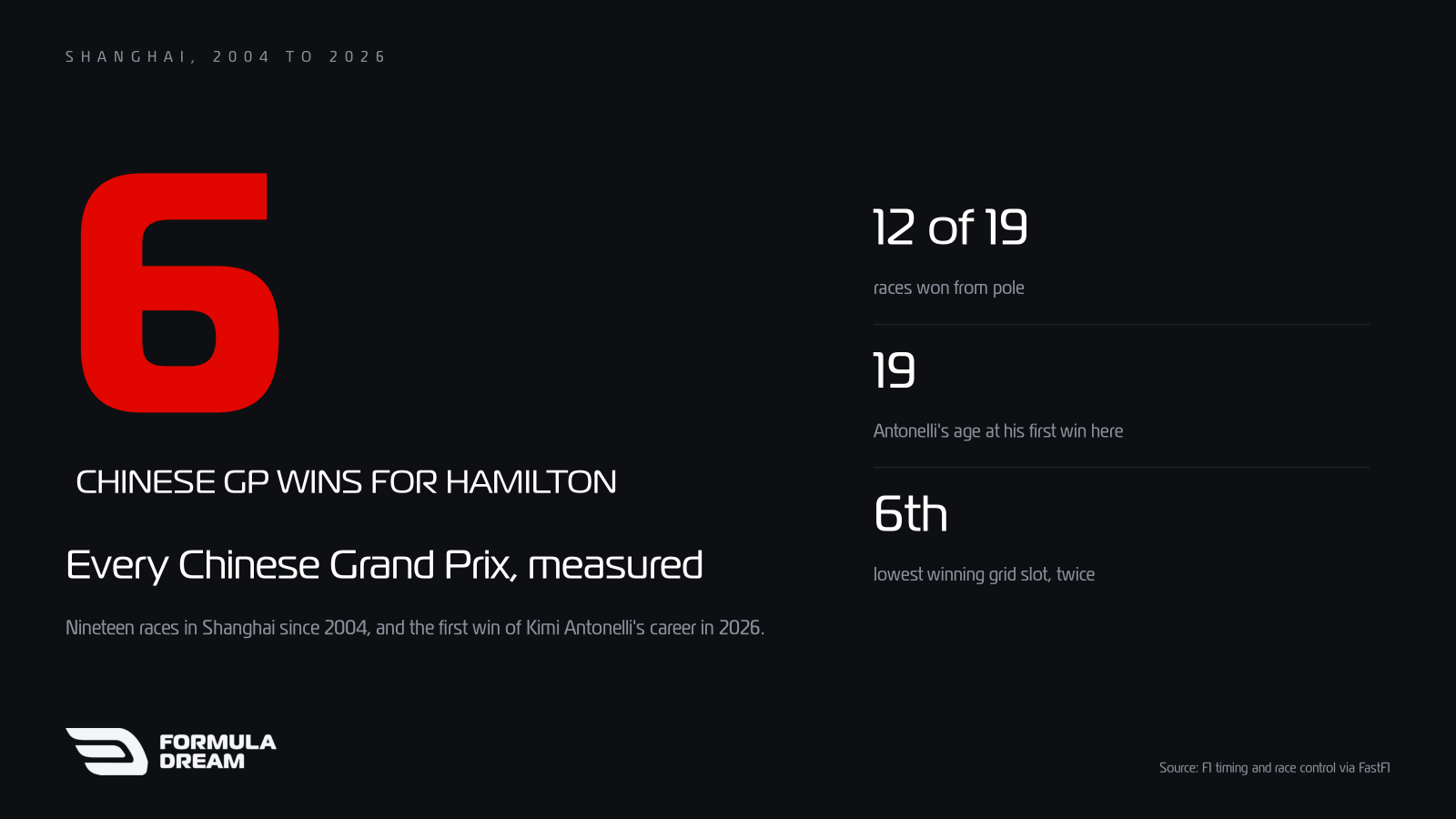
Nineteen Chinese Grands Prix have been held in Shanghai since 2004. Lewis Hamilton won six, pole won twelve, and in 2026 Kimi Antonelli took the first win of his career there, at 19, with Hamilton on the podium for Ferrari for the first time. Every winner, grid slot and safety car, measured.