How Fast Do F1 Cars Go? Top Speed Measured | Formula Dream
Guides
How Fast Are F1 Cars? Top Speed, Acceleration, Braking and Cornering
How fast F1 cars really go, measured at every 2026 round: the top speed at each circuit, how quickly pole-sitters reach 100 and 200 km/h at the start, how hard they brake, and how fast they take the fastest corners.
An F1 car reaches about 320 to 358 km/h at the end of a long straight. The fastest speed-trap reading of the 2026 season so far is 358 km/h, by Esteban Ocon in the Barcelona race, and the official Grand Prix record is 372.5 km/h, set by Valtteri Bottas at the 2016 Mexican Grand Prix.
From a race start in 2026, pole-sitters reached 100 km/h in a median 3.0 seconds. Under the heaviest braking of 2025, a car lost 210 km/h in 2.12 seconds.
Those are the numbers people ask for. They are also the least interesting thing about the car. A modern hypercar gets close to that top speed. What no road car on earth can touch is how violently an F1 car stops, and above all how fast it goes around a corner.
And in 2026 the picture has flipped in a way almost nobody expected. The cars are quicker down some straights than last year, and several seconds a lap slower.
F1 car top speed: the least interesting number
Every article on this subject quotes the same record: 372.5 km/h, Bottas, Mexico, 2016. It is a decade old and it tells you nothing about a car racing this year.
So we measured it. Here is the highest speed-trap reading at every 2026 round so far, taken from Formula 1's own timing data.
Circuit
Qualifying
Race
Fastest in the race
Barcelona
340
358
Ocon
Shanghai
322
353
Gasly
Silverstone
317
351
Hamilton
Montreal
329
348
Gasly
Budapest
336
346
Sainz
Monza
338
338
Norris
Zandvoort
331
336
Lindblad
Miami
327
334
Russell
Spielberg
323
334
Antonelli
Spa
315
323
Lawson
Melbourne
315
321
Russell
Suzuka
291
308
Hulkenberg
Monaco
285
287
Bortoleto
Highest speed-trap reading per session at every 2026 round to the Italian Grand Prix, in km/h
The fastest a 2026 F1 car has been measured is 358 km/h, by Esteban Ocon in the Barcelona race. Monaco tops out at 287. That is a 71 km/h spread across the same cars in the same season, which is the point people miss when they ask for a single number: there isn't one. The circuit decides.
Two things in that table are worth a second look. Race speeds matched or beat qualifying speeds at every circuit, level only at Monza, because a car in traffic gets a tow and qualifying runs are usually alone. And Monza, the Temple of Speed, is not the fastest venue on the calendar: five circuits beat its 338 km/h, led by Barcelona and Shanghai.
The old records are still worth knowing. The official Grand Prix record is Bottas's 372.5 km/h in Mexico in 2016, where air more than 2,200 metres up cuts drag. Williams also recorded Bottas at 378 km/h in qualifying at Baku that year, but not at the official speed trap, so it does not count as the record.
Here is the surprise: F1 cars are not built for top speed at all. They run so much downforce, and therefore so much drag, that a lower-downforce car would out-run them in a straight line. They sacrifice top speed on purpose, because the grip that downforce buys is worth far more everywhere else on the lap. Top speed is a by-product. It is not the goal.
We measured every speed trap in a season. The whole grid fits inside 4 km/h.
This is the part you will not find on a spec sheet, because it needs a full season of timing data rather than a headline figure.
Across the 2025 season we measured the fastest team through the speed trap against the slowest. The gap was 3.75 km/h. Five of the ten teams were identical to the nearest km/h. Over the same season, those same ten teams were separated by 1.623 seconds of lap time.
That is the whole argument in two numbers. Straight-line speed is where F1 cars are most alike. Lap time is where they are furthest apart. Anyone ranking teams by top speed is measuring the one thing the sport has almost completely converged on.
The trap data holds another surprise: Mexico is faster than Monza. Mexico City's altitude does more for top speed than Monza's long straights do. The full breakdown is in our piece on what the speed traps actually show.
Acceleration: how fast do F1 cars get to 100 km/h?
No team publishes an official 0-100 km/h time, and the figure you usually see, about 2.6 seconds, is an estimate repeated from site to site. So we timed the real thing: the pole-sitter's launch at every 2026 race start, from standstill on the grid.
0 to 100 km/h: a median of 3.0 seconds across 12 race starts. The quickest was 2.57 seconds, Kimi Antonelli at Spa.
0 to 200 km/h: a median of 5.5 seconds across 11 starts, leaving out Monaco, where the cars are braking for the first corner before they get there. The quickest was 4.62 seconds, also at Spa.
These are race starts with a full fuel load, usually on medium tyres, so they are slower than a car would manage in ideal conditions. They are also what an F1 car actually does on a Sunday.
At low speed an F1 car is limited by traction, not power. There is not yet enough downforce for the tyres to use everything the power unit offers, so it has to be fed in carefully. The faster the car goes, the more downforce it makes, the harder the tyres grip, and the harder it keeps pulling at speeds where a road car has long since run out of shove.
Braking: the most unbelievable number of all
If the acceleration is remarkable, the braking is almost hard to believe. Brembo, which supplies the brakes, puts the hardest stop of 2025 at turn 1 in Baku: cars slowed from 329 km/h to 119 km/h in 2.12 seconds, over 108 metres, at a peak of 5g, with the driver pressing the pedal with 176 kg.
Two things make it possible. The carbon brake discs work at temperatures that would destroy a road car's steel brakes, and can bite far harder. And, once again, downforce: at high speed the aero pushes the car into the track so hard that the tyres can take enormous braking force without locking up.
That has changed in 2026. The new cars carry less downforce and recover far more energy through the motor, and Brembo's figures for turn 3 at Silverstone show peak deceleration falling from 4.5g in 2025 to 2.9g in 2026. The loads on the driver are covered in our guide to g-force.
The real superpower: cornering speed
Straight-line numbers are impressive, but they are not what makes an F1 car special. This is. F1 cars corner at speeds that sound made up.
We took the pole lap at Silverstone and Spa in 2025 and 2026 and measured the slowest speed through each of the most famous fast corners.
Corner
2025 pole lap
2026 pole lap
Blanchimont, Spa
315 km/h
326 km/h
Maggotts, Silverstone
311 km/h
280 km/h
Copse, Silverstone
305 km/h
282 km/h
Raidillon, Spa
304 km/h
301 km/h
Pouhon, Spa
296 km/h
269 km/h
Slowest speed through each corner on the pole lap, measured from F1 timing data
On 2025 cars, Copse was taken at 305 km/h and Maggotts at 311 km/h. No other type of car comes remotely close. A supercar that feels planted at 150 km/h through a bend would be a passenger, off the track, at the speeds an F1 car treats as routine. It is entirely down to downforce: the car is pressed into the tarmac so hard that the tyres generate cornering grip with no road-car equivalent.
The 2026 column shows exactly what the new rules traded away. The corners that lean hardest on downforce got much slower: Copse lost 23 km/h and Pouhon 27. Blanchimont, which is nearly flat out, got faster, because the 2026 cars are quicker in a straight line.
Are 2026 F1 cars faster or slower?
Slower, and it is not close. But only around a lap.
The 2026 rules cut aerodynamic downforce sharply. The wings now switch between a low-drag setting on the straights and a high-downforce setting for braking zones and corners, and every car can use the low-drag setting on defined straights. The old DRS overtaking aid is gone. A driver within one second of the car ahead at the detection point instead gets Overtake Mode: extra energy to deploy on the following lap.
The result is a car that is quicker in a straight line in places and much slower through the corners. Less drag on the straights buys speed. Far less downforce in the corners costs much more than it buys, as the corner table above shows.
We measured it. Comparing pole laps at the ten circuits raced in both seasons, 2026 is 3.046% slower than 2025. On a 90 second lap that is about 2.7 seconds. Every single one of those ten circuits got slower, with no exceptions. The full comparison is in our measurement of whether F1 cars are getting faster.
This is exactly why top speed is such a poor way to judge an F1 car. By that measure, 2026 looks like progress in places. By lap time, it is the biggest step backwards since 2022.
Why F1 cars are so fast
Three things combine to make all of it possible, and none of them is just "a big engine":
Power-to-weight. A power unit making around 1,000 horsepower in a car that weighs under 800 kilograms with the driver, a ratio no road car comes close to.
Downforce. The thread running through everything above. At speed, aerodynamics press the car into the track, and that borrowed grip is what powers the braking and, above all, the cornering.
Carbon brakes and slick tyres. Brakes that thrive at extreme temperatures and tyres engineered for one job, grip, are what turn all that downforce into the numbers.
Take any one of those away and the whole thing collapses. Together, they make an F1 car the fastest thing on four wheels around a lap, by a distance that is not close.
Watch the speed happen live
Numbers on a page are one thing. Watching them arrive in real time is another.
The Formula Dream app runs a live Dashboard during every session: every car moving on the circuit map, a timing tower with lap times, gaps, intervals, tyre compound and age, plus flag and safety car alerts the moment they happen. You also get live driver radio as it is broadcast, and every FIA document of the weekend collected as it is published, which is where the stewards' decisions that actually change results appear.
It is free, no subscription, no ads, and independent. Not affiliated with Formula 1.
The obvious comparison is IndyCar, which is faster in a straight line on an oval and slower almost everywhere else. We went through it properly in F1 vs IndyCar.
Frequently asked questions
How fast do F1 cars go?
About 320 to 358 km/h at the end of the longest straights in 2026, depending on the circuit, and under 290 km/h at Monaco. The fastest reading this season is 358 km/h, at Barcelona.
What is the top speed of an F1 car?
The official Grand Prix record is 372.5 km/h, set by Valtteri Bottas at the 2016 Mexican Grand Prix. Williams recorded him at 378 km/h at Baku the same year, but not at the official speed trap.
How fast does an F1 car accelerate?
From a 2026 race start, pole-sitters reached 100 km/h in a median 3.0 seconds, and 2.57 seconds at best, with 200 km/h in a median 5.5 seconds. No team publishes official acceleration figures.
How quickly can an F1 car brake?
At turn 1 in Baku in 2025, Brembo measured cars slowing from 329 km/h to 119 km/h in 2.12 seconds over 108 metres, at a peak of 5g. 2026 cars brake less hard.
How fast do F1 cars go around corners?
On the 2025 pole lap at Silverstone, Copse was taken at 305 km/h and Maggotts at 311 km/h. The 2026 cars are slower through those corners, at 282 and 280 km/h.
Are 2026 F1 cars slower than 2025?
Around a lap, yes. We measured 2026 pole laps as 3.046% slower than 2025 at the ten circuits raced in both seasons, about 2.7 seconds on a 90 second lap.
Why are F1 cars faster than supercars?
An enormous power-to-weight ratio, carbon brakes and slick tyres, and above all downforce, which presses the car onto the track for grip. It is in cornering and braking, far more than top speed, where they leave road cars behind.
Method
Speed traps: the highest speed-trap reading in each qualifying session and race, FastF1 lap data, every 2026 round to the Italian Grand Prix.
Launches: the pole-sitter's car data on the opening lap of each 2026 race, timed from the last standstill sample to 100 and 200 km/h. Car data is sampled about every quarter of a second, so each time carries roughly that much uncertainty. The Austrian Grand Prix had no usable standstill sample.
Corners: the lowest speed within one second either side of each corner's marker on the pole lap, located by the car's position rather than by distance.
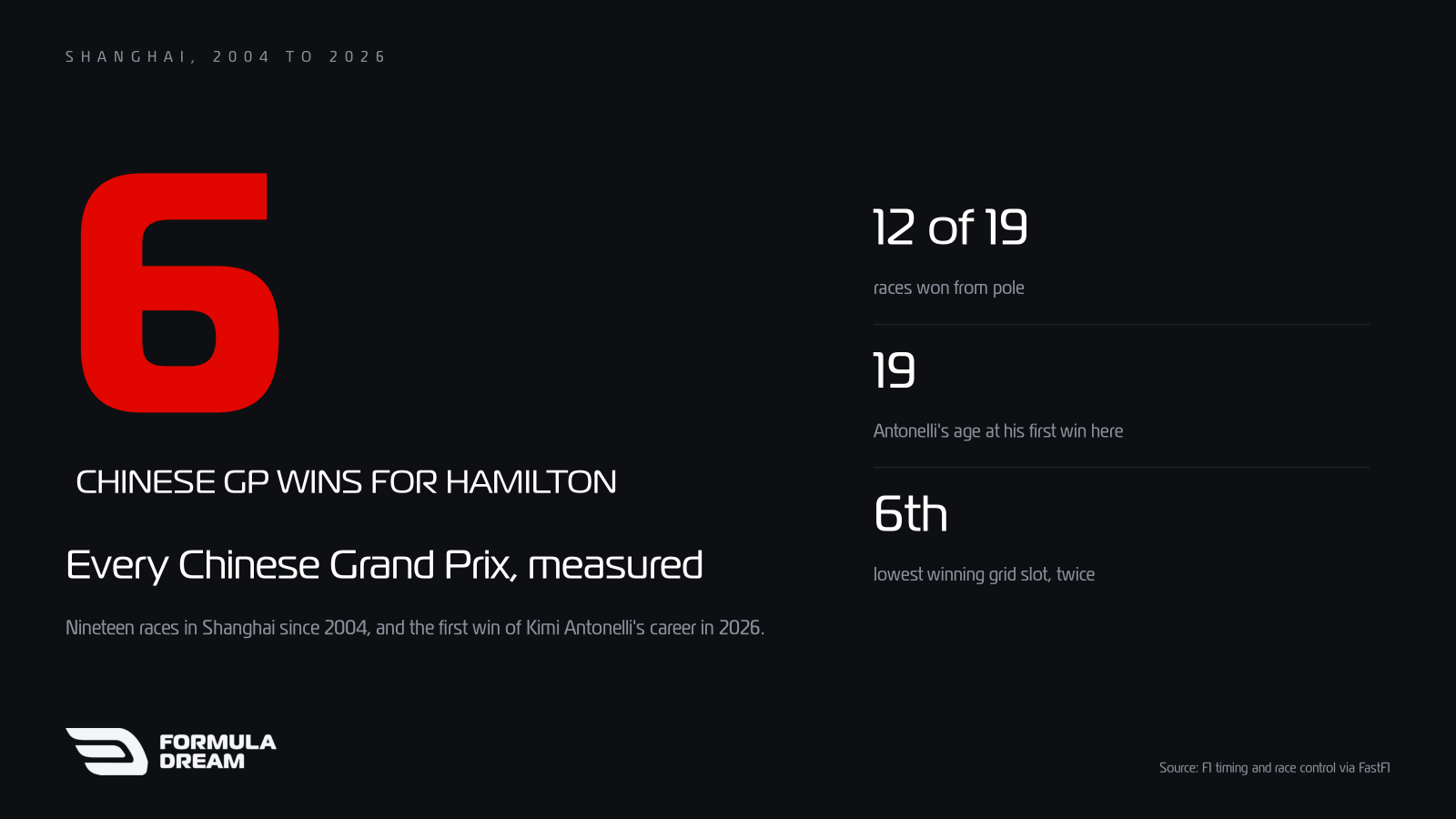
Nineteen Chinese Grands Prix have been held in Shanghai since 2004. Lewis Hamilton won six, pole won twelve, and in 2026 Kimi Antonelli took the first win of his career there, at 19, with Hamilton on the podium for Ferrari for the first time. Every winner, grid slot and safety car, measured.